
How to build a versatile, minimalist wardrobe around chambray fabric, with outfit formulas, seasonal layering strategies, and a practical buying guide for wardrobe minimalists.
The capsule wardrobe concept has one central promise: fewer pieces, more outfits, less stress. It works when every item you own can do multiple jobs, combining freely with other pieces across different settings and seasons. That description fits chambray almost perfectly.
As noted in FashionBeans’ minimalist wardrobe guide, chambray is free from the cultural baggage that makes denim difficult to dress up, while still carrying the casual ease that makes denim so popular. It pairs naturally with almost everything already in a typical wardrobe, it works across seasons, and it improves with age. Those are exactly the qualities a capsule wardrobe demands of its pieces.
This guide is for wardrobe minimalists who want to build a considered, functional closet. We will cover how chambray fits into a capsule framework, which specific pieces to invest in, how to build outfit formulas that stretch a small wardrobe further, and how to think about the long-term value of what you buy.
Why Chambray Belongs in a Capsule Wardrobe
Not every fabric earns a place in a capsule wardrobe. To justify a spot in a limited, carefully chosen closet, a piece needs to work across multiple settings, seasons, and styling contexts. Chambray passes that test comfortably.
The versatility argument
Chambray occupies a rare position in the fabric spectrum. It is casual enough for a weekend grocery run but structured enough, when paired with the right pieces, for a client lunch or a smart-casual dinner. That range is hard to find in a single garment.
As Stridewise’s capsule wardrobe guide puts it, chambray is “both durable and super versatile… the plain weave frees it from denim’s cultural baggage and makes for a textured shirt that can look surprisingly smart with chinos and loafers.” That smart-to-casual range is exactly what makes it capsule-worthy.
The longevity argument
A capsule wardrobe is built on pieces that last. Fast fashion does not belong in one. A quality chambray shirt, cared for properly, lasts 5 to 10 years and softens with every wash. It also does not chase trends in any meaningful way. A chambray shirt bought today will look just as appropriate in five years as it does now. Trend-immune longevity is one of the most important qualities a capsule piece can have.
The neutrality argument
Classic blue chambray reads as a neutral in most outfit contexts. Like navy or gray, it recedes and lets other pieces do the talking, or it anchors a look when everything else is more muted. This is the behavior capsule wardrobes depend on: pieces that work with everything rather than demanding attention.
What Is a Capsule Wardrobe?
Before building one, it helps to be clear on what a capsule wardrobe actually is, because the term gets used loosely.
The concept was popularized by London boutique owner Susie Faux in the 1970s and later brought mainstream by designer Donna Karan. According to Who What Wear’s capsule wardrobe guide, blogger Caroline Rector of Un-Fancy helped define the modern version as a collection of roughly 30 pieces per season, each chosen for its versatility, quality, and fit within a cohesive color palette.
As Fashion Times’ capsule wardrobe analysis notes, a typical capsule wardrobe includes 5 to 8 versatile tops, 3 to 5 bottoms that mix with all tops, 2 to 3 layering pieces or outerwear, 3 to 5 pairs of shoes, and a small number of accessories. Every piece should combine with most of the others.
Why capsule wardrobes work
The main benefits, beyond having fewer things to manage, are reduced decision fatigue in the morning, lower spending over time because you stop buying things that do not combine with what you own, and a consistent personal style that feels deliberate rather than random.
According to Neat Apparel’s capsule wardrobe guide, the problem with most full wardrobes is not volume but connection. Most people are not short on clothes. They are short on clothes that actually work together. A capsule fixes that by design.
Chambray as the Anchor Piece
In a capsule wardrobe, certain pieces function as anchors: items that do not just fill a slot but actively connect other pieces together. A chambray shirt is one of those anchors.
Why it connects everything
Chambray’s heathered indigo blue sits in a color space that works naturally alongside warm neutrals (tan, camel, cream), cool neutrals (gray, navy, white), and earthy tones (olive, terracotta, rust). That is a broad range of colors that covers most capsule wardrobe palettes.
It also spans formality registers. Chambray dressed up with tailored pants and a blazer reads smart-casual. Chambray dressed down with white jeans and sneakers reads casual weekend. A single shirt that can do both cuts your wardrobe needs significantly.
How many chambray pieces should a capsule include?
As FashionBeans advises, one chambray shirt is enough for a true minimalist capsule. It performs enough outfit variations on its own that a second is rarely necessary unless you want different weights or fits for different seasons.
For women, the calculus is slightly different. A chambray shirt and a chambray dress can coexist in a capsule wardrobe without redundancy, since they serve different functional and silhouette roles. A third chambray piece, such as a cropped jacket or overshirt, is a consideration only if both existing pieces would see genuine use.
Women’s Chambray Capsule Wardrobe
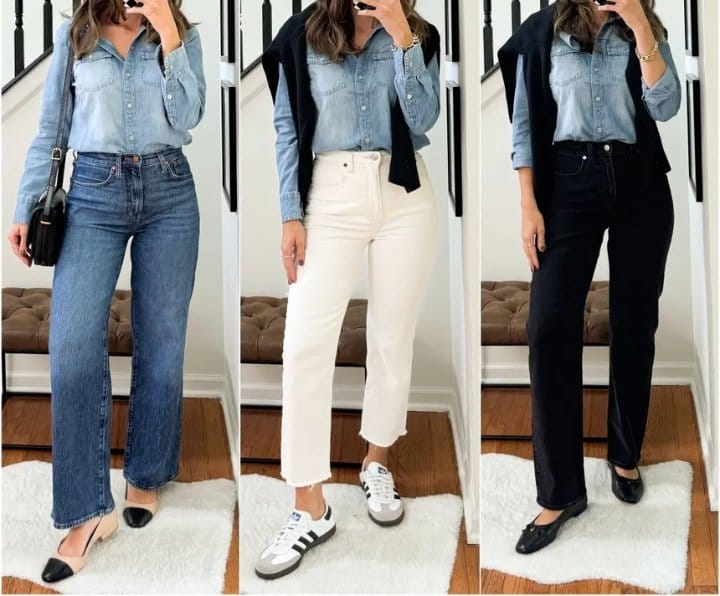
Here is a practical, seasonally flexible capsule wardrobe framework built around chambray as its central shirting piece. Every piece listed below is intended to combine with multiple others in the set.
- Chambray button-down shirt (relaxed or semi-fitted)
- Chambray shirt dress (belted, knee to midi length)
- White or cream straight-leg pants
- Dark wash straight-leg jeans
- Tailored navy or camel trousers
- A-line or midi skirt in a solid neutral
- Fitted blazer in navy, camel, or white
- Lightweight merino or cotton cardigan
- White or striped fitted tee (to layer under chambray overshirt)
- Classic trench coat in camel or beige
- Wool coat in gray, navy, or camel
- White sneakers
- Loafers or pointed-toe flats
- Ankle boots in tan or black
- Tan or cognac leather tote or crossbody bag
- Minimal gold jewelry set
Men’s Chambray Capsule Wardrobe
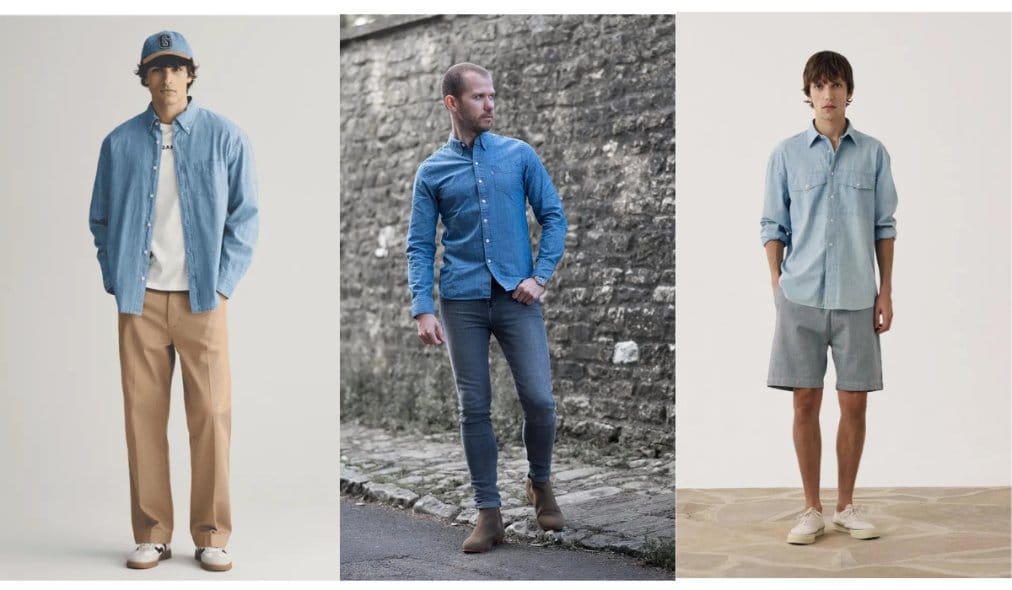
For men, chambray fills the exact gap between the t-shirt and the dress shirt that makes casual-to-smart dressing genuinely effortless. As noted in The Bear House’s minimalist wardrobe guide, two to three button-down shirts in Oxford cloth or chambray are a recommended foundation for any male capsule wardrobe.
- Chambray button-down shirt (classic or slim fit)
- Dark wash straight-leg jeans
- Khaki or stone chinos
- Olive or navy slim-fit trousers
- Gray dress pants (for office settings)
- Merino crewneck or V-neck sweater (navy, gray, or camel)
- Sport coat or blazer in navy or gray tweed
- White or gray fitted tee (to layer under chambray)
- Wool overcoat in charcoal or camel
- Waxed or quilted jacket for casual settings
- White leather low-top sneakers
- Tan suede or leather loafers
- Dark leather Oxford or Derby shoes
- Simple leather or canvas belt
- Classic watch with leather or canvas strap
Building Your Color Palette Around Chambray
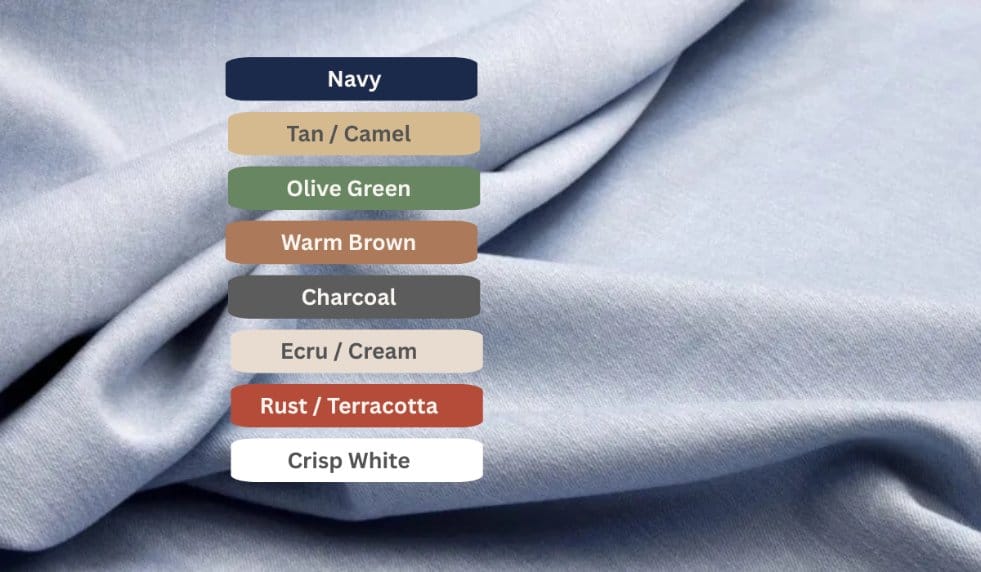
One of the most practical aspects of chambray is how easily it anchors a capsule wardrobe color palette. The heathered indigo blue of classic chambray sits in a neutral-adjacent space that works with almost everything.
The core capsule palette for chambray
Build 70 to 80% of your capsule wardrobe from these neutrals, as recommended by minimalist wardrobe guides. These colors combine in any arrangement and ensure that chambray, as one of the palette anchors, will always have something to work with.
Where to introduce color
In a capsule wardrobe, color works best as an accent rather than a foundation. A single bold piece, whether a rust-colored sweater, an olive jacket, or a terracotta accessory, reads as intentional against a neutral base. Chambray handles this well: it is distinctive enough to be interesting but neutral enough not to compete with a color accent.
Chambray in a monochromatic outfit
Tonal dressing, building a full outfit in one color family, is one of the strongest current directions in minimalist fashion. Blue chambray as the top, navy trousers or dark denim as the bottom, and a lighter blue or white accessory creates a deliberate, considered tonal look that feels modern and effortlessly cohesive.
Wearing Chambray Across All Four Seasons
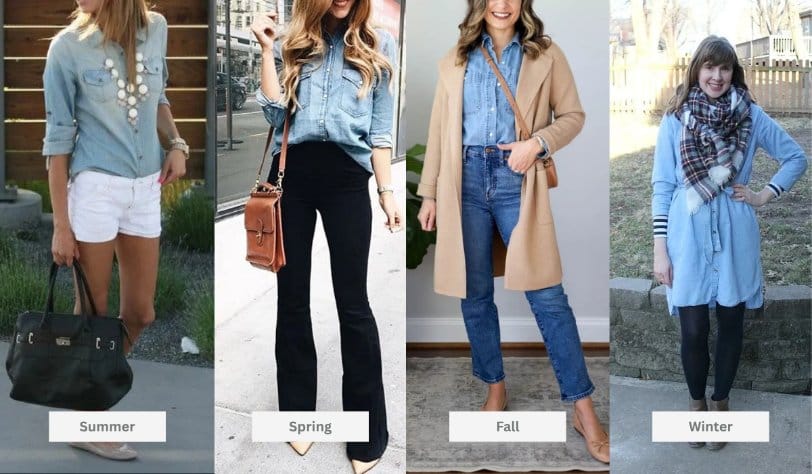
One of the tests of a true capsule piece is whether it can earn its place across the whole year, not just one or two seasons. Chambray passes this test, though the approach changes depending on the weather.
- Chambray shirt alone, untucked over shorts or linen pants
- Chambray dress with sandals
- Lightweight chambray as a beach or travel cover layer
- Sleeveless chambray blouse with white pants
- Chambray shirt tucked into chinos or tailored pants
- Chambray dress with a light knit cardigan
- Chambray blouse under a blazer
- Chambray overshirt over a tee, sleeves rolled
- Chambray under a chunky knit sweater with collar visible
- Chambray dress with ankle boots and opaque tights
- Chambray shirt as a layering piece under a trench
- Chambray overshirt over a long-sleeve tee
- Chambray as base layer under a merino sweater
- Chambray collar peeking out of a turtleneck
- Chambray under a wool overcoat as a mid-layer
- Chambray under a quilted or padded jacket
The key shift across seasons is not the chambray itself but what surrounds it. In summer, it stands alone. In winter, it disappears beneath layers but continues doing useful work as a breathable, comfortable base layer that prevents the trapped, overheated feeling that synthetic base layers can cause.
Outfit Formulas for Maximum Versatility
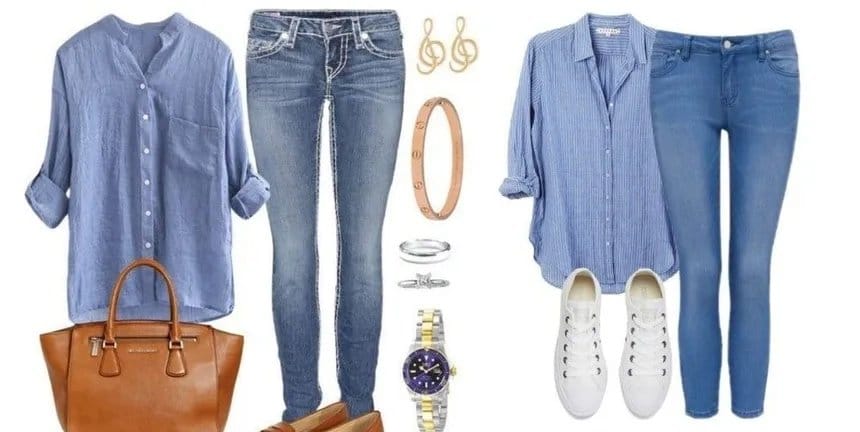
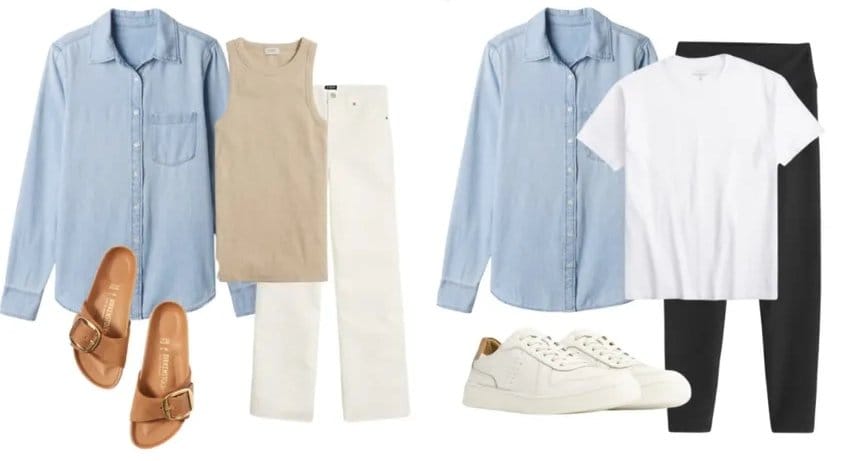
Outfit formulas are the engine of a capsule wardrobe. Instead of deciding what to wear from scratch each morning, you have a set of proven combinations that always work. Here are the core chambray outfit formulas worth building into your repertoire.
The Cost-Per-Wear Case for Chambray
Cost-per-wear is one of the most useful frameworks for evaluating clothing purchases in a capsule wardrobe context. It reframes the question from “how much does this cost?” to “how much does each use of this cost?” A $200 garment worn 200 times costs $1.00 per wear. A $30 garment worn 5 times and discarded costs $6.00 per wear. Quality wins.
Cost-Per-Wear: Quality Chambray Shirt Over Time
For comparison, a fast fashion shirt at $20 worn 10 times before it deteriorates costs $2.00 per wear. Over a decade of replacing such shirts every season or two, the cumulative spend, and the environmental impact, is dramatically higher than a single quality investment piece worn consistently.
The capsule wardrobe philosophy and the cost-per-wear logic point in the same direction: buy less, buy better, and use what you have.
Fabric Durability Calculator Fabric Cost Comparison Calculator
How to Buy Chambray for a Capsule Wardrobe

In a capsule wardrobe, every purchase carries more weight than in a standard closet. You cannot hide a bad buy behind 40 other things. Here is what to prioritize when adding chambray to a minimal closet.
Fit above everything
In a capsule wardrobe, fit matters more than in a larger one because you cannot compensate with variety. A chambray shirt that fits well across the shoulders and chest, with a collar that sits flat and sleeves that end at the right point, will look good in every outfit it appears in. A poor fit undermines everything.
Fabric quality
Look for 100% cotton or linen chambray. The fiber content label should list a single natural fiber with no hidden synthetic blend. In the hand, good chambray feels soft with a slight texture from the two-tone weave. If it feels rough or plasticky, it is not worth adding to a capsule.
Color choice
For most people building a capsule wardrobe, classic medium indigo blue is the correct starting point. It is the most versatile, the most timeless, and the one most likely to combine naturally with other pieces already in your wardrobe. White chambray is a strong second choice for warmer climates or a lighter color palette. Avoid very saturated colors for your first chambray piece since they are harder to integrate across a whole capsule.
Construction quality signals
Even stitching, buttons that sit flat and are securely sewn, a collar that holds its shape, and French seams or flat-felled seams on the inside all signal that a shirt was made to last. These are the details that separate a garment that will be worn for a decade from one that begins to deteriorate after a season.
- Check the fiber content label: 100% cotton or linen chambray
- Feel the fabric: soft with slight texture, not rough or stiff
- Check the fit across the shoulders and collar before anything else
- Look at the interior seams for finishing quality
- Check button security and alignment across the placket
- Choose classic blue as your first chambray piece
- Consider certifications: GOTS for organic, OEKO-TEX for chemical safety
- Buy from brands that publish their supply chain information
Caring for Your Capsule Chambray Pieces

In a capsule wardrobe, each piece works harder than in a larger closet. That makes care more important, not less. A chambray shirt that is washed incorrectly, worn carelessly, or stored badly will not last the decade you need it to.
| Care Step | Best Practice | Why It Matters |
|---|---|---|
| Washing | Cold water, gentle cycle, inside out | Preserves color and fiber integrity |
| Drying | Air dry in shade | Prevents shrinkage and color fading |
| Ironing | Low to medium heat, press cloth, inside out | Keeps fabric surface pristine |
| Wash frequency | Only when genuinely needed; air out between wears | Each wash adds minor wear; fewer washes means longer life |
| Storage | Fold rather than hang for lightweight pieces | Prevents shoulder distortion over time |
| Stain treatment | Spot-clean immediately before washing | Set stains are harder to remove and may require aggressive treatment |
| Repairs | Replace buttons and fix small tears promptly | Minor repairs extend life by years at minimal cost |
Common Capsule Wardrobe Mistakes
Building a capsule wardrobe sounds simple in theory. In practice, most people make a few predictable mistakes early on. Here is what to watch out for.
Buying for aspiration rather than reality
The most common mistake. Buying a very formal chambray piece for a smart office you rarely visit, or a highly casual piece for a relaxed lifestyle you wish you had, rather than the life you actually live. A capsule wardrobe should reflect your real daily life, not an idealized version of it.
Choosing pieces that do not combine
A capsule wardrobe fails when its pieces are an assortment rather than a system. Every item should combine naturally with most of the others. If you add a chambray shirt in an unusual color or cut that only works with one or two other pieces, it is not earning its place in a limited wardrobe.
Going too small too fast
Trying to live with 15 pieces immediately is a common source of frustration. Start with reducing to 30 to 37 well-chosen pieces, as most capsule wardrobe frameworks suggest, and see how that feels before cutting further. A wardrobe that feels restrictive is not a successful capsule.
Prioritizing price over quality
Buying cheap versions of capsule pieces defeats the purpose. The whole value of owning fewer things is that each thing should be excellent. A $40 chambray shirt that falls apart in two years and needs replacing is not a good capsule investment. A $90 shirt that lasts eight years and softens beautifully is.
Forgetting about care
Pieces in a capsule wardrobe need to be cared for properly because they are working harder than pieces in a larger wardrobe. Build the habit of checking labels, washing correctly, and doing small repairs promptly.
Frequently Asked Questions
Yes, it is one of the best. Chambray is versatile across settings and seasons, pairs naturally with most neutral palettes, lasts 5 to 10 years with proper care, and does not follow short-term trends. It meets every requirement a capsule wardrobe places on its pieces: versatility, longevity, and visual neutrality.
For men, one quality chambray shirt is typically enough. It can generate 20 or more outfit combinations on its own. For women, one chambray shirt and one chambray dress can coexist without redundancy since they serve different silhouette and functional roles. A third chambray piece is rarely necessary unless your lifestyle genuinely demands it.
White, cream, navy, camel, tan, olive, charcoal, warm brown, and rust all pair naturally with classic blue chambray. These colors form the foundation of most capsule wardrobe color palettes, which is part of what makes chambray such a natural fit. Build 70 to 80% of your wardrobe from these neutrals and chambray will work with almost all of it.
Yes. In summer it works as a standalone piece. In spring and fall it layers with a cardigan or blazer. In winter it functions as a breathable base layer under sweaters and coats. The approach changes by season, but the garment itself earns its place in the wardrobe every month of the year.
Yes. The cost-per-wear math is compelling. A quality chambray shirt at $90 worn twice a week for 7 years works out to roughly $0.12 per wear. A budget version at $30 that falls apart after 18 months costs $0.29 per wear, more than twice as much, and needs replacing. In a capsule wardrobe context, investing in quality is always the more economical decision over the long term.
Prioritize fit across the shoulders and collar first. Check that the fiber content is 100% cotton or linen with no synthetic blend. Look for clean interior seams, securely attached buttons, and a collar that holds its shape. For color, start with classic medium indigo blue, which is the most versatile and easiest to integrate into an existing wardrobe.
Start with one quality chambray shirt or dress as your core shirting piece. Build your bottoms around neutrals that work with it: white pants, dark jeans, and tailored trousers or chinos. Add one or two layering pieces (a blazer, a cardigan) and one or two outerwear pieces (a trench or wool coat). Keep accessories simple and in the same neutral palette. The chambray piece will combine naturally with almost everything in this framework.
They overlap but are not identical. Minimalist dressing is a broader philosophy about reducing excess and dressing with less visual noise. A capsule wardrobe is a specific practical framework for achieving that. You can dress minimally without having a formal capsule, and you can build a capsule that is not particularly minimalist in aesthetic. Most people who build capsule wardrobes do so because they want the practical benefits of minimalist dressing without having to think about it every day.
Conclusion
If you were designing a fabric specifically to serve a capsule wardrobe, you would end up with something very close to chambray. It is versatile across settings and seasons, visually neutral enough to combine with almost anything, durable enough to last years of regular wear, and just distinctive enough to make an outfit feel considered rather than plain.
The minimalist wardrobe and the chambray shirt are a natural pairing. Both reward quality over quantity, both improve with time, and both perform better the more intentionally you use them.
Key takeaways:
- Chambray passes the capsule wardrobe test on versatility, longevity, visual neutrality, and trend independence. Few fabrics tick all four.
- One quality piece does more than several cheap ones. The cost-per-wear math strongly favors a single well-made shirt over repeated budget replacements.
- Build your color palette around chambray. White, navy, camel, olive, and warm neutrals combine naturally with classic blue chambray in any combination.
- Outfit formulas remove morning friction. Having five or six proven chambray combinations ready to go eliminates decision fatigue without removing variety.
- Chambray works all year round. On its own in summer, layered in fall and winter. A piece that earns its place every month is exactly what a capsule wardrobe needs.
- Care matters more in a small wardrobe. Each piece works harder. Treat chambray properly and it will reward you with years of softening, improving wear.
This is the fifth and final article in our chambray series. Explore the complete series:
- The Complete Guide to Chambray Fabric
- 2026 Fabric Trends: What’s In, What’s Out
- Sustainable Style With Organic Cotton
- Most Durable Fabrics for Everyday Wear
- Fast Fashion vs Slow Fashion
Last reviewed: June 2026 | Category: Style Guides | Back to Fabric Guides