
The number that tells you how heavy, warm, or sheer a fabric will actually be
You’re browsing quilting cotton online, or checking a t-shirt’s spec sheet, and you see a number followed by “GSM.” No picture, no fabric in hand, just a number. What is it actually telling you?
GSM shows up on nearly every fabric listing, pattern description, and spec sheet you’ll come across, but it rarely gets explained in a way that connects the number to something you can actually picture. This guide fixes that: what GSM means, how to read the ranges, and how to use it to predict whether a fabric will feel light and airy or thick and structured before it ever arrives.
Short answer: GSM stands for grams per square meter, and it measures how heavy or dense a fabric is. Lower numbers mean lighter, more see-through fabric. Higher numbers mean heavier, more structured fabric. It’s a useful, objective measurement, but a higher number doesn’t automatically mean better quality, only a heavier one.
Table of Contents
What GSM Actually Means
GSM stands for grams per square meter. It’s a straightforward measurement: take one square meter of fabric, weigh it in grams, and that number is the GSM.
It’s the international standard for describing fabric weight, used across cotton, polyester, fleece, and nearly every other textile. A fabric doesn’t need to be cut into a full square meter to figure out its GSM. Manufacturers typically cut a small, precisely sized swatch, weigh it, and scale the result up mathematically.
Unlike thread count, which only applies to woven fabric, GSM works for both woven and knit fabrics. That makes it the more universal of the two measurements, and the one you’ll see far more consistently across different fabric types.
How to Read GSM Numbers: Light, Medium, Heavy
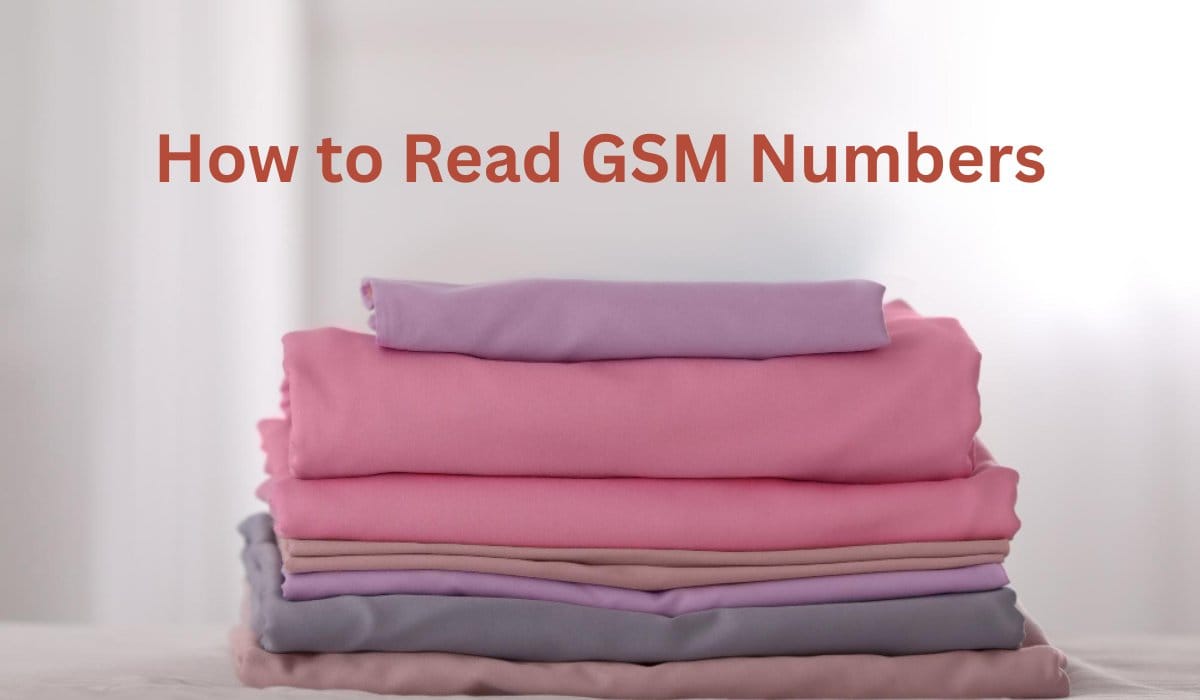
Once you know the rough bands, a GSM number starts to paint a real picture in your head.
| Weight class | GSM range | What it feels like | Typical fabrics |
|---|---|---|---|
| Lightweight | Under 150 | Airy, soft, often slightly see-through | Voile, lawn, batiste, muslin |
| Medium weight | 150–250 | Substantial but still breathable | Poplin, quilting cotton, standard t-shirt jersey |
| Heavyweight | 250–400 | Thick, structured, warm | Twill, sweatshirt fleece, lighter canvas |
| Extra heavyweight | 400+ | Stiff, dense, built for durability | Heavy canvas, upholstery cotton, workwear |
These bands are useful starting points, not hard rules. A fabric right on the edge between two bands, at 145 or 155 GSM for example, will feel closer to its neighbors than the label alone suggests.
GSM vs Ounces: Converting Between Systems
In the US, fabric weight is sometimes listed in ounces per square yard instead of GSM, especially for denim and canvas. Both measure the same thing: weight over a given area. They just use different units.
The conversion is simple. Divide GSM by 33.906 to get ounces per square yard. Multiply ounces per square yard by 33.906 to get GSM.
Example: A 150 GSM fabric works out to about 4.4 oz/yd² (150 ÷ 33.906). A 10 oz/yd² canvas works out to about 339 GSM (10 × 33.906).
You don’t need to memorize the exact number. Knowing the rough conversion is usually enough to compare a US-listed denim weight against a metric quilting cotton weight without getting confused about which one is actually heavier.
| GSM | Approx. oz/yd² | oz/yd² | Approx. GSM |
|---|---|---|---|
| 100 | 2.9 | 3 | 102 |
| 150 | 4.4 | 5 | 170 |
| 200 | 5.9 | 7 | 237 |
| 300 | 8.8 | 10 | 339 |
| 400 | 11.8 | 14 | 475 |
Keep this table handy the next time a US pattern lists ounces and a fabric shop lists GSM. A quick glance tells you whether you’re actually comparing similar weights or not.
Does Higher GSM Mean Better Quality?
Not automatically, and this deserves the same honest answer we gave for thread count. A higher GSM means a heavier, denser fabric. It doesn’t automatically mean a better-made one.
A heavyweight fabric made from poor-quality, short-staple, carded cotton can still feel rough and wear out faster than a well-made lightweight fabric from long-staple, combed cotton. Weight and quality are related but separate things.
Sheerness is also sometimes the entire point of a fabric. Voile and lawn are intentionally lightweight, and a “heavier” version of either would defeat the purpose. The right GSM depends entirely on what you’re making, not on chasing the highest number available.
GSM by Product: What to Look For
Everyday T-Shirts

150 to 200 GSM is the standard comfort range for regular tees, substantial enough to hold its shape without feeling heavy in warm weather.
Sweet spot: 150–200Dress Shirting and Blouses

100 to 150 GSM keeps shirting fabric crisp and breathable, light enough for tucking and layering without going sheer.
Sweet spot: 100–150Quilting Cotton
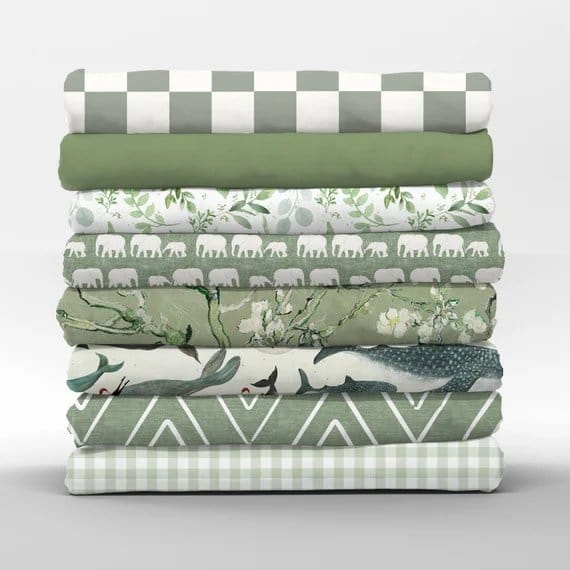
130 to 160 GSM is standard for quilting cotton, giving it enough body to hold stitches cleanly without becoming stiff or hard to piece.
Sweet spot: 130–160Bedding and Sheets

120 to 200 GSM is typical for cotton sheeting, a separate measurement from thread count that still affects how substantial the fabric feels.
Sweet spot: 120–200Canvas and Bags

280 to 400+ GSM gives canvas the structure and durability needed for bags, totes, and anything meant to hold its shape under weight.
Sweet spot: 280–400+Sweatshirt Fleece

280 to 400 GSM is common for cotton fleece, dense enough for warmth while still allowing the fabric to move comfortably.
Sweet spot: 280–400Not sure what GSM fits your specific project? Our free Fabric Weight Calculator matches fabric weight to project type in seconds.
Try the CalculatorHow GSM Interacts With Weave and Knit Type
The same GSM number can feel surprisingly different depending on how the fabric is constructed. A tightly woven fabric at 180 GSM feels dense and structured. A knit fabric at the same 180 GSM feels stretchy and soft, since knit loops trap more air than a tight weave does.
Two woven fabrics at identical GSM can also differ. A loosely woven fabric spreads its weight across a more open structure, while a tightly woven fabric of the same weight packs that mass more densely. The loose weave often drapes better and feels airier, even though the scale would say they weigh exactly the same.
This is why GSM works best as a comparison tool within similar fabric types rather than across completely different ones. Comparing a woven poplin’s GSM to a knit jersey’s GSM tells you they weigh the same per square meter, but very little about how each will actually feel or drape once it’s sewn.
Where GSM Fits With Thread Count, Combing, and Ring-Spinning
GSM measures overall fabric weight. Thread count measures how many threads are packed into a square inch of woven fabric specifically. They’re related but not interchangeable, and a fabric can have a perfectly reasonable GSM for its intended use while still feeling disappointing if the yarn underneath is low quality.
The same logic we covered for combed cotton, ring-spun cotton, and mercerized cotton applies here directly. A 180 GSM fabric made from carded, open-end, unmercerized yarn will feel rougher and wear faster than a 180 GSM fabric made from combed, ring-spun cotton, even though both share the exact same weight on paper.
GSM tells you how heavy a fabric is. It doesn’t tell you what it’s made of or how that yarn was processed. You need both pieces of information to predict how a fabric will actually perform.
How to Estimate GSM Yourself
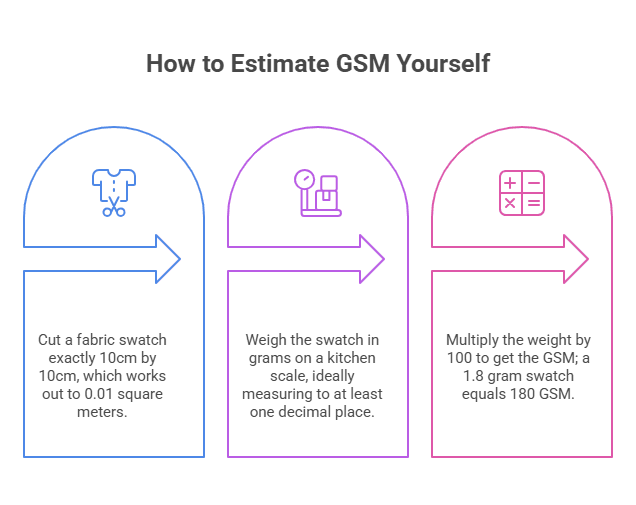
You don’t need professional equipment to get a reasonably close GSM estimate at home.
- Cut a fabric swatch exactly 10cm by 10cm. That works out to 0.01 square meters.
- Weigh the swatch in grams on a kitchen scale, ideally one that measures to at least one decimal place.
- Multiply the weight by 100 to get the GSM. A swatch weighing 1.8 grams works out to 180 GSM.
This method won’t match a lab-grade circle cutter and precision scale exactly, but it gets close enough to sanity-check a listing or compare two fabrics sitting side by side.
Frequently Asked Questions
Conclusion
GSM is one of the most useful numbers in fabric shopping, once you know how to read it. It tells you, in one simple figure, roughly how a fabric will feel before it ever arrives: light and airy, comfortably substantial, or heavy and structured.
What it doesn’t tell you is everything else that makes a fabric feel good or hold up over time. That part comes from fiber quality, spinning method, and finishing, the same factors covered elsewhere in this cotton quality series.
A few things worth remembering:
- Lower GSM means lighter fabric. Higher GSM means heavier fabric. Neither is universally better, since the right weight depends entirely on the project.
- To convert between GSM and ounces per square yard, divide or multiply by 33.906.
- GSM works for both woven and knit fabric, unlike thread count, which only applies to woven fabric.
- The same GSM feels different across weave types and knit structures. Compare fabrics of similar construction, not across completely different ones.
- A correctly chosen GSM paired with combed, ring-spun, well-finished cotton beats a mismatched or overly heavy GSM made from lower-grade fiber every time.
Used alongside what you now know about thread count, combing, ring-spinning, and mercerizing, GSM completes the picture. It tells you how heavy a fabric is. The rest of this series tells you what that weight is actually made of.
Want the complete picture of cotton fiber, weight, and care? Our full cotton fabric guide ties it all together in one place.
Disclaimer: This article is for general informational and educational purposes only. It is not a substitute for professional textile sourcing, manufacturing, or product testing advice. Fabric weight ranges, conversions, and industry practices can vary between brands, manufacturers, and countries.
Figures referenced above are general estimates based on common industry practice at the time of writing and may change. Always check the specific product listing or contact the manufacturer directly for exact fabric specifications before purchasing or sewing.