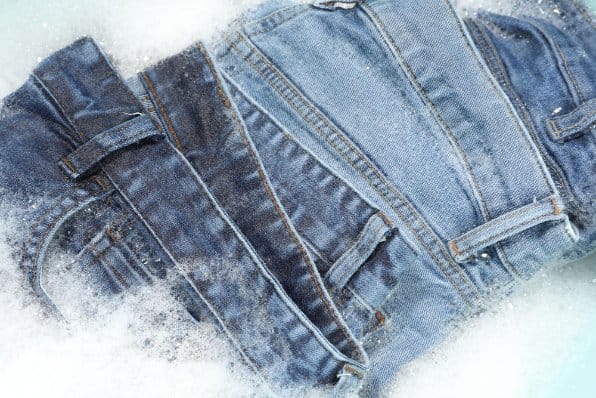

That pair of acid wash jeans looks effortlessly cool. The faded, mottled pattern makes every piece look like it already has a story. But there is another story behind the fabric, one that happens long before the garment reaches a store.
It is a story about rivers running toxic colours in Turkey. About workers spraying chemicals with no protective equipment in poorly ventilated workshops. About water being used at a scale most people would find hard to believe. And about an industry that is slowly, imperfectly, trying to do better.
This guide does not ask you to stop buying acid wash denim. It just gives you the full picture, the things brands rarely put on a label, along with the practical tools you need to make more informed choices when you shop.
If you are new to acid wash denim and want to understand what it is and how it is made before reading this, our complete guide to acid wash denim fabric is a good starting point.
The Look Has a Cost
Acid wash denim gets its distinctive high-contrast, bleached appearance from pumice stones soaked in oxidising chemicals, typically potassium permanganate or sodium hypochlorite. The stones tumble against dry fabric in sealed drums, transferring the chemical unevenly and stripping indigo dye in unpredictable patterns.
The process produces a genuinely unique result. No two pieces come out looking the same. But it also generates wastewater laced with heavy metals and chemical residue, creates stone dust that clogs water systems, and puts workers in direct contact with substances that international health agencies classify as hazardous.
Understanding this does not require giving up the trend. It does require knowing where the garment came from, what went into making it, and what options exist for doing it better.
Sources: Fashion Index, Clean Clothes Campaign Turkey (2024), industry environmental data.
The Environmental Impact
The environmental footprint of acid wash denim production falls into three main categories: water consumption, chemical pollution, and textile waste. Each is significant on its own. Together, they make acid wash one of the most demanding of all denim finishing techniques.
Water Consumption
Denim production is extraordinarily water-intensive at every stage, from growing the cotton to the final wash cycle. A single pair of jeans can require upwards of 20,000 litres of water across its entire lifecycle, a figure that includes irrigation of the cotton crop as well as the dyeing and washing stages.
Acid wash specifically requires multiple wash cycles: the initial dry tumble, a neutralisation rinse, and typically further washes to remove stone dust and chemical residue. Each cycle draws heavily on water resources, particularly in regions where water is already under stress.
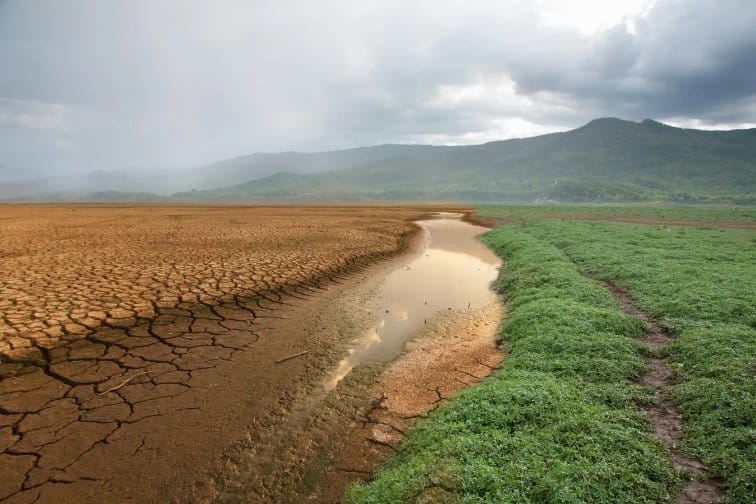
The situation is made worse by where most denim is manufactured. Production is concentrated in parts of Asia, South Asia, and the Middle East where water scarcity is already a serious issue. Consuming large volumes of water for fashion finishing in these regions carries consequences that extend well beyond the factory walls.
Chemical Pollution
The two primary chemicals used in acid washing are sodium hypochlorite and potassium permanganate. Both are powerful oxidising agents. Both generate hazardous waste when not properly treated.
When sodium hypochlorite is used, it releases chlorine and salts into wastewater. The neutralisation process uses reducing agents that produce sulphur dioxide. When potassium permanganate is used, it leaves manganese dioxide residue that must be removed from the fabric and treated in wastewater before discharge. Research published in Polymers (NIH, 2023) confirms that these compounds raise biochemical oxygen demand (BOD) and chemical oxygen demand (COD) in waterways, threatening aquatic life and contaminating groundwater.
In regions without strict environmental regulations or enforcement, factories sometimes discharge untreated wastewater directly into rivers and agricultural land. China’s Pearl River has been visibly stained indigo by denim washing runoff. Turkey’s Ergene Basin, once agricultural land, has been so contaminated by denim chemical discharge that it is now considered unsuitable for farming.
The Ergene Basin in Turkey, which supplies water to much of the surrounding agricultural region, has been severely contaminated by chemical runoff from denim production facilities. A 2024 report by Clean Clothes Campaign Turkey found the area is no longer suitable for agriculture, directly affecting local communities whose livelihoods depend on farming.
Pumice Stone Waste
Traditional acid washing uses volcanic pumice stones imported primarily from Italy, Greece, and Turkey. As these stones tumble against fabric, they break down and create fine stone dust. This dust mixes with chemical wastewater, adding to the complexity and cost of wastewater treatment.
The stones themselves are single-use or limited-use resources. They cannot be indefinitely recycled, and the mining of pumice has its own land use and ecological consequences. Growing demand for acid wash effects drove such rapid depletion of European pumice deposits that mining expanded into sites in California, Arizona, and New Mexico in the US, prompting pushback from environmental groups.
Microfibre Release and Fabric Weakening
The bleaching process weakens denim fibres. This means acid wash garments shed more microfibres during consumer washing than untreated denim. Those fibres enter waterways through washing machine drainage and have been found in rivers, oceans, and in the tissue of aquatic animals. Because cotton microfibres are technically biodegradable, this is less severe than synthetic microfibre pollution, but it is still a contributing factor to overall water quality degradation.
See how your denim habits stack up with the Denim Environmental Impact Tracker, a free tool to estimate the footprint of your wardrobe choices.
The Human Cost
The environmental impact of acid wash production is serious. The impact on the workers who make these garments is arguably more urgent, and it receives far less attention.
The Sandblasting Legacy
To understand today’s worker health crisis, you need to know what came before potassium permanganate. For decades, the denim industry used sandblasting, blasting high-pressure sand against fabric, to create worn and faded effects. The process produced silica dust, which workers inhaled in confined spaces, often with no respiratory protection.
The result was an epidemic of silicosis, an incurable, progressive lung disease caused by inhaled silica particles. In Turkey alone, advocacy groups documented 122 deaths from occupational silicosis among denim workers. The disease continues to affect survivors, many of whom developed symptoms years after leaving the industry.
Turkey banned denim sandblasting in 2009. Other countries followed. It was a genuine step forward. But the chemical that replaced sandblasting has its own serious problems.
Potassium Permanganate: The Replacement That Came With Its Own Risks
After sandblasting was banned, potassium permanganate (PP) spray became the dominant method for achieving the bleached, vintage look on denim. It is easy to apply, fast-acting, and produces results that consumers and brands demand.
It is also classified as a hazardous substance by the European Chemicals Agency (ECHA) and listed on the US Environmental Protection Agency’s (EPA) hazardous chemicals registry. Despite this, it remains unregulated in most of the countries where denim is manufactured.
According to the Labour Behind the Label investigation (2021) and the 2024 Clean Clothes Campaign Turkey report, workers exposed to PP spray report: facial skin problems, blurred vision, respiratory issues, chest tightness, lung inflammation, and symptoms similar to bronchitis and pneumonia. Long-term exposure is associated with potential liver and kidney damage, and animal studies suggest possible effects on fertility and fetal development.
Workers typically apply PP spray using spray guns in enclosed spaces, often without full protective equipment. The chemical turns into fine airborne particles when sprayed, making inhalation almost impossible to avoid without proper respiratory protection. In subcontracted facilities, safety standards are frequently lower and oversight is harder to enforce.
The Scale of the Problem
Potassium permanganate is now used in roughly 90% of processes to create the bleached look in denim products sold on high streets around the world. While some major brands have made commitments to phase it out, progress has been slow. A 2024 report by Clean Clothes Campaign Turkey assessed 44 brands and found that many were unclear or evasive about their use of PP spray in their supply chains.
“We lost 122 people to silicosis as a result of work in the denim industry. Neither we nor the sector can handle another tragedy.” – Abdulhalim Demir, former Turkish denim worker and report author, Clean Clothes Campaign Turkey.
The problem is not limited to Turkey. Workers in Bangladesh, Pakistan, China, and India face similar exposure, often with even less regulatory protection. The supply chain for acid wash denim is long, frequently subcontracted multiple times, and genuinely difficult to trace from the consumer end.
What Brands Are Responsible For
Brands that sell acid wash denim have a responsibility to know what is happening in their supply chains, including at Tier 2, 3, and 4 subcontractors where finishing operations often take place. Supply chain transparency, including disclosure of which facilities perform chemical washing and what chemicals they use, is a reasonable and increasingly demanded standard.
Some brands have made meaningful commitments. Levi Strauss moved to ban sandblasting years before it was legally required and has invested significantly in laser technology at its manufacturing facilities. Others have been less forthcoming. The distinction matters, and it is increasingly possible for consumers to find out which side of that line a brand sits on.
The broader context of ethical production in fashion is covered in our article on fast fashion vs slow fashion, which looks at how buying habits connect to production conditions.
Fashion and the Bigger Picture
Acid wash denim does not exist in isolation. It is part of a broader fashion production system that generates significant environmental and social costs at scale.

In 2026, fashion ranks among the top five most polluting industries globally. The textile sector is responsible for an estimated 1,715 million tonnes of CO2 emissions annually and consumes more than 79 billion cubic metres of water per year, according to industry data cited in sustainability research. Both figures are projected to increase substantially by 2030 if current growth patterns continue.
Denim manufacturing contributes a significant share of that total. Cotton cultivation alone is one of the most water and pesticide-intensive forms of agriculture. Indigo dyeing adds chemical load. And finishing processes like acid washing are the final, often most chemically intensive stage of the production chain.
The demand for pre-distressed, pre-aged looks, of which acid wash is one expression, is a relatively modern phenomenon driven by fashion cycles that value novelty and newness. Understanding that this demand has direct consequences in communities far from where the garments are sold is not a reason to feel guilty about fashion. It is simply context for making more intentional decisions.
Acid wash finishes appear across all demographics, including in children’s clothing ranges. Denim in kids’ clothing carries the same production implications as adult garments. Parents who care about sustainable choices should apply the same scrutiny to children’s acid wash denim as to their own.
For a broader look at the environmental costs of coloured denim production specifically, our article on the environmental cost of coloured denim fabric goes into further detail.
Sustainable Alternatives That Actually Work
The good news is that the industry is not standing still. Several alternatives to traditional acid washing are now commercially viable, and some have been adopted at scale by major manufacturers. Here is an honest assessment of each.
Enzyme Washing
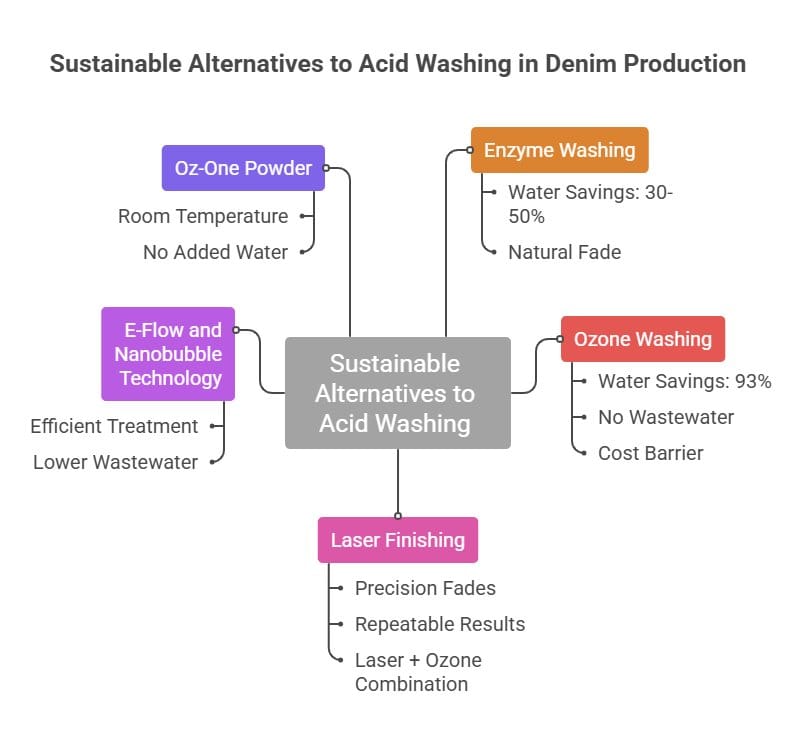
Enzyme washing uses biological enzymes derived from fungi and bacteria to break down the surface dye on denim. The enzymes are targeted, biodegradable, and require significantly less water than acid or stone washing.
Research puts water savings from enzyme washing at 30 to 50% compared to conventional acid wash processes. The results are subtler than traditional acid wash: the look is more of a natural fade than a high-contrast bleach pattern. For brands that want the worn-in aesthetic without the dramatic contrast, enzyme washing is often the best fit.
Ozone Washing
Ozone washing generates ozone gas (O3) inside a sealed chamber and exposes the denim to it directly. The ozone oxidises the indigo dye on the fabric surface, producing fading effects that can closely mimic acid wash, without any water and without any harsh chemicals.
The water savings are dramatic. Some factories report cutting water use from 70 litres per pair of jeans in the washing stage to just 5 litres using ozone technology. That is approximately a 93% reduction. The process also eliminates contaminated wastewater entirely, since no chemicals are dissolved in water during treatment.
The main barrier to adoption is cost. Ozone generation equipment requires significant capital investment. Not every factory can afford it, particularly smaller subcontracted facilities. But as technology prices fall and demand for cleaner production grows, ozone washing is becoming more widespread.
Laser Finishing
Laser technology is the most technically sophisticated option currently available. Precision lasers burn away indigo dye from the fabric surface in programmable patterns, achieving fades, whiskers, abrasion marks, and contrasts that are consistent and repeatable, without a single drop of water and without any chemicals.
Levi’s has been a notable adopter of laser technology at scale. The company has deployed laser systems processing thousands of pairs of jeans per hour across multiple facilities. Other major manufacturers including Jeanologia have developed laser + ozone combination systems that can achieve effects very close to traditional acid wash while eliminating the chemical and water burden entirely.
The limitation of laser alone is that it can sometimes look too precise and uniform compared to the natural randomness of stone and chemical washing. Combining laser with ozone treatment addresses this, creating results that are both sustainable and visually convincing.
E-Flow and Nanobubble Technology
E-flow technology uses nano-sized bubbles of air carrying a small amount of chemistry to treat fabric. Because the chemical is delivered in tiny bubble form rather than dissolved in water, the volume of water and chemicals required drops sharply. The results are precise, efficient, and the wastewater burden is far lower than conventional wet processing.
Nanobubble systems work on a similar principle, using extremely fine bubbles to carry ozone or other treatment agents into fabric more efficiently than liquid-based methods. Both technologies are relatively new at commercial scale, but are being adopted by forward-looking manufacturers.
Oz-One Powder and Chemical Alternatives
Italian sustainable chemicals company Officina+39 developed Oz-One Powder specifically to replace potassium permanganate in the acid wash process. The product is chlorine-free and permanganate-free, works at room temperature in a standard washing machine with no added water, and breaks down indigo and sulphur black dyes to achieve a bleached effect.
As reported by Sourcing Journal, the process requires no specialist ozone machinery, making it accessible to factories that cannot afford major equipment upgrades. It represents a practical, incremental improvement that can be adopted without overhauling an entire production line.
Comparing the Options
| Method | Water Savings vs Conventional | Chemical Use | Visual Result | Barrier to Adoption |
|---|---|---|---|---|
| Enzyme Washing | 30-50% | Biodegradable enzymes only | Subtle, natural fade | Low – uses standard equipment |
| Ozone Washing | Up to 90% | None (ozone gas only) | Strong contrast, close to acid wash | Medium – equipment investment |
| Laser Finishing | Near 100% | None | Precise, customisable patterns | High – significant capital cost |
| E-Flow / Nanobubble | 60-80% | Dramatically reduced | Flexible, varies by chemistry | Medium – newer technology |
| Oz-One Powder | Full waterless process | Chlorine-free, PP-free | Bleached, acid wash-like | Low – no new equipment needed |
| Traditional Acid Wash | Baseline (0%) | Sodium hypochlorite or PP spray | High contrast, mottled | Low cost – widely used, cheap |
Traditional Acid Wash
- Potassium permanganate or chlorine bleach
- Multiple water-intensive rinse cycles
- Workers handle spray guns with limited PPE
- Contaminated wastewater requiring treatment
- Stone dust and chemical sludge as waste
Sustainable Alternatives
- Ozone gas, lasers, or biodegradable enzymes
- Up to 90-100% water reduction possible
- Significantly improved worker safety
- Minimal or zero contaminated wastewater
- Reduced or eliminated stone waste
How to Read the Labels: Certifications Explained
Certifications are not perfect, but they are the most reliable tool consumers currently have for evaluating a brand’s environmental and social commitments. Here is what the main ones actually mean for denim.
What it covers: Tests the finished garment for over 3,000 harmful substances, including residual chemicals from dyeing and washing processes.
What it doesn’t cover: How the garment was made, worker conditions, or water/energy use during production.
For acid wash denim: Confirms the garment you are wearing does not contain harmful chemical residue at levels that could affect your health. A useful baseline.
How to verify: Check the licence number on the OEKO-TEX website at oeko-tex.com.
What it covers: The entire supply chain from fibre to finished product. Requires at least 70% certified organic fibres. Covers environmental standards in processing and social criteria including worker rights.
What it doesn’t cover: Synthetic fibres or products with less than 70% organic content cannot be GOTS certified.
For acid wash denim: Rare but meaningful. A GOTS-certified acid wash denim piece represents a genuinely higher bar for environmental and social responsibility.
How to verify: Check the GOTS public database at global-standard.org.
What it covers: Chemical safety and resource efficiency in textile manufacturing. Covers the production process, not just the end product.
What it doesn’t cover: Organic fibre sourcing or farm-level practices.
For acid wash denim: A bluesign certified wash process indicates that the chemicals and processes used meet strict safety and environmental standards. Particularly relevant for acid wash.
How to verify: Check bluesign.com product finder.
What it covers: Worker rights, living wages, safe working conditions, and a ban on discrimination, forced and child labour.
What it doesn’t cover: Chemical safety in the garment itself, or environmental process standards.
For acid wash denim: Addresses the human cost side of the supply chain. Particularly relevant given the PP spray worker health crisis.
How to verify: Check fairtrade.net.
What it covers: Sustainable cotton farming practices, including reduced pesticide use, water stewardship, and soil health.
What it doesn’t cover: What happens to the cotton after it leaves the farm. Does not cover the washing or finishing stage.
For acid wash denim: A starting point. BCI cotton reduces the upstream environmental impact but tells you nothing about the acid wash process itself.
How to verify: Check bettercotton.org brand members.
What it covers: A scoring system developed by Jeanologia that rates denim washing processes across water use, chemical use, energy consumption, and worker health. Scores 0-33 are low impact, 34-66 medium, above 66 high.
What it doesn’t cover: Not a third-party consumer label, but an industry tool used by brands and suppliers.
For acid wash denim: Some brands now publish EIM scores for their washing processes. It is worth looking for this data if it is available.
A Practical Shopping Guide
Here is what to actually do when you are standing in a shop or browsing online and want to make a more informed choice about acid wash denim.

Questions Worth Asking (or Researching)
- Does the brand publish information about its washing processes? Look for mentions of ozone washing, laser finishing, or enzyme treatment. If a brand uses these and does not mention it, they are probably not using them.
- Does the brand carry relevant certifications? Check for OEKO-TEX, GOTS, bluesign, or Fairtrade. Look up the licence number on the certification body’s website to verify it is current.
- Does the brand publish a supplier list or supply chain disclosure? Brands that are serious about accountability tend to be transparent about where their garments are made. Vague or absent supplier information is a meaningful red flag.
- Has the brand made specific commitments about PP spray? Some brands have pledged to eliminate potassium permanganate from their supply chains. Publicly available commitments with timelines are more meaningful than general sustainability language.
- Is there a secondhand or repair programme? Brands that take their environmental commitments seriously often support garment longevity. Resale programmes, repair services, or take-back schemes are positive indicators.
Green Flags
- + Specifies laser, ozone, or enzyme washing in product descriptions
- + Carries OEKO-TEX, GOTS, or bluesign certification with a verifiable licence number
- + Publishes a supplier list or factory disclosure document
- + Has a published policy on PP spray elimination with a timeline
- + Uses organic cotton, recycled cotton, or Better Cotton Initiative sourcing
- + Offers repair or take-back programmes
Red Flags for Greenwashing
- x Vague language like “eco-friendly” or “sustainably made” with no specific certifications or process details
- x Claims of “natural” processes for acid wash without specifying which alternative to PP is being used
- x Certifications that sound official but are self-issued or unverifiable
- x No supplier information and no response when asked directly about their wash process
- x Very low prices on acid wash denim from unverified supply chains
Use our Fabric Identification Quiz to learn more about the materials in your wardrobe and what different fabric treatments mean for wearability and care.
What You Can Do Right Now
You do not need to overhaul your wardrobe to make a meaningful difference. Small, consistent choices add up. Here is where to start.
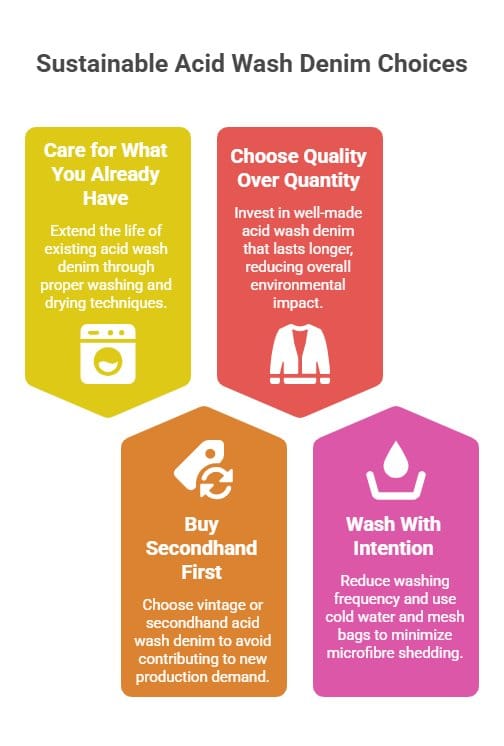
Care for What You Already Have
The most sustainable garment is the one you already own. Extending the life of acid wash denim you already have is one of the highest-impact actions available.
Wash less often, always inside out, in cold water on a gentle cycle with mild detergent. Air dry wherever possible. These habits do not just preserve the look of the garment; they reduce the microfibre and chemical load going into water systems every time you wash.
Our denim care guide covers the full range of care techniques in detail.
Buy Secondhand First
Choosing vintage or secondhand acid wash denim is one of the most direct ways to enjoy the look without contributing to new production demand. The garment already exists. The environmental cost has already been paid. Buying it secondhand extends its life and keeps it out of landfill.
Platforms like Vinted, Depop, and eBay carry strong selections of acid wash denim. Charity shops, vintage markets, and consignment stores are also worth searching. The acid wash revival has made original 1980s and 1990s pieces highly sought-after, but more recent acid wash garments are also widely available secondhand at affordable prices.
Choose Quality Over Quantity
A single well-made acid wash jacket worn for ten years produces a fraction of the environmental impact of five cheaper pieces bought and discarded over the same period. Price-per-wear is a more honest measure of value than retail price alone.
Better-made acid wash denim typically uses heavier base fabric, which holds up better to the bleaching process, wears more slowly, and lasts longer. Paying more for a piece you will wear for years is almost always the more sustainable choice.
Wash With Intention
If you own acid wash denim, reduce how often you wash it. Use a cold wash. Use a mesh laundry bag to reduce microfibre shedding. These are small changes that collectively reduce the ongoing environmental cost of the garments you already own.
The Denim Wash Frequency Calculator helps you build a personalised washing schedule that protects your garments and reduces your environmental impact.
Is the Price Premium Worth It?
Sustainably produced acid wash denim typically costs more than conventionally produced equivalents. That price difference is real, and it matters for shoppers working with limited budgets. But understanding what the premium actually pays for changes how it feels.

What You Are Paying For
A higher price for certified, sustainably produced acid wash denim typically reflects higher costs at several points in the supply chain: organic cotton that costs more to grow, ozone or laser equipment that represents a capital investment for the manufacturer, certifications that require annual audits and fees, and in some cases higher wages for workers in certified facilities.
Conventional cheap acid wash denim is cheap partly because those costs have been transferred elsewhere: to the waterways near the factory, to the workers doing the chemical spraying, and to the communities living downstream. The price difference is not the brand charging more for the same thing. It is closer to the real cost of production being made visible.
The 73% Statistic
Industry research suggests that approximately 73% of shoppers are willing to pay more for sustainably produced denim. The reality, however, is that most people still buy on price when the moment comes. Understanding what the premium reflects is one way to bridge that gap between intention and action.
When Budget Is a Real Constraint
If certified sustainable acid wash denim is simply out of budget, secondhand is the answer. Buying existing acid wash pieces, whether from high street brands or designer labels, costs less than new sustainable production and still sidesteps the demand for new manufacturing. It is a genuinely good option, not a compromise.
A secondhand acid wash jacket from a charity shop beats a new one from a certified sustainable brand in almost every environmental metric. The best sustainable choice depends on context, not just labels.
Frequently Asked Questions
Traditional acid wash denim production is not considered sustainable. It uses large volumes of water, relies on chemicals that generate hazardous waste, and poses serious health risks to production workers. However, the industry is increasingly adopting alternatives including ozone washing, laser finishing, and enzyme treatments that achieve similar visual results with dramatically lower environmental and health impacts. Sustainably produced acid wash denim does exist, but it requires looking for specific certifications and process disclosures.
The two main chemicals are sodium hypochlorite (bleach) and potassium permanganate (PP). Both are classified as hazardous. Potassium permanganate is listed by the US Environmental Protection Agency and the European Chemicals Agency as a hazardous substance. Prolonged occupational exposure is associated with respiratory disease, skin and eye damage, liver and kidney problems, and potential effects on fertility. For consumers wearing the finished garment, residual chemical levels are much lower, but OEKO-TEX certification offers confirmation that the garment is safe for skin contact.
A single pair of jeans requires upwards of 20,000 litres of water across its full lifecycle, from cotton farming through dyeing, washing, and finishing. The acid wash finishing stage itself requires several rinse and treatment cycles beyond the base production. Ozone washing can cut the water used in the finishing stage by up to 90%, and laser finishing uses virtually none. The 20,000-litre figure is for the full lifecycle including cotton cultivation, which accounts for the large majority of the total.
Laser finishing combined with ozone treatment comes closest to eliminating the environmental footprint of the washing stage entirely. Laser uses no water and no chemicals. Ozone uses no water and no synthetic chemicals. Together, they can produce results that closely mimic traditional acid wash with dramatic reductions in environmental impact. For brands that cannot invest in laser technology, enzyme washing is the most accessible lower-impact option. Oz-One Powder by Officina+39 is a practical step-change solution that requires no new equipment and eliminates PP spray.
No single certification covers everything. OEKO-TEX STANDARD 100 confirms the finished garment is free from harmful chemicals at levels that affect wearer health. GOTS covers organic fibre sourcing and responsible supply chain practices end to end. bluesign covers responsible chemical and resource use in manufacturing. Fairtrade covers worker rights and wages. BCI covers sustainable cotton farming. For acid wash denim specifically, OEKO-TEX and bluesign are most directly relevant to the washing process. Always verify licence numbers on the certifying body’s website.
Technically, laser finishing achieves a similar visual result but through a completely different process. Traditional acid wash uses chemical bleaching to fade dye. Laser finishing uses precision light energy to burn away dye at the surface level. The result can look extremely similar, particularly when ozone treatment is combined with laser to add the irregular, cloud-like quality of traditional acid wash. Many brands now use laser finishing and describe the result as “acid wash-inspired” or simply sell it as acid wash by appearance. From a sustainability perspective, laser-finished denim is significantly cleaner to produce.
Sustainability claims in fashion should always be verified rather than taken at face value. Look for specific technology names (ozone, laser, enzyme), verifiable third-party certifications with licence numbers you can check, supplier disclosure documents, and where possible published EIM (Environmental Impact Measurement) scores. General language like “eco-friendly” or “responsibly made” without supporting evidence is a greenwashing warning sign. The more specific and verifiable a claim is, the more credible it tends to be.
Conclusion
Acid wash denim is not inherently off-limits for a consumer who cares about sustainability. But buying it without knowing what went into its production means accepting consequences that affect people and places you will never see.
The workers who spray potassium permanganate in Turkish and Bangladeshi factories are producing garments for the same global market that now has the tools and awareness to demand cleaner alternatives. The farms and rivers near denim production facilities in Asia bear the environmental cost of production decisions made thousands of miles away. Understanding this is not about guilt. It is about making the connection between a purchase and its origins.
Here are the key takeaways from this guide:
- Traditional acid wash production is resource-intensive and chemically hazardous. Water consumption, chemical pollution, and worker health risks are all significant and documented.
- The worker health crisis around potassium permanganate is real and ongoing. Unlike sandblasting, which was banned, PP spray remains largely unregulated in most producing countries.
- Sustainable alternatives genuinely work. Ozone washing, laser finishing, and enzyme treatment can achieve results visually close to traditional acid wash with dramatically lower environmental and health impacts.
- Certifications are useful but incomplete. OEKO-TEX confirms the garment is safe to wear. GOTS confirms a responsible organic supply chain. bluesign confirms responsible chemical use in production. Using them together gives the most complete picture.
- Secondhand is often the best answer. Buying existing acid wash pieces removes your purchase from new production demand entirely.
- Caring for what you have is one of the highest-impact actions available. Washing less, washing cold, and extending the life of your denim reduces both your ongoing footprint and the demand for replacement production.
- The price premium for sustainable acid wash reflects real costs. Cheaper acid wash denim is often cheap because the true costs are being externalised onto waterways and workers rather than built into the price.
The industry is changing. Consumer pressure, tightening regulation in major markets, and genuine innovation in washing technology are all pushing production in a better direction. The gap between what acid wash denim looks like in a shop and what went into making it is slowly, imperfectly, getting smaller.
Knowing this, and acting on it even in small ways, is part of what keeps that progress moving forward.
Next up: if you want to recreate the acid wash look at home without the factory footprint, our DIY acid wash denim guide covers five techniques step by step, with full safety guidance and upcycling project ideas.
References and Further Reading
- National Institutes of Health / PMC: Critical Review on Sustainability in Denim – peer-reviewed environmental impact analysis of denim production and washing methods
- Clean Clothes Campaign: Potassium Permanganate Bleaching Report 2024 – covering worker health and environmental contamination across 44 brands
- Labour Behind the Label: Concerns Raised Over Chemical Use in Denim Bleaching – worker health impacts of PP spray
- WWD / Sourcing Journal: Will the Denim Industry Ever Ban Potassium Permanganate? – industry analysis on PP regulation and alternatives
- Sourcing Journal: Officina+39 Eco-Friendly Denim – Oz-One Powder and sustainable acid wash alternatives
- Wiley / Coloration Technology: Sustainable Approaches to Fashionable Denim Fading – peer-reviewed review of conventional and modern washing techniques (2025)