
Picture a market stall somewhere in the mid-1980s. A teenager spots a pair of jeans unlike anything they have ever seen. The denim is faded, but not evenly. It looks like the fabric has already lived a whole life. Those jeans stopped people in their tracks in cities from Tokyo to Lagos to Buenos Aires.
That was acid wash denim making its mark on the world.
More than four decades later, the look is back. Wide-leg acid wash jeans have been on runways at Alaïa and Bottega Veneta. Streetwear labels are building full collections around the finish. It is not a throwback. It is a current fashion story.
This guide covers everything: what acid wash denim fabric actually is, how it is made, how it compares to other finishes, how to wear and care for it, and what the sustainability conversation looks like right now.
Already know the basics of denim? Good. This guide focuses specifically on acid wash as a fabric treatment. For a broader introduction to denim itself, see our complete guide to denim fabric.
This Article Is Part of a Series
This guide covers the full acid wash denim story. For deeper reading on a specific angle, each of the three guides below focuses entirely on that topic.
What Is Acid Wash Denim Fabric?
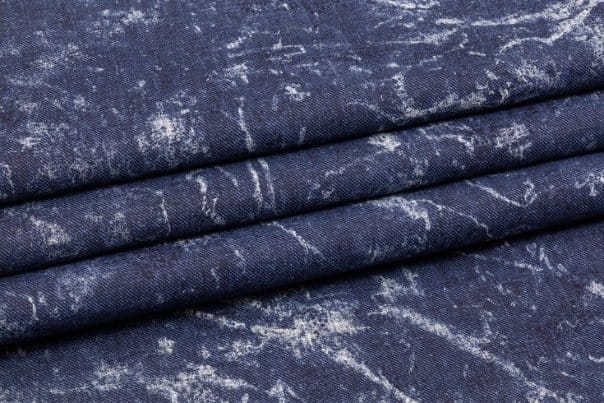
Acid wash denim is denim that has been treated with a bleaching process to create a high-contrast, mottled, patchy appearance. The lighter areas look almost white or pale blue. The darker areas hold onto the original indigo colour. The result is sharp, dramatic, and deliberately uneven.

Here is the part that surprises most people: despite the name, no actual acid is used. The process relies on pumice stones soaked in oxidising chemicals, most commonly sodium hypochlorite (bleach) or potassium permanganate. Those treated stones tumble against the dry fabric and transfer the chemical unevenly, which is exactly what creates that signature look.
The name “acid wash” stuck because it sounded bold and chemical in an era that loved bold and chemical. It now refers to the visual result rather than the chemistry behind it.
Other Names for the Same Look
Acid wash denim goes by several names depending on who is making it and how dramatic the contrast is. Marble wash, snow wash, moon wash, and ice wash are all used to describe similar techniques. The names differ mainly in how light or heavy the bleaching is and which chemicals are used.
What Makes Each Piece Unique
The stones tumble differently every single time. They hit the fabric at different angles and with different pressure. That is why no two acid wash pieces come out looking exactly the same. The pattern is unpredictable by design, and that unpredictability is one of the biggest reasons people love the finish.
Why people love it
- Every piece is genuinely one-of-a-kind
- Instantly recognisable aesthetic
- Works across jeans, jackets, shirts, and more
- Softer feel than raw or untreated denim
- Bridges vintage and contemporary style
Worth knowing before you buy
- Bleaching can slightly weaken fabric fibres
- Traditional production has environmental concerns
- Contrast can soften over time with washing
- Premium sustainable versions are harder to find
- Early wear may appear at seams and stress points
Acid wash is most effective on 100% cotton denim because cotton absorbs the bleaching agent well and releases indigo dye in a controlled way. The higher the cotton content, the more defined and consistent the final pattern.
Where Did Acid Wash Denim Come From?
The story of acid wash denim does not start in a factory. It starts on a beach.
The 1960s: Nature Did It First
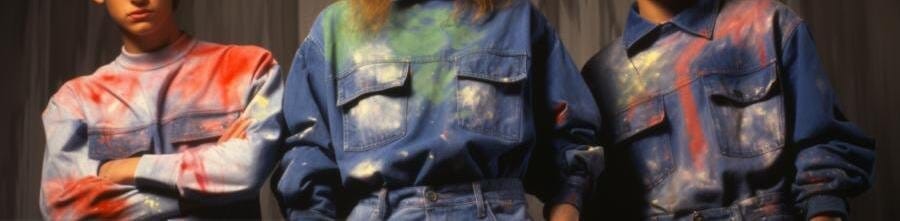
In the 1960s, surfers noticed their old Levi’s were changing. Salt water, sand, and long days in the sun were fading their jeans in uneven, beautiful ways. The fabric was lightening in some spots and staying darker in others, giving it that broken-in look that new jeans simply could not replicate.
People started trying to speed up this process at home. They soaked jeans in diluted bleach, scrubbed them with sand, or left them out in the sun to fade. The goal was straightforward: make new jeans look lived in.
The 1970s: Stone Washing Sets the Stage
Towards the end of the 1970s, the fashion industry began using pumice stones to replicate that aged look at scale. Stone washing gave designers the ability to produce soft, pre-faded denim consistently and quickly. But the results were fairly uniform. The industry wanted something more dramatic.
The 1980s: The Commercial Breakthrough
In the early 1980s, punk scenes were already bleach-spraying their own denim for a raw, mottled effect. By the mid-decade, the fashion industry had found a way to reproduce this at scale.
The modern acid wash process was patented in Italy by the Rifle Jeans Company in February 1986, as documented by the Wikipedia entry on stone washing. The technique involved soaking pumice stones in bleaching chemicals before tumbling them with garments in a completely dry drum.
From Italy, the look spread fast. Within two years, acid wash denim was everywhere. High street stores, music videos, nightclubs. It belonged to no single country or culture. It went global almost immediately.
Acid wash was embraced across continents at the same time. Whether you were in Lagos, Seoul, Buenos Aires, or Manchester in 1987, there is a good chance you encountered it. The look crossed every border without needing translation.
How Is Acid Wash Denim Made?
The manufacturing process is more precise than it looks. What appears random and chaotic is actually the result of carefully controlled steps. Here is how it works at an industrial level:
Simplified overview of the industrial acid wash denim production process.
Why Is the Drum Kept Completely Dry?
This surprises most people. The dry tumbling stage is what produces that sharp, high-contrast pattern. If water were added, the chemical would spread more evenly across the fabric and produce a uniform fade rather than the dramatic, patchy effect that defines acid wash.
The uneven contact between the chemically soaked stones and the dry fabric is what creates the cloud-like patches. The more the stone touches an area, the lighter it goes. Areas with less contact hold more of the original colour.
Which Chemical: Potassium Permanganate or Sodium Hypochlorite?
Both are used in the industry, but they behave differently. Potassium permanganate is considered more controllable and tends to produce a warmer-toned result. Sodium hypochlorite (standard bleach) produces a cooler, brighter contrast. The choice depends on the intended look and the base colour of the denim being treated.
For a broader look at denim finishing techniques, our guide to washed denim fabric covers the full range.
Properties of Acid Wash Denim Fabric
Acid wash denim shares most core properties of regular denim, but the bleaching process changes a few things worth knowing about.
Texture and Feel
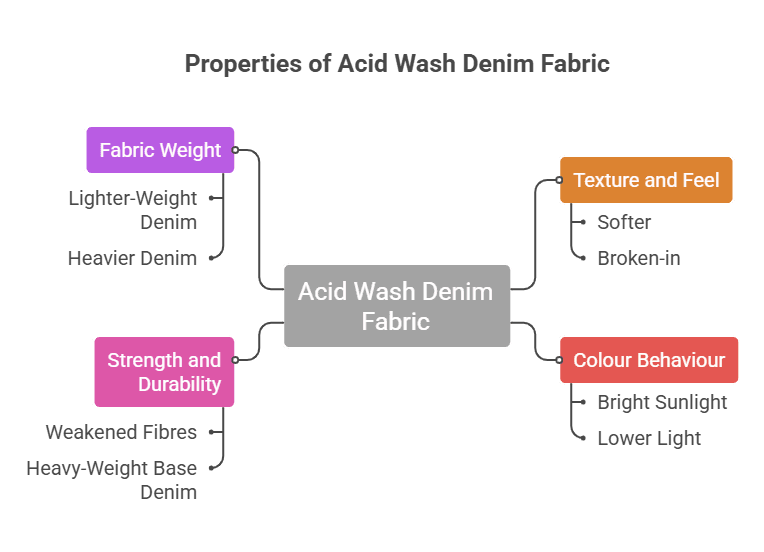
Acid washed denim is noticeably softer than raw denim. The bleaching and tumbling process breaks down some of the stiffness in the cotton fibres, giving the fabric a comfortable, broken-in feel straight away. You do not need to break in an acid wash jacket the way you would with untreated denim.
Colour Behaviour in Different Light
The contrast in acid wash denim shifts depending on light conditions. In bright sunlight, the lighter patches appear almost white while the darker areas stay deep indigo or near-black. In lower light, the contrast softens and the fabric reads as a more uniform mid-tone. This is part of why acid wash photographs so well.
Strength and Durability
The bleaching process does weaken the fabric fibres to some degree. Areas that receive heavy chemical contact may show earlier wear at seams and stress points over time. This is not usually a problem for everyday use, but it is worth factoring in if you plan to wear the piece hard.
Higher-end acid wash garments typically use heavier-weight base denim to compensate for this, and better manufacturing controls chemical exposure more precisely.
Fabric Weight and the Final Result
Lighter-weight denim (around 8 to 10 oz) produces a subtler, more washed-out result. Heavier denim (12 oz and above) holds more of the original indigo and creates stronger contrast. If you want that bold, high-impact look, heavier base fabric gives a more dramatic finish.
Stretch vs Non-Stretch
Stretch denim containing elastane or spandex can also be acid washed. The bleaching process works on the cotton component, though the stretch fibres can be more sensitive to harsh chemicals. Stretch acid wash denim has become increasingly popular for fitted jeans and slim-cut jackets.
“No two acid wash pieces come out looking exactly the same. The unpredictability of the process is part of what makes it so appealing.”
Acid Wash vs Other Denim Washes
Acid wash is one technique among many used to finish denim. Here is a full comparison so you can see exactly where it sits and what makes it different:
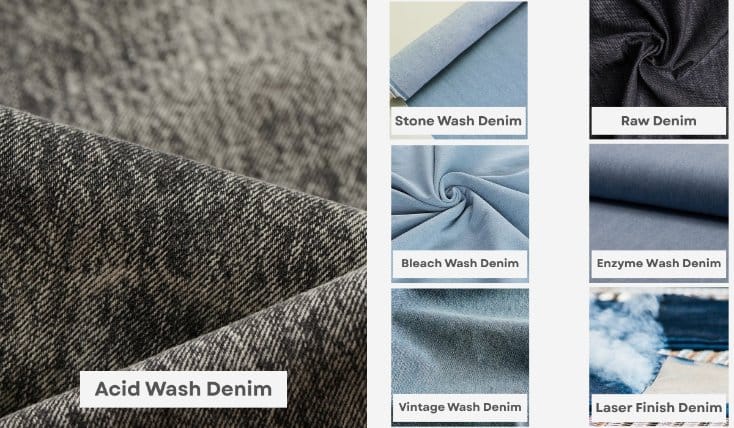
| Wash Type | Visual Result | Process | Feel | Durability | Eco Impact |
|---|---|---|---|---|---|
| Acid Wash | High contrast, mottled, cloud-like patches | Chemical-soaked pumice stones, dry tumble | Softened | Moderate | Highest |
| Stone Wash | Even, overall fade with worn appearance | Pumice stones only, no chemicals | Very soft | Good | Moderate |
| Raw Denim | Deep, saturated dark indigo, no fade | No washing or treatment applied | Stiff | Excellent | Lowest |
| Bleach Wash | Uniform lightening across entire garment | Diluted bleach soak | Soft | Moderate | High |
| Enzyme Wash | Subtle, natural-looking surface fade | Biological enzymes break down surface dye | Very soft | Good | Lower |
| Vintage Wash | Aged, worn-in appearance | Light distressing plus mild chemical treatment | Soft | Good | Moderate |
| Rinse Wash | Minimal change, slight colour softening | Basic cold or warm water wash only | Slightly softer than raw | Very good | Low |
| Laser Finish | Precise, controlled fading patterns | Laser burns away surface dye selectively | Unchanged | Very good | Very low |
The key difference between acid wash and stone wash is contrast. Stone wash uses abrasion alone for even fading and softening. Acid wash uses chemically treated stones to strip dye selectively, creating those sharp light-and-dark zones.
The key difference between acid wash and a standard bleach wash is distribution. A bleach wash soaks the whole garment, producing an even result. Acid wash applies bleach only where the stone physically contacts the fabric, which is why the result is patchy and varied.
Not sure which denim type suits your wardrobe? Try the Find Your Perfect Jeans Style tool for personalised fit and finish recommendations.
Acid Wash on Other Fabrics
Denim is the classic canvas for acid washing, but the technique extends well beyond jeans and jackets. The same bleaching principle works on other cotton-rich fabrics, though the results vary by fabric structure and weight.
Cotton T-Shirts and Sweatshirts
These are the second most common application of acid washing. Cotton jersey and fleece absorb bleach differently from woven denim because the fabric structure is looser. The result tends to be softer and more cloudy rather than sharp and bold. Acid wash hoodies became a streetwear staple from the late 1980s onward and are enjoying a strong revival right now.

Canvas and Twill
Heavy canvas and twill fabrics respond well to acid washing. The tight weave holds contrast clearly, and the result can look bold and structured. Canvas acid wash pieces, including bags and workwear-style jackets, carry a strong visual weight because the base fabric is so dense.
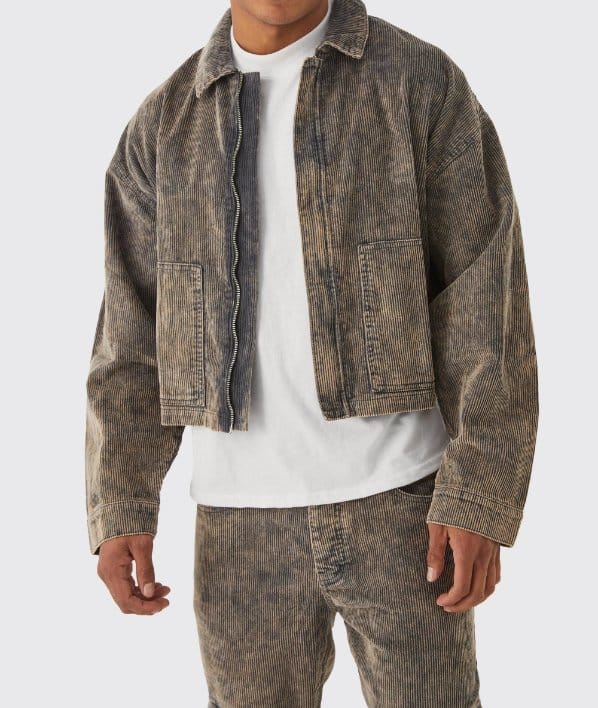
Corduroy
Corduroy is an interesting candidate because the ridged pile structure catches the bleaching agent differently at the top of each ridge compared to the valleys. This can produce a subtle two-tone striped effect across the surface of the fabric.
Chambray
Chambray is a lighter plain-weave cotton often compared to denim. When acid washed, chambray produces a more subtle and understated effect because the base fabric is lighter to begin with. The look is less dramatic than denim acid wash but can work well for shirts and lighter garments.
What Does Not Work Well
Purely synthetic fabrics like polyester do not respond well to bleach-based acid washing. The dye is bonded differently to the fibre, and results are inconsistent. Wool and silk should never be treated with bleaching agents. The chemicals will permanently damage the protein fibres.
The Cultural Journey: Decade by Decade
Acid wash denim has lived through more cultural moments than almost any other fabric treatment. Understanding this timeline helps explain why the look keeps returning and why it carries so much meaning.
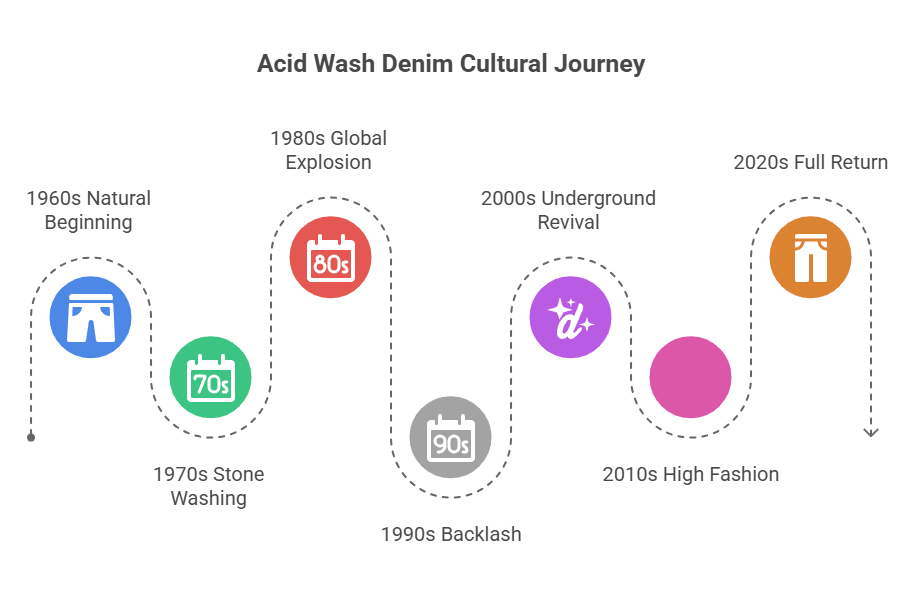
Surfers notice that salt water and sun are fading their jeans in beautiful, uneven ways. Young people begin experimenting with bleach and sun exposure to replicate the effect at home. The aesthetic becomes tied to freedom, the outdoors, and counterculture movements worldwide.
The fashion industry begins using pumice stones to age denim commercially. Pre-faded jeans become widely available for the first time. The result is even and uniform, which plants the seed for something more dramatic to come.
Punk and new wave scenes bleach their own denim for a raw, mottled effect. The Rifle Jeans Company patents the commercial acid wash process in Italy in 1986. Within two years, acid wash is on every high street worldwide, worn across all demographics and style tribes. Hard rock, heavy metal, and glam scenes all claim it. Even children’s fashion absorbed the look, with acid wash pieces appearing throughout kids’ clothing ranges by the late 1980s.
Grunge and minimalism push dark, raw denim back to centre stage. Acid wash becomes associated with excess and falls out of mainstream favour. Snow wash, which keeps more original indigo around the seams, carries the torch briefly into the early 1990s before also fading away.
A quiet nostalgia for 1980s fashion begins building. Acid wash appears in vintage markets and from small independent labels catering to retro-minded buyers. The mainstream has not caught up yet, but the appreciation is steadily growing.
Luxury fashion houses start referencing acid wash on the runway. Brands including Balmain and Proenza Schouler incorporate the look into high-end collections. Streetwear picks it up at the same time. Acid wash shifts from dated to nostalgic-chic.
The 2026 fashion cycle has brought acid wash denim firmly back. Designers are working with wider silhouettes, sustainable finishing techniques, and unexpected colour treatments. It is being built into major collections rather than used as a novelty detail.
“Acid wash denim does not disappear between revivals. It waits, adapts, and comes back with something new to say.”
For a broader view of how denim is performing in current trend cycles, see our article on 2026 fabric trends.
Is Acid Wash Denim Still in Style in 2026?
Yes, and the current version looks more considered than the 1987 original.
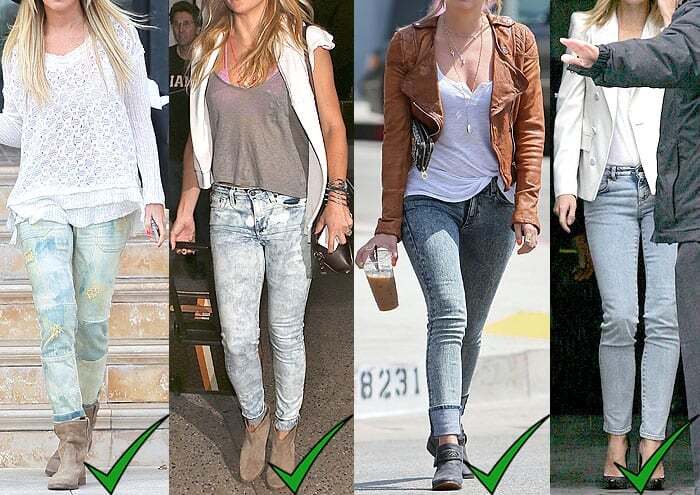
Luxury brands including Alaïa and Bottega Veneta have featured voluminous acid wash denim skirts and wide-leg jeans in recent collections. The focus is on structured, intentional silhouettes rather than the oversized, anything-goes approach of the original era.
Streetwear has embraced acid wash just as enthusiastically. Wide-leg and barrel-leg fits are dominant right now, and acid wash suits these shapes well because the bold pattern needs room to breathe.
Source: Industry analysis aggregated from Google Trends, social listening, and runway data, 2025-2026.
What makes the current revival interesting is that it is not purely nostalgic. Designers are pairing acid wash with contemporary details: cropped blazers, metallic hardware, tie-dye acid wash treatments, and colour-dyed base fabrics that produce unexpected results when bleached.
The coloured denim market has also embraced acid wash principles. Brands are experimenting with black acid wash, indigo-on-indigo treatments, and pastel-toned base fabrics that create striking contrasts under bleaching.
Styling an acid wash jacket with acid wash jeans in a tonal pairing is one of the most photographed looks of the current season. The key is keeping the tones related rather than perfectly matching.
For more context on where this sits in the bigger trend picture, our 2025 fashion trends article covers the full landscape.
How to Style Acid Wash Denim
One of the strongest arguments for acid wash denim is how flexible it is. It pairs well with minimal pieces and with statement pieces. The key is deciding which direction you are going before you get dressed.
The Casual Everyday Look
Pair acid wash jeans with a plain white or black cotton t-shirt and clean trainers. This is one of the most universal outfits you can put together, and acid wash does all the visual work. The simpler the top, the more the jeans lead.

Smart-Casual: An Unexpected Combination
An acid wash jacket worn over a crisp button-down shirt creates an interesting tension between polish and edge. Ground it with dark trousers or chinos. This works well in creative professional settings or for evening plans that are casual but intentional.

The Layered Streetwear Approach
Acid wash denim works particularly well when layered. An oversized acid wash jacket over a plain hoodie, with wide-leg acid wash trousers in a related tone, creates a confident double-denim moment. Keep the tones from the same wash range and they will coordinate naturally.
For Warmer Climates and Seasons
Acid wash denim shorts and skirts are strong warm-weather options. Pair with a lightweight linen or cotton top for a look that is easy and low-effort. The contrast in the denim adds enough visual interest on its own.
What to Avoid
Very busy prints competing with the mottled denim pattern tend to cancel each other out visually. If your top has a lot going on, keep the acid wash piece simpler, such as a skirt or jacket. If the acid wash piece is bold, let it lead.
Acid wash reads differently around the world. In Japan it is often styled with clean, quality basics. In Brazil and parts of West Africa it tends to be mixed with more colour and pattern. In Europe it is frequently grounded with neutral palettes. There is no single correct approach.
Looking for the right fit to go with your acid wash pieces? Our guide to finding the perfect jeans covers fit tips that apply across all denim finishes.
Take the Denim Care Quiz to get personalised care recommendations based on your specific denim type and lifestyle.
How to Care for Acid Wash Denim
The contrast that makes acid wash denim special can soften over time with careless washing. The good news is that the right habits make a significant difference. Here is what to do.
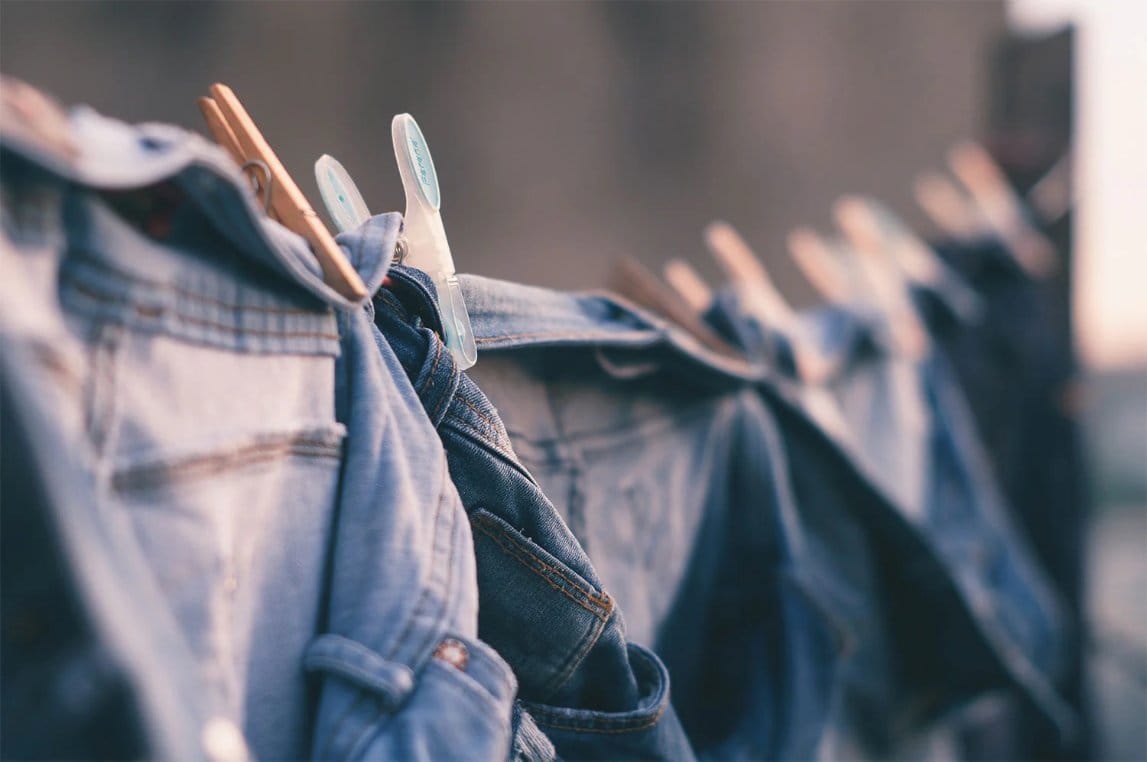
Watch: How to Wash Jeans Without Fading Them

Hannah IRL shares practical tips on washing jeans the right way, including cold water techniques, air drying, and how to avoid the most common mistakes that cause fading and fabric damage.
How Often Should You Wash Acid Wash Denim?
Like all denim, acid wash does not need washing after every single wear. Every 3 to 5 wears is a reasonable guide for jeans. Jackets can go much longer between washes, especially when worn over other layers.
Less washing means longer-lasting contrast, which means the piece keeps its character for more time. Spot cleaning small marks is a better option than a full machine wash whenever practical.
Use the Denim Wash Frequency Calculator to get a personalised washing schedule based on your lifestyle and how often you wear denim.
For a complete reference on denim maintenance, our denim care guide covers all denim types in detail.
The Environmental Reality
Acid wash denim is one of the most visually striking finishes in fashion. It is also one of the most demanding to produce responsibly. This section looks at that honestly, without either overstating the problem or glossing it over.
What Makes Traditional Acid Washing Problematic
The conventional process uses sodium hypochlorite or potassium permanganate, both of which generate hazardous waste when not properly managed. Research published in Polymers (National Institutes of Health, 2023) confirms that sodium hypochlorite treatment on denim can release hypochlorous acid, which affects aquatic ecosystems and poses respiratory risks to workers without adequate protection.
Pumice stone dust adds to waste streams if water treatment is insufficient. And because the bleaching agents weaken fabric fibres, the garment may not last as long as untreated denim, which adds to textile waste over time.
The broader picture of denim’s environmental cost is covered in our article on the environmental cost of denim production.
Sustainable Alternatives That Are Already Here
The industry has been actively developing cleaner alternatives, and several are now commercially viable.
Ozone washing uses ozone gas in a closed chamber to fade denim without water or harsh chemicals. It dramatically reduces chemical consumption and produces far cleaner wastewater than traditional methods.
Laser finishing uses precise laser technology to burn away surface dye in controlled patterns, producing acid wash-style effects without any chemicals at all. Adoption is growing steadily among major manufacturers.
Enzyme washing uses biological enzymes derived from fungi and bacteria to break down surface dye. It is gentler on fibres, produces softer fabric, and has a significantly lower environmental load compared to chemical bleaching.
Oz-One Powder, developed by Italian sustainable chemicals company Officina+39, allows manufacturers to achieve an acid wash appearance using a waterless, chlorine-free process that runs at room temperature in a standard washing machine. As reported by Sourcing Journal, the product does not require specialist ozone machinery, making it accessible to a wider range of factories.
What to Look For as a Consumer
When buying acid wash denim, look for brands that specify ozone washing, laser finishing, or enzyme treatments in their product descriptions. Certifications like OEKO-TEX and GOTS indicate better chemical management practices throughout the production chain.
Some brands now publish their wash processes on their websites. If that information is not available, it is a reasonable question to ask before buying. The sustainability conversation in this category is moving in a better direction, but consumer interest is part of what keeps that movement going.
For more on how fashion production choices add up, our article on fast fashion vs slow fashion covers the broader picture.
Track the environmental footprint of your denim wardrobe with the Denim Environmental Impact Tracker.
Our dedicated sustainability guide covers chemical risks, the worker health crisis around potassium permanganate, eco-friendly production alternatives, and how to shop for acid wash denim more responsibly.
The Global Acid Wash Denim Market
Acid wash denim is not just a fashion statement. It represents a growing and commercially active segment of the global textile industry.
Source: Industry market analysis, 2023-2024.
North America and Europe are the largest consumption markets, while production is concentrated in Asia. China and Pakistan account for the majority of global acid wash denim manufacturing output. Bangladesh, India, and Vietnam are also major producing countries.
Two forces are shaping the market simultaneously. Fashion revival is driving demand. At the same time, brands face growing pressure from consumers and regulators for cleaner production methods. Manufacturers investing in sustainable finishing technology are finding a commercial advantage as well as an ethical one.
Organic cotton blends within the acid wash segment are growing at around 7% annually. Four-way stretch acid wash variants are also expanding, driven by crossover demand from athleisure. The market data makes clear that acid wash denim is a commercially serious category with genuine investment behind it.
For more on how this fits into broader market movements, our article on coloured denim market trends provides current analysis.
Frequently Asked Questions
The name stuck for historical reasons rather than chemical accuracy. The process uses oxidising agents like sodium hypochlorite or potassium permanganate, which are powerful but are not acids in the traditional sense. In the 1980s, “acid wash” was a more dramatic-sounding name than alternatives, and it caught on. Today it refers to the visual result, not the chemistry behind it.
No, they are related but different. Stone wash uses plain pumice stones without chemicals to soften and uniformly fade denim through physical abrasion alone. Acid wash uses pumice stones soaked in bleaching chemicals, creating sharp, high-contrast patches rather than an even fade. Stone wash produces a soft, uniform vintage look. Acid wash produces bold, dramatic contrast. The two techniques are sometimes combined for different effects.
The contrast can soften with repeated washing, particularly in warm or hot water. The lighter, bleached areas will not fade further since they have already been stripped of colour. However, the darker indigo areas can continue to fade with each wash, gradually reducing the contrast between light and dark zones.
Washing in cold water, inside out, on a gentle cycle is the most effective way to preserve the contrast and keep the piece looking as intended for longer.
Absolutely. Acid wash denim is firmly back in the mainstream for 2026. Luxury brands including Alaïa and Bottega Veneta have featured it in recent collections, and it has a strong presence in streetwear globally. The current version favours wider silhouettes and more controlled contrast compared to the original 1980s look. It is being treated as a current trend rather than just a nostalgic reference.
Cotton-rich fabrics respond best. This includes cotton jersey (t-shirts and sweatshirts), canvas, twill, corduroy, and chambray. Blended fabrics with a high cotton content can also be treated, though results are less predictable. Purely synthetic fabrics like polyester do not respond well to traditional acid washing. Protein fibres such as wool and silk should never be treated with bleaching agents.
Traditional acid wash production is considered one of the more environmentally demanding denim finishing processes due to its use of harsh chemicals and the hazardous waste generated when those chemicals are not properly managed. However, the industry is actively moving towards cleaner alternatives. Ozone washing, laser finishing, enzyme treatments, and new powder-based systems can achieve similar visual results with far less environmental impact.
When buying, look for brands that specify their wash process and carry relevant certifications such as OEKO-TEX or GOTS.
Turn it inside out, wash on a cold and gentle cycle with mild detergent, and avoid products containing bleach or optical brighteners. Air dry where possible, or tumble dry on the lowest heat setting only. Wash as infrequently as you can manage. Jackets worn over other layers typically need washing far less often than jeans. Spot cleaning visible marks is a better option than a full machine wash whenever practical.
Acid wash is a chemical treatment that changes the colour of the fabric through bleaching. Distressed denim is about physical damage: rips, tears, fraying, abrasion marks, and holes that suggest the fabric has been worn hard over time. The two techniques are often combined, and a piece can be both acid washed and distressed. They produce different types of aged appearance and can work well together or independently.
Conclusion
Acid wash denim has earned its place in fashion history several times over. It started with surfers and salt-bleached jeans, turned into a global phenomenon through the 1980s, went quiet, came back in high fashion, and is now a genuine trend for 2026. That kind of staying power is not luck. It is the sign of something that genuinely works.
What separates acid wash from most trends is that the look comes from an actual physical and chemical process. It is not digitally printed or pattern-applied. It involves stones, chemistry, and a controlled amount of unpredictability. No two pieces are identical. There is real craft in it, even if that craft is currently being reimagined through more responsible production methods.
Here are the key takeaways from this guide:
- No actual acid is used. The name is historical. The process uses bleach-soaked pumice stones tumbled in a dry drum with the fabric.
- The look comes from uneven stone contact. The patchy, high-contrast pattern is created because stones touch different areas differently. That is also why every piece is unique.
- It is softer than raw denim straight from purchase, but the bleaching process slightly weakens fibres over time.
- It is genuinely on trend in 2026. Wide-leg silhouettes, considered styling, and luxury brand adoption have all confirmed this.
- Proper care preserves the contrast. Cold water, gentle cycle, inside out, and mild detergent make a real difference to how long the piece holds its look.
- Sustainability is improving fast. Laser finishing, ozone washing, and enzyme treatments now offer the same visual results with a far lower environmental footprint.
- The technique works beyond denim. Cotton jerseys, canvas, and corduroy all respond to acid washing, which explains why the look keeps appearing across so many product categories.
If you are thinking about adding acid wash to your wardrobe, start with one strong piece: a wide-leg pair of jeans, a structured jacket, or even an oversized sweatshirt. Pair it simply, care for it correctly, and it will last far longer than a trend piece has any right to.
Coming up next in this five-part series: a deep dive into the sustainability side of acid wash production. We look honestly at what the traditional process costs the planet, which brands are doing things differently, and how to shop for this look without the environmental compromise. Stay tuned for Article 2.
References and Further Reading
- Wikipedia: Stone Washing (history of stone washing and the Rifle Jeans Company patent)
- National Institutes of Health / PMC: Critical Review on Sustainability in Denim (peer-reviewed environmental impact analysis)
- Sourcing Journal: Officina+39 Eco-Friendly Denim Innovations (Oz-One Powder and sustainable acid wash alternatives)