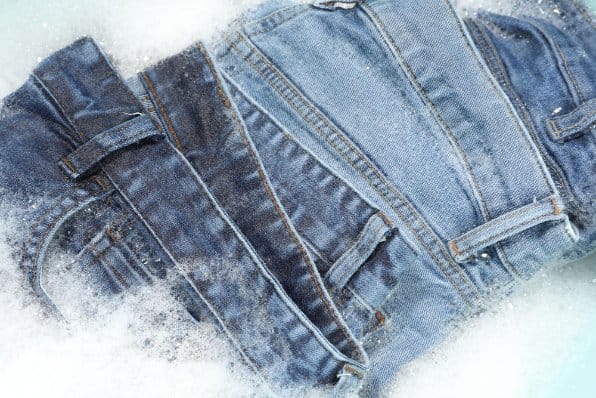

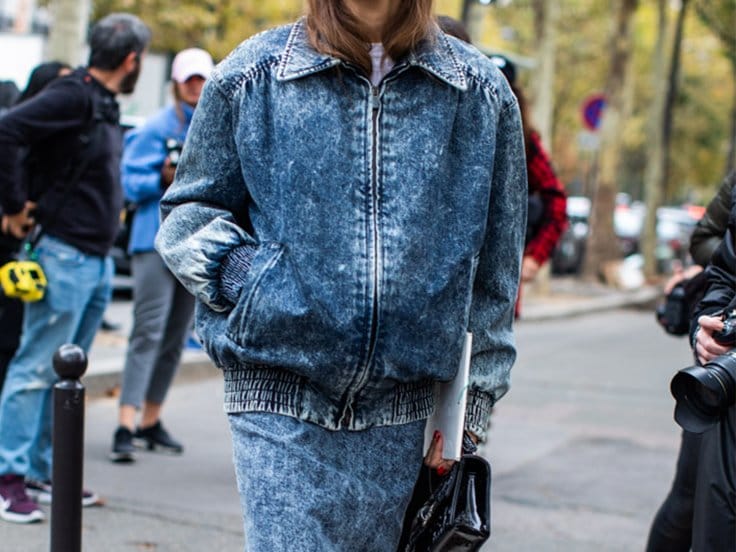
Acid wash denim is one of those techniques that fashion students encounter in textbooks as a 1980s trend and then discover on the runway in their final year of school. It keeps reappearing because it is not really a trend. It is a finishing technique with a specific visual language, a documented industrial history, and a set of design properties that reward anyone who understands it properly.
This guide is written for people who want to go deeper than styling advice. It covers the chemistry and manufacturing history, the technical behaviour of the fabric in garment construction, how to sequence your wash if you are applying acid wash to your own garments, how leading designers have used this technique as a deliberate aesthetic tool, and where the technique fits in the current design landscape of 2026.
Whether you are working on a student collection, developing a professional line, or simply want to understand what this fabric is actually doing and why, this is the guide that treats the subject with the technical respect it deserves.
For the foundational overview of acid wash denim including its properties and cultural history, our complete acid wash denim guide is a useful companion. For the sustainability side of the production process, which every working designer should understand, our environmental cost of denim article covers it in full.
Acid Wash as a Design Innovation
Most design students are taught that acid wash emerged as a trend in the 1980s. That framing undersells what actually happened. Acid wash was not a trend that appeared and passed. It was an industrial innovation that changed how the fashion industry thought about fabric finishing as a design tool.
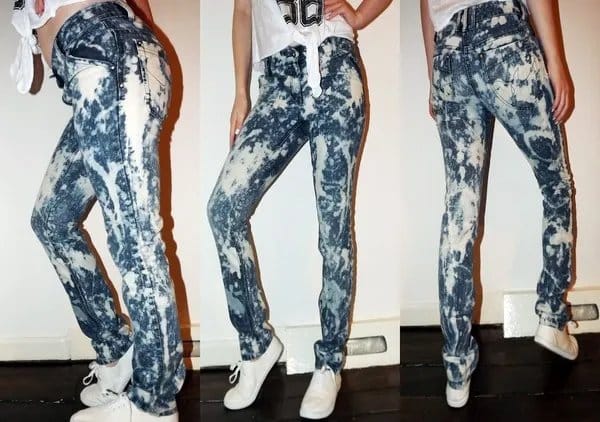
Before acid washing, denim was finished in a relatively limited range of ways: raw, rinsed, or stone washed. The look of the fabric was largely determined by its base colour and weave. Acid washing changed that. For the first time, the surface treatment of the garment could produce a complex, non-repeatable visual pattern that looked like years of wear compressed into a single industrial process.
That shift, from fabric as a uniform material to fabric as a variable surface, is still influencing how designers think about denim today. Laser finishing, ozone treatments, and nanobubble technology are all, in a sense, descendants of the logic that acid washing established: that the wash is a design decision, not just a finishing step.
“The wash is not something that happens to the garment after it is designed. The wash is part of the design. Acid washing made that clear for the first time at industrial scale.”
Understanding acid wash through this lens, as a technique rather than a trend, is what allows designers to use it deliberately rather than reactively. It is not about whether the look is currently fashionable. It is about understanding what the technique does, when it is the right tool, and how to control it.
The Technical Origin Story
The precise origin of acid washing is contested, as with most industrial innovations. What is well-documented is the sequence of events that brought it into mainstream production.
California surfers noticed that salt water and sun were bleaching their Levi’s in irregular, high-contrast patterns. The look was prized for its authenticity. People began trying to replicate it at home using diluted bleach and sand, establishing the basic chemical principle: oxidising agents applied unevenly to denim cotton remove surface indigo dye selectively.
French duo Marithé + François Girbaud are widely credited with industrialising stone washing, using pumice stones in industrial drums to abrade denim and produce a uniform faded effect. As documented in the FIT Museum’s Denim: Fashion’s Frontier exhibition, this set the stage for more complex finishing techniques. Stone washing was a physical process: abrasion without chemistry.
Punk and skinhead subcultures were already bleach-splattering their own denim for a mottled, camouflage-like effect known as snow wash. This early version retained more of the original dark dye around seams and the waistband. The aesthetic was rebellious and anti-commercial. As documented by the National Library of Scotland’s denim history archive, Guess Jeans offered the first commercially “pre-washed” jeans as early as 1981.
The modern acid wash process was accidentally discovered and then patented in Italy by the Rifle Jeans Company. The accident: pumice stones and jeans were tumbled together in a machine that still contained residual bleach from a previous cycle. The stones picked up the bleach and transferred it unevenly to the dry fabric during tumbling, creating the characteristic high-contrast mottled pattern. The dry tumble is the crucial variable. Without it, the result is a standard bleach wash.
American Garment Finishers (AGF) of Texas industrialised the process in North America and offered it to Levi Strauss. AGF subsequently improved the technique by replacing sodium hypochlorite with potassium permanganate, which produced a more natural-looking abraded result and was less damaging to the cotton fibres. Other abrading materials, including marble sand and expanded glass foam, were also developed as pumice alternatives.
Acid wash spread rapidly across markets. It was worn across genders, age groups, and economic brackets. Hard rock, glam metal, pop, and hip-hop cultures all claimed it simultaneously. At its peak, it appeared in collections from mass market to high street to premium denim brands worldwide.
As fashion cycles moved faster, acid wash returned not as a throwback but as a deliberate aesthetic reference. Designers at Balmain, Proenza Schouler, Acne Studios, and later Alaïa and Bottega Veneta began using acid wash and related treatments as a considered design language rather than a commercial trend.
The Rifle Jeans discovery is a useful case study for design students: one of the most commercially significant fabric treatments of the 20th century was an industrial accident. The creative decision was recognising what the accident had produced and understanding how to replicate it deliberately. That transition from accident to technique is where design thinking begins.
How Designers Have Used It
Understanding how other designers have deployed acid wash as a tool, rather than just riding a wave, gives you a framework for using it with intention in your own work.
The French duo did not invent acid wash but were instrumental in shaping how stone and acid washing were used as design tools. They treated the wash as part of the garment’s identity, not just its finish, producing pieces where the fade pattern was as much a design element as the cut.
Versace used acid wash as part of its signature excess aesthetic: gold hardware, bold print mixing, and heavily treated denim. The house treated acid wash as a luxury surface rather than a counterculture reference, which was a significant repositioning of the technique’s social meaning.
Under Olivier Rousteing, Balmain brought acid wash back into luxury denim with embellished, body-conscious silhouettes. The contrast between the casual, worn finish and the highly constructed, fitted garments created a deliberate tension that became a signature of the house’s denim aesthetic in that period.
Acne Studios incorporated bleached and acid-treated denim as part of a broader exploration of tactile authenticity. As noted in trade reporting on their 2026 collections, they used ripped and bleached denim “not as shock value, but as a way to add tactile realism” to pieces designed to look lived-in without sacrificing structure.
Alaïa’s use of acid wash denim in voluminous skirts and wide-leg jeans brought the technique into a couture-adjacent context. The pairing of high-contrast bleached denim with the house’s signature sculptural approach is a recent example of acid wash being used in a way that has nothing to do with 1980s nostalgia.
Bottega’s approach to wide-leg acid wash jeans leaned into proportion and restraint: the wash was dramatic but the styling was quiet, allowing the fabric treatment to anchor the look without competing with other elements. A study in how to let a surface treatment lead.
The pattern across these examples is consistent. The designers who use acid wash most effectively treat the wash as a deliberate visual statement and make choices about everything else, silhouette, styling, hardware, construction, in relation to it rather than in parallel to it.
How the Fabric Behaves
Acid wash denim shares the structural properties of its base fabric but the bleaching process introduces specific changes that matter for construction and garment longevity. Here is the complete technical picture.
Base Construction
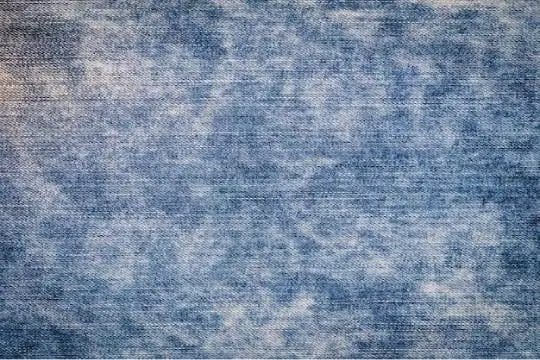
Denim is a 3×1 twill weave: the warp thread passes over three weft threads before going under one. This produces the characteristic diagonal rib on the face of the fabric. The warp threads carry most of the indigo dye, which is why denim fades at the surface rather than uniformly through the weave. Acid washing exploits this: the oxidising agent strips the surface indigo from raised warp threads while the recessed weft threads retain more colour, producing the characteristic light-and-dark contrast.
Fabric Weight and Its Design Implications
| Weight (oz) | Classification | Acid Wash Result | Best For | Construction Notes |
|---|---|---|---|---|
| 5-8 oz | Lightweight | Subtle, washed-out; less contrast | Shirts, summer dresses, light skirts | Drapes well; treat like woven cotton |
| 9-11 oz | Mid-weight | Good contrast, controlled bleaching | Jeans, skirts, shorts, structured tops | Most versatile; standard denim sewing techniques apply |
| 12-14 oz | Heavyweight | Bold, high contrast, dramatic result | Jackets, structured trousers, outerwear | Requires heavy-duty equipment; allows for bleaching compensation |
| 15+ oz | Very heavyweight | Maximum contrast; slow bleaching | Workwear-influenced pieces, conceptual design | Industrial machines recommended; seam bulk significant |
Fibre Strength After Treatment
The bleaching process weakens cotton fibres to a measurable degree. Research published in Polymers (NIH, 2023) confirms that sodium hypochlorite treatment degrades tensile strength in treated denim. The practical implications for designers: seams and stress points in acid-washed garments need reinforcement, particularly at the crotch, belt loops, pocket corners, and inseams. Heavier base fabric compensates for this by starting from a position of greater strength.
Colour Behaviour Under Different Lighting
Acid wash denim reads very differently under different light conditions. In direct sunlight, the bleached areas appear nearly white and the dark areas read as deep indigo. In interior or low light, the contrast softens and the fabric reads as a more uniform mid-tone. This means your garment will look different in a showroom than it does in natural light, and different on a runway under stage lighting than it does on a street. Photographing acid wash under multiple lighting conditions before finalising a collection look is worthwhile.
Shrinkage Behaviour
Acid-washed denim behaves differently from raw denim in terms of shrinkage. Because the fabric has already been wet processed during the acid wash procedure, much of the initial shrinkage has already occurred. Sanforized acid wash denim (which has been pre-mechanically shrunk) will show residual shrinkage below 2.5%. Unsanforized acid wash denim is rarer but can still exhibit up to 5% shrinkage if not pre-washed before construction.
Grain Behaviour and the Twill Problem
Denim twill weave has a strong bias pull that becomes more pronounced after washing. If you cut denim on the cross grain, it will distort into a parallelogram shape and will not square up after washing. Always lay pattern pieces on the lengthwise grain and ignore the cross grain for alignment. For trouser legs specifically, alternating the direction of front and back leg pieces (one cut right-side up, one cut inverted) helps prevent leg twist after washing.
Construction: Technical Guidance
Acid wash denim presents the same construction challenges as any heavyweight cotton denim, with the addition of the fibre weakening consideration. Here is what matters technically.
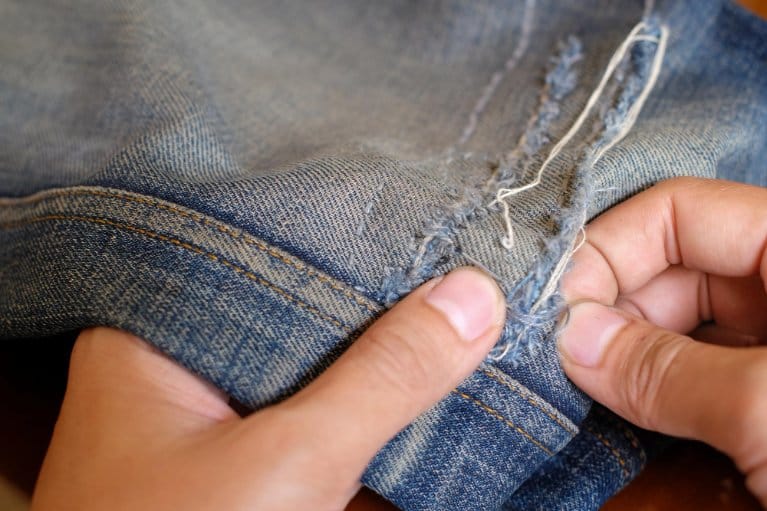
Light to mid-weight (up to 11 oz): 90/14 denim needle
Heavy weight (12 oz+): 100/16 denim needle
Stretch acid wash denim: stretch needle, not denim needle
Denim needles have a sharp point and reinforced shaft to handle the tight weave. Replace frequently as they dull quickly. A blunt needle causes skipped stitches, thread breakage, and surface damage to the fabric.
Construction seams: All-purpose polyester thread, which has slight stretch and is stronger than cotton thread under stress.
Topstitching: Heavy-duty polyester or upholstery thread. Never use topstitching thread in the bobbin as this creates excessive bulk.
Contrast topstitching: A deliberate design decision. Classic denim uses amber or gold topstitching. Contemporary acid wash pieces often use white or tonal thread for a cleaner finish.
Standard seams: 2.5 to 3 mm
Multiple layers (waistbands, cuffs): 3 to 3.5 mm to prevent puckering through thick sections.
Topstitching: 3.5 to 4 mm for the classic denim look.
Shorter stitches weaken the seam under tension. Longer stitches improve appearance on topstitching and ease movement through bulky intersections.
Standard: 1.5 cm minimum. Denim frays and the bleaching process can make edges more prone to fraying than untreated cotton.
For finished seams: Flat-felled seams are the industry standard for denim. They encase raw edges and add structural strength at stress points.
Grading seams: Grade seam allowances at intersections to reduce bulk, particularly at waistbands, yokes, and inseam-side seam junctions.
Denim twill has slight mechanical stretch from its weave structure. Use a fusible tricot interfacing rather than a woven interfacing for waistbands, cuffs, and plackets. Tricot moves with the fabric rather than working against it.
Pre-wash interfacing before applying it. Interfacing and fabric can shrink at different rates if washed separately after construction.
Use a pressing cloth when applying fusible interfacing to acid wash denim to protect the surface.
Use heavy-duty metal zippers, tack buttons, and rivets rather than standard nylon zippers or plastic buttons. Denim puts significant stress on closures, and acid-washed denim’s slightly weakened fibres make reliable hardware even more important.
Rivets at pocket corners and bartacks at belt loop bases are standard practice in denim construction and should not be omitted for aesthetic reasons on a functioning garment.
Press on a high-temperature cotton setting with plenty of steam. Use a hardwood tailor’s clapper after pressing to absorb steam and set crisp seams even through heavy layers.
Hammer bulky seam intersections with a mallet before stitching to flatten them enough for the presser foot to travel evenly. Place a protective piece of fabric between the mallet and the garment.
Cut mid-weight and light-weight denim on the fold using sharp shears or a fresh rotary cutter blade. Cut heavyweight denim in a single flat layer. Folded heavy denim can cause pattern pieces to shift during cutting, creating misaligned pieces.
Mark with a water-soluble chalk pencil in a contrasting colour. Marks must wash out cleanly and should not leave residue that interferes with the wash finish.
Multi-layer seam intersections are the most common source of construction problems in denim. Here is the professional approach:
- Grade seam allowances at intersections. Trim each layer to a slightly different width so no two layers are the same thickness. This distributes bulk rather than concentrating it.
- Hammer the seam area firmly with a mallet before approaching it with the machine. This flattens the fibres and makes the transition through the machine smoother.
- Use a hump jumper (also called a Jean-a-Ma-Jig) under the back of the presser foot when approaching a thick seam. This levels the foot and prevents the machine from stalling or skipping stitches.
- Reduce machine speed through multi-layer intersections. Hand-crank the wheel at the thickest point if necessary. Speed is the enemy of accuracy at seam intersections in heavy denim.
- After stitching, press immediately with steam and apply the clapper. Then topstitch while the seam is still warm from pressing, which helps the machine travel more smoothly through the layers.
For a broader reference on denim fabric types and their construction differences, our guide to washed denim fabric covers the full spectrum of denim finishes and their structural implications.
Wash Sequencing: When Does the Acid Wash Happen?
This is one of the most practically important questions for designers working with acid wash as a technique applied to their own garments, rather than sourcing pre-washed fabric. The answer shapes everything from your pattern grading to your construction sequence.
In industrial production, acid washing almost always happens after garment construction. Garments are sewn in their finished form and then treated in the wash drum. This is why seams, pockets, and waistbands show heavier bleaching: they have multiple layers and are raised surfaces, so they receive more contact with the treated pumice stones.
Option A: Wash After Construction (Industrial Approach)
Industrial wash sequence: acid washing applied to the completed garment.
Advantages: The wash creates natural variation across seams, edges, and flat panels that mimics real wear patterns. Pocket edges, collar points, and hemlines bleach more heavily, which looks authentic. This approach is what produces the most genuinely acid-washed appearance.
Disadvantages: You cannot predict exactly where the bleach will concentrate. Construction details you have worked carefully on may bleach unevenly. For a controlled or graphic design result, this unpredictability can be a problem.
Option B: Wash Fabric Before Construction
Alternative sequence: acid washing applied to fabric yardage before cutting and construction.
Advantages: You see the wash result before you cut. You can use the pattern of light and dark deliberately in your design. Seams will not be more bleached than flat panels, which can be a more considered look.
Disadvantages: You lose the authentic variation at seams and edges that makes acid wash look genuinely worn. The result looks more deliberately treated. It also requires significantly more fabric, as you need to account for waste when cutting around the wash pattern.
Wash after construction if you want the most authentic acid wash result and are comfortable with some unpredictability in where the bleach concentrates. Wash before construction if you want creative control over the visual composition of the garment and are working with a specific pattern placement concept. Many designers use both within a single collection to create variation.
Pattern Placement and the Wash
If you are working with pre-washed fabric, or if you are washing at the fabric stage rather than the garment stage, pattern placement becomes a genuine design decision. The bleach distribution across the fabric is not uniform, which means different panels of your garment will carry different levels of contrast.
Using the Wash Pattern Deliberately
On a flat piece of acid-washed fabric, the bleach typically concentrates in certain areas and leaves others darker. The most interesting design decisions come from using this variation rather than fighting it. A light patch centred on the front thigh of a pair of trousers looks intentional. Light areas positioned at shoulders and elbows on a jacket reference natural wear points authentically.
Before cutting, lay your fabric out fully and map where the light and dark areas fall. Consider each major panel of your garment and decide whether the light areas will sit at the most visually prominent points of each panel.
Cutting for Consistency vs Cutting for Variation
In mass production, shade-wise cutting is standard practice: garments are cut from fabric rolls of the same shade and tracked through production to ensure all panels in a single garment match. For acid wash, this principle applies differently: you may want the front and back of a garment to carry similar levels of contrast, or you may want deliberate variation as a design feature.
If cutting from a single piece of treated fabric, alternate front and back leg pieces (or jacket front and back panels) to ensure the wash distribution is balanced rather than having all the light areas concentrated on one half of the garment.
Single-Layer Cutting for Precision
For heavyweight acid wash denim, always cut in a single layer. Folded fabric creates registration errors even with accurate pinning. Single-layer cutting gives you complete visual control over exactly which part of the wash pattern is captured in each pattern piece. This is particularly important when the wash pattern has strong directional character.
Sourcing Acid Wash Denim
Sourcing decisions shape everything: the visual result, the cost, the environmental footprint, and the creative options available to you. Here is what to look for and what questions to ask.
What to Specify When Ordering
Acid wash denim varies enormously depending on the base fabric, the chemical used, the exposure time, and the finish applied. When sourcing, specify:
- Base weight in oz per square yard – this determines drape, structure, and the intensity of the bleaching result
- Cotton content – 100% cotton or blend percentage
- Wash type – potassium permanganate, sodium hypochlorite, or sustainable alternative (ozone, enzyme, laser)
- Contrast level – request swatches showing light, medium, and heavy contrast options
- Stretch or non-stretch – elastane percentage if stretch is required
- Sanforization – confirm whether the fabric has been pre-shrunk and to what residual shrinkage tolerance
Sustainable Sourcing Options
The environmental cost of traditional acid wash production is significant, as covered in our guide to the environmental cost of denim production. As a designer, sourcing from mills that use ozone washing, laser finishing, or enzyme-based alternatives is both an ethical and increasingly a commercial consideration as buyers and retailers apply more scrutiny to supply chain practices.
Look for mills with bluesign, OEKO-TEX STANDARD 100, or GOTS certification. Ask specifically whether the wash process uses potassium permanganate spray. Some mills will not answer this question clearly, which is itself an informative response.
Minimum Order Quantities and Small-Scale Access
Major denim mills typically operate with minimum orders of thousands of metres, which is not practical for student projects or small-scale designers. For small runs, consider:
- Deadstock fabric suppliers who carry pre-washed acid wash denim in smaller quantities
- Wholesale fabric markets (Textile District in Los Angeles, Marché Saint-Pierre in Paris, Cloth House in London) that stock pre-washed denim by the metre
- Online fabric suppliers specialising in denim who carry pre-treated options
- Treating standard untreated denim yourself using the techniques in our DIY acid wash denim guide
Use the Fabric Cost Comparison Calculator to evaluate the real cost difference between sourcing pre-washed acid wash denim and treating base denim yourself.
Building a Collection Around Acid Wash
Acid wash denim has enough visual weight that it can anchor a collection or a product line on its own. But it also has enough versatility that it can be used as one element within a broader design narrative. Here is how to think about both approaches.
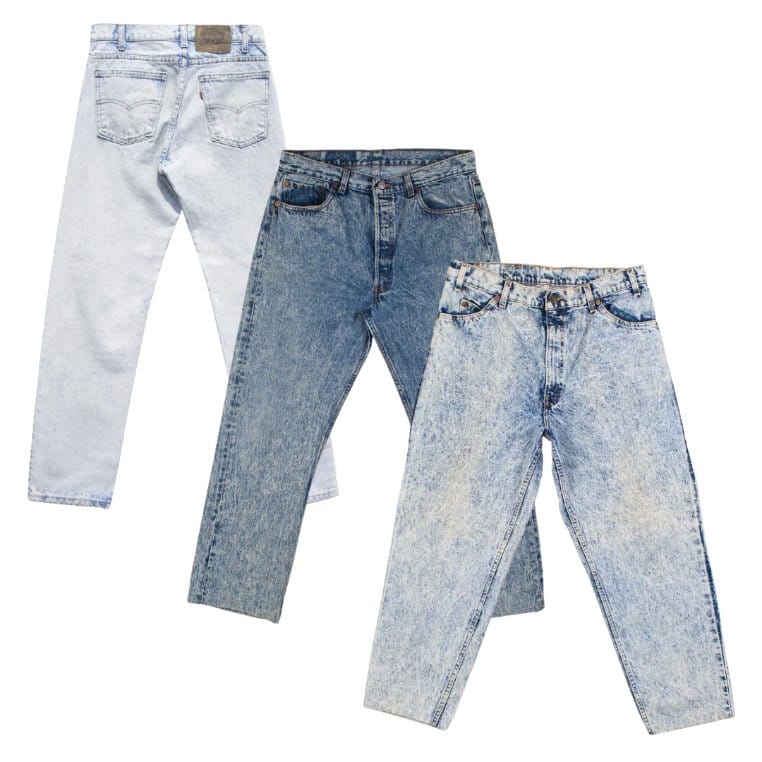
When Acid Wash Is the Hero
If the wash treatment is the central design statement, everything else needs to be in service of it. Silhouette choices should give the wash pattern room to read clearly. Volume and width in the lower half allow the bleached pattern to be seen as a surface rather than being compressed into fitted lines. Hardware, closures, and detailing should be clean and restrained so they do not compete with the visual complexity of the fabric surface.
Colour combinations that work best with acid wash as a hero: white or near-white basics, deep navy or black separates that create strong contrast, and tonal denim combinations where different pieces carry different levels of the same wash.
When Acid Wash Is One Element
Using acid wash as one texture within a mixed-fabric collection allows you to play with contrast between the bleached, rough surface of treated denim and smoother or more refined fabrics. Common pairings in contemporary collections:
- Acid wash denim with silk chiffon or crepe de chine for a casual-luxe contrast
- Acid wash denim with raw or unfinished cotton for a mixed-texture approach
- Acid wash denim as outerwear over jersey or knit for the contemporary streetwear direction
- Acid wash denim panels within a patchwork garment alongside other treatments (raw, overdyed, distressed)
The Double Denim Consideration
The current strength of the double denim trend gives designers specific creative latitude. A matched acid wash jacket and trouser in exactly the same wash works as a set. A deliberate mismatch within the same wash family (the jacket is darker, the trousers lighter) creates a more considered, designed appearance than matching. Most designers working in this space in 2026 are choosing the deliberate mismatch approach.
“The most common mistake with acid wash in a student collection is treating the fabric as the concept rather than as the material for a concept. The wash is a tool, not an idea.”
The 2026 Trend Landscape for Designers
Understanding where acid wash sits in the current design landscape helps you position your work in relation to it, whether you are aiming to be current, to push against the trend, or to find the spaces within it that have not yet been fully explored.
Sources: Industry market analysis, runway data aggregation, 2025-2026.
What the Runway Is Doing
The 2026 spring/summer collections confirmed that acid wash and bleach-treated denim are being approached as technical objects rather than nostalgic references. As trade reporting noted, “designers approached denim in 2026 as a technical object – the conversation moved away from disposable trend cycles and toward refinement: how a leg breaks over a shoe, how a rise alters posture, how finishing techniques change the way fabric reads in motion.”
This is a useful framing for student work: if your use of acid wash is about the technique’s technical behaviour in relation to a garment’s construction and silhouette, it is a contemporary design decision. If it is primarily about the 1980s reference, you are working in pastiche territory.
Design Opportunities That Are Not Saturated
- Acid wash beyond indigo. Black denim bleached to rust and amber, coloured denim base fabrics bleached to unexpected results. The Instagram acid wash revival has been largely blue-and-white. Other colour stories are less explored.
- Controlled geometric wash patterns. Most DIY and consumer acid wash is random. Precision-applied bleach using resist techniques, stencils, or laser technology to create intentional geometric or graphic wash patterns has strong potential in a market saturated with random cloud patterns.
- Acid wash beyond denim. Bleached cotton canvas, corduroy, and twill carry different visual properties than denim. These have been explored in streetwear but not extensively at the designer level.
- Acid wash as part of a repair or transformation narrative. Overdying bleached denim, combining acid wash with visible mending or boro-influenced stitching, treating acid wash as a starting point for further transformation rather than a finished surface.
- Sustainable wash alternatives with a visible process story. Laser-finished and ozone-washed denim that is presented with full process transparency is a relatively underpopulated space, particularly at the student and emerging designer level where brand narrative is as important as the garment.
- Mixed wash patchwork. Combining panels of different wash intensities within a single garment, creating a gradient or tonal range across the piece as a deliberate construction feature.
The coloured denim market trends article explores how the broader denim market is evolving, which provides useful context for positioning design decisions within the commercial landscape.
Frequently Asked Questions
Industrial practice is to wash after construction, which produces the most authentic result where seams and edges bleach more heavily than flat panels, mimicking real wear patterns. Washing before construction gives you creative control over pattern placement but loses that authentic variation. Which approach is correct depends on the design intent. Both are valid and many designers use both within a single collection to create variation between pieces.
Use a denim needle: 90/14 for light to mid-weight and 100/16 for heavyweight. Replace needles frequently as denim dulls them quickly, and a blunt needle causes skipped stitches and surface damage. For construction seams, use all-purpose polyester thread. For topstitching, use heavy-duty polyester or upholstery thread, but keep all-purpose thread in the bobbin, as topstitching thread in the bobbin creates too much bulk. For stretch acid wash denim, switch to a stretch needle rather than a denim needle.
Leg twist comes from incorrect grain line placement. Always cut denim trouser pieces precisely on the lengthwise grain and use the selvage as your reference. Do not try to square up denim on the cross grain as the twill weave pulls it into a parallelogram that will not hold square after washing. Alternating the direction of front and back leg pieces when cutting (one right-side up, one inverted) also helps distribute the grain tension and reduce twist. Pre-washing fully before cutting is essential to eliminate residual shrinkage that could cause post-construction distortion.
Research confirms that bleaching agents used in acid washing do reduce the tensile strength of cotton fibres to a measurable degree. The practical effect depends on the base fabric weight and the intensity of the treatment. Heavier base fabric (12 oz and above) compensates well. For designers, this means reinforcing stress points is more important in acid wash garments than in untreated denim. Flat-felled seams, bartacks at belt loop bases and pocket corners, and rivets at high-stress points are all standard practice and should not be omitted.
Major mills have minimum orders that are impractical for small collections. Practical alternatives: deadstock fabric suppliers often carry pre-washed acid wash denim in smaller quantities at competitive prices. Wholesale fabric markets in major fashion cities carry denim by the metre. Some online specialist denim suppliers offer certified sustainable options at accessible minimums. Alternatively, sourcing untreated denim from a certified sustainable mill and applying the acid wash treatment yourself gives you full process control and is often the most cost-effective and transparent option for a student or emerging designer collection.
Stone wash uses physical abrasion (pumice stones tumbled with damp denim) to produce a uniform surface fade. The result is even, soft, and reads as a natural vintage look. Acid wash uses chemically soaked pumice stones in a dry tumble, stripping surface dye selectively to create the high-contrast mottled pattern. The design distinction: stone wash says worn-in and relaxed. Acid wash says deliberately treated and visually bold. Stone wash recedes; acid wash advances. Choosing between them is a design decision about how much the fabric treatment should lead the visual narrative of the garment.
Yes, and with interesting results. Overdying acid wash denim, applying a new colour over the existing bleached pattern, produces different colour depths in the light and dark areas because the bleached areas have less residual dye competing with the new colour. This creates a tonal, layered effect that is distinct from both plain overdyed denim and standard acid wash. The bleached areas absorb new dye more readily, so they typically end up closer to the applied colour while the darker areas mix the new dye with residual indigo. Testing on sample fabric before committing to a full piece is strongly recommended.
Provide a physical swatch reference, not a digital image. Acid wash effects are highly variable and colour calibration between screens and fabric is unreliable. When briefing a wash house, specify: the desired contrast level (light, medium, or heavy bleaching), whether you want even or directional distribution across the garment, any areas you want protected or treated more heavily, the base fabric weight and cotton content, and any sustainability requirements regarding the chemicals used. Request a blanket wash sample before bulk production and sign off on this before cutting begins.
Conclusion
Acid wash denim rewards the designer who understands it technically rather than the one who uses it because it is currently fashionable. The technique has been part of the design vocabulary for nearly forty years. It will continue to cycle through fashion because its fundamental visual properties, high contrast, surface complexity, authentic-looking age, are genuinely useful across a wide range of design contexts.
The designers who use it most effectively treat it as what it is: a fabric finishing technique with specific properties, specific construction implications, and a specific visual language. Understanding all three is what makes the difference between a garment where the acid wash is a design decision and one where it is just a fabric choice.
Here are the key technical and design takeaways from this guide:
- Acid wash is a design tool, not just a trend. Its visual language has been used deliberately by designers from Marithé + François Girbaud in the 1980s to Alaïa in 2026. Understanding this history gives you a framework for using it with intention.
- The fabric’s bleached fibres are weaker. Reinforce stress points: bartacks, rivets, flat-felled seams. Heavier base fabric compensates for this.
- Grain line precision matters more with acid wash. The wash pattern makes grain errors visible. Cut single-layer on the lengthwise grain for every piece.
- Wash sequence is a design decision. Washing after construction produces authentic wear-pattern variation. Washing before gives you creative control over pattern placement. Both are valid approaches depending on the design intent.
- Use the right needle, thread, and seam finish. Denim needle (90/14 or 100/16), all-purpose polyester for construction, heavy-duty polyester for topstitching, flat-felled seams at stress points.
- Sourcing sustainably is increasingly a professional requirement. Ask mills about their wash process, look for verifiable certifications, and consider deadstock or self-applied treatments for small-scale collections.
- The most interesting design opportunities in 2026 are not in replicating the classic blue-and-white acid wash look. Geometric wash patterns, non-indigo base fabrics, mixed wash patchwork, and sustainable wash alternatives with visible process narratives are all relatively underexplored spaces.
For the full overview of acid wash denim covering history, styling, care, and the cultural story, our complete acid wash denim guide is the natural companion to this technical article.
References and Further Reading
- Wikipedia: Stone Washing – documented history of stone wash and acid wash patents including Rifle Jeans Company and AGF
- FIT Museum: Denim: Fashion’s Frontier Exhibition – academic and curatorial overview of denim history including Marithé + François Girbaud
- National Library of Scotland: Denim Crazes 1979-1989 – cultural and fashion history of acid wash in the 1980s
- NIH / PMC: Critical Review on Sustainability in Denim – peer-reviewed research on bleaching agents and fibre strength
- Seamwork: Ultimate Guide to Sewing with Denim – practical construction guidance including needles, thread, seam finishing
- Wholesale Jeans (trade): Denim Silhouettes and Constructions for 2026 – industry trend analysis