
Think about the jeans you wear most. Chances are they already look slightly different from when you first bought them. A little softer at the knees. A little lighter where the pocket sits. That casual, lived-in look you love? Raw denim takes that idea and runs with it, completely on purpose.
Raw denim is one of the few fabrics in the world where the whole point is that it changes over time. And not just randomly. It changes based on you. How you walk. Where you sit. What you carry. The fold of your knee. The curve of your thigh. Over months of wear, your raw denim jeans become something no one else in the world has. Not even someone wearing the exact same pair from the exact same brand.
That is what makes raw denim so compelling. But there is a lot more to it than just buying a stiff pair of dark jeans and waiting.
In this guide, we cover everything: what raw denim is at the fabric level, how it is made, how it fades, how it compares to every other type of denim, where it comes from, how to care for it, and why it is one of the most sustainable clothing choices you can make.
If you already own a pair and want to understand them better, this guide is for you. If you are thinking about buying your first pair, it is also for you. And if you just love fabric and want to go deep on one of the most interesting textiles out there, welcome.
For a wider look at the complete guide to denim fabric, we cover the full picture there. This article is specifically about raw denim and everything that makes it different.
What Is Raw Denim Fabric?
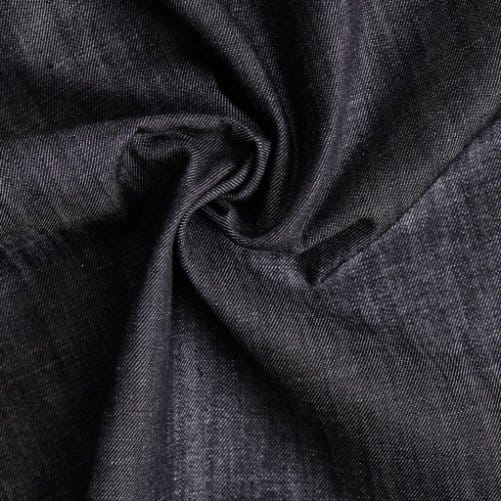
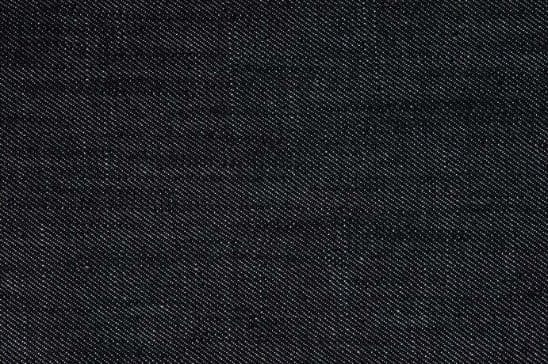
Raw denim is denim fabric that has not been washed, treated, or chemically processed after it was woven and dyed. It goes straight from the loom to the cutting table to the finished garment, without any water touching it along the way.
You will also hear it called dry denim or hard denim. All three names mean the same thing: this fabric has not seen the inside of an industrial washing machine. What you get is the fabric in its original state, full starch, deep dark indigo, and a stiffness that can feel close to cardboard when you first hold it.
Most jeans you find in a typical clothing shop have been washed multiple times before they reach you. Some have been stone-washed, enzyme-washed, bleached, or laser-distressed.
These processes soften the fabric and create the worn-in look right away. Raw denim skips all of that. The worn-in look is something you create yourself, over time, through actual wear.
What Raw Denim Is Not
Here is the biggest confusion people run into. Many people use raw and selvedge as if they mean the same thing. They do not.
Raw refers to how the fabric is processed after weaving. Specifically, that it has not been washed.
Selvedge refers to how the fabric is woven, using an old-style shuttle loom that creates a clean, self-finished edge along both sides of the fabric.
You can absolutely have raw denim that is not selvedge. You can also have selvedge denim that has been pre-washed. The two terms describe different things entirely. We go into this comparison in detail later in this guide.
Nearly all denim sold anywhere in the world was raw until the 1970s. Pre-washed and distressed denim only became the norm as fast fashion scaled up and demand for ready-to-wear comfort grew. Raw denim is actually the original.
For a broader look at 100% cotton denim fabric in general, including its construction and properties, that article is a great companion to this one.
The Science of Indigo: Why Raw Denim Fades the Way It Does
To understand why raw denim fades in such a striking, personalised way, you need to know a little about indigo dye. Because indigo is unusual. It behaves differently from almost any other dye used in textile production.
Indigo Only Coats the Surface
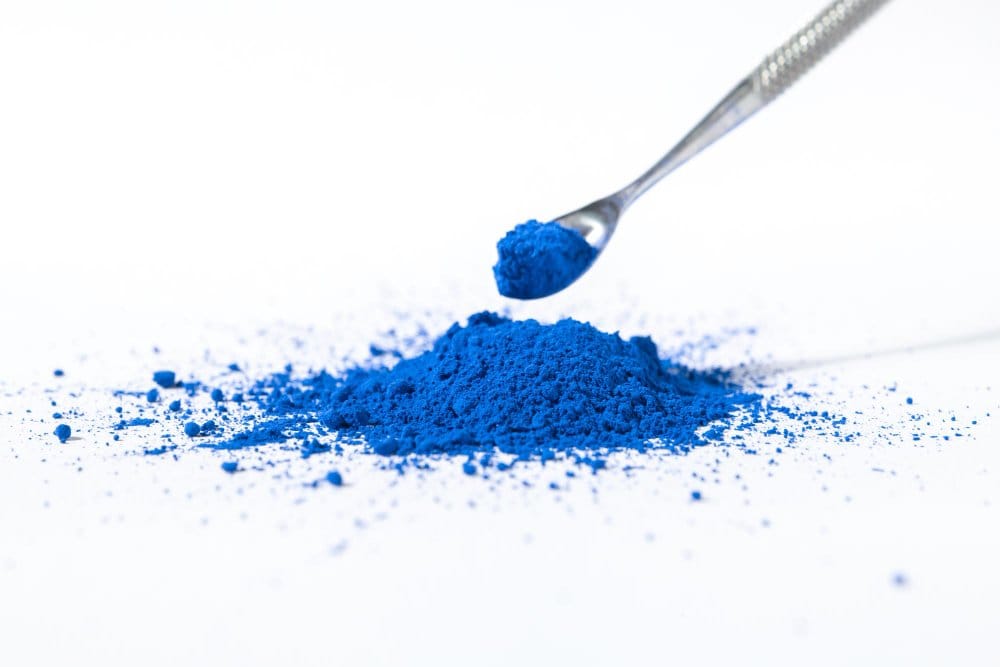
Most dyes work by penetrating the fiber. Indigo does not. It bonds only to the outer surface of the cotton yarn, leaving the white core untouched. This surface-bonding behaviour is what gives denim its unique ageing quality (source: ScienceDirect).
Every time the fabric moves or rubs against a surface, tiny particles of that surface indigo wear away, revealing the white cotton underneath. Areas with the most friction (knees, thighs, back pockets) fade first and fastest. Calmer areas hold their dark blue much longer.
The result is a dramatic contrast between the lightest and darkest parts of the jeans. Denim enthusiasts call this a high-contrast fade, and it is one of the most visually striking things raw denim does over time.
Natural vs Synthetic Indigo
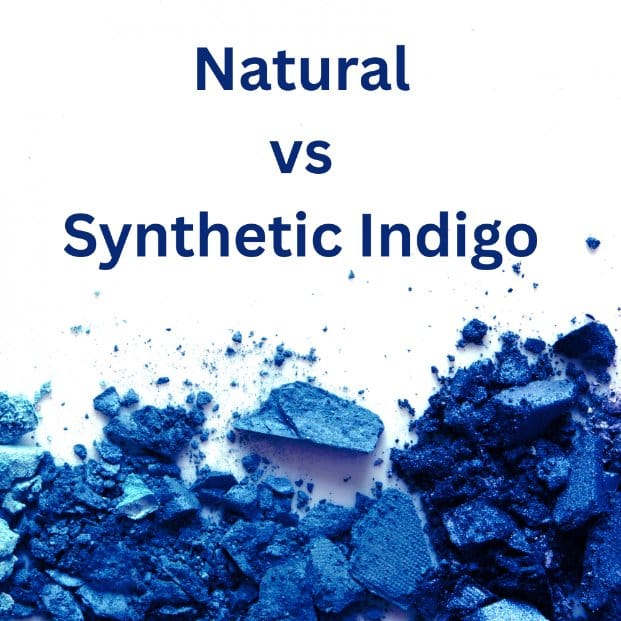
Indigo was originally extracted from plants, particularly Indigofera tinctoria, a shrub grown across South Asia, Africa, and parts of the Americas. This natural indigo was the backbone of denim dyeing for centuries.
By the late 1800s, chemists developed a way to synthesise indigo in a lab. Synthetic indigo became the industry standard almost overnight because it was cheaper, more consistent, and easier to produce at scale. Today, the vast majority of denim is dyed with synthetic indigo.
Some premium mills and specialist brands have returned to natural indigo dyeing. It gives a slightly different, often slightly greener hue, and fades in a subtly different way.
It is also considered a more sustainable option since it avoids petrochemical production. However, it is significantly more expensive than synthetic indigo.
Rope Dyeing vs Slasher Dyeing
There are two main methods for applying indigo to denim yarn, and they produce noticeably different results.
Rope dyeing bundles the warp yarn into thick ropes and passes them through a series of indigo baths, with air exposure between each dip to allow oxidation.
This creates an uneven distribution of dye, which produces the characteristic slubby, irregular character of premium denim. Rope-dyed denim fades with more texture and depth.
Slasher dyeing passes individual yarn sheets through dye baths in a flat, uniform way. It is faster and less expensive but produces a more consistent dye saturation. Fades tend to be smoother and less dramatic.
Most high-quality raw denim uses rope dyeing. When a brand describes their denim as rope-dyed, it is a signal of traditional production methods and better fade character.
The Anatomy of Raw Denim Fabric
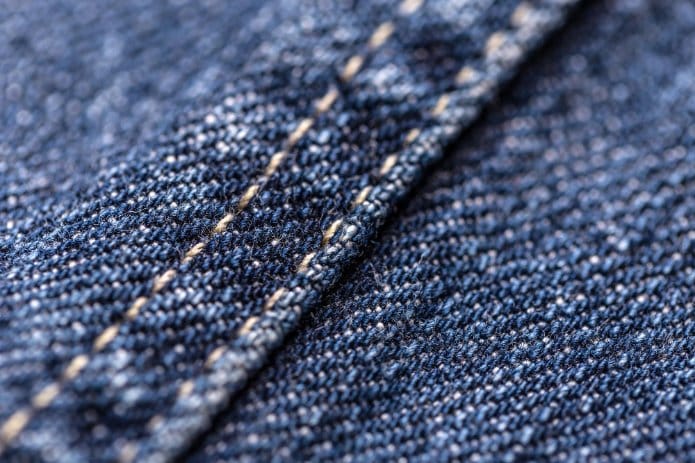
Raw denim is not just one thing. The fabric varies significantly depending on how it is woven, what yarn is used, how heavy it is, and what cotton went into it.
Understanding these variables helps you pick the right pair and understand why some denim costs far more than others.
The Twill Weave
All denim is a cotton twill fabric. That diagonal ribbing you see on the inside of your jeans is the twill weave. In denim, the most common structure is a 3×1 twill: the warp thread (running vertically) passes over three weft threads (running horizontally) before going under one.
This structure makes the fabric strong, durable, and built for serious wear.
In raw denim, the warp threads are dyed with indigo while the weft threads are left natural (white or cream). That is why the face of your jeans is deep blue, but the inside shows creamy white.
It is also why raw denim fades the way it does. Only the warp threads carry the dye, so those are the threads that wear away over time.
Ring-Spun vs Open-End Spun Yarn
The way the cotton is spun into yarn has a significant effect on how the finished denim looks and fades.
Ring-spun yarn uses an older spinning method that twists cotton fibers tightly together. The result is yarn with slightly irregular thickness, natural slubs, and a textured surface.
This irregularity is a good thing. It means fades are more dramatic and varied. Most premium raw denim uses ring-spun yarn, and brands are usually proud to say so.
Open-end spun yarn (also called rotor-spun) is a faster, more industrial method that produces a more uniform yarn. The denim is smoother and more consistent but fades in a flatter, less interesting way.
Ring-spun is what you want for the kind of rich, complex fades that raw denim enthusiasts are after. You will see this term used in product descriptions by quality brands as a positive signal.
Fabric Weight: The Complete Guide
Denim weight is measured in ounces per square yard (oz) or grams per square metre (GSM). It is one of the most important choices when buying raw denim, affecting comfort, durability, and fade intensity.
See our lightweight vs heavyweight fabric guide for a broader comparison across all fabric types.
Use the Fabric Weight Calculator to find the perfect GSM or oz rating for your project or lifestyle.
Use the Fabric Weight Calculator →Cotton Quality: Long-Staple vs Short-Staple
Not all cotton is the same. The length of the individual cotton fibers, called the staple length, directly affects how smooth, strong, and long-lasting the finished yarn is.
Long-staple cotton produces stronger, smoother yarn with fewer loose ends. It wears better, pills less, and produces a cleaner fade.
Premium raw denim brands often specify their cotton source. You will see references to Zimbabwe cotton, US Supima, Egyptian cotton, and Japanese-grown varieties. All are known for their long staple lengths and quality.
Short-staple cotton is more common and less expensive. It is perfectly fine for everyday denim but does not offer the same character or longevity as long-staple options.
To learn more about different cotton types and their properties, see our guide to cotton fabric.
Sanforized vs Unsanforized Raw Denim
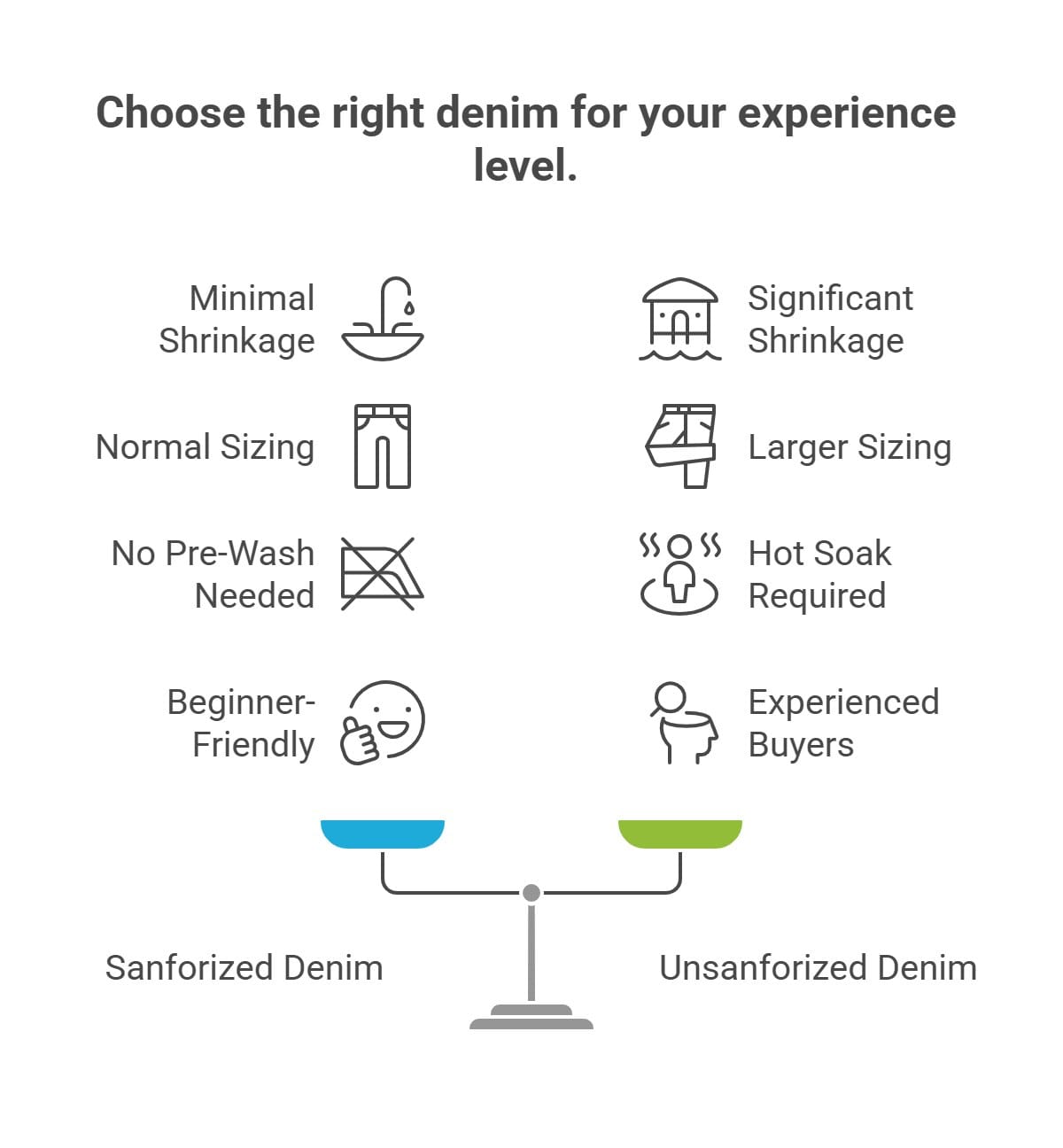
When you shop for raw denim, you will almost certainly come across these two terms. They affect how you size your jeans and what you do before you wear them for the first time. Getting this wrong is one of the most common mistakes raw denim beginners make.
- Mechanically pre-shrunk at the mill
- Shrinks only 1–3% after washing
- Size as you normally would (or size down slightly)
- No need for a hot soak before first wear
- Most raw denim on the market is sanforized
- More predictable and beginner-friendly
- Also called loom-state denim
- Can shrink up to 10% after the first hot wash
- Buy one to two sizes larger than your usual size
- Requires a hot soak before or right after first wear
- Often considered more traditional and “authentic”
- For more experienced raw denim buyers
Sanforisation was invented in the 1930s by an engineer named Sanford Lockwood Cluett. The fabric is dampened, stretched, and then compressed against a heated rubber belt.
This causes most of the shrinkage to happen before the jeans ever reach you. The process is now a standard part of denim finishing worldwide (Encyclopaedia Britannica), and it made raw denim far more practical for everyday buyers.
Unsanforized denim is the true original. Brands like Japan’s Iron Heart and Oni Denim still produce loom-state fabrics that purists prefer. The idea is that the hot soak itself becomes part of the ritual, and the shrinkage helps the jeans conform even more tightly to your body from the start.
For sanforized denim: size down one size at the waist. The fabric will stretch out by around half an inch to an inch during wear. For unsanforized denim: go one to two sizes up and do a hot soak before wearing. The jeans will shrink down to your size. When in doubt, read the brand’s specific sizing advice.
Raw Denim vs Everything Else
One of the most common questions people have is how raw denim stacks up against other types of denim and other fabrics. Here is the breakdown you need, with a comparison table followed by a deeper look at each one.
| Feature | Raw Denim | Washed Denim | Selvedge Denim | Stretch Denim | Chambray |
|---|---|---|---|---|---|
| Cotton Content | 100% cotton | Usually 100% cotton | Usually 100% cotton | Cotton + elastane blend | 100% cotton |
| Out-of-Box Feel | Stiff, structured | Soft, ready to wear | Stiff (if raw) | Soft, stretchy | Very soft, lightweight |
| Fade Potential | Exceptional | Limited | Excellent | Poor | N/A |
| Durability | Very High | Moderate | Very High | Moderate | Low–Moderate |
| Personalisation | High | Low | High | Low | Low |
| Sustainability | Good | Mixed | Good | Poor (microplastics) | Good |
| Comfort from Day 1 | Low | High | Low (if raw) | Very High | Very High |
| Price Range | £80–£350+ | £25–£150 | £120–£450+ | £30–£120 | £20–£60 |
| Biodegradable | Yes (100% cotton) | Yes (if 100% cotton) | Yes (100% cotton) | No (elastane blend) | Yes |
Raw Denim vs Washed Denim
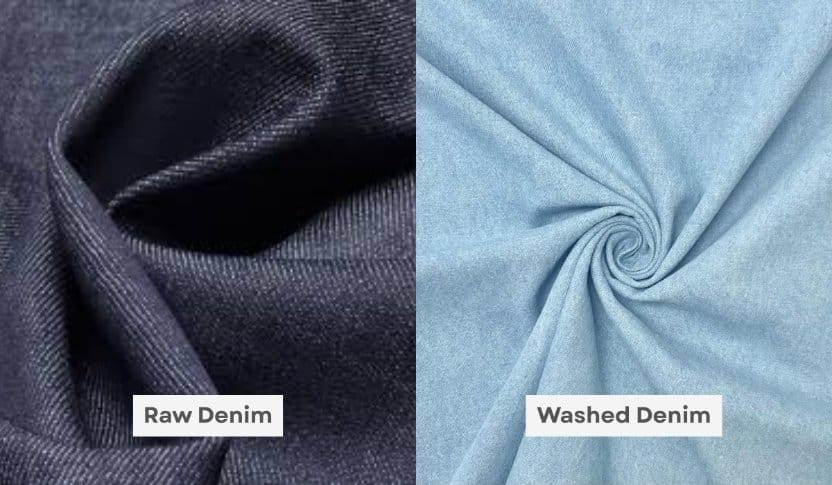
Washed denim is the most common type of denim in the world. After the garment is sewn, it goes through one or more washing cycles to remove stiffness and create a pre-aged look.
Stone washing adds pumice stones to speed up mechanical wear. Enzyme washing uses biological agents to break down the surface indigo. Bleaching lightens the colour further.
The key difference in everyday use is that washed denim is comfortable from day one, but its fade journey is basically already finished when you buy it. With raw denim, that journey has not started yet, and you are the one who shapes it.
Raw Denim vs Selvedge Denim
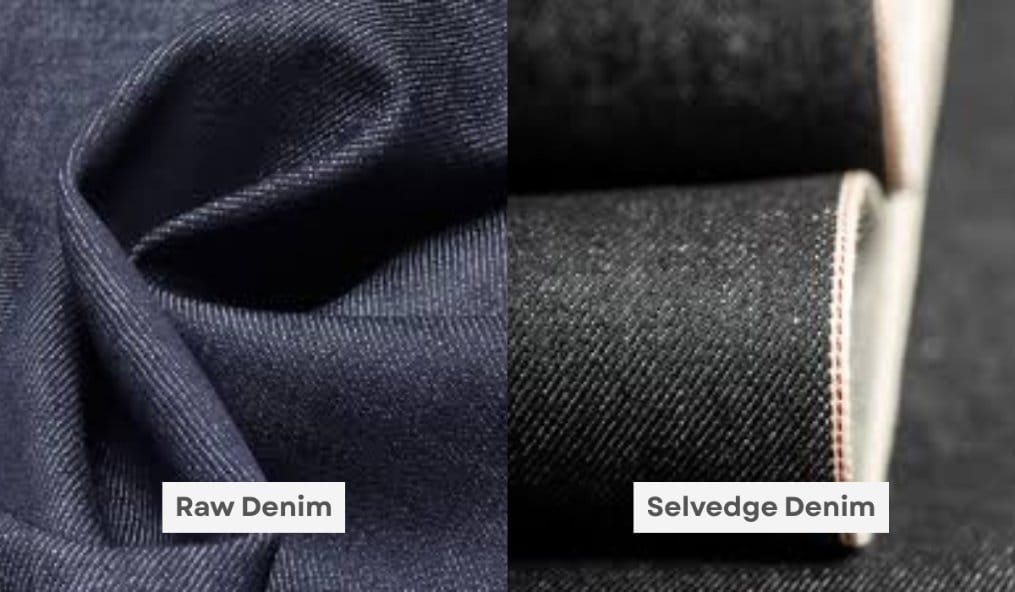
Selvedge denim is woven on shuttle looms, the older, slower looms that were standard before the 1950s. The shuttle passes the weft thread back and forth in a continuous loop, creating a clean, tightly bound edge on both sides of the fabric.
This edge does not fray and is often left visible on the turned-up cuff of a pair of jeans.
Selvedge fabric is narrower than modern denim, usually around 30 inches wide vs 60 inches for modern looms. This means more fabric is used per pair, which is one reason selvedge jeans cost more.
Most selvedge denim is sold raw, and most premium raw denim is selvedge. But they are not the same thing. Think of raw selvedge denim as the premium tier where both qualities combine.
Raw Denim vs Stretch Denim
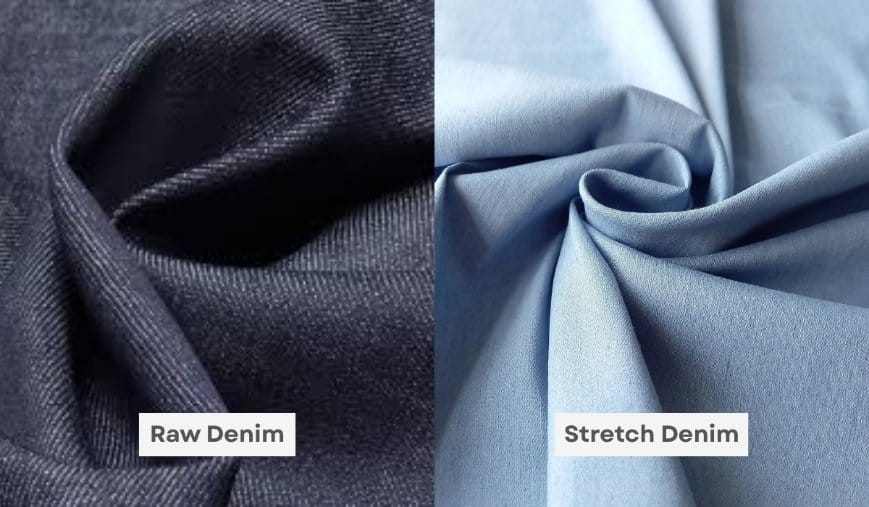
Stretch denim blends cotton with elastic fibres, usually elastane (also sold as Spandex or Lycra). It moves with your body and is genuinely more comfortable to wear all day, especially in fitted cuts.
But stretch denim has real drawbacks. The elastane means the fabric cannot be recycled like pure cotton. It is not biodegradable. And every wash releases microscopic synthetic fibres into the water supply, which end up in rivers and oceans.
Raw denim is 100% cotton. It is biodegradable, recyclable, and does not shed microplastics. That difference matters if you care about your environmental footprint.
Raw Denim vs Distressed and Pre-Worn Denim
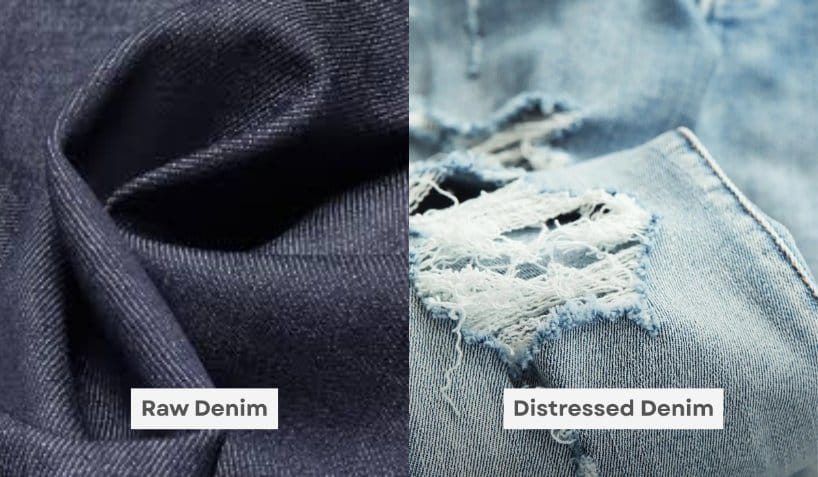
Distressed denim is designed to look old before it gets old. Brands use sandblasting, grinding wheels, laser technology, chemical sprays, and hand scraping to simulate years of wear, all before the jeans leave the factory.
There is nothing wrong with liking that look. But raw denim fans will tell you the genuine article cannot be faked. True fades have a depth and variation that no machine can copy, because no machine knows exactly how you move.
Distressing also comes at an environmental cost. Sandblasting has been banned in several countries due to health risks to workers, and the chemical treatments involved add significantly to a garment’s footprint.
Raw Denim vs Organic Cotton Denim
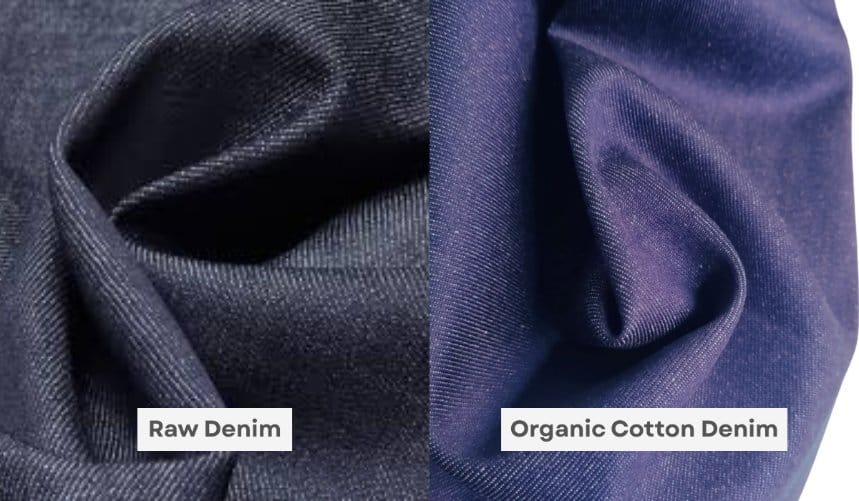
Organic cotton denim is not the same as raw denim, but they can overlap. Organic refers to how the cotton was grown, without synthetic pesticides or fertilisers. Raw refers to how the fabric is processed after weaving.
You can absolutely have raw denim made from organic cotton. That combination is the most sustainable option. Look for the GOTS certification if this matters to you. Our guide to sustainable style with organic cotton covers this in more detail.
Raw Denim vs Chambray
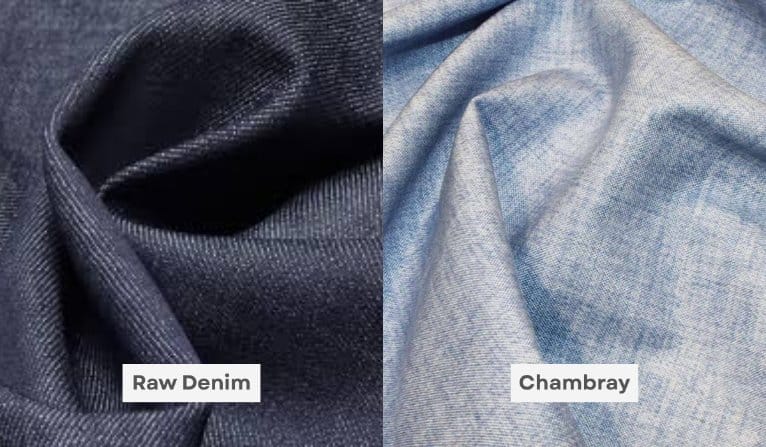
Chambray is often compared to denim because both use cotton and share a similar blue colour. But they are quite different. Chambray uses a plain weave rather than a twill, making it much lighter, softer, and more breathable.
It does not fade the same way as denim. Chambray is great for shirts and summer dresses. Raw denim is built for jeans, jackets, and heavyweight use. They belong in completely different contexts.
Where Raw Denim Comes From: A Global Story
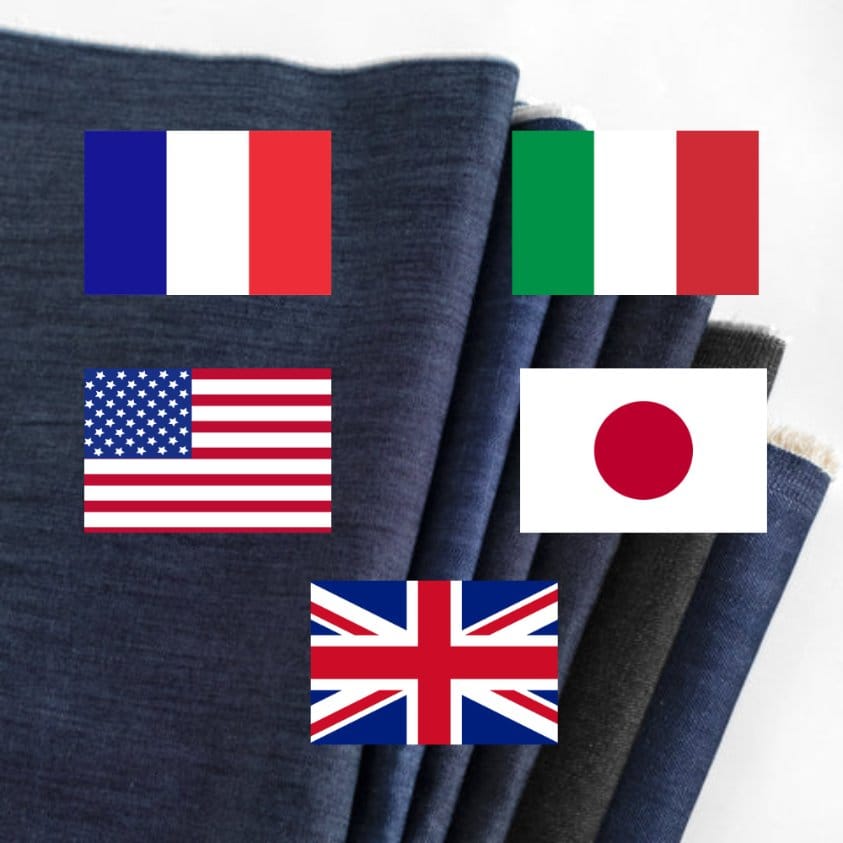
Raw denim has roots in multiple countries, and its story is genuinely international. Trying to pin it down to one place would get the history wrong.
The word “denim” comes from serge de Nîmes, a sturdy cloth woven in the city of Nîmes in southern France. The term shortened over time to just “denim.” Nîmes was a major textile hub in the 1600s and 1700s.
The word “jeans” likely comes from Bleu de Gênes, meaning “blue of Genoa,” a similar heavy cotton fabric worn by Genoese sailors. Italy is also home to Candiani Denim, one of the world’s leading sustainable denim mills, operating since 1938.
In 1873, Levi Strauss and Jacob Davis patented rivet-reinforced work pants for miners and labourers. Cone Mills in North Carolina was one of the last major US selvedge mills. American denim shaped workwear culture globally through the 20th century.
Japan is now the most respected raw denim producer in the world. From the 1970s onwards, mills like Kaihara, Kurabo, and Kuroki began recreating vintage American selvedge denim with remarkable precision. Japanese raw denim sets the global standard for quality.
The UK has a growing heritage denim scene with brands like Hiut Denim (Wales) and Tender Co (England). European brands like Benzak Denim Developers and Tenue de Nîmes (both Netherlands) produce quality work sourced from Japanese and Italian mills. Denim is a genuinely global craft.
The coloured line along the edge of selvedge denim (often red, but also gold, green, or even glow-in-the-dark) was originally used by mills to identify their fabrics. Today it is a design detail, visible when the cuff is turned up.
Denim has also had an impact on children’s fashion for generations. This article on facts about denim in kids’ clothing covers some interesting history and practical information for parents.
The Fading Culture: Your Jeans, Your Story
If you spend any time in the raw denim world, you will quickly discover that the community around it is deeply passionate. People post photos of their fades, track progress over years, and discuss specific fabrics with the detail usually reserved for wine or vintage watches.
It sounds obsessive from the outside. But once you understand what is actually happening to the fabric, it starts to make a lot of sense.
The Key Fade Patterns to Know
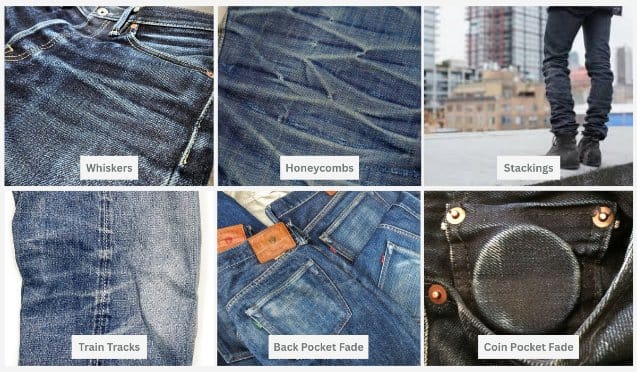
Denim enthusiasts have names for all the different types of fade patterns that develop over time. Here are the main ones:
- Whiskers: Radiating fade lines at the thigh and hip crease. They form from the way you sit, and every person’s whiskers look slightly different.
- Honeycombs: The grid-like fade pattern behind the knees. It develops from repeated bending and is one of the most prized fade details in the denim world.
- Stackings: Horizontal fade lines at the bottom hem where the fabric bunches at the ankle, most visible on longer inseams worn uncuffed.
- Train tracks: Sharp crease lines along the outer seams of the leg, formed by the seam pressing into the thigh during regular wear.
- Coin pocket fade: A circular fade mark on the coin pocket from a key fob, watch, or similar item carried regularly there.
- Back pocket fade: The outline of a wallet or phone fading into the denim. Even this tells something about how you carry yourself.
The Fade Timeline: What to Expect
Your jeans feel like cardboard. The indigo is at its most concentrated. The colour is deep, uniform navy-blue. You may notice a little dye transfer onto lighter surfaces. This is normal.
The fabric begins to loosen up noticeably, especially at the knees and waist. You can see the very first hints of crease lines forming where you move. Still very dark overall.
With daily wear, the first whisker lines appear on the thighs and honeycomb patterns start behind the knees. The fabric is noticeably more comfortable. Your own patterns are clearly taking shape.
Most people do their first full wash around now. The fades are set enough to hold through it. After washing, the contrast between light and dark areas becomes even sharper.
By one year the jeans look unmistakably yours. The fade map of the past year is written into the fabric. No two pairs worn this long will ever look the same.
Premium raw denim can last 5, 8, even 10+ years with care. At this stage the jeans have a depth and character that no factory treatment can come close to recreating.
Raw Denim and the Environment
Denim has a serious environmental problem. Making conventional jeans involves enormous amounts of water, chemical dyes, synthetic fertilisers, and energy-intensive processing.
The result is a garment with one of the largest footprints of anything in your wardrobe. Raw denim is not a perfect solution, but it is genuinely one of the better options within the denim category. Here is why.
Where Raw Denim Does Better
The pre-washing and distressing used in conventional denim production add significant water and chemical use to every garment. Stone washing, enzyme washing, bleaching. Raw denim skips all of it.
The fabric is processed once, dyed, and woven. That is it.
Because raw denim is designed to last years rather than seasons, one quality pair worn for 7 years has far less environmental impact than three or four cheap washed pairs bought over the same period.
When made from 100% cotton with no synthetic blends, raw denim is fully biodegradable. Remove the metal rivets, and the fabric breaks down in around 10 to 12 months in the right conditions. Stretch denim blended with elastane does not share that quality.
The Fast Fashion Connection
Raw denim sits at the opposite end of the spectrum from fast fashion. Fast fashion denim is cheap, pre-distressed, and designed to look the same on everyone. It is often made with synthetic blends that cannot be recycled.
Raw denim encourages the opposite mindset: buy once, buy well, wear for years. It fits naturally with the slow fashion movement that has grown significantly in recent years.
Use the Denim Environmental Impact Tracker to see how your choices compare.
Try the Tracker →A Note on Certifications
If sustainability is a priority for you, look for these on the label or brand website:
- GOTS (Global Organic Textile Standard): Covers organic cotton farming and responsible processing.
- OEKO-TEX Standard 100: Confirms the finished fabric has been tested for harmful substances.
- Bluesign: Focuses on responsible chemical management and resource efficiency in fabric production.
How to Buy Raw Denim: What to Look For
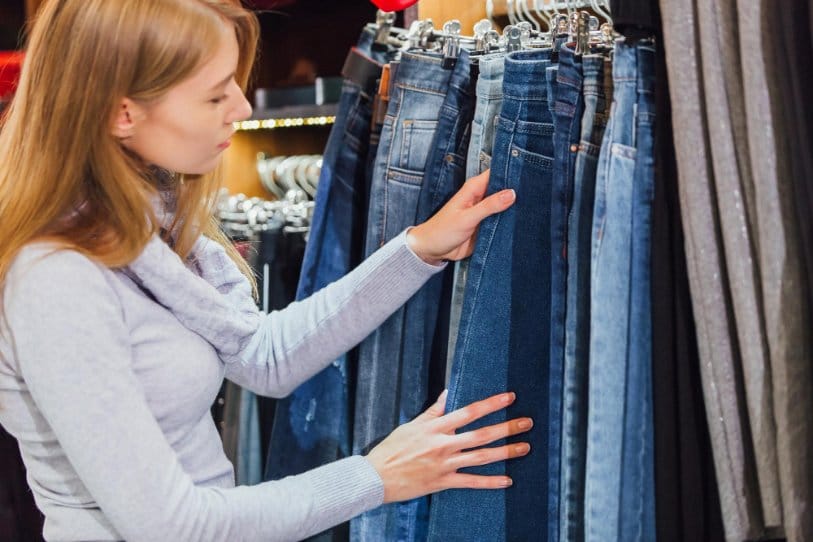
Buying your first pair of raw denim can feel overwhelming. There are a lot of variables, and the terminology can be confusing. Here is a straightforward checklist to guide you through it.
Key Things to Check Before You Buy
- Sanforized or unsanforized? This decides how you size. Sanforized: go true to size or size down slightly. Unsanforized: size up by one to two. Always read the brand’s specific guidance.
- Weight. Under 12oz for warmth and easy break-in. 12-14oz for a versatile everyday option. 14oz and above for serious fades and durability. Match it to your climate.
- Ring-spun or open-end yarn? Ring-spun gives more character and richer fades. Quality brands will tell you in the product description.
- Cotton origin. Japanese, Zimbabwean, Egyptian, and US Supima cotton all signal quality long-staple fibers. Brands proud of their cotton will say so.
- Selvedge or non-selvedge? Selvedge adds cost and character. Worth it if you cuff your jeans and want to show the selvedge ID. Non-selvedge can still be excellent.
- Where is it made? Japan sets the global standard. Italian and European mills are also strong. Country of production matters for both quality and labour standards.
- Price and fit. Entry-level raw denim starts around £80. Premium selvedge can reach £350 and above. Do not over-invest on your first pair. Find the process first, then go deeper.
Use our interactive jeans style finder to match your body type and lifestyle to the right cut.
Find Your Perfect Jeans Style →Also see our guide to perfect jeans for women for fit-focused advice, and our guide to the most durable fabrics for everyday wear for a broader perspective on longevity in clothing.
How to Break In Raw Denim
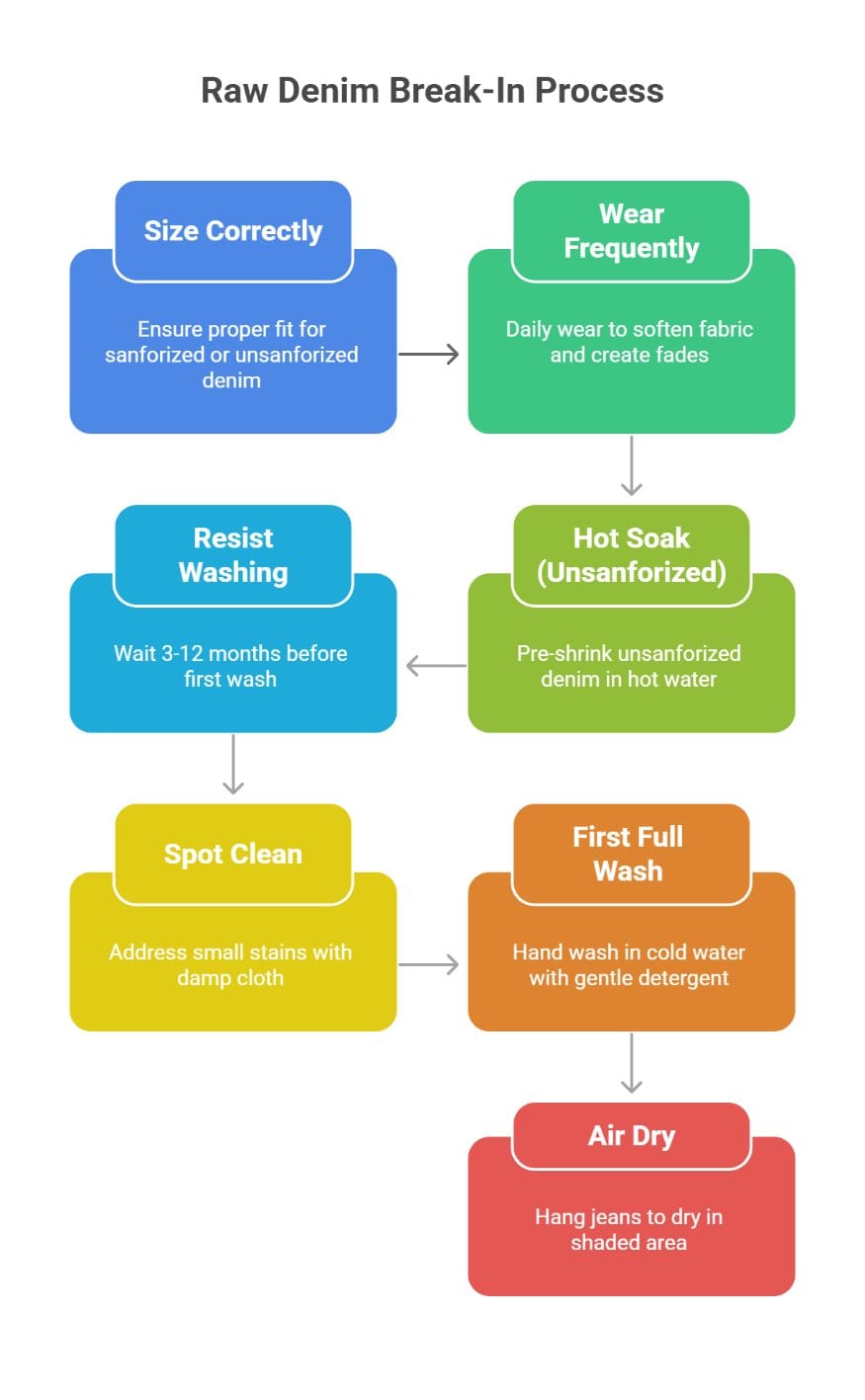
Breaking in raw denim is not complicated, but it does take patience. The whole point is to let the fabric respond to your body and movements over time. There are no shortcuts that produce the same results as genuine wear.
Step-by-Step Break-In Guide
- Size correctly from the start.
For sanforized denim, size down slightly at the waist. The fabric will stretch out during wear. For unsanforized denim, size up by one to two sizes and plan for a hot soak. Getting the size right at the start is the most important step.
- Wear them as much as possible in the first few months.
Daily wear is ideal. The more friction and movement the fabric experiences, the faster it softens and the more defined your fades become. The fabric creases where you bend and move most, and those creases become the foundation of your fade map.
- Do a hot soak if unsanforized.
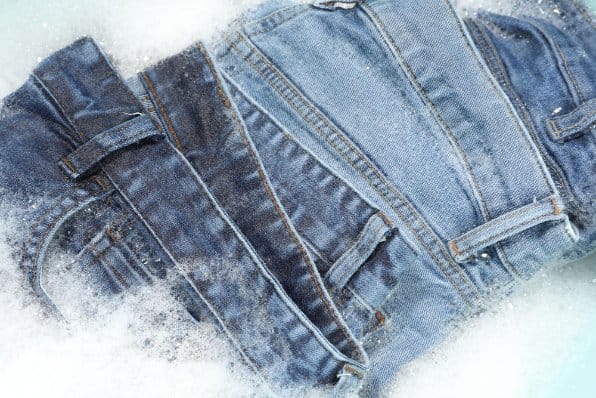
Fill a bathtub with hot water and either wear the jeans in the bath (the old-school method, which helps them take your exact shape) or soak them flat and then wear them while still damp. Let them air dry on your body or hung up. This pre-shrinks the fabric to your size.
- Resist washing for as long as possible.
For most people, waiting 3 to 6 months before the first full wash gives the best fade results. The indigo needs time to set in your specific crease patterns before water disrupts it. Many enthusiasts go 6 to 12 months. Find what works for you.
- Spot clean in the meantime.
For small stains or marks during the break-in period, use a damp cloth or a soft toothbrush with a tiny drop of mild soap. Rub gently and air dry. This handles everyday mess without interfering with your fades.
- Do your first full wash correctly.
Turn the jeans inside out. Hand wash in cold water with a small amount of gentle detergent designed for denim or dark clothes. Soak for 30 to 45 minutes, then rinse thoroughly. Do not wring them out. Roll them in a towel to remove excess water instead.
- Air dry only. Always.
Hang by the waistband in a shaded area with good airflow. Never use a tumble dryer. Heat damages the cotton, warps the shape, and causes uneven fading. Put them back on while slightly damp to help them reshape to your body.
The jeans will feel stiff and slightly uncomfortable for the first few weeks. That is temporary. What you get on the other side is a pair that fits you better than anything bought off the shelf.
Raw Denim Care Guide
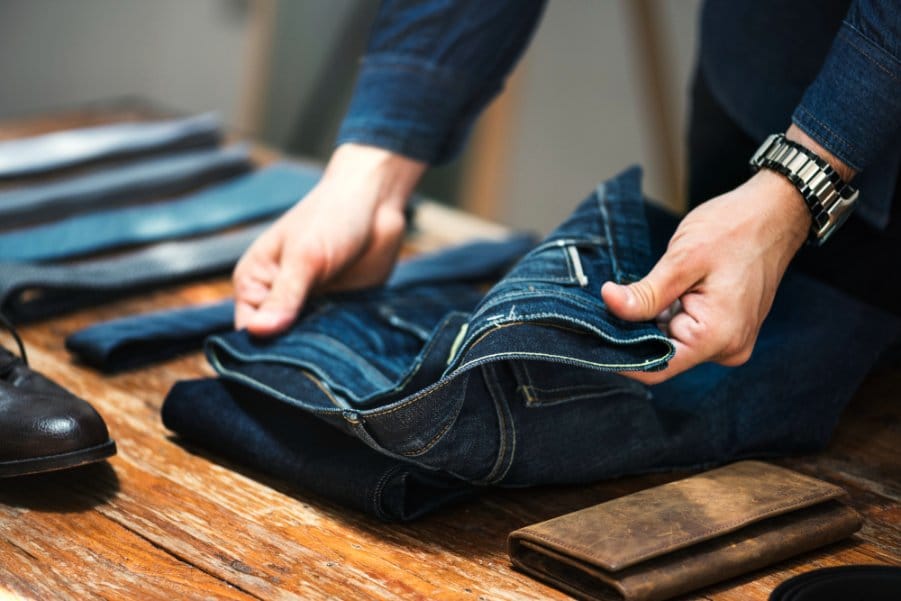
Once you are past the initial break-in period, caring for raw denim is actually straightforward. The main rule: wash less, wash gently, and always air dry.
For a full reference on caring for denim in general, see our denim care guide.
How Often to Wash
There is a famous debate in the raw denim world about how often to wash. One side says never wash. The other side says wash when needed. The practical answer is somewhere in between.
After the break-in period, most people wash their raw denim every 3 to 6 months, or when the jeans start to smell or become visibly dirty. There is no single right answer. What matters is that you wash as infrequently as is comfortable for you, using cold water and gentle methods when you do.
Use the Denim Wash Frequency Calculator to get a personalised recommendation.
Calculate Your Wash Schedule →Step-by-Step Washing Instructions
- Turn the jeans inside out to protect the outer surface.
- Use cold water. Always cold. Warm or hot water accelerates fading and risks shrinkage.
- Add a small amount of mild detergent. Products designed for dark or denim fabrics are best. Avoid standard biological detergents.
- Soak for 30 to 45 minutes without agitating. Let the water do the work.
- Rinse twice in cold water to remove all detergent. Leftover detergent dulls the indigo.
- Do not wring. Press gently or roll in a dry towel to remove excess water.
- Hang by the waistband in shade. Keep away from direct sunlight and heat.
- Do not use a dryer. Ever.
Freshness Between Washes
To keep your jeans fresh between washes, hang them outside in open air for a few hours. Some people put jeans in the freezer to kill bacteria. The science on freezing is mixed, but airing them out genuinely works.
Storage
Fold raw denim rather than hanging it, to avoid stretching the waistband and belt loops. Store somewhere cool and dry, away from direct sunlight. If putting a pair away for a long stretch, make sure they are clean and fully dry first.
Raw Denim in 2026 and Beyond
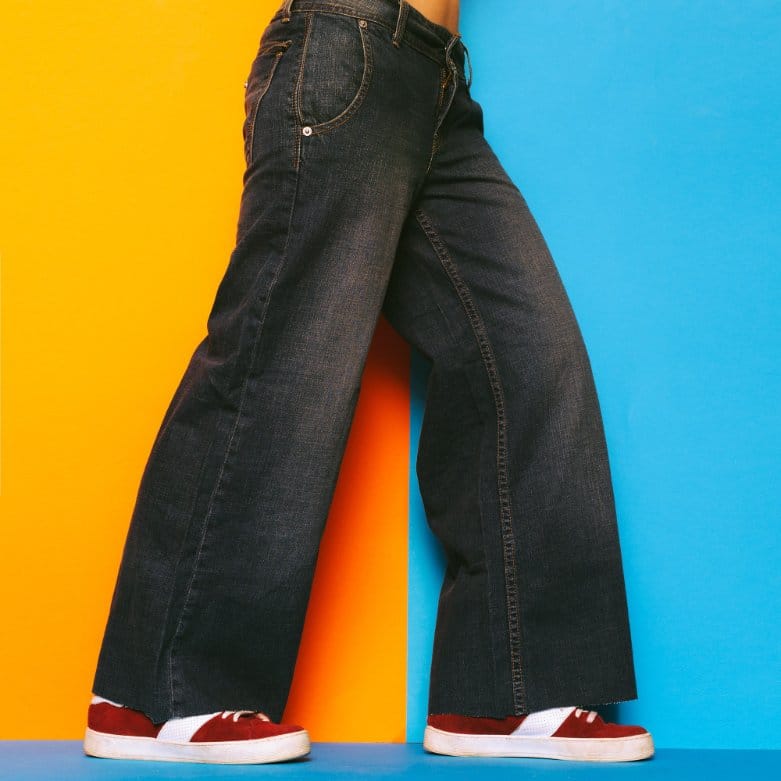
Raw denim is having a genuine moment. After years as a niche interest, it has moved firmly into the broader fashion conversation.
The slow fashion movement is a big part of this. People are thinking differently about clothing: buy less, buy better, make it last. Raw denim fits that mindset exactly. It is also a reaction against the sameness of fast fashion, a desire for clothing that is genuinely personal.
Style-wise, raw denim is turning up in wide-leg and relaxed silhouettes as well as the classic straight cut. Gender-neutral options are growing too, opening the fabric to a much wider global audience.
Raw denim jackets, shirts, and overshirts are also making a strong comeback. The fabric is moving well beyond jeans.
Our 2026 fabric trends guide puts this in the broader context of where textiles are heading.
Dark indigo pairs with almost any colour and the structure of raw denim looks put-together even with a simple t-shirt. As the jeans fade, they only get more interesting. See our 2026 colour trends guide for shades that work well alongside raw indigo.
Raw Denim Glossary: Terms You Need to Know
- Raw Denim / Dry Denim / Hard Denim
- Denim fabric that has not been washed or treated after weaving and dyeing. All three terms mean the same thing.
- Selvedge (or Selvage)
- A self-finished edge created by weaving on a shuttle loom. Selvedge is the British English spelling; selvage is common in American English. Both refer to the same thing.
- Sanforized
- Denim that has been mechanically pre-shrunk at the mill. Will only shrink 1–3% after washing.
- Unsanforized (Loom-State)
- Denim that has not been pre-shrunk. Can shrink up to 10% after the first hot wash. Requires sizing up.
- Warp
- The vertical threads in the weave. In denim, these are the indigo-dyed threads.
- Weft
- The horizontal threads in the weave. In denim, these are usually left natural (white or cream).
- Ring-Spun
- A traditional spinning method that produces yarn with natural irregularities, which creates richer, more dramatic fades.
- Indigo
- The dye used to colour denim blue. It bonds only to the surface of the yarn, which is why the fabric fades where friction occurs.
- Whiskers
- Radiating fade lines at the thigh and hip crease, shaped by how you sit and move.
- Honeycombs
- The grid-like fade pattern behind the knees, formed by repeated bending.
- Stackings
- Horizontal fade lines at the bottom hem, caused by fabric stacking at the ankle.
- Train Tracks
- Sharp crease fade lines running along the outer seams of the leg.
- Rope Dyeing
- An indigo dyeing method where yarn is bunched into ropes and passed through multiple dye baths. Produces richer, more complex fades.
- Slasher Dyeing
- A faster, more industrial dyeing method. Produces more uniform colour saturation and flatter fades.
- Oz (Ounces)
- The unit used to measure denim fabric weight per square yard. Higher oz = heavier, stiffer, more durable fabric.
Frequently Asked Questions About Raw Denim Fabric
Raw denim is denim fabric that has not been washed, treated, or distressed after being woven and dyed. It comes straight from the loom with a stiff texture and deep indigo colour. Also called dry denim or hard denim.
No. Raw refers to how the fabric is processed (or not processed) after weaving. Selvedge refers to how the fabric is woven, using a shuttle loom that creates a self-finished edge. Most premium raw denim is also selvedge, but the two terms describe completely different things.
Sanforized raw denim has been pre-shrunk at the mill and will only shrink 1-3% after washing. Unsanforized raw denim has not been pre-shrunk and can shrink up to 10% after the first hot wash. Check whether your jeans are sanforized before buying so you can size correctly.
Most people notice the fabric softening after 2 to 4 weeks of regular wear. Clear fade patterns like whiskers and honeycombs usually start appearing around 3 to 6 months. Full personalised fades develop over 12 to 24 months of consistent wearing.
Try to wait at least 3 to 6 months before the first full wash so your fade patterns can set properly. After that, every 3 to 6 months is typical for regular wearers. Use spot cleaning for minor stains in between washes.
Raw denim is significantly more sustainable than fast fashion denim. It skips the water-intensive pre-washing and chemical distressing process. When made from 100% cotton, it is fully biodegradable. Its durability means it lasts much longer, reducing how often you need to replace it.
For warm climates or beginners, under 12oz is a good starting point. For a versatile all-season option, 12-14oz is the most popular range. If you want dramatic fades and live somewhere cooler, 14-16oz is excellent. Heavyweight options above 16oz are for committed enthusiasts who want the full raw denim experience.
Yes, with care. Turn inside out, use cold water, a gentle cycle, and a small amount of mild detergent. Avoid high-speed spin. Hand washing or soaking in a bathtub is gentler and will protect your fades better.
Sanforized denim has been pre-shrunk mechanically and will keep its size after washing (1-3% shrinkage). Unsanforized denim has not been pre-shrunk and can shrink up to 10%. Buyers of unsanforized denim usually size up by one to two sizes. Most raw denim sold today is sanforized.
For the right person, yes. A quality pair of raw denim can last 7 to 10 years with good care. Over that time, the cost-per-wear is often lower than buying several cheap pairs. If you enjoy the process of breaking them in and watching them develop, raw denim is one of the most rewarding purchases you can make in clothing.
Take the Denim Care Quiz to find out exactly what your denim type is and how to care for it.
Take the Denim Care Quiz →Conclusion
What We Covered
Raw denim is one of the most interesting fabrics in everyday clothing. It is unwashed, unprocessed, and built to change over time. The indigo sits on the surface of the cotton, ready to fade exactly where you move and live in it. No two pairs ever look the same after a few months of real wear.
We covered how raw denim is made: the twill weave, ring-spun yarn, fabric weights, and the cotton quality that separates good pairs from great ones. We looked at how indigo dyeing works and why rope-dyed denim fades with more depth than slasher-dyed alternatives.
We compared raw denim to washed, selvedge, stretch, distressed, organic, and chambray, tracing its global roots across France, Italy, the United States, Japan, and the UK.
We also walked through the fading culture, the break-in process, how to care for raw denim long-term, and where it sits in the sustainability conversation.
Key Takeaways
- Raw denim is not selvedge denim. They describe different things. Raw = unwashed. Selvedge = woven on a shuttle loom with a self-finished edge. Most premium raw denim is both, but not always.
- Check the weight before you buy. Under 12oz for beginners and warm climates. 12–14oz for most people. 14–16oz and above for serious enthusiasts who want dramatic fades.
- Know whether your denim is sanforized. Unsanforized denim will shrink significantly. Buying the wrong size because you did not check this is a very common and avoidable mistake.
- The break-in process takes time, and that is the whole point. The stiffness is temporary. The fades you earn after months of wear cannot be bought or manufactured.
- Wash less, wash cold, always air dry. These three rules will keep your raw denim looking and lasting at its best.
- Raw denim is one of the most sustainable choices in the denim category. It skips industrial pre-washing, lasts longer than fast fashion alternatives, and is fully biodegradable when made from 100% cotton.
- The investment pays off over time. A quality pair of raw denim worn for 7 to 10 years costs far less per wear than cycling through cheap pairs every year or two.
Our Recommendations
If you are new to raw denim, start with a sanforized pair in the 12-14oz range from a brand that is open about their fabric source. Japanese denim is a safe starting point for quality. Give it three months of daily wear before forming any opinion.
If you already own raw denim and want to go further, try a heavier weight next. The fades will be more pronounced and the durability noticeably better. Selvedge options are worth exploring at this stage.
And if you care about sustainability, look for brands that use organic or responsibly sourced cotton, are transparent about their production, and build garments to last beyond a single season.
Raw denim rewards patience and attention. That is what makes it different from almost everything else in your wardrobe.
For further reading, see our guide to the difference between denim and jeans, our cotton care guide, and our complete guide to denim fabric.
- United Nations Environment Programme (UNEP): UN Alliance for Sustainable Fashion – water consumption data for denim production
- Levi Strauss & Co.: Planet Sustainability – lifecycle carbon footprint analysis for jeans
- Encyclopaedia Britannica: Sanforizing – history and process of sanforization
- ScienceDirect: Indigo (Chemistry) – indigo dye chemistry and surface bonding properties
- Global Organic Textile Standard (GOTS): global-standard.org – organic textile certification
- OEKO-TEX: OEKO-TEX Standard 100 – harmful substance testing for textiles
The information in this article is intended for general educational and informational purposes only. While we make every effort to keep content accurate and up to date, fabric properties, brand practices, and sustainability standards can change over time. Prices, availability, and certifications mentioned are indicative and may vary by region and retailer.
Always check directly with the brand or manufacturer for the most current sizing, care, and sourcing information before purchasing. Clothing Digest does not receive payment or incentives from any brand or mill mentioned in this article. External links are provided for reference only. We are not responsible for the content of external sites.