
Colored denim carries a bigger environmental price tag than most people realise. Here is an honest look at the dye chemistry, the pollution, the human cost, and what is actually being done about it.
Most people who care about sustainability know that denim has an environmental problem. You have probably seen the statistics about water, chemicals, and pollution.
But there is a part of that story that almost never gets told properly: colored denim specifically carries its own set of environmental concerns that go beyond what happens when you make a pair of blue jeans.
Blue denim uses indigo, a well-documented dye with known problems. Colored denim uses different dye systems entirely: sulfur dyes, reactive dyes, and in some cases azo compounds. Each brings its own chemistry, its own wastewater profile, and its own risks for workers and local environments.
This guide does not exist to make you feel guilty about your wardrobe. It exists because understanding the specific problems with colored denim production is the first step toward making purchasing decisions that actually reflect your values. There is genuinely good news in here too: the technology is changing faster than most people know.
Why Colored Denim Is a Different Sustainability Problem
When people talk about denim’s environmental footprint, the conversation almost always centers on indigo. That makes sense: indigo is the defining dye of the industry and its problems are well-documented.
But colored denim does not use indigo. Black, grey, brown, red, green, pink, and every other non-blue denim shade are dyed using completely different chemistry. And that chemistry comes with its own set of problems that are often worse in specific ways.
There are three main dye families used in colored denim production:
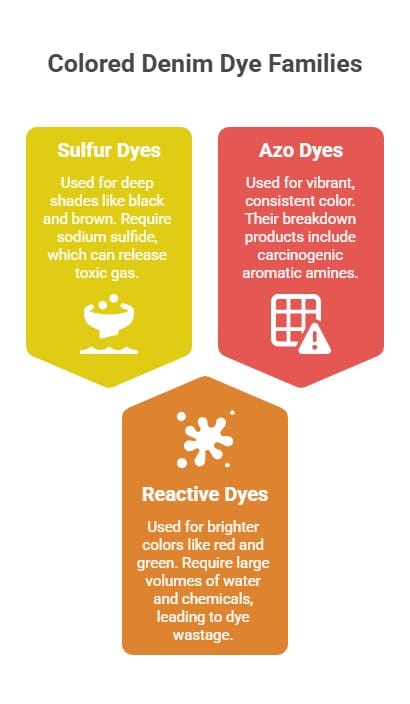
- Sulfur dyes are used for black, dark grey, dark brown, and other deep shades. They require sodium sulfide as a reducing agent to make the dye water-soluble. Sodium sulfide can release hydrogen sulfide gas, which is toxic to workers and harmful to aquatic organisms in wastewater.
- Reactive dyes are used for the wide range of brighter colors: red, green, pink, orange, mustard, and purple. They bond chemically with cotton fiber, which sounds positive, but they also require large volumes of water, salt, and alkaline chemicals to fix properly. Significant dye wastage occurs in the rinse process.
- Azo dyes are a subset of synthetic dyes widely used across the textile industry, including some colored denim. They are cheap and produce vibrant, consistent color. They are also the most scrutinized for toxicity. Their breakdown products include aromatic amines, several of which are classified as carcinogenic.[1]
In other words, when you buy a pair of red, black, or green jeans, the dye system used to create that color has different environmental and health implications compared to a pair of blue jeans. Not always worse across every metric, but different, and in some areas, more problematic.
This is not information most brands volunteer, and most sustainable fashion content skips over it entirely. Understanding how colored denim fabric is made is the foundation for understanding why its environmental profile differs.
The True Scale of the Problem: By the Numbers
Before getting into what makes colored denim specifically problematic, it helps to understand the baseline: denim production overall is one of the most resource-intensive manufacturing processes in fashion.
These numbers describe the overall denim industry. For colored denim specifically, the dyeing stage often requires more rinse cycles to fix non-indigo colors onto the fiber. This means more water per garment, more chemical inputs, and more wastewater per piece than a comparable blue denim garment.
Worth knowing: Up to 15% of the dye applied during the dyeing process escapes the fiber and enters wastewater. For reactive dyes used in most colored denim, that figure can be even higher.
In regions with inadequate water treatment infrastructure, this dye goes directly into rivers and groundwater without any treatment at all.
What Exactly Goes into the Water
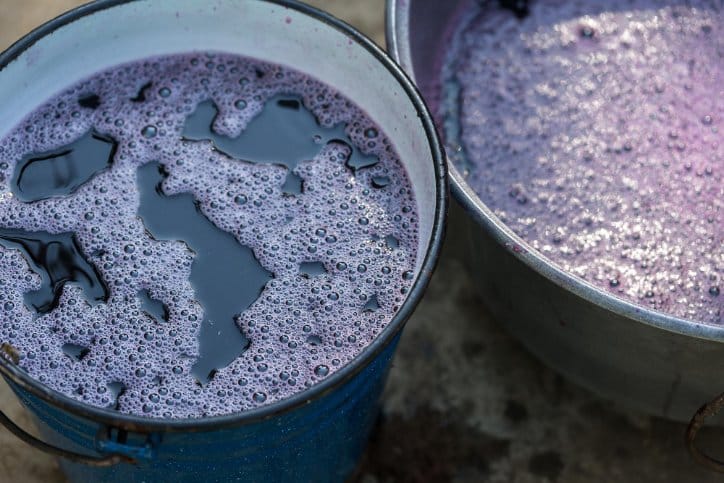
Textile dye wastewater is not just colored water. It contains a mixture of dye residues, processing chemicals, and degradation products that create serious environmental problems when released untreated.
Sulfur Dyes (Used for Black, Dark Grey, Dark Brown Denim)
Sulfur dyes are the most widely used dye family for dark colored denim. They are relatively inexpensive and produce deep, rich colors. The environmental concerns center on the reducing agent used to make them work.
Sodium sulfide is required to convert sulfur dyes into a water-soluble form for dyeing. It can release hydrogen sulfide gas during processing, which is toxic to workers and aquatic life.[1]
The wastewater from sulfur dyeing has a high sulfide content, high pH, and high chemical oxygen demand. All of these can deplete oxygen in waterways and seriously harm aquatic ecosystems.
Research is actively developing non-sulfide reducing alternatives such as glucose and fructose for sulfur dyeing, but these are not yet widespread in industrial use.
Reactive Dyes (Used for Bright and Medium-Toned Colored Denim)
Reactive dyes are used to achieve the wider color palette in denim: red, green, orange, mustard, pink, and purple. They bond directly to cotton fiber, but the process is water and salt-intensive.
The fixation rate for reactive dyes on cotton ranges from 60% to 90%.[4] That means 10% to 40% of the dye can end up in wastewater even in a well-run facility.
This unfixed dye is highly visible in wastewater, contributes to color toxicity in waterways, and reduces light penetration in aquatic environments, disrupting photosynthesis for aquatic plants.
Fixing reactive dyes also requires large amounts of salt and alkali, which further raises the toxicity and treatment difficulty of the resulting wastewater.
Azo Dyes and Their Breakdown Products
Azo dyes represent approximately 50% of all synthetic dyes used in the textile industry, including some colored denim applications.[1] The primary concern is not the dye itself but what it breaks down into under certain environmental conditions.
When azo dyes degrade in water or soil, they can release aromatic amines. Several of these compounds are classified as carcinogenic. Between 60% and 70% of azo dyes are considered toxic and resistant to conventional water treatment processes because of their chemical stability.
Heavy Metals in Dye Formulations
Some dye formulations, particularly certain metal-complex dyes used in fashion textiles, contain heavy metals including chromium, lead, cadmium, copper, and nickel. These metals accumulate in aquatic sediments and enter the food chain.
Their effects on human health include damage to the kidneys, nervous system, and immune system, as well as links to birth defects and cancer in populations living near unregulated dyeing facilities.[1]
| Dye Type | Used For | Key Chemical Concerns | Environmental Impact |
|---|---|---|---|
| Sulfur dyes | Black, dark grey, dark brown denim | Sodium sulfide reducing agent, hydrogen sulfide gas | HIGH Toxic to aquatic organisms; high oxygen demand in wastewater |
| Reactive dyes | Bright colors: red, green, pink, orange, yellow | High salt and alkali use; 10-40% dye wastage into effluent | HIGH Persistent color in waterways; disrupts aquatic photosynthesis |
| Azo dyes | Wide range of colors | Aromatic amine breakdown products, many classified carcinogenic | HIGH Toxic degradation products; resist conventional treatment |
| Indigo (blue denim) | Classic blue denim only | Sodium dithionite reducing agent; alkaline pH | MODERATE Major water and chemical use; less toxic than sulfur breakdown |
| Natural/plant dyes | Specialist sustainable lines | Mordants may be needed; variable fastness | LOWER Biodegradable in most formulations; limited commercial scale |
The wastewater produced at denim dyeing facilities typically shows high pH, elevated biological and chemical oxygen demand, significant turbidity, and the presence of sulfates, chlorides, and phenols. When this water reaches rivers and groundwater (as it does regularly in regions without proper treatment infrastructure), the consequences for local communities and ecosystems are severe and long-lasting.[1]
The Human Cost: What Happens to the People Making Your Jeans
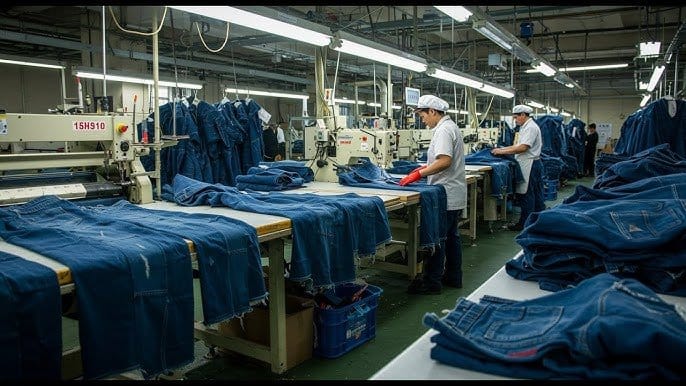
The environmental impact of denim dyeing does not stop with rivers and groundwater. The people who work in dyeing and finishing facilities face direct, daily exposure to the same chemicals that enter wastewater.
Routine Chemical Exposure
Factory workers in dyeing operations handle formaldehyde, chlorine, potassium permanganate, sulfur compounds, and in some facilities, sodium dithionite. Prolonged exposure to these substances is linked to skin diseases, respiratory disorders, chemical burns, and in some cases cancer.[5]
Respiratory protection is often inadequate in lower-cost manufacturing regions. Chronic bronchitis, asthma, and other pulmonary conditions have been documented in communities living and working near denim production facilities.
Sandblasting and Silicosis
Sandblasting is a technique used to create a worn-in, distressed look on denim. It involves high-pressure spraying of fine silica sand at fabric. Workers who perform this task without proper protection inhale silica dust, which over time causes silicosis, an irreversible scarring of lung tissue that can be fatal.
Sandblasting has been banned in several countries including Turkey and the European Union, but it remains in use in some manufacturing regions with weaker regulatory enforcement. The distressed jeans on the average high street rack may have been finished using this method.
Where Denim Is Made and Why Geography Matters
The majority of the world’s denim is produced in China, India, Bangladesh, Pakistan, Mexico, and parts of Southeast Asia. Environmental and labor regulations in these regions vary enormously. In areas with stricter oversight, dye facilities treat their wastewater before releasing it. In areas with weaker enforcement, they often do not.
In Xintang, China, sometimes called the jeans capital of the world. Investigations found rivers running visibly colored from dye runoff, with cadmium levels in river sediments reported at 128 times over Chinese national environmental standards, and pH levels similar to ammonia. Communities downstream reported elevated rates of skin conditions and gastrointestinal disease.[5]
It is important to note that conditions have improved in some of these regions following regulatory pressure and corporate auditing. But the fact that they existed at all, and that enforcement gaps remain, is worth keeping in mind when choosing where your money goes.
Does Colored Denim Pollute More Than Blue Denim?
This is the question sustainability advocates actually want answered, and it deserves a straight response rather than a vague “it depends.”
The answer is: in some specific ways, yes, and in others, not necessarily more, but differently.
Where Colored Denim Has a Higher Impact
- More water per garment: Reactive dyes used for bright colors require more rinse cycles to remove unfixed dye and processing chemicals. This adds water consumption at the fabric dyeing stage compared to standard indigo yarn dyeing.
- More complex wastewater: The chemical mix in colored dye effluent can be harder to treat than indigo wastewater. Reactive dye residues in particular are persistent in water and resist standard treatment processes.
- Higher dye loss rate: Indigo dyeing, while water-intensive, wastes less dye overall because it builds up in controlled layers. Reactive dyes for bright colors can lose 10-40% of the applied dye into wastewater.
- Ozone bleaching does not work: Ozone washing is one of the most effective sustainable finishing technologies for denim, reducing water by 65% and chemicals by 80%. But it only works on indigo-dyed denim. Sulfur-colored denim cannot achieve the same effect with ozone, limiting which sustainable finishing technologies are available for colored pieces.[1]
Where Blue and Colored Denim Share the Same Problems
- Cotton cultivation water use (the same regardless of what color the fabric is dyed)
- Weaving energy consumption
- Transport and logistics emissions
- Consumer washing impact (which accounts for approximately 20% of a garment’s lifetime environmental footprint)
- End-of-life disposal and the barriers to recycling
| Factor | Blue Indigo Denim | Colored Denim |
|---|---|---|
| Dye water use | High (multiple dip-and-oxidise cycles) | Higher for reactive dyes; comparable for sulfur dyes |
| Chemical inputs | Sodium dithionite, alkali, sodium hydrosulfite | Sodium sulfide (sulfur), salt and alkali (reactive), mordants |
| Wastewater toxicity | High pH, oxygen depletion, indigo residues | Can be higher; azo breakdown products, sulfide compounds |
| Dye waste % | Lower (indigo builds in controlled layers) | 10-40% dye loss with reactive dyes |
| Ozone finishing compatible? | Yes, highly effective | No for sulfur-dyed pieces (major limitation) |
| Laser distressing compatible? | Yes | Yes, for most colored denim |
| Worker exposure risks | Sodium dithionite, aniline dust in powder indigo | Hydrogen sulfide (sulfur dyes), aromatic amines (azo), formaldehyde |
The takeaway is not that you should only wear blue jeans. The environmental profile of your colored denim depends heavily on which dye system was used, where it was produced, and whether the facility treated its wastewater.
None of that information is currently required on your clothing label, though the EU is moving toward changing that.
The Gap Between Knowing and Doing
One of the most striking things about sustainable fashion data is the distance between what consumers say they care about and what they actually do when making a purchase.
In Europe, 58% of consumers say they prefer eco-friendly denim. A worldwide survey found that over a quarter of consumers reported making significant changes toward buying more sustainable products. And three in five consumers globally said sustainability was at least somewhat important when buying clothing.
But research published in 2024 found that price is still the single most influential factor when consumers choose sustainable denim, ahead of material, brand name, and eco-labeling combined.[6]
In the US, 56% of fashion consumers agreed that environmentally friendly clothes are often too expensive. And only 11% of Italian consumers in one survey identified fashion as one of the most polluting industries globally, despite it accounting for a significant share of worldwide carbon emissions.
This is not a judgment. It reflects several real barriers: price premiums for certified sustainable goods, lack of clear labeling, difficulty in verifying brand claims, and the reality that sustainability information is rarely presented in a way that connects directly to purchasing decisions.
The greenwashing problem: As sustainable denim has become a marketing priority, so has greenwashing, brands claiming environmental credentials that do not hold up to scrutiny.
Using vague terms like “eco-conscious” or “responsible” without third-party certification is common. The most useful way to filter genuine claims from marketing language is to look for independently verified certifications, which are covered in Section 8 below.
The EU’s incoming Digital Product Passport regulation will require brands to disclose materials, manufacturing processes, and environmental data in a machine-readable format attached to products. When this comes into effect, the information gap between consumers and manufacturers will narrow significantly. For now, certifications and brand transparency reports are the best available tools.
For more background on how consumer choices shape the industry, the fast fashion vs slow fashion guide covers the structural factors that make meaningful change difficult, and where individual choices still have genuine weight.
What the Industry Is Actually Changing
The picture so far is not an easy one. But it is not static either. The denim industry is investing in technologies that genuinely reduce the environmental footprint of dyeing, including for colored denim, and the pace of change has accelerated since 2020.
Here is an honest look at what is actually working, with real figures where they exist:
Dye is applied as a foam rather than a liquid bath. The foam adheres to the fabric surface more precisely, dramatically reducing water use and dye wastage. Foam dyeing is being adopted in denim mills across Japan, Europe, and increasingly in South Asia. It is applicable to both indigo and colored denim systems.
CO2 is pressurised until it becomes a supercritical fluid that acts as a solvent for dye. The fabric is dyed in a sealed chamber with no water at all. After dyeing, the CO2 is cleaned and 95% is recycled back into the system.
It also speeds up the dyeing process by 40% and removes the drying stage entirely. Currently most effective for polyester fibers; application to cotton is an active area of development.
Laser technology creates distressed effects, fading, and surface patterns on denim without any water or chemicals. It replaces stonewashing, sandblasting, and chemical bleaching. Brands including Levi’s have reported saving over 3.5 billion liters of water since adopting laser finishing at scale, alongside 96% water reduction for certain finishing steps.
Ozone gas is used to bleach and fade denim in a near-waterless process. Jeanologia’s G2 Ozone system produces zero waste and achieves the faded look without chemical bleaching. The significant limitation: ozone finishing only works on indigo-dyed fabric. It does not work on sulfur-colored denim, which is a real constraint for black and dark-colored pieces.
Enzymes replace chemical treatments in softening, stone-washing effects, and surface finishing. They are biodegradable, work at lower temperatures, and significantly reduce the toxicity of wastewater.
Approximately 62% of certified organic denim manufacturers now incorporate bio-based softeners. The Jeanologia Colorbox technology has reduced water by up to 60%, salt by 76%, energy by 45%, and chemicals by 60% in garment dyeing processes.[1]
Researchers are engineering bacteria, algae, and fungi to produce dye pigments from agricultural byproducts. These biological dyes have no carcinogenic properties and their production requires far less water and chemical input than synthetic dye manufacturing. Still largely at research and pilot scale, but moving toward commercial viability.[1]
Some leading manufacturers now run closed-loop systems that treat and recycle process water internally. DL1961 recycles 98% of water used in production, cutting consumption to approximately 10 gallons per pair. Triarchy’s system recycles 85% of water and repurposes indigo sludge. Jeanologia’s H2Zero system targets zero discharge. These are real-world implementations, not theoretical goals.
Digital spray applies exactly the amount of dye needed directly onto the fabric using digitally controlled nozzles. This removes the dye bath entirely, uses a fraction of the water and chemical inputs of conventional dyeing, and produces significantly less effluent. It also allows for greater design precision and smaller production runs, reducing overproduction waste.
The Honest Limitation
These technologies are real and effective. The barrier is not technical. It is economic and structural. Denim mills operate on very thin margins. The upfront cost of new machinery is high. And brands have historically been reluctant to pay a premium for more sustainably produced fabric.
A sustainable denim review published in late 2025 in the journal Sustainability found that the most effective treatments (enzymes, ozone, laser, and recycled materials) can achieve water reductions of up to 60%.[7]
The technologies exist. What is missing is the financial incentive for mills and brands to adopt them at scale. Consumer demand for verified sustainable denim is one of the most direct ways to change that calculation.
How to Buy Colored Denim More Responsibly
Buying perfectly sustainably is not currently possible. The supply chain is too opaque and the certifications too variable for any purchase to be consequence-free. But there is a significant difference between an uninformed purchase and an informed one, and that difference is worth making.
The Certifications That Actually Mean Something
Certifications are the most reliable proxy for supply chain verification that is accessible to consumers. Here is what each one actually covers:
What the EU Digital Product Passport Will Change
The European Union is introducing a Digital Product Passport as part of its Ecodesign for Sustainable Products Regulation. When it takes effect – phased in from 2025 onward – garments sold in EU markets will need to carry a digital record containing information about the materials used, the manufacturing process, repairability, and end-of-life options.
For the first time, this will make supply chain transparency a legal requirement rather than a marketing choice. If you buy colored denim sold in European markets, this passport will eventually tell you far more than a label currently does about where and how it was made.
Second-Hand as the Lowest-Impact Option
The most straightforward way to buy colored denim with the lowest environmental footprint is to buy it second-hand. The dyeing impact has already occurred. No new production is triggered. Water and chemical use per garment effectively drops to near zero for that transaction.
The upcycled and second-hand denim market was valued at nearly half a billion dollars in 2024 and is projected to double by 2032, driven by exactly this kind of reasoning. It is not a niche preference anymore. It is a mainstream option available through dedicated resale platforms, charity shops, and growing brand take-back programs.
A Practical Buying Checklist
- Look for at least one credible third-party certification (GOTS, OEKO-TEX, Bluesign) before buying new colored denim
- Check whether the brand publishes a sustainability report with measurable water and chemical targets
- Prefer brands that use laser finishing or waterless dyeing – these are often highlighted in brand sustainability pages
- Buy second-hand where possible, especially for statement colors (red, bright green, vivid pink) where dye impact is highest
- Buy fewer, better-quality pieces – a garment worn 100 times has a fraction of the per-wear impact of one worn 10 times
- Avoid heavily distressed or washed colored denim unless the brand specifies laser or ozone finishing – traditional stone-washing and chemical distressing adds significant environmental cost
- Check the fabric composition – 100% cotton or organic cotton is more recyclable at end of life than cotton-elastane blends
The Denim Environmental Impact Tracker helps you understand the environmental cost of your denim garments and identify where to reduce your footprint most effectively.
What You Can Do at Home to Lower the Impact
The production stage of denim gets most of the attention, but post-purchase care accounts for roughly 20% of a garment’s total lifetime environmental footprint. How you wash, dry, and maintain colored denim matters more than most people think.
Wash Less, and Cold
Denim does not need washing after every wear. It picks up odors slowly, and frequent washing is the fastest way to degrade both color and fiber quality.
Washing in cold water at 30 degrees Celsius or below uses significantly less energy than warm cycles and reduces dye loss from the fabric.
If you wash a pair of jeans every 10 wears rather than every 2, you reduce the cumulative water, energy, and microfibre release from that garment by 80% over its lifetime. That is a meaningful number.
The Microfibre Problem
Each wash of a denim garment releases synthetic microfibers into the water supply. Research has documented that one pair of used jeans can release around 56,000 microfibres per wash. These microfibers pass through most water treatment plants and accumulate in marine sediments and organisms.
Using a microfibre-catching laundry bag (such as those made by Guppyfriend) significantly reduces the amount of microfibers that reach waterways. Air drying rather than tumble drying also reduces microfibre shedding, as heat and friction in the drum accelerates fibre breakdown.
Extend the Garment’s Life
The longer you keep a garment in use, the lower its per-wear environmental cost. Repairing rather than replacing, re-dyeing faded pieces at home where possible, and donating rather than discarding are all straightforward ways to extend the value of what has already been produced.
The denim care guide covers specific techniques for maintaining colored denim so it lasts longer and fades in a controlled, intentional way rather than degrading prematurely.
End of Life
When a piece of colored denim is genuinely worn out, the most sustainable disposal option depends on its fiber content. Pure cotton denim can be mechanically recycled into new fiber or repurposed as insulation or padding. Cotton-elastane blends are harder to recycle because separating the fibers requires chemical processes.
Several denim brands now run take-back programs. Donating to textile collection schemes is better than bin disposal, where denim joins the estimated 16 kg of fashion waste per person that goes to landfill annually in the EU.
The Denim Wash Frequency Calculator gives you a personalised washing schedule based on the denim type and how you wear it – helping you extend garment life while reducing water and energy use.
Frequently Asked Questions
Is colored denim more harmful to the environment than blue denim?
In some specific ways, yes. Non-indigo dyes used in colored denim, particularly reactive dyes for bright colors and sulfur dyes for black, require more complex chemistry, more water in some processes, and produce wastewater that is harder to treat than standard indigo effluent.
Ozone finishing, one of the most effective sustainable technologies, also cannot be used on sulfur-colored denim. Both blue and colored denim share the same large baseline footprint from cotton farming and consumer washing. The key differences are in the dyeing stage specifically.
What makes black denim particularly problematic?
Black denim is typically dyed with sulfur dyes, which require sodium sulfide as a reducing agent. This chemical can release hydrogen sulfide gas during processing, which is toxic to workers and aquatic organisms.
The wastewater from sulfur dyeing is also highly alkaline and has high oxygen demand, making it harmful to river ecosystems when released untreated. Ozone finishing, a major sustainable technology, does not work on sulfur-colored denim, limiting available eco-alternatives.
Are azo dyes in colored denim dangerous to wear?
In certified garments sold in regulated markets, azo dye exposure through skin contact is considered low risk. The dye is fixed to the fiber and concentrations of harmful breakdown products are strictly limited by regulations like EU REACH.
The primary dangers are to factory workers handling undiluted dyes, and to ecosystems downstream of unregulated facilities. The OEKO-TEX Standard 100 certification specifically tests for azo dye residues, so garments carrying this certification have been verified safe for skin contact.
What is the most sustainable way to buy colored denim?
Second-hand is the most impactful option. The dyeing has already occurred and no new production is triggered. For new purchases, look for garments certified by GOTS or Bluesign, which independently verify the dyeing and finishing process.
Brands that specify laser finishing, waterless dyeing, or closed-loop water systems offer meaningfully lower impact than standard production. Buying fewer, higher-quality pieces that last longer is also one of the most effective ways to reduce your per-wear footprint.
What is foam dyeing and is it actually better?
Foam dyeing applies dye suspended in foam rather than a liquid bath. The foam adheres to fabric more precisely, reducing both water use and dye wastage. Studies show it can cut water consumption by up to 83% without compromising color quality.
It works for both indigo and colored denim systems, making it one of the most broadly useful sustainable dyeing technologies available. Adoption is growing but not yet universal, particularly in lower-cost manufacturing regions.
Does washing colored denim at home release harmful chemicals?
In certified garments, the dye chemicals are fixed to the fiber and are not meaningfully released during normal washing. The more significant concern is microfibre release. Each wash can release tens of thousands of tiny fiber particles that pass through water treatment plants.
Using a microfibre-catching laundry bag and washing in cold water on a gentle cycle significantly reduces this impact. Washing less frequently is the single most effective step, denim does not need washing after every wear.
What certifications should I look for on colored denim?
GOTS (Global Organic Textile Standard) is the most comprehensive, covering the full supply chain including dyeing and finishing with strict chemical restrictions. OEKO-TEX Standard 100 verifies the finished product is free from harmful substances.
Bluesign specifically covers chemical safety and resource efficiency in fabric manufacturing, directly relevant to the dyeing stage. Fair Trade covers labor conditions. For colored denim specifically, GOTS or Bluesign are the most meaningful certifications to look for.
Can colored denim be recycled at end of life?
Pure cotton colored denim can be mechanically recycled into new fiber or repurposed as insulation, padding, or industrial rags. Cotton-elastane blends are harder to recycle because separating the fibers requires additional processing.
The dye itself does not prevent recycling, but recycled fiber tends to produce off-white or grey outputs requiring re-dyeing. Donating to textile collection schemes, using brand take-back programs, or buying from brands with recycling guarantees are the most accessible end-of-life options.
Why does colored denim often cost more than blue denim?
Non-indigo dyes are generally more expensive per unit than indigo. Reactive dyes require more processing steps, more water, and more salt to fix properly. Sulfur dyes need additional chemical inputs.
Where sustainable dyeing technologies are used, equipment and process costs are also higher. Colored denim also requires more quality control in dye consistency than blue denim. These factors combine to make colored denim production cost more than standard blue denim at equivalent quality.
Conclusion
The environmental cost of colored denim is real, specific, and often more serious than the general “denim is bad” narrative covers. Non-indigo dyes bring their own chemistry, their own wastewater challenges, and in some cases their own worker health risks that are distinct from what happens when you dye blue jeans.
But the situation is not hopeless, and informed choices do make a difference – both in the direct impact of individual purchases and in the market signal they send to manufacturers.
Here are the key things to carry forward:
- Colored denim uses different dye systems from blue denim – sulfur dyes for dark shades, reactive dyes for bright colors, sometimes azo compounds. Each has specific environmental and health implications that standard denim sustainability content rarely addresses.
- The dyeing stage is where the most significant environmental damage happens. Up to 15% of applied reactive dye can escape into wastewater. Sulfur dyeing can release toxic hydrogen sulfide. Ozone finishing – one of the most effective sustainable technologies – cannot be used on sulfur-colored denim.
- Workers in dyeing facilities face direct chemical exposure daily. Where environmental regulations are weak, communities near these facilities bear health burdens they did not choose.
- The technologies to dramatically reduce this impact already exist: foam dyeing, laser finishing, supercritical CO2 dyeing, closed-loop water systems, enzyme processing. The barrier is economic, not technical. Consumer demand for verified sustainable products shifts that calculation.
- Second-hand is the most impactful purchase decision you can make. For new purchases, GOTS, Bluesign, and OEKO-TEX Standard 100 are the most meaningful certifications to look for in colored denim specifically.
- Post-purchase care matters more than most people think. Washing less frequently, in cold water, with a microfibre bag, and air drying reduces the consumer-stage footprint by a significant margin over a garment’s lifetime.
- The EU Digital Product Passport will eventually make supply chain transparency a legal requirement for garments sold in European markets. Until then, certifications, brand transparency reports, and second-hand purchasing are the best available tools.
For a deeper understanding of colored denim as a fabric, including how it is made, which shades are trending, and how to style it, the complete colored denim fabric guide covers all of that in detail.
For keeping your existing denim in good condition for as long as possible, the denim care guide has everything you need.