
Everything You Need to Know About Double Layer Chiffon, From Construction to Care
Table of Contents
- What is Double Face Chiffon Fabric?
- History and Evolution
- Types of Double Face Chiffon
- Properties and Characteristics
- Double Face Chiffon vs. Other Fabrics
- Uses and Applications
- Why Choose Double Face Chiffon?
- Sustainability and Environmental Impact
- How to Sew with Double Face Chiffon
- Care and Maintenance
- Buying Guide
- Styling Ideas
- Common Mistakes to Avoid
- Frequently Asked Questions
Remember that iconic scene in “What A Girl Wants” where Amanda Bynes dramatically tears away the outer layer of her double face chiffon dress to reveal a stunning gown underneath? That movie moment perfectly shows what makes double face chiffon special. It’s not just one layer of sheer, delicate fabric. It’s two layers working together to create something more practical and beautiful.
If you’ve ever worked with regular chiffon fabric, you know the struggle. It’s gorgeous but so sheer you can see right through it. You need lining, extra layers, or you risk showing more than you intended. Double face chiffon solves this problem right out of the gate.
This guide walks you through everything about double face chiffon. Whether you’re a home sewer planning your next project, a fashion student learning about fabrics, or someone who just wants to understand what they’re buying, you’ll find practical answers here. No confusing jargon. Just clear information about what this fabric is, how it works, and how to use it successfully.
What is Double Face Chiffon Fabric?
Double face chiffon is exactly what it sounds like. It’s chiffon with two usable sides instead of the typical single layer. But there’s more to it than just doubling up the fabric.
The Basic Structure
Think of double face chiffon as two thin layers of chiffon joined together. Unlike single-layer chiffon that’s almost see-through, double face chiffon gives you opacity without losing that signature flowy, lightweight feel that makes chiffon special.
The two layers work together but they’re not just stuck randomly. They’re either woven together during manufacturing or carefully bonded afterward. This connection creates a fabric that’s stronger and more stable than regular chiffon while keeping the soft drape everyone loves.
How It’s Made: Two Main Methods
Bonded Double Face Chiffon
In the bonded method, manufacturers take two separate pieces of chiffon and fuse them together using heat, adhesive, or special bonding techniques. The two layers remain distinct, and if you look at the edge of the fabric, you can sometimes see where they meet. This type is often easier to work with because the layers stay connected during sewing.
Woven Double Face Chiffon
The woven method is more complex. During the weaving process itself, the fabric is constructed with two layers that interlock. This creates a single piece of fabric that happens to have two faces. You can’t separate the layers because they’re woven together from the start. This type often feels more cohesive and drapes slightly differently than bonded versions.
What Makes It Different from Regular Chiffon?
Regular silk chiffon or polyester chiffon has that beautiful, floaty quality but you can see right through it. It’s made from highly twisted yarns woven in a plain weave pattern, creating a slightly rough texture and a sheer appearance.
Double face chiffon keeps the twisted yarn construction and the soft drape, but adds that second layer for coverage. The result is a fabric that moves like chiffon but doesn’t require lining in most applications. You get the elegance without the transparency problem.
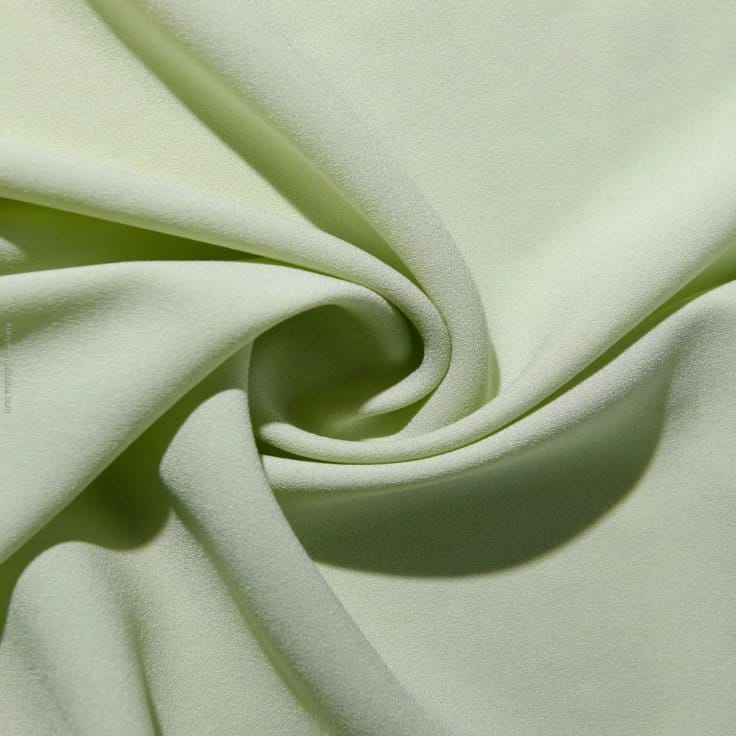
Light green double face chiffon fabric highlighting smooth surface, soft drape, and lightweight layered construction.
The Terminology Can Be Confusing
You might see this fabric called different names in stores and online. “Double face chiffon,” “double layer chiffon,” “two-layer chiffon,” and “bonded chiffon” often refer to similar products, though they can have slight construction differences.
Don’t confuse double face chiffon with double cloth, which is a completely different type of reversible fabric usually made from wool or cotton. Double cloth typically has two distinct colors or patterns on each side and is much heavier than any chiffon.
When comparing fabrics, you might also consider tulle vs chiffon in children’s clothing, as both offer lightweight options with different properties.
History and Evolution
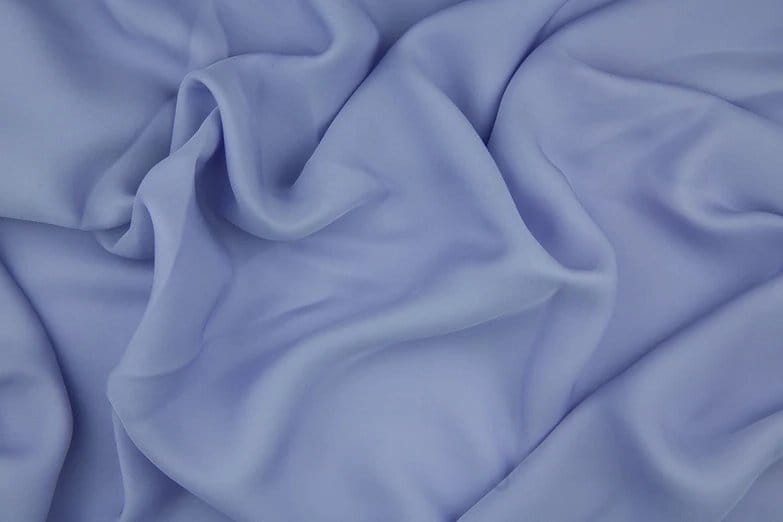
Blue double face chiffon fabric displaying graceful drape and smooth texture that reflects the fabric’s evolution into modern lightweight fashion materials.
To understand double face chiffon, it helps to know where regular chiffon came from first. Chiffon originated in France around the 1700s. The word comes from the French word “chiffe,” which means cloth or rag (though there’s nothing rag-like about this luxurious fabric).
The Early Days: Silk Only
For about 200 years, chiffon was made exclusively from silk. This made it extremely expensive and only affordable for wealthy people. The fabric was prized for its delicate, airy quality, but even back then, people struggled with how sheer it was. Fashion designers had to use multiple layers or clever lining techniques to make garments wearable.
According to The Museum at FIT, chiffon became hugely popular in the early 1900s in Europe and America, especially for evening wear and special occasions. But the sheerness remained a constant challenge. Women wore multiple layers of chiffon or used slips and linings underneath.
The Synthetic Revolution
Everything changed in 1938 when nylon was invented. Suddenly, chiffon could be made from synthetic fibers, making it much more affordable. Nylon chiffon looked similar to silk but cost far less and was more durable.
Then in 1958, polyester entered the picture. Polyester chiffon became the most popular version because it was even cheaper to produce, held colors well, and could be easily cared for at home. It still looked elegant but was practical enough for everyday use.
When Did Double Face Chiffon Appear?
The exact origin of double face chiffon isn’t well documented, but it likely developed in response to the practical needs of fashion designers and home sewers. As chiffon became more popular for everyday wear (not just special occasions), people wanted the elegant look without the hassle of lining every garment.
By the late 20th century, manufacturers had figured out ways to bond or weave two layers together during production. This innovation made chiffon more user-friendly while keeping its beautiful characteristics. Double face chiffon became particularly popular in:
- Bridal fashion (where coverage matters but elegance is required)
- Saree production (especially in India where chiffon sarees are traditional)
- Evening wear (allowing for flowing designs without constant worry about transparency)
- Scarves and wraps (where both sides would be visible)
Modern Developments
Today’s double face chiffon benefits from advanced textile technology. Manufacturers can create versions with different weights, opacity levels, and finishes. Some modern double face chiffons even feature:
- Slight stretch for better fit
- Different colors on each layer for reversible designs
- Special treatments for wrinkle resistance
- Eco-friendly production methods using recycled fibers
The fabric continues to adapt to changing fashion needs while keeping the qualities that made chiffon beloved in the first place.
Types of Double Face Chiffon
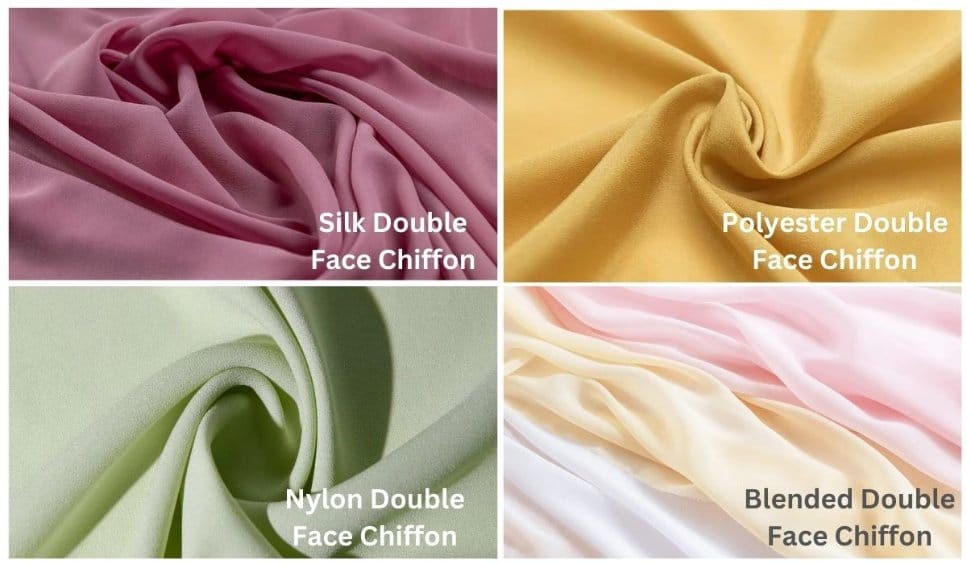
Different types of double face chiffon including silk, polyester, nylon, and blended options for various garment needs.
Not all double face chiffon is created equal. Different fiber contents and construction methods create fabrics with distinct properties. Here’s what you need to know about each type.
By Fiber Content
Silk Double Face Chiffon
This is the luxury option. Silk chiffon in double face form feels incredibly soft against your skin. It has a natural sheen that synthetic versions can’t quite match. The drape is fluid and moves beautifully with your body.
Silk double face chiffon works well for high-end evening wear, bridal gowns, and special occasion pieces. It’s breathable and feels cool in warm weather. However, it’s expensive, usually ranging from $30 to $80 per yard depending on quality. It also requires careful handling and often needs dry cleaning.
Polyester Double Face Chiffon
Polyester chiffon in double face construction is the most common and practical choice. It’s affordable (usually $5 to $15 per yard), durable, and easy to care for. You can often machine wash it, and it doesn’t wrinkle as easily as silk.
Modern polyester double face chiffon can look surprisingly similar to silk, especially in photographs. The drape is good, though slightly different from silk. It holds color well, so you’ll find it in every shade imaginable. It’s less breathable than silk but still comfortable for most occasions.
This is your go-to for bridesmaid dresses, everyday special occasion wear, dance costumes, and any project where you need the look of chiffon without the silk price tag.
Nylon Double Face Chiffon
Nylon chiffon falls between silk and polyester in terms of properties. It’s stronger than both, with good stretch recovery. This makes it excellent for garments that need to hold their shape.
Nylon double face chiffon has a slight sheen, though not as much as silk. It’s more resistant to tears and snags than polyester. Price-wise, it sits in the middle range, around $8 to $20 per yard.
Consider nylon for dance wear, performance costumes, or any garment that will get a lot of movement and wear. It’s also good for garments that you want to last for years without showing wear.
Blended Double Face Chiffon
Some manufacturers blend fibers to get the best properties of each. Common blends include:
- Silk-Polyester Blend: Combines silk’s luxurious feel with polyester’s durability and easier care
- Polyester-Spandex Blend: Adds stretch for fitted garments while keeping the chiffon look
- Silk-Cotton Blend: Creates a more matte finish with good breathability
By Construction Method
Heat-Bonded Double Face Chiffon
In this method, two layers are fused using heat without adhesive. This creates a strong bond while keeping the fabric relatively soft. The layers won’t separate during normal use, but if you look closely at cut edges, you can see the two distinct layers.
Heat-bonded versions tend to be slightly stiffer than woven double face chiffon but are easier for beginners to sew. The layers stay put while you work, reducing slipping and shifting.
Adhesive-Bonded Double Face Chiffon
This uses a very thin layer of adhesive between two chiffon layers. The adhesive is usually heat-activated during manufacturing. When done well, you won’t feel the adhesive at all. Lower-quality versions might feel slightly stiff or lose their bond over time with washing.
Always test wash a swatch before committing to a large project with adhesive-bonded chiffon, especially if it’s from an unknown supplier.
Woven-Together Double Face Chiffon
This is the most seamless type. The two layers are created simultaneously on the loom, with connecting threads holding them together. You can’t separate the layers because they’re structurally integrated.
Woven double face chiffon often has the best drape and the most consistent quality throughout the fabric. It’s typically more expensive than bonded versions but worth it for high-end projects.
Special Varieties
Iridescent Double Face Chiffon
This features different colors on each layer, creating a color-changing effect as the fabric moves. One layer might be copper while the other is pale blue, creating a stunning two-tone appearance. This is popular for evening wear and statement pieces.
Crepe Double Face Chiffon
Crepe chiffon has a slightly more textured surface than regular chiffon. In double face form, it offers a bit more body while still draping beautifully. It’s less prone to snagging than smoother versions.
Jacquard Double Face Chiffon
Jacquard chiffon has patterns woven into the fabric itself. When made as double face, you might see the pattern on one side with a solid color on the other, or different patterns on each side. This creates unique reversible possibilities.
| Type | Price Range (per yard) | Care Level | Best Use |
|---|---|---|---|
| Silk Double Face | $30-80 | High (dry clean) | Luxury garments, bridal |
| Polyester Double Face | $5-15 | Low (machine wash) | Everyday wear, costumes |
| Nylon Double Face | $8-20 | Low to Medium | Performance wear, dance |
| Blended Double Face | $10-35 | Medium | Special occasions |
Properties and Characteristics
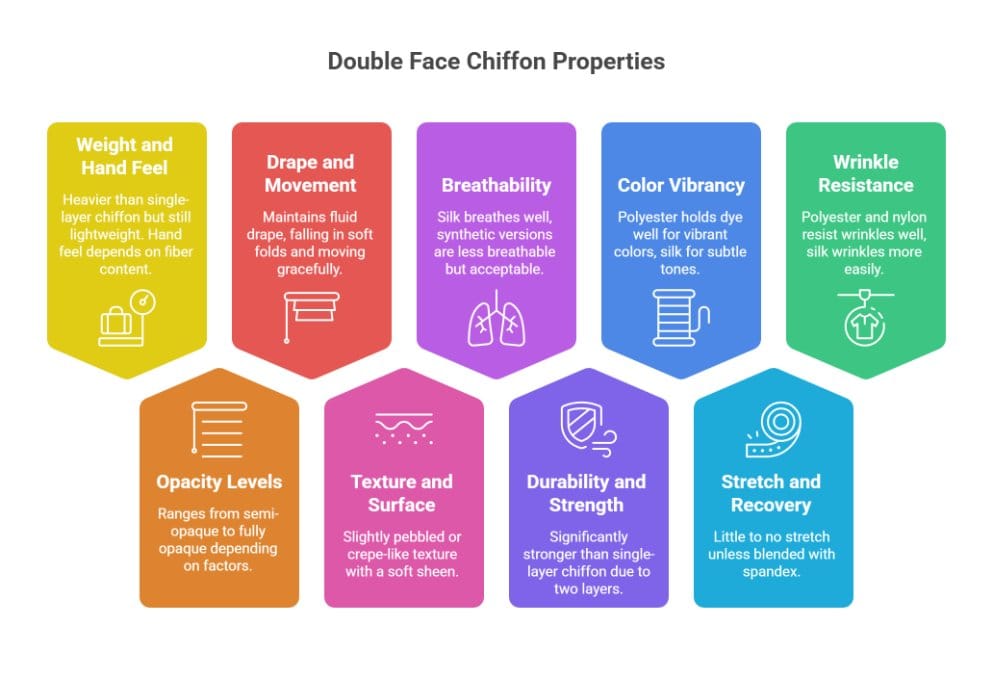
Double face chiffon fabric properties and characteristics explained visually for easy understanding of performance and features.
Understanding what double face chiffon feels like, how it behaves, and what makes it unique helps you decide if it’s right for your project.
Weight and Hand Feel
Double face chiffon weighs more than single-layer chiffon (obviously, since there are two layers), but it still qualifies as a lightweight fabric. A typical double face chiffon weighs between 60-90 GSM (grams per square meter), compared to 25-35 GSM for single-layer chiffon.
The hand feel depends on the fiber content. Silk versions feel the smoothest and softest. Polyester has a slightly more synthetic feel but is still pleasant. The fabric should flow easily through your hands without stiffness.
If you’re looking for lightweight fabric options, our Chiffon Type Selector Quiz can help you find the perfect match for your needs.
Opacity Levels
This is where double face chiffon really shines compared to regular chiffon. While single-layer chiffon is quite sheer, double face chiffon ranges from semi-opaque to fully opaque depending on:
- The weight of each individual layer
- The color (darker colors are less see-through)
- The fiber content (silk tends to be slightly more transparent than polyester)
- The construction method (bonded versions are usually more opaque)
For most applications, you won’t need a separate lining with double face chiffon, though some people still choose to add one for very light colors or for extra body in the garment.
Drape and Movement
Double face chiffon maintains that beautiful fluid drape that makes chiffon so popular. It falls in soft folds and moves gracefully with the wearer. The drape is slightly less fluid than single-layer chiffon due to the added weight, but most people find this a positive trade-off.
The fabric has a soft hand drape rather than a stiff one. It doesn’t stand away from the body on its own. Instead, it follows curves and creates flowing lines. This makes it perfect for A-line skirts, flowing sleeves, and draped necklines.
Texture and Surface
Like regular chiffon, double face versions have a slightly pebbled or crepe-like texture from the twisted yarns used in construction. This texture isn’t rough or scratchy; it’s subtle and adds visual interest.
The surface has a soft sheen that catches light without being shiny. Silk versions have more sheen, while polyester can range from matte to somewhat shiny depending on how it’s finished.
Breathability
Silk double face chiffon breathes well and feels cool against skin, making it comfortable even in warm weather. Synthetic versions are less breathable but still acceptable for most uses. The two-layer construction does reduce airflow compared to single-layer chiffon, but it’s still a good choice for summer garments.
Durability and Strength
Double face chiffon is significantly stronger than single-layer chiffon. The two layers support each other, reducing the risk of tears and snags. This doesn’t mean it’s indestructible, but it’s much more practical for everyday wear.
The twisted yarn construction common to all chiffons adds strength. Nylon versions are the most durable, followed by polyester, then silk. With proper care, a double face chiffon garment can last for years.
Color Vibrancy
Polyester double face chiffon holds dye exceptionally well, resulting in vibrant, saturated colors. Silk takes dye differently, creating more subtle, sophisticated tones. You’ll find double face chiffon in every color imaginable, from soft pastels to bold jewel tones.
Iridescent versions (with different colors on each layer) create unique color-shifting effects as the fabric moves and light hits it from different angles.
Stretch and Recovery
Most double face chiffon has little to no stretch unless it’s blended with spandex or elastane. Silk has a tiny bit of natural give, but not enough to call it stretchy. Nylon has the most stretch recovery among the common options.
If you need stretch in your project, look specifically for double face chiffon blended with 2-5% spandex. These versions will still look like chiffon but will have more give for fitted garments.
Wrinkle Resistance
Polyester and nylon double face chiffon resist wrinkles pretty well. You might get some creasing from packing or storage, but these usually fall out when the garment is hung up or worn.
Silk double face chiffon wrinkles more easily and usually requires steaming or careful pressing to look its best. This is one reason why polyester versions are more popular for travel and everyday wear.
Double Face Chiffon vs. Other Fabrics
Understanding how double face chiffon compares to similar fabrics helps you make better decisions for your projects. Let’s break down the key differences.
Double Face Chiffon vs. Regular Chiffon
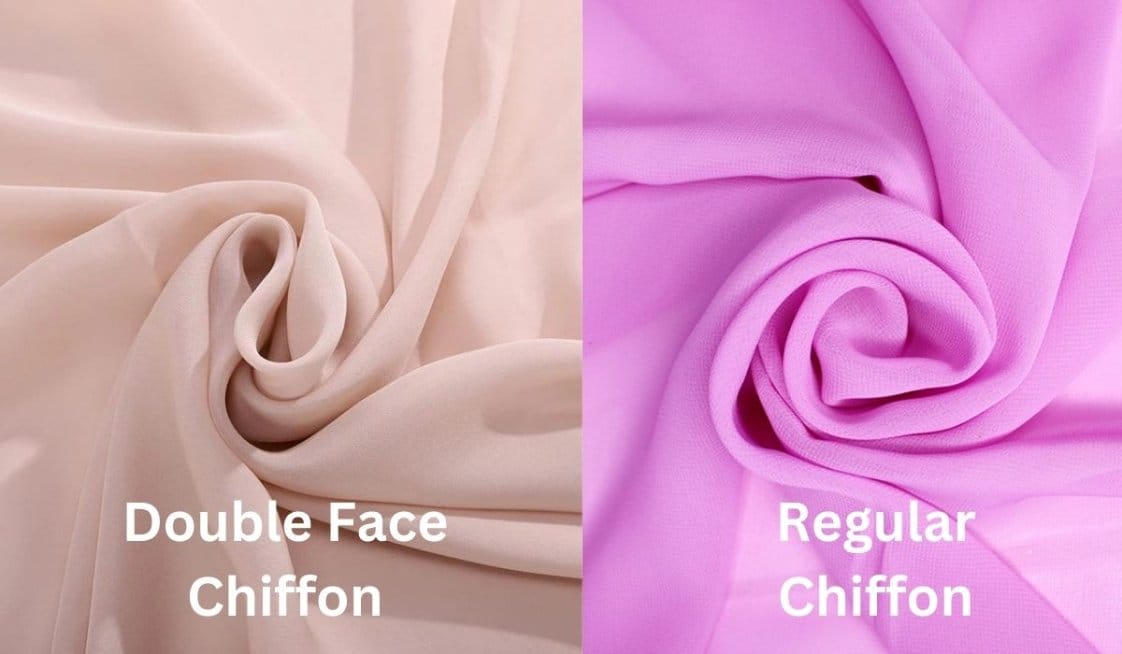
Double face chiffon versus regular chiffon to show added opacity, durability, and improved drape.
This is the most obvious comparison since they’re closely related.
Double Face Chiffon Advantages
- Much less transparent (semi-opaque to opaque)
- Stronger and more durable
- Easier to sew (less slippery)
- Often doesn’t need lining
- More forgiving of sewing mistakes
- Better for beginners
Regular Chiffon Advantages
- More lightweight and airy
- More fluid drape
- Less expensive per yard
- Better for layering effects
- More ethereal appearance
The Bottom Line: Choose double face chiffon when you want the chiffon look without the sheerness problem. Choose regular chiffon when you specifically want that see-through, ultra-lightweight quality or when you’re planning to layer the fabric.
Double Face Chiffon vs. Georgette
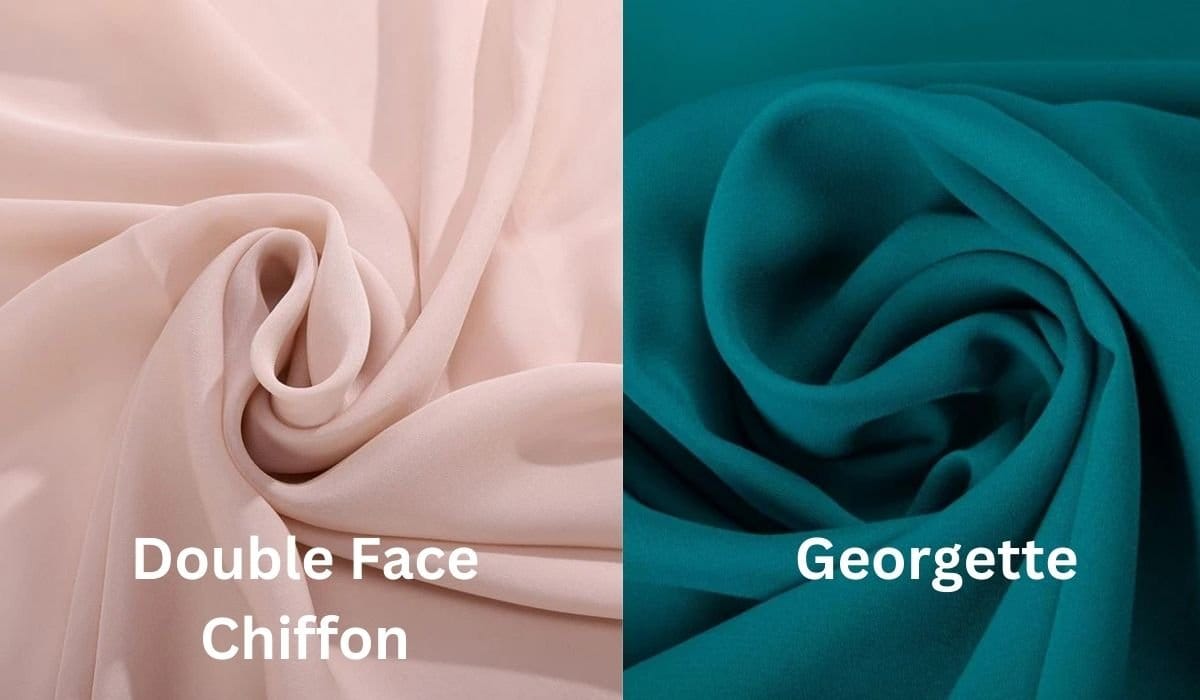
Fabric comparison between smooth double face chiffon and lightly textured georgette for different garment effects.
People often confuse these two fabrics. Georgette is another lightweight fabric that looks similar to chiffon at first glance.
Key Differences:
- Texture: Georgette has a more pronounced crepe texture and feels grainier. Chiffon is smoother.
- Weight: Georgette is slightly heavier and has more body than even double face chiffon.
- Drape: Chiffon flows more freely; georgette has more structure and holds pleats better.
- Appearance: Georgette has a matte finish; chiffon has a subtle sheen.
- Opacity: Regular georgette is more opaque than single chiffon but similar to double face chiffon.
When to Choose What: Pick double face chiffon for more delicate, flowing designs with a soft sheen. Choose georgette when you want more structure, better pleat retention, or a matte appearance. Georgette works better for tailored pieces, while double face chiffon excels in romantic, flowing designs.
Double Face Chiffon vs. Organza
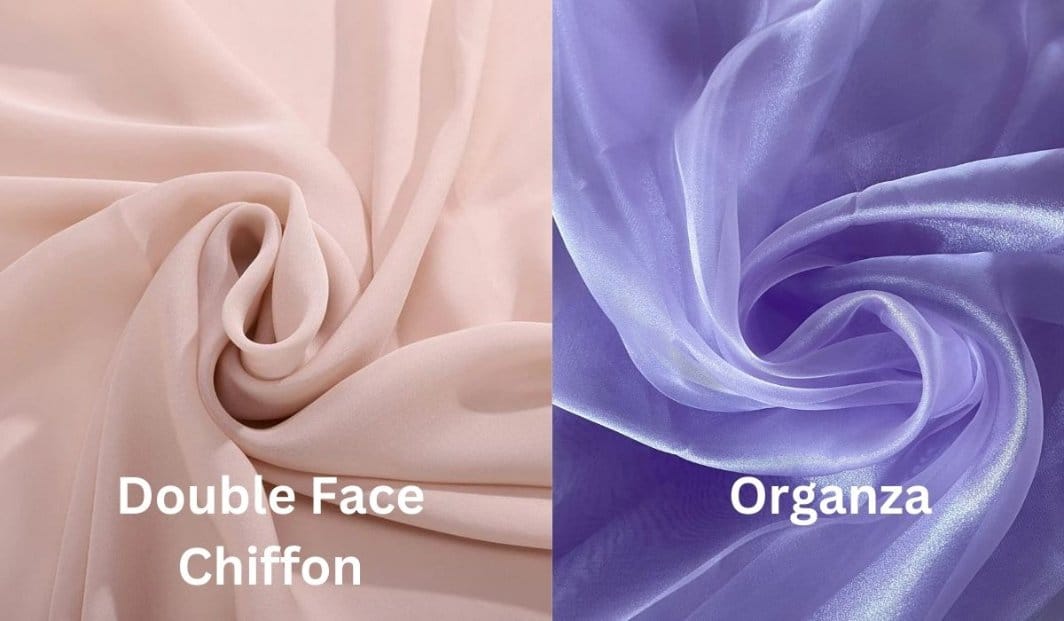
Double face chiffon and organza comparison highlighting soft flow versus crisp structure for formal designs.
Organza is another lightweight, sheer fabric, but it’s quite different from chiffon.
Major Differences:
- Stiffness: Organza is crisp and holds its shape. Chiffon is soft and drapey.
- Hand Feel: Organza can feel scratchy. Chiffon is soft and comfortable.
- Uses: Organza is for structure (petticoats, structured sleeves). Chiffon is for fluid designs.
- Sound: Organza rustles and makes noise. Chiffon is silent.
The Choice: These fabrics aren’t really interchangeable. Use organza when you need the fabric to stand away from the body or hold a specific shape. Use double face chiffon when you want soft, flowing movement.
Double Face Chiffon vs. Double Cloth
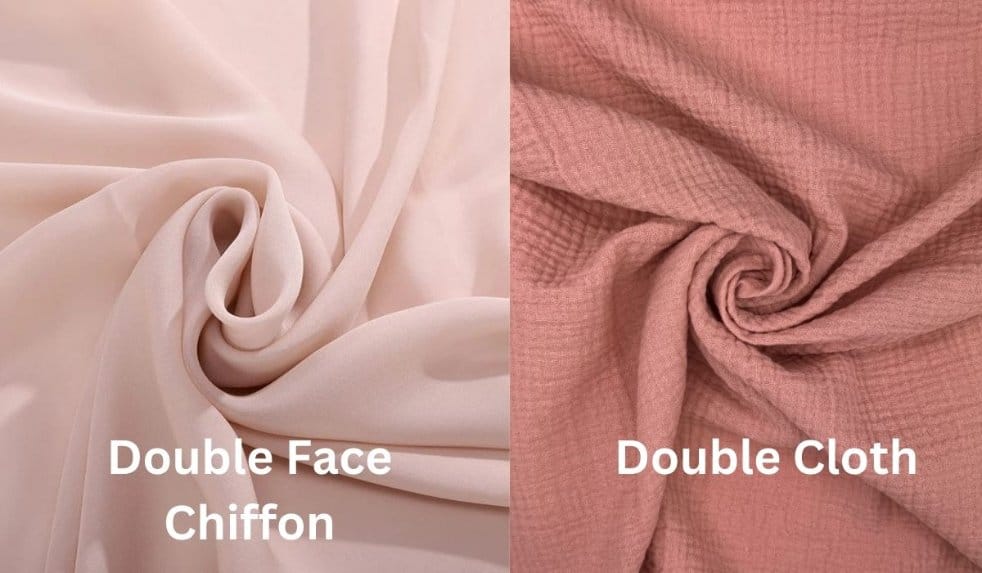
Lightweight double face chiffon contrasted with heavier double cloth fabric to show differences in thickness and structure.
This causes confusion because the names sound similar, but these are completely different fabrics.
Double cloth is typically made from wool or cotton. It’s a woven fabric where two layers are joined together with visible binding threads. You can actually see where the two layers connect, and sometimes you can partially separate them at the edges.
Double cloth is:
- Much heavier than double face chiffon
- Usually reversible with different colors/patterns on each side
- Used for coats, jackets, and structured garments
- Has a completely different drape (structured, not flowy)
Don’t Mix These Up: If you’re shopping online and see “double cloth,” that’s not the same as “double face chiffon.” They’re used for entirely different types of projects.
Double Face Chiffon vs. Crepe
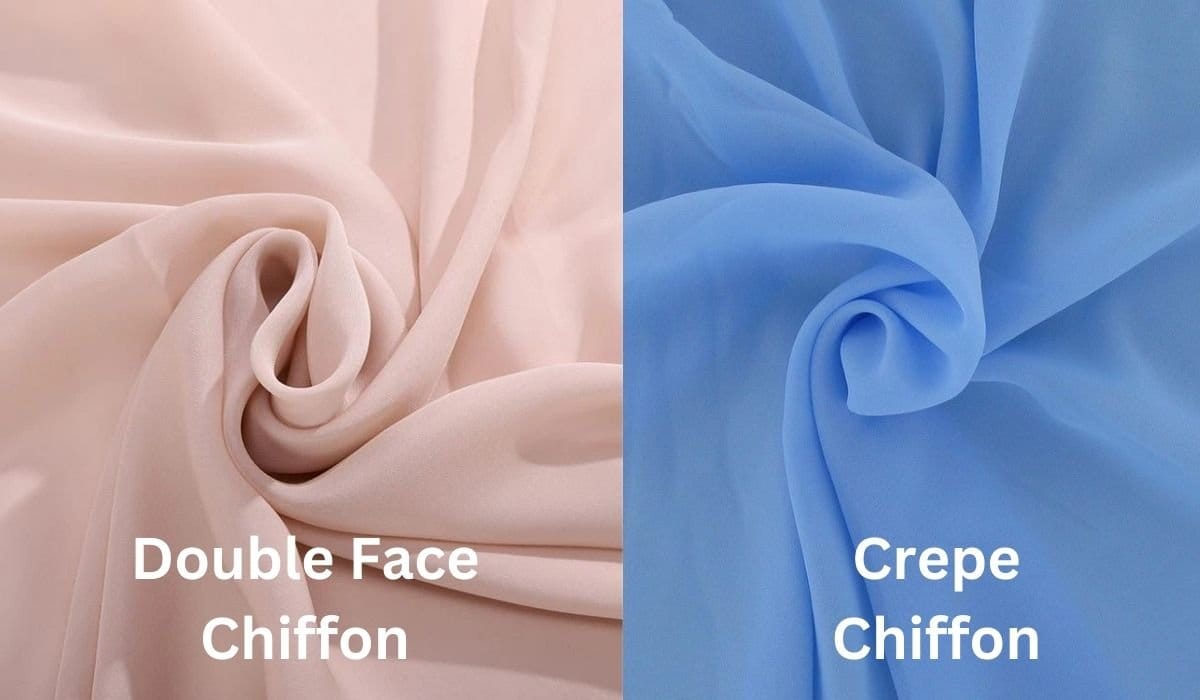
Double face chiffon compared with crepe chiffon to highlight differences in texture, drape, and fabric finish.
Crepe fabrics have a crinkled texture created by using highly twisted yarns (similar to chiffon’s construction). But crepe generally refers to heavier fabrics with more body.
Crepe chiffon is actually a type of chiffon with more texture. When made as double face, it offers the best of both worlds, but the texture is more pronounced than smooth double face chiffon.
Double Face Chiffon vs. Voile
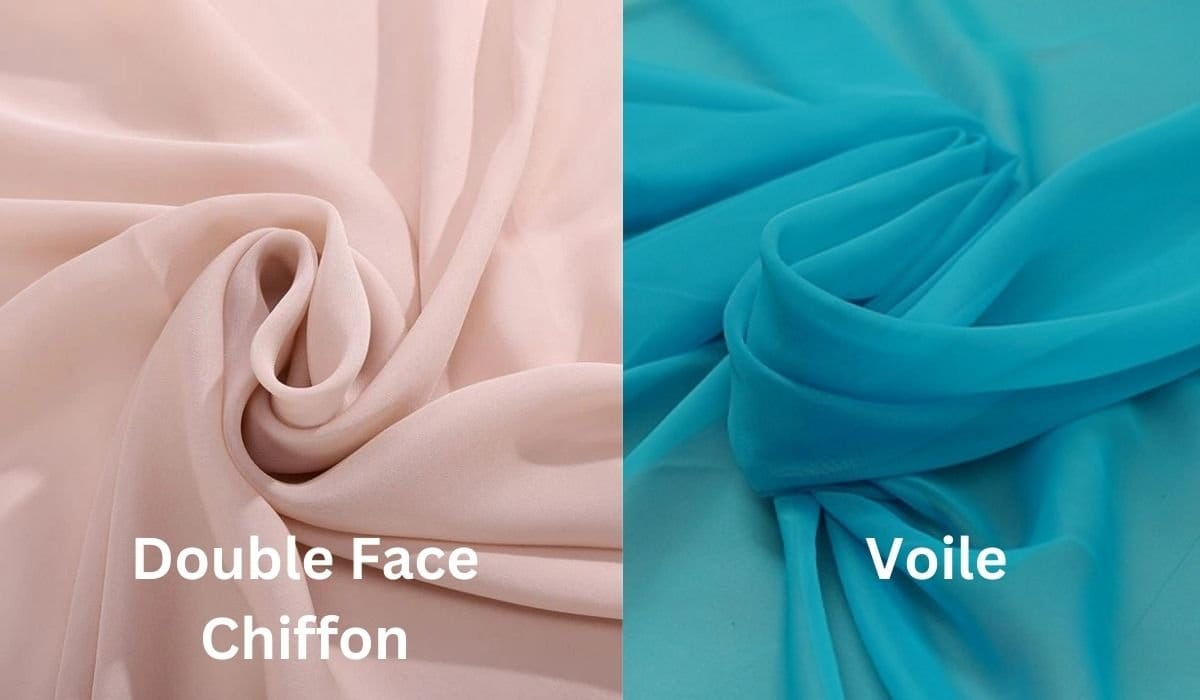
Double face chiffon contrasted with voile fabric to highlight silky drape versus soft breathable cotton feel.
Voile is another lightweight, semi-sheer fabric, but it’s woven differently. It’s made with a plain weave from combed cotton or cotton blends.
Comparisons:
- Feel: Voile is softer and more like cotton. Chiffon has more texture.
- Drape: Chiffon drapes more fluidly. Voile has a slightly crisper fall.
- Sheerness: Cotton voile is less sheer than single chiffon but similar to double face chiffon.
- Use: Voile is better for summer tops and casual wear. Double face chiffon is better for dressier occasions.
| Fabric | Weight | Drape | Transparency | Best For |
|---|---|---|---|---|
| Double Face Chiffon | Light | Very fluid | Semi-opaque to opaque | Flowing dresses, evening wear |
| Regular Chiffon | Very light | Extremely fluid | Very sheer | Layered looks, overlays |
| Georgette | Light-medium | Fluid with structure | Semi-opaque | Blouses, structured dresses |
| Organza | Light | Stiff, stands away | Sheer to semi-sheer | Structured elements, overlays |
| Double Cloth | Heavy | Structured | Opaque | Coats, jackets |
Uses and Applications
Double face chiffon works beautifully for many different projects. Here’s where it really shines.
Fashion and Clothing
Evening Wear and Formal Gowns
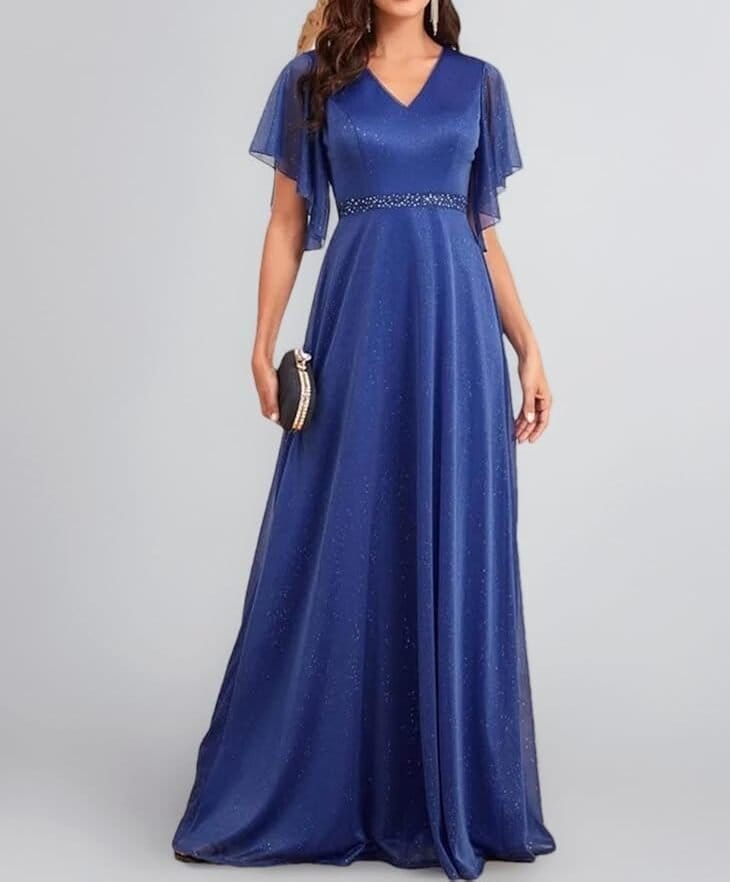
Chic navy chiffon evening dress combining elegance, lightweight comfort, and graceful movement for special events.
This is probably the most popular use. Double face chiffon creates those flowing, romantic evening gowns you see on red carpets and at formal events. The fabric drapes beautifully over the body without clinging, creating a flattering silhouette.
It works well for:
- Full-length evening gowns with flowing skirts
- Empire waist dresses that need soft gathering
- Draped or Grecian-style gowns
- Gowns with flowing sleeves or cape details
Bridal and Bridesmaid Dresses
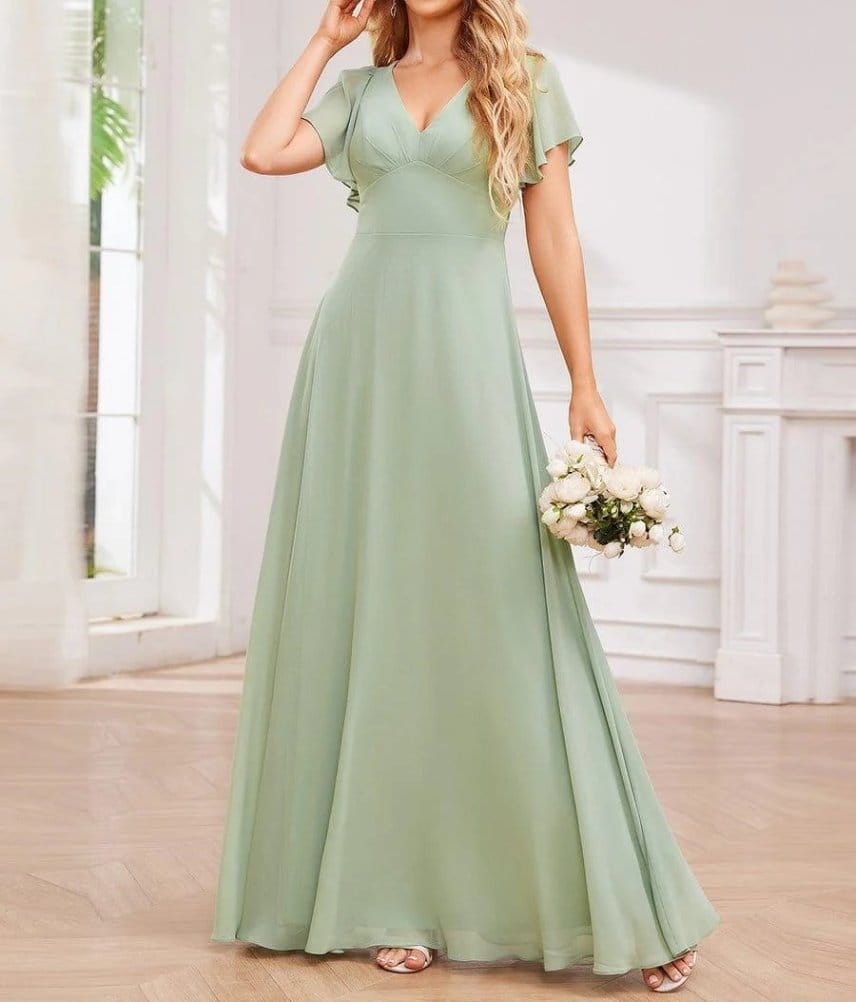
Elegant bridesmaid dress in double face chiffon featuring a graceful drape and romantic flowing silhouette.
Brides and bridesmaids love double face chiffon because it photographs beautifully and moves gracefully. It’s especially popular for destination weddings and outdoor ceremonies because it’s lightweight and comfortable in warm weather.
The fabric works for both the main wedding dress and bridesmaid dresses. For brides, it’s often used in flowing sleeves, overlays, or for the entire gown in more casual wedding styles. For bridesmaid dresses, it’s perfect because you can get multiple dresses in the same fabric that will all photograph consistently.
Blouses and Tops
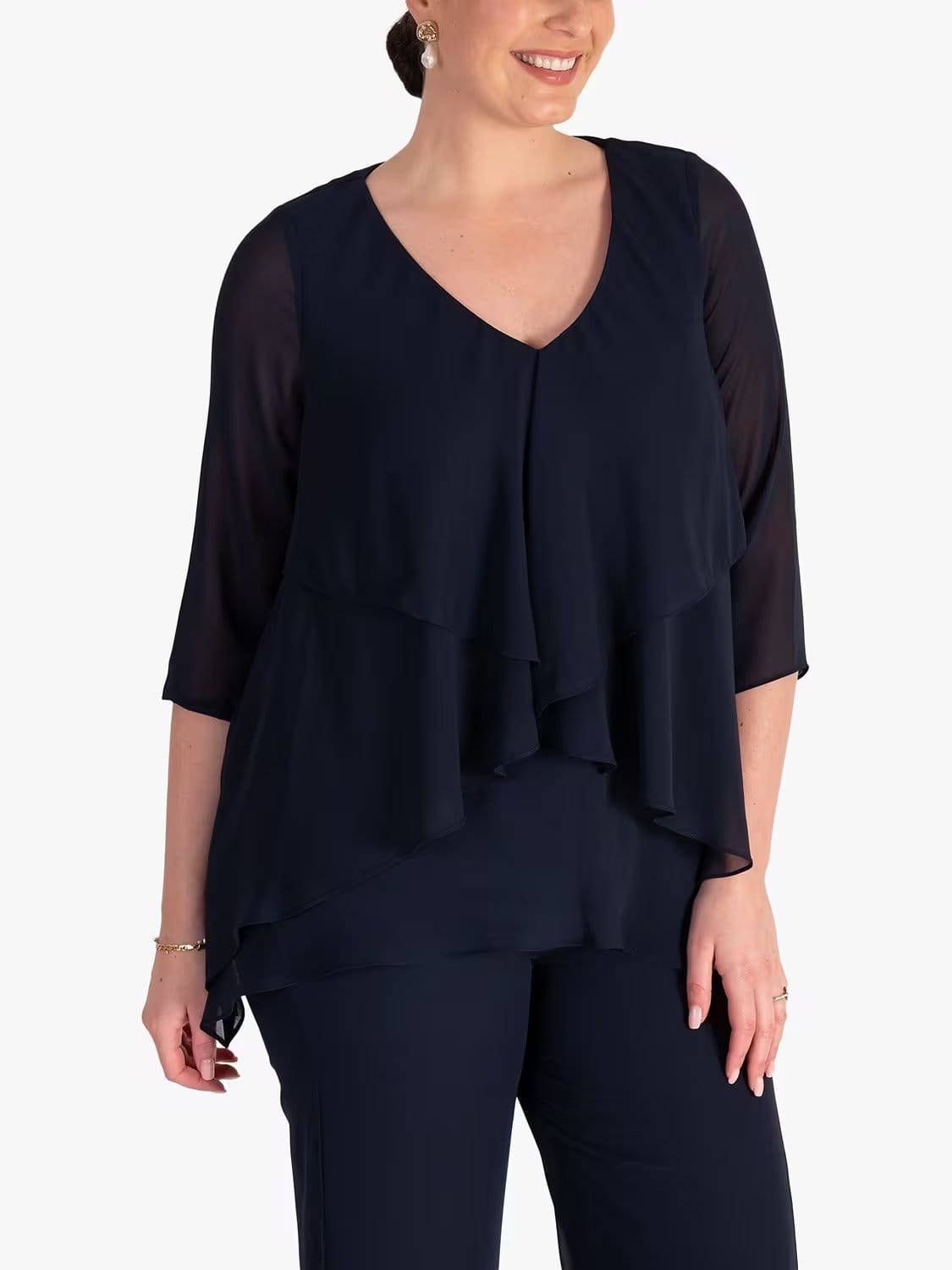
Layered chiffon blouse with soft drape and sheer sleeves, showcasing the lightweight elegance of double face chiffon fabric.
Double face chiffon makes beautiful dressy blouses. Unlike regular chiffon, you often don’t need a camisole underneath (though light colors might still benefit from one). The fabric is opaque enough for professional settings while still being elegant.
Popular styles include:
- Draped neckline blouses
- Peasant-style tops with gathered details
- Button-front shirts with a flowy fit
- Kimono-style tops
Skirts and Dresses
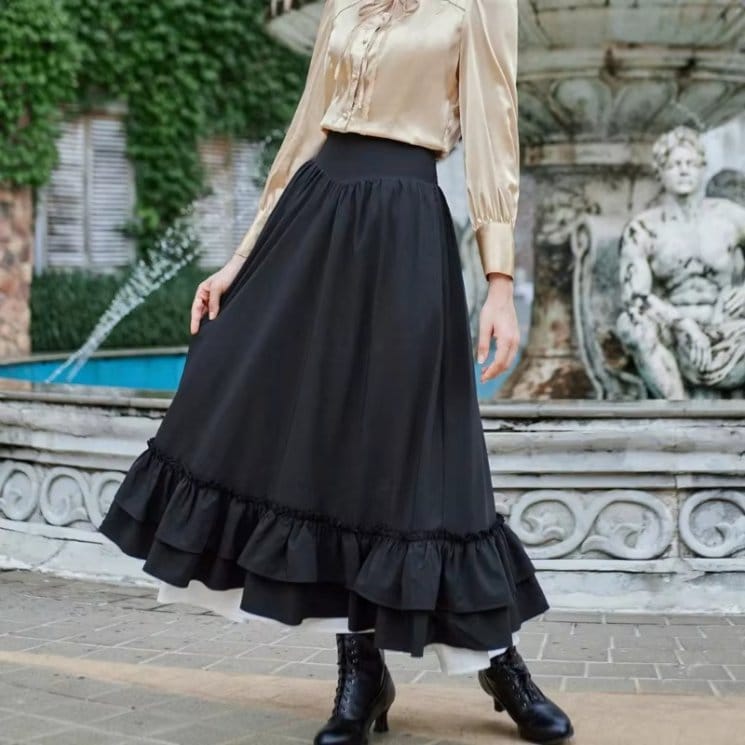
Flowing black double face chiffon skirt with ruffle detail, perfect for breathable everyday wear and elegant styling.
A-line skirts in double face chiffon are flattering on almost everyone. The fabric creates a gentle swing as you walk without adding bulk. Maxi skirts in this fabric are comfortable and elegant for both day and evening wear.
For dresses, double face chiffon works for both fitted bodices with flowing skirts and entirely draped designs. The opacity means you can create dresses that are actually wearable without extensive lining work.
Scarves and Wraps
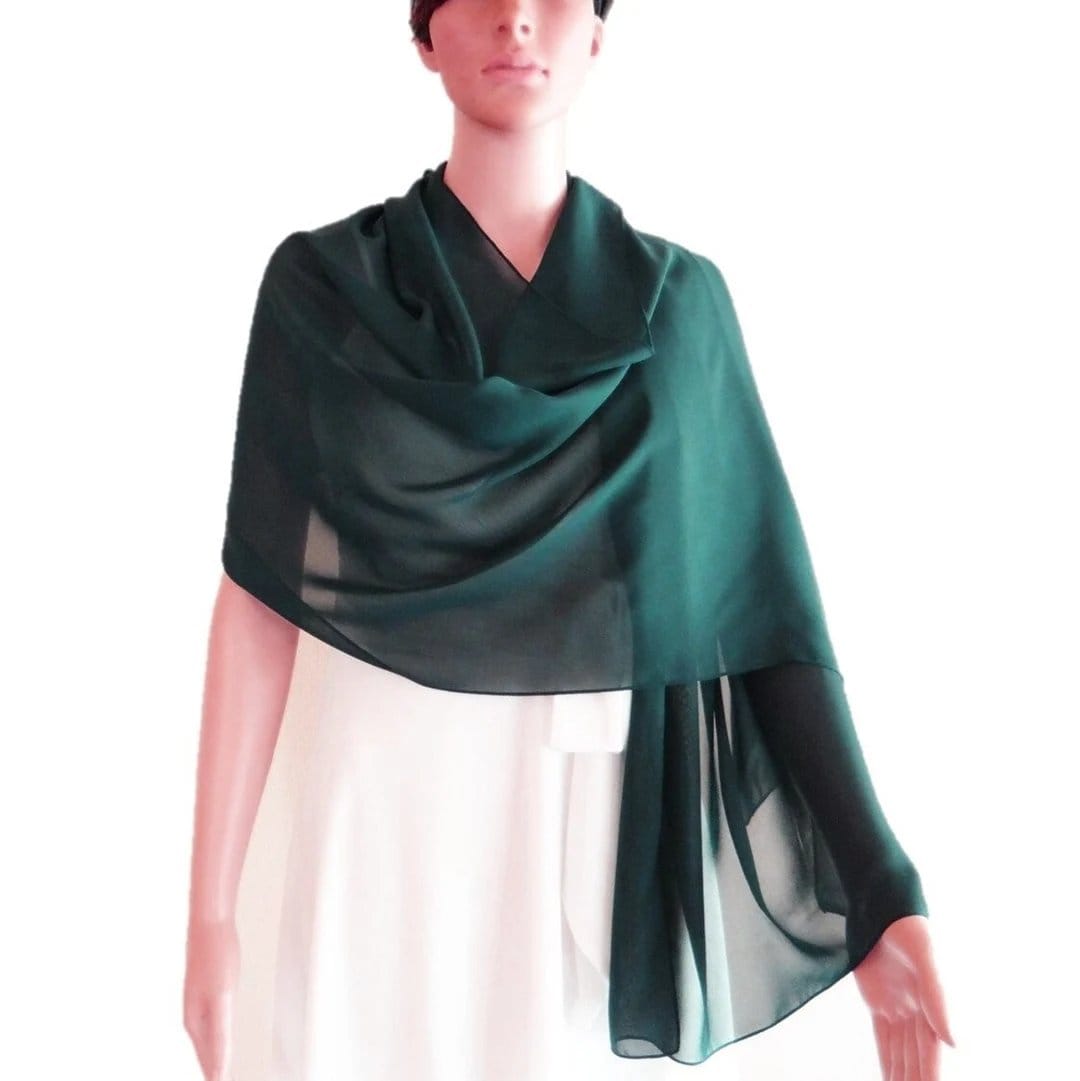
Lightweight double face chiffon shawl offering soft coverage, breathable comfort, and elegant layering for formal outfits.
This is where the “double face” aspect really matters. Since both sides of a scarf or wrap are visible, having two finished sides makes the accessory look professional from every angle.
Double face chiffon scarves drape beautifully around the neck and shoulders. They’re lightweight enough to wear indoors but can add a touch of warmth outdoors. Iridescent versions (with different colors on each layer) create especially stunning scarves that shift in color as they move.
Traditional and Cultural Garments
In South Asian fashion, double face chiffon is extremely popular for sarees. The fabric drapes beautifully in the traditional style and photographs well at weddings and celebrations. The added opacity compared to single-layer chiffon makes these sarees more practical for actual wear.
The fabric is also used in other traditional garments worldwide where flowing, elegant fabric is desired but practical wear is important.
Beyond Clothing
Home Decor
Double face chiffon has applications in home decorating, particularly for creating elegant, flowing effects:
- Curtains and Drapes: The fabric filters light beautifully while still providing some privacy. It’s especially nice for spaces where you want an airy, romantic feel.
- Bed Canopies: Double face chiffon creates that dreamy, flowing canopy look without being so sheer that it offers no visual barrier.
- Table Overlays: For special events, double face chiffon table runners or overlays add elegance without being heavy.
Event and Wedding Decor
Event designers use double face chiffon for various decorative purposes:
- Ceiling draping that creates flowing, romantic spaces
- Backdrop curtains for photo areas
- Chair sashes and bows
- Fabric swags and garlands
The fabric is light enough to drape easily but has enough body to hold its arrangement without constant adjustment.
Costume and Performance Wear
Dancers and performers appreciate double face chiffon for costumes. It moves beautifully during performance, creating dramatic visual effects without the transparency issues of single-layer chiffon.
It’s used in:
- Ballet and contemporary dance costumes
- Theater costumes where flowing movement is needed
- Figure skating dresses (usually polyester or nylon versions)
- Stage performance outfits
Photography and Film
Photographers love double face chiffon for portrait and maternity photography. The fabric creates beautiful flowing effects in photos without being overly transparent. It catches wind beautifully for outdoor shoots.
Why Choose Double Face Chiffon?
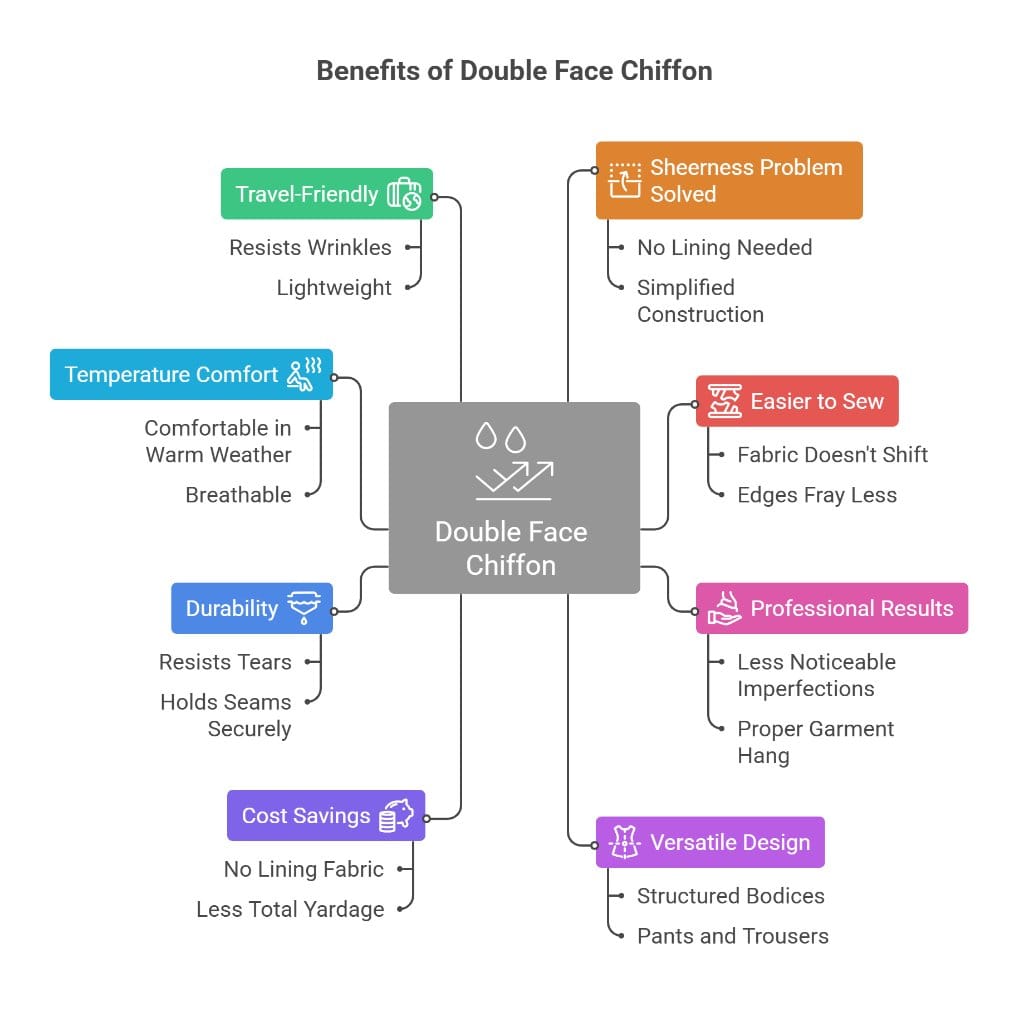
Benefits of double face chiffon illustrated through a clear infographic covering comfort, durability, sewing ease, and design versatility.
Let’s talk about what makes double face chiffon worth considering over other fabric options. These benefits explain why it’s become so popular despite being more expensive than single-layer chiffon.
The Sheerness Problem is Solved
This is the biggest advantage. Regular chiffon is beautiful but frustratingly see-through. You end up needing:
- Separate lining pieces for every pattern piece
- Slip or camisole underneath
- Multiple layers of the same fabric
- Constant worry about what shows through
Double face chiffon eliminates most of these concerns. While you might still line very light colors or fitted bodices, many projects need no additional lining at all. This saves time, reduces fabric costs, and simplifies construction.
Easier to Sew (Seriously)
If you’ve ever wrestled with regular chiffon, you know it can slip and slide under your sewing machine needle like it has a mind of its own. The two layers in double face chiffon add just enough grip and stability to make sewing significantly easier.
Benefits for sewing:
- Fabric doesn’t shift as much during cutting
- Layers don’t separate or slide against each other while sewing
- Edges fray less than single-layer chiffon
- Seams are less visible because the fabric has more body
- Gathering and pleating work more predictably
This makes double face chiffon a much better choice for intermediate sewers who want that chiffon look but don’t have years of experience working with slippery fabrics.
Professional Results Without Professional Skills
Because the fabric is more forgiving, you can achieve professional-looking results more easily. Small imperfections in your seams or gathering are less noticeable. The fabric’s body helps the garment hang properly even if your construction isn’t perfect.
This doesn’t mean you can be sloppy. It means that the fabric works with you instead of fighting you at every step.
Versatile Design Potential
Double face chiffon works for more garment styles than regular chiffon. The added opacity and structure mean you can use it for:
- Structured bodices without lining
- Fitted sleeves that don’t require slip linings
- Pants and wide-leg trousers (which would be impossible with sheer chiffon)
- Professional wear that’s elegant but workplace-appropriate
You’re not limited to just floating, fully lined gowns. The fabric adapts to both casual and formal designs.
Cost Savings in the Long Run
Yes, double face chiffon costs more per yard than single-layer chiffon. But consider what you save:
- No lining fabric needed for most projects (saves $3-10 per yard)
- Less total yardage required since you’re not cutting lining pieces
- Time savings from simpler construction (which has value)
- Less waste from mistakes since the fabric is easier to handle
For many projects, you’ll actually spend less overall using double face chiffon even though it costs more per yard.
Durability for Actual Wear
Garments made from double face chiffon hold up better to wearing and washing than those made from single-layer chiffon. The double layer construction:
- Resists tears and snags better
- Holds seams more securely
- Withstands wearing stress better (sitting, moving, dancing)
- Maintains appearance longer with proper care
This matters especially for event wear that might be worn multiple times or for garments you plan to keep for years.
Temperature Comfort
Despite having two layers, double face chiffon is still light enough to be comfortable in warm weather. It’s not as cool as single-layer chiffon, but it’s far cooler than most lined garments.
The breathability (especially in silk versions) makes it suitable for summer events, outdoor weddings, and warm-climate wear. You get the coverage you need without overheating.
Travel-Friendly
Polyester and nylon double face chiffon pack well for travel. They resist wrinkles reasonably well, and any creases usually fall out after hanging. The fabric is lightweight, so it doesn’t take up much room or add weight to luggage.
For destination weddings or events that require travel, this practical advantage matters more than you might think.
Photogenic
Double face chiffon photographs beautifully. It catches light without looking shiny. It moves naturally in photos without looking stiff or artificial. The slight texture adds visual interest in photographs that flat fabrics don’t provide.
For events where lots of photos will be taken (weddings, galas, performances), this is a real advantage.
Sustainability and Environmental Impact
If you care about how your fabric choices affect the environment, understanding the sustainability of double face chiffon matters. The impact varies significantly based on what the fabric is made from.
Silk Double Face Chiffon: The Natural Option
Environmental Positives
Silk is a natural, biodegradable fiber. A silk garment will eventually break down completely if composted, unlike synthetic fabrics that can persist for hundreds of years.
The production of silk doesn’t require petroleum-based chemicals. Silkworms eat mulberry leaves, which can be grown organically without pesticides. The silk production process releases minimal toxins into water and air compared to synthetic fiber manufacturing.
According to research from Britannica, silk production can be done sustainably with proper farming practices.
Environmental Concerns
Silk production does have environmental costs. Growing mulberry trees requires water, though less than cotton farming needs. The process of harvesting silk involves boiling cocoons with the silkworm inside, which raises ethical concerns for some people (though the environmental impact is minimal).
Conventional silk farming sometimes uses pesticides and chemicals for processing. Look for organic certifications if this concerns you.
Water usage in silk processing can be significant. The degumming process (removing sericin from raw silk) uses substantial water, though this can be treated and recycled in modern facilities.
What to Look For
When buying silk double face chiffon, look for these certifications:
- GOTS (Global Organic Textile Standard): Ensures organic silk production with strict environmental standards
- OEKO-TEX Standard 100: Tests for harmful substances in the final fabric (OEKO-TEX official site)
- Peace Silk or Ahimsa Silk: Allows the silkworm to complete its life cycle before harvesting silk (though this makes different fabric properties)
Polyester Double Face Chiffon: The Synthetic Story
Environmental Challenges
Polyester is made from petroleum, a non-renewable resource. The production process is energy-intensive and releases greenhouse gases. This makes polyester’s carbon footprint significantly larger than natural fibers.
Polyester doesn’t biodegrade. A polyester garment in a landfill will sit there for hundreds of years. When polyester fabric is washed, it releases microplastics into water systems. These tiny plastic particles make their way into oceans and eventually into the food chain.
Chemical dyes and finishing treatments used on polyester can pollute water if not properly managed. Many polyester production facilities are in countries with less strict environmental regulations.
The Recycled Polyester Alternative
Recycled polyester (made from plastic bottles or recycled garments) addresses some concerns. It uses existing plastic rather than new petroleum. The process still requires energy but less than creating virgin polyester.
Recycled polyester double face chiffon is becoming more available. Look for fabrics certified by:
- GRS (Global Recycled Standard): Verifies recycled content and tracks the supply chain
- Recycled Claim Standard (RCS): Documents recycled material content
Even recycled polyester still sheds microplastics when washed and won’t biodegrade. But it’s a better choice than virgin polyester if you want synthetic fabric.
Learn more about recycled polyester options and their benefits.
Making Polyester More Sustainable
If you choose polyester double face chiffon:
- Buy quality fabric that will last for years
- Wash less frequently and use cold water
- Use a microplastics-catching laundry bag (like Guppyfriend)
- Don’t throw away polyester garments (donate, repurpose, or recycle)
- Choose recycled polyester when available
Nylon Double Face Chiffon
Nylon has a similar environmental profile to polyester. It’s petroleum-based, doesn’t biodegrade, and releases microplastics. Some argue nylon is slightly better because it’s more durable and lasts longer, reducing replacement frequency.
Recycled nylon (often made from fishing nets and carpet fibers) is available but less common in chiffon fabrics. The same care practices that make polyester more sustainable apply to nylon.
Comparing the Options
| Factor | Silk | Organic Silk | Virgin Polyester | Recycled Polyester |
|---|---|---|---|---|
| Biodegradable | Yes | Yes | No | No |
| Renewable Resource | Yes | Yes | No | Partially |
| Carbon Footprint | Lower | Lowest | Higher | Moderate |
| Microplastics | No | No | Yes | Yes |
| Water Pollution Risk | Moderate | Low | Higher | Moderate |
| Durability | Good | Good | Excellent | Excellent |
The Longevity Factor
One of the most sustainable choices you can make is buying quality fabric that lasts. A well-made garment worn for 10 years has far less environmental impact than cheap items replaced yearly.
Double face chiffon (whether silk or synthetic) is durable enough to last years with proper care. This longevity is itself a form of sustainability. Taking good care of what you make or buy matters more than almost any other single choice.
Making Better Choices
Here’s a practical approach to choosing more sustainable double face chiffon:
- Buy the best quality you can afford. It will last longer.
- Choose silk or organic silk when budget allows and the project is appropriate.
- If buying synthetic, look for recycled content and GRS certification.
- Buy only what you need. Leftover fabric often goes to waste.
- Care for items properly to extend their life.
- Consider secondhand sources for vintage or gently used fabric.
- Use every scrap. Even small pieces can become accessories or embellishments.
For a deeper look at fabric sustainability, read about natural vs synthetic fabrics and their environmental impacts.
How to Sew with Double Face Chiffon
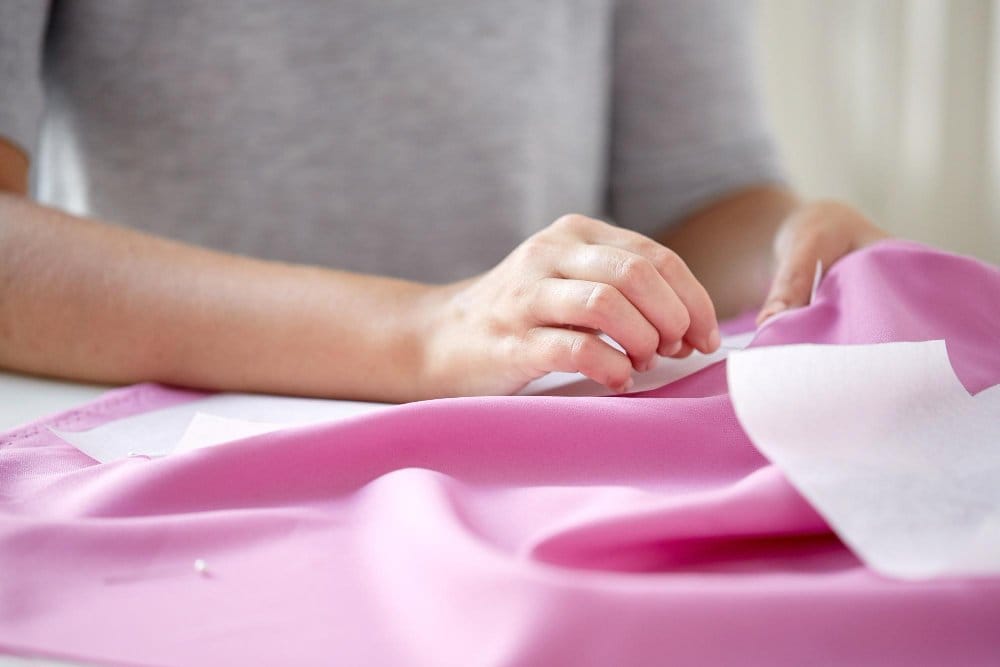
Preparing double face chiffon for sewing with pins and pattern paper to ensure accuracy and smooth garment construction.
Ready to actually work with this fabric? Here’s everything you need to know to get good results, even if you’re not an expert. Our beginner’s guide to sewing provides additional foundational techniques.
Step-by-Step Sewing Guide
Preparation and Cutting
Prewash (Maybe): Check your fabric’s content. Silk double face chiffon usually shouldn’t be prewashed (it can lose body). Polyester might shrink slightly, so prewashing in cool water is safer if you plan to machine wash the finished garment.
Let It Rest: After bringing fabric home or unfolding it, let it rest flat for several hours or overnight. This lets wrinkles fall out naturally and the fabric relax to its natural state.
Cutting Setup:
- Use a rotary cutter and cutting mat for the cleanest edges. Sharp fabric scissors work too but require more careful handling.
- Cut on a single layer rather than folding the fabric. Yes, this takes longer, but it’s more accurate.
- Pin pattern pieces within seam allowances so pin holes won’t show in the finished garment.
- Use pattern weights instead of pins when possible to avoid any holes or marks.
Marking: Use tailor’s chalk or washable markers that work on delicate fabrics. Test on a scrap first. Avoid tracing wheels that might snag the fabric.
Tools and Supplies You’ll Need
The Right Needle: Use a fine needle (size 60/8 or 70/10 for machine sewing, size 9 or 10 for hand sewing). Sharp or microtex needles work best. A dull or too-large needle will snag and damage the fabric.
Thread Selection: Choose fine thread (50 weight or finer). Cotton-wrapped polyester or 100% polyester thread works well. The thread color should match your fabric exactly because seams will show through the layers.
Machine Settings:
- Stitch length: 2.0-2.5mm (slightly shorter than normal)
- Tension: May need to be slightly reduced (test on scraps)
- Presser foot pressure: Lighter than normal to prevent fabric stretching
Helpful Tools:
- Walking foot or dual feed foot (helps prevent layers from shifting)
- Tissue paper or tear-away stabilizer
- Seam sealant (Fray Check) for finishing edges
- Sharp scissors or rotary cutter
- Fine pins or pin alternatives (silk pins if using pins)
Sewing Techniques That Work
Test First: Always sew test seams on scraps before starting your actual project. Adjust tension, stitch length, and pressure based on these tests.
Seam Options:
French Seams (Best Choice):
- Sew with wrong sides together first
- Trim seam allowance to 1/8 inch
- Press seam to one side
- Fold right sides together, enclosing raw edges
- Sew again, trapping raw edges inside
French seams look beautiful on sheer or semi-sheer fabrics because they’re neat even when visible through the fabric.
Narrow Hem or Rolled Hem:
- Roll edge very narrow (1/8 inch or less)
- Stitch close to the fold
- Trim excess if needed
Flat Felled Seams: Good for straight seams that need strength. Takes more time but creates a professional finish.
Prevent Slipping: Place tissue paper between the fabric and feed dogs. Sew through the paper, then tear it away afterward. This prevents the fabric from being pulled into the machine and helps even feeding.
Start and Stop Carefully: Hold thread tails when starting to prevent the fabric from being pulled down into the feed dogs. When ending, leave long thread tails and tie them off by hand rather than backstitching (which can cause puckering).
Special Techniques
Gathering: Double face chiffon gathers beautifully. Use the longest stitch length on your machine and don’t backstitch at the ends. Sew two parallel rows of stitching, then gently pull both bobbin threads together to create gathers. Distribute gathers evenly before securing.
Darts: Taper darts to nothing at the point. Don’t backstitch. Instead, leave long thread tails and tie them off by hand. Press darts carefully with low heat to avoid shine or damage.
Zippers: Use invisible zippers when possible. They work beautifully with double face chiffon and create the neatest finish. Regular zippers work too but require more careful installation.
Buttonholes: These can be tricky in double face chiffon. Consider using alternative closures like hooks and eyes, snaps, or ties. If you must use buttonholes, interface the area first with very lightweight fusible interfacing.
Hemming: Narrow rolled hems work best. You can also use a baby hem (very narrow) or a single-fold hem. Avoid wide hems that add bulk and distort the drape.
Pressing Tips
Heat Settings: Use the lowest heat setting that’s effective for your fiber content. Silk and polyester both require low heat. Test on scraps first.
Steam: Light steam helps. Too much steam can cause water spots on some fabrics (especially silk).
Pressing Cloth: Always use a pressing cloth between the iron and your fabric. This prevents shine, scorching, or texture changes.
Technique: Press rather than iron. Lift the iron and set it down gently rather than sliding it across the fabric. Sliding can stretch and distort double face chiffon.
Let It Cool: Don’t handle pressed areas immediately. Let them cool completely on the ironing board to set the press.
Common Sewing Problems and Solutions
| Problem | Cause | Solution |
|---|---|---|
| Fabric puckering at seams | Thread tension too tight | Reduce upper tension slightly; use quality thread |
| Layers separating at edges | Bonding coming apart | Use seam sealant on raw edges; choose better quality fabric next time |
| Skipped stitches | Needle too dull or wrong type | Replace with fresh sharp or microtex needle |
| Fabric pulled into machine | Needle too large; improper start | Use smaller needle; hold threads when starting |
| Wavy seams after sewing | Stretching while sewing | Reduce pressure on presser foot; use walking foot |
For additional sewing techniques and troubleshooting, check our sewing machine troubleshooting guide.
Care and Maintenance
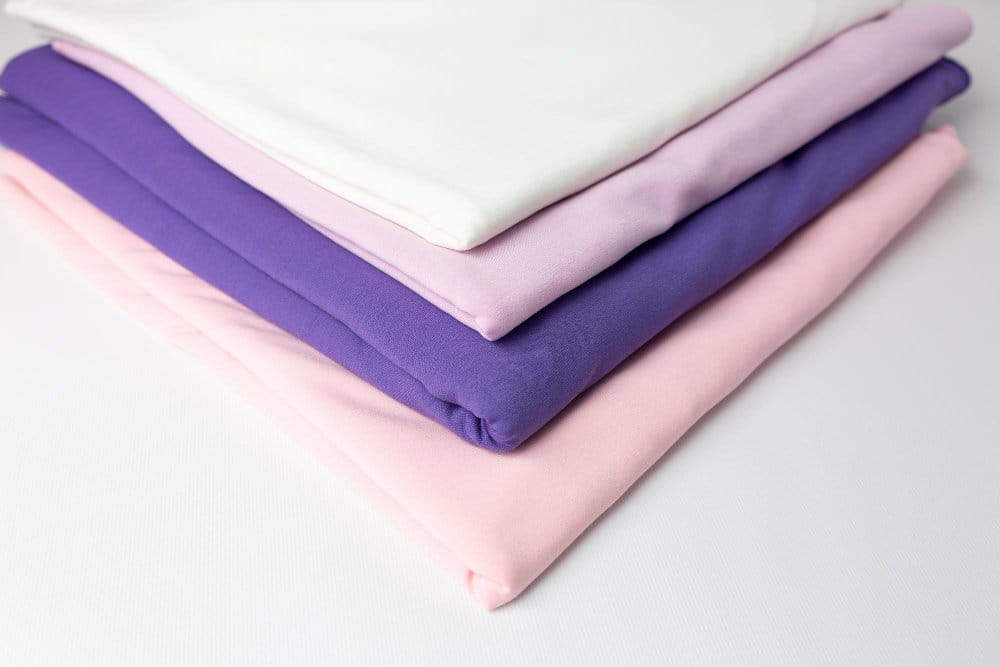
Pastel double face chiffon fabrics stacked neatly, perfect for gentle washing, careful handling, and long lasting garment care.
Taking care of double face chiffon properly makes your garments last years instead of just a few wears. The care depends on fiber content, so always check your fabric’s specifics first.
Reading Care Labels and Determining Fiber Content
Before washing anything, check the care label if your fabric came with one. If you bought fabric by the yard without care instructions, you need to know the fiber content. Ask when purchasing, or do a burn test on a small scrap (cotton burns differently than synthetics).
Washing Double Face Chiffon
Silk Double Face Chiffon
Dry Cleaning (Safest): Professional dry cleaning is the safest choice for silk double face chiffon. It maintains the fabric’s body and sheen while cleaning it thoroughly. Specify that your garment is delicate silk.
Hand Washing (If Necessary): If you must wash silk double face chiffon at home:
- Fill a basin with cool water (not cold, not warm)
- Add a tiny amount of gentle detergent made for silk or delicates
- Swish the water gently to dissolve detergent
- Submerge the garment and swish very gently for 2-3 minutes maximum
- Don’t rub, scrub, or wring
- Rinse thoroughly in cool water until no soap remains
- Press gently between clean towels to remove excess water (don’t wring)
Never: Use hot water, harsh detergents, bleach, or fabric softener on silk double face chiffon. These can permanently damage the fibers or change the fabric’s texture.
Polyester Double Face Chiffon
Machine Washing (Usually Safe): Most polyester double face chiffon can be machine washed, but gently:
- Turn garment inside out
- Place in a mesh laundry bag for protection
- Use cool or cold water
- Select delicate or gentle cycle
- Use mild detergent (avoid harsh chemicals)
- Skip fabric softener (it can build up on synthetics)
Hand Washing (Better Choice): Hand washing is always gentler and helps polyester chiffon last longer. Follow the same process as silk but you can be slightly less delicate.
Nylon Double Face Chiffon
Treat similarly to polyester. Nylon can handle machine washing on gentle cycle but hand washing is better for longevity. Use cool water and mild detergent.
Drying Double Face Chiffon
The Golden Rule: Air Dry Only
Never put double face chiffon in the dryer. The heat can:
- Melt or damage synthetic fibers
- Cause shrinkage
- Create permanent wrinkles
- Damage the bonding between layers (for bonded types)
- Change the fabric’s texture and hand
Proper Air Drying:
For Silk:
- Gently press water out using towels (never wring)
- Lay flat on a clean, dry towel on a flat surface
- Reshape garment to original dimensions
- Keep away from direct sunlight (can fade colors)
- Let dry completely before moving or storing
For Polyester and Nylon:
- Remove excess water by pressing between towels
- Can hang on padded hanger to dry (won’t stretch as much as silk)
- Keep in shaded area with good air circulation
- Garment should be dry within a few hours
Removing Stains
Act fast with stains. The longer they sit, the harder they are to remove.
For Fresh Stains:
- Blot (don’t rub) immediately with a clean, absorbent cloth
- For water-soluble stains, dab with cool water
- Work from outside of stain toward center to prevent spreading
- Let air dry and assess if more treatment is needed
For Set Stains: Take silk to professional cleaners. For polyester, you can try gentle stain removers made for delicates, but test on an inconspicuous area first.
Never Use: Bleach, harsh spot removers, or anything with alcohol on double face chiffon. These can permanently discolor or damage the fabric.
Ironing and Steaming
Iron Settings
Use the lowest heat setting appropriate for your fiber:
- Silk: Low heat (silk setting), no steam or very light steam
- Polyester: Low heat (synthetic setting), no steam
- Nylon: Low heat (synthetic setting), no steam
Ironing Technique
- Always use a pressing cloth between iron and fabric
- Iron on the wrong side of the garment when possible
- Press rather than slide the iron
- Don’t let iron sit in one spot (can scorch or create shine)
- Test on a scrap or hidden area first
Steaming (Often Better)
A handheld steamer works wonderfully for double face chiffon. It refreshes the fabric without direct heat contact. Hold the steamer a few inches away from the fabric and let the steam do the work. Gently pull fabric taut while steaming for best results.
Storage
Short-Term Storage
Hanging: Use padded hangers to prevent shoulder marks. Don’t use wire or thin plastic hangers. Make sure garments have completely dried before hanging.
Folding: If you must fold, place tissue paper between layers to prevent creasing. Don’t stack heavy items on top.
Long-Term Storage
- Make sure garment is completely clean (stains worsen over time)
- Fold loosely with acid-free tissue paper between layers
- Store in a breathable garment bag (not plastic, which traps moisture)
- Keep in cool, dry place away from direct sunlight
- For silk, add cedar blocks or lavender sachets for moth protection
Refreshing Between Wears
You don’t need to wash double face chiffon after every wear. Instead:
- Hang garment in bathroom while showering (steam refreshes fabric)
- Air out garment on a padded hanger for 24 hours before storing
- Spot clean small marks rather than washing entire garment
- Use fabric refresher spray made for delicates (test first)
When to Seek Professional Care
Take your double face chiffon to professional cleaners if:
- Garment is silk and heavily soiled
- There are oil-based stains
- Garment has beading, sequins, or complex embellishments
- You’re unsure about fiber content
- Home cleaning attempts haven’t worked
- Garment is expensive or has sentimental value
Care Decision Flowchart
Buying Guide
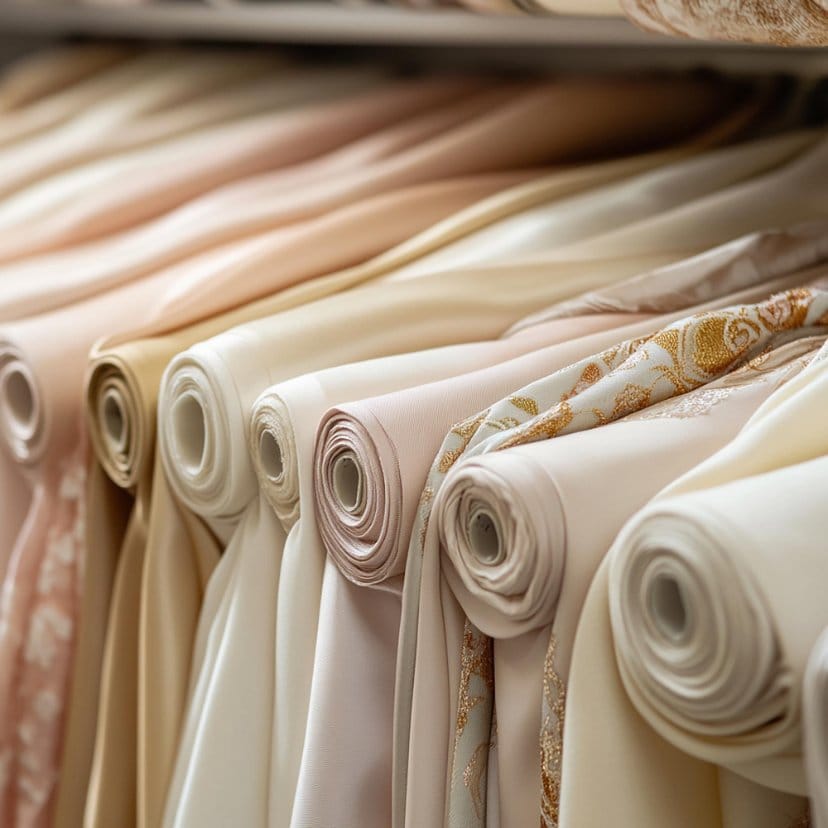
Double face chiffon fabric rolls in neutral tones highlighting soft drape, lightweight feel, and premium quality for dresses and formal garments.
Buying double face chiffon can feel overwhelming with so many options. Here’s how to make smart choices and get good value.
What to Look for When Shopping
Quality Indicators
Examine the Hand Feel: The fabric should feel smooth and soft, not rough or scratchy. It should flow easily through your hands. Stiff fabric usually means lower quality or too much sizing (starch added during manufacturing).
Check the Edges: Look at a cut edge. For bonded double face chiffon, the two layers should be firmly attached. If you can easily separate them with your fingers, the bonding is poor and will fail during sewing or washing.
Hold It Up to Light: Even though double face chiffon is more opaque than single layer, you should still see some light transmission. It shouldn’t be completely solid (that’s not chiffon). The opacity should be even across the whole piece.
Test the Drape: Hold a corner and let the fabric hang. It should fall in soft, fluid folds. Fabric that hangs stiffly or creates sharp creases isn’t good quality chiffon.
Look at the Weave: The weave should be even and consistent. Hold it up to light and check for thin spots or irregularities. These indicate manufacturing problems.
Color Considerations
Color affects how the fabric looks and how practical it is:
- Light Colors: Beautiful but show everything. May still need lining. White and pale pastels are less forgiving.
- Medium Colors: Most versatile. Good opacity. Easy to work with.
- Dark Colors: Most opaque. Show dust and threads during construction. Fade more noticeably over time.
- Prints: Can hide construction details and minor imperfections. Make sure print is evenly aligned on both layers.
Where to Buy
Online Fabric Retailers
Pros:
- Huge selection of colors and types
- Can compare prices easily
- Shop from home
- Often have customer reviews
- Many offer swatches for small fee
Cons:
- Can’t touch fabric before buying
- Colors may look different on screen
- Shipping costs add up
- Return policies vary
- Quality can be inconsistent
Tips for Online Shopping:
- Always order swatches first for important projects
- Read reviews carefully, especially regarding quality
- Understand the return policy before ordering
- Buy from retailers who specialize in apparel fabric (not craft fabric)
- Check if color is accurate to photos (read reviews)
Local Fabric Stores
Pros:
- Touch and examine fabric in person
- See true colors in natural light
- Get immediate advice from staff
- No shipping wait or costs
- Support local business
Cons:
- Limited selection compared to online
- May be more expensive
- Time needed to visit store
- May not carry specialty types
Specialty Bridal and Evening Wear Fabric Stores
These typically carry higher-quality double face chiffon in sophisticated colors. Expect to pay more, but quality is usually excellent. Staff expertise is often superior to general fabric stores.
Price Expectations
Understanding typical prices helps you recognize good deals and avoid suspiciously cheap (likely poor quality) fabric.
| Type | Budget | Mid-Range | High-End |
|---|---|---|---|
| Polyester | $5-8/yard | $8-12/yard | $12-20/yard |
| Nylon | $8-12/yard | $12-18/yard | $18-25/yard |
| Silk | $25-35/yard | $35-50/yard | $50-80+/yard |
Red Flags for Too-Cheap Fabric:
- Polyester under $4/yard (likely very thin or poorly made)
- Silk under $20/yard (probably not real silk or very low quality)
- Prices that seem too good to be true (they usually are)
How Much to Buy
Always buy extra. Mistakes happen, and you can’t perfectly match color if you need more later.
General Guidelines:
- Simple project: Pattern requirement + 0.5 yard
- Complex project: Pattern requirement + 1 yard
- First time working with fabric: Pattern requirement + 1.5 yards
- No pattern (draping or experimenting): Buy generous amount
Remember that double face chiffon is typically 44-60 inches wide. Make sure your pattern is designed for your fabric width or adjust yardage accordingly.
Questions to Ask Before Buying
Whether shopping in person or online, get answers to:
- What is the fiber content? (Silk, polyester, nylon, blend?)
- What is the fabric width?
- Is it bonded or woven together?
- Does it need to be dry cleaned or can it be washed?
- Is the color true to photos? (For online orders)
- What is the return policy?
- Are swatches available?
- Is there enough yardage in stock for my project?
Ordering Swatches
For online purchases of expensive fabric or large projects, swatches are worth it. They typically cost $2-5 including shipping.
What to Test with Swatches:
- True color (view in natural daylight)
- Hand feel and drape
- Opacity against your skin tone
- How it takes pressing (test on a corner)
- Sewing behavior (make a test seam)
- Washing behavior (if you plan to wash finished garment)
Avoiding Common Buying Mistakes
- Don’t buy based on photos alone for important projects. Colors look different on every screen.
- Don’t skimp on yardage. Running short is frustrating and often impossible to fix.
- Don’t ignore fiber content. Silk and polyester behave differently and require different care.
- Don’t buy too cheap. Quality matters, especially for special occasion wear.
- Don’t forget to check fabric width. Patterns assume specific widths.
Styling Ideas and Inspiration

Designer working with double face chiffon fabric while planning patterns and stylish garments for elegant fashion projects.
Double face chiffon works in more ways than you might think. Here are ideas for different occasions and seasons.
Formal and Evening Wear
Floor-Length Gowns: The classic use. An A-line or empire waist gown in double face chiffon creates that elegant, flowing look perfect for galas, formal weddings, or prom. Choose darker colors (navy, burgundy, emerald) for winter events. Lighter pastels work beautifully for spring and summer occasions.
Cocktail Dresses: Knee-length or midi-length dresses in double face chiffon work for semi-formal events. A fitted bodice with a flowing skirt flatters most body types. Add a statement necklace and heels for complete elegance.
Dressy Separates: A double face chiffon top paired with dressy pants or a sleek skirt creates sophisticated evening looks. This is more versatile than a dress because you can wear the pieces multiple ways.
Wedding and Bridal
Bridesmaid Dresses: Double face chiffon is a top choice because multiple dresses in the same fabric photograph consistently. The fabric is comfortable enough for all-day wear but elegant enough for formal photos. Consider different necklines or sleeve styles in the same fabric and color for a coordinated but not identical look.
Bridal Overlays: A double face chiffon overlay on a wedding dress adds romantic flow without covering up detailed work on the base dress. This works especially well for outdoor or beach weddings.
Mother of the Bride/Groom Dresses: Double face chiffon in sophisticated colors (navy, champagne, dusty rose) creates appropriate but beautiful dresses for mothers. The modest opacity is perfect for this role.
Everyday and Casual
Summer Blouses: A simple chiffon blouse in a solid color or subtle print works over jeans or dress pants. Keep it casual with sneakers or dress it up with heels. Light colors and breathable silk make this work even on warm days.
Maxi Skirts: A flowing maxi skirt in double face chiffon paired with a simple tank or t-shirt creates an effortless summer look. The skirt moves beautifully while walking and photographs well.
Beach Cover-ups: A loose, flowing tunic or caftan in polyester double face chiffon works perfectly as a swimsuit cover-up. It dries quickly and packs light for travel.
Seasonal Styling
Spring
- Pastels and florals in lightweight silk or polyester
- Flutter sleeve dresses
- Flowing scarves in cheerful colors
- Layered over long-sleeve base pieces
Summer
- Bright, saturated colors
- Sleeveless or cap-sleeve styles
- Maximum flow and minimum layers
- Beach and vacation wear
Fall
- Rich jewel tones (burgundy, emerald, sapphire)
- Layered under cardigans or jackets
- Long sleeves with flowing skirts
- Paired with boots and heavier accessories
Winter
- Deep, sophisticated colors (black, navy, wine)
- Evening and holiday party wear
- Worn with wraps or shawls
- Formal events and celebrations
Pairing with Other Fabrics
Double face chiffon works beautifully combined with:
- Lace: Lace bodice with chiffon skirt creates romantic, feminine looks
- Satin or Charmeuse: Smooth satin combined with flowing chiffon adds textural interest
- Knits: Chiffon overlay on a knit base creates comfortable, flowing casual wear
- Denim: Dressy chiffon top with casual jeans creates interesting contrast
Accessories
Jewelry: Delicate pieces work best. Heavy, chunky jewelry can snag the fabric. Choose smooth designs without rough edges.
Shoes: Let the fabric drape properly with appropriate shoes. Heels elongate the line of floor-length chiffon. Sandals work for casual summer styles. Avoid shoes with rough edges or details that might catch fabric.
Outerwear: Fitted jackets or cropped cardigans work well. Avoid heavy coats that crush the fabric. Wraps and shawls complement the flowing aesthetic.
Common Mistakes to Avoid
Learning from others’ mistakes saves time, money, and frustration. Here’s what commonly goes wrong and how to prevent it.
Buying Mistakes
Not Buying Enough Fabric: The most common mistake. Always buy extra. You can’t match color later, and running short in the middle of a project is terrible. Better to have leftovers than not enough.
Choosing Wrong Fiber for Your Needs: Silk is beautiful but requires dry cleaning. If that’s not realistic for your lifestyle, choose polyester. Match the fabric to how you’ll actually use and care for the garment.
Buying Based Only on Photos: Colors look different on every screen. For important projects, order swatches. That $3 swatch saves you from $50 of wrong-color fabric.
Ignoring Quality to Save Money: Cheap double face chiffon often has poor bonding that fails after a few washes. The layers separate or the fabric feels stiff. Spending $7/yard instead of $4/yard makes a huge difference in results.
Sewing Mistakes
Not Testing Settings First: Jumping straight into your project without test seams causes problems. Thread tension, stitch length, and presser foot pressure all need adjustment for chiffon. Spend 15 minutes testing on scraps to save hours of frustration.
Using the Wrong Needle: A dull or too-large needle damages fabric with every stitch. Use a fresh, fine needle (size 60/8 or 70/10). Change it frequently. Needles are cheap; fabric isn’t.
Choosing Inappropriate Seam Finishes: Regular seam allowances look bulky and messy on sheer or semi-sheer fabric. French seams or narrow hems look professional and are worth the extra time.
Pulling or Stretching While Sewing: Let the machine feed the fabric. Don’t pull it through. This causes wavy, stretched-out seams that can’t be fixed. If fabric isn’t feeding smoothly, adjust presser foot pressure or use a walking foot.
Skipping the Tissue Paper Trick: Sewing through tissue paper between fabric and feed dogs prevents so many problems. Don’t skip this step just to save time. It actually saves time by preventing mistakes.
Care Mistakes
Using the Dryer: This destroys double face chiffon. Heat melts synthetics and shrinks silk. Always air dry. No exceptions. It’s not worth the convenience risk.
Wrong Water Temperature: Hot water damages all types of chiffon. Cool or cold water only. Hot water causes shrinkage, damages bonding, and can fade colors.
Harsh Detergents or Bleach: These break down fibers and damage color. Use gentle detergent made for delicates. Never use bleach or harsh stain removers.
Hanging Silk Wet: The water weight stretches silk permanently. Always lay silk flat to dry. Polyester and nylon can hang, but silk cannot.
Ironing Too Hot: High heat creates shine, melts synthetics, and damages silk. Always use the lowest effective heat setting. When in doubt, use a steamer instead.
Design and Pattern Mistakes
Choosing Patterns That Don’t Work: Double face chiffon needs patterns designed for flowing fabrics. Structured, tailored patterns don’t work well. Choose patterns that use the fabric’s drape instead of fighting it.
Attempting Complex Details: Complicated closures, patch pockets, and fussy details look messy in chiffon. Keep designs simple. Let the fabric be the star.
Lining When You Don’t Need To: The whole point of double face chiffon is not needing lining for most projects. Don’t add unnecessary lining out of habit. It adds bulk and work without benefit.
Wearing and Storing Mistakes
Wrong Undergarments: Rough seams on undergarments can snag chiffon. Wear seamless undergarments under chiffon garments. Smooth is key.
Jewelry That Snags: Rings, bracelets, and watches with rough edges catch and pull threads. Be careful what jewelry you wear with chiffon.
Storing Folded Long-Term: Fold lines become permanent. Hang garments on padded hangers for storage. If you must fold, use tissue paper and don’t crease sharply.
Plastic Garment Bags: Plastic traps moisture and prevents breathing. Use cloth garment bags instead, especially for long-term storage.
Frequently Asked Questions
Conclusion
Double face chiffon solves the biggest problem with regular chiffon while keeping everything people love about it. You get that beautiful, flowing drape and elegant appearance without the frustrating sheerness that makes single-layer chiffon so challenging to work with.
Whether you choose silk for luxury projects, polyester for practical everyday wear, or nylon for performance applications, double face chiffon offers real advantages. It’s easier to sew, more versatile in garment styles, and often eliminates the need for lining. These benefits save time, reduce fabric costs, and make professional-looking results achievable even for sewers with moderate experience.
Key Takeaways
For Buyers: Order swatches before committing to large purchases. Understand that fiber content dramatically affects both the fabric’s behavior and care requirements. Quality matters more than saving a few dollars per yard. Buy extra fabric because you can’t match color later.
For Sewers: Test your machine settings on scraps before starting your actual project. Use fine needles, gentle handling, and appropriate seam finishes. The tissue paper trick and French seams are your friends. Take your time and the fabric will reward you with beautiful results.
For Care: Never put double face chiffon in the dryer. Hand washing or gentle machine washing (depending on fiber content) keeps garments looking good for years. Silk needs dry cleaning or very careful hand washing. Store properly on padded hangers or folded with tissue paper.
For Sustainability: Silk is biodegradable but expensive. Polyester is practical but creates microplastics. Choose recycled polyester when available, and buy quality that lasts. The most sustainable choice is making garments you’ll actually wear for years and taking proper care of them.
Making It Work for You
The best double face chiffon for you depends on your specific needs. A silk version makes sense for a once-in-a-lifetime wedding dress or special heirloom garment. Polyester works perfectly for bridesmaid dresses, everyday special occasion wear, or learning projects. Nylon suits performance and dance applications where durability matters most.
Don’t let the delicate nature of chiffon intimidate you. Double face construction makes this fabric significantly more approachable than its reputation suggests. With proper preparation, the right tools, and reasonable care during sewing, you can create stunning garments that look professional and wear well.
Start with a simple project if you’re new to the fabric. A scarf or basic top helps you understand how it behaves before attempting a complex dress. Build your confidence gradually. The skills you develop working with double face chiffon transfer to other delicate fabrics too.
Your Next Steps
If you’re planning a project with double face chiffon:
- Decide on fiber content based on your budget, care preferences, and garment purpose
- Order swatches to test color and quality before buying full yardage
- Calculate yardage needed and add extra for mistakes and testing
- Gather the right tools: fine needles, quality thread, tissue paper, gentle detergent
- Choose a pattern appropriate for flowing fabrics
- Test all machine settings and techniques on scraps first
- Take your time during construction; rushing causes most problems
- Follow proper care instructions to make your finished garment last
Double face chiffon offers the perfect balance between elegance and practicality. It brings that sophisticated, flowing aesthetic to your wardrobe without the extreme challenges of working with sheer fabric. Whether you’re making a formal gown for a special event, comfortable summer wear, or anything in between, double face chiffon delivers beautiful results.
The fabric has earned its popularity in fashion precisely because it solves real problems while maintaining beauty. Understanding how to choose, work with, and care for it properly means you can create garments you’ll love wearing for years. That combination of elegance and wearability is what makes double face chiffon worth knowing about and using.
For more fabric guides and sewing tips, explore our comprehensive collection of fabric and textile resources.