
Discover the warmth, stretch, and year-round versatility of this natural knit fabric
Table of Contents
- Introduction
- What is Wool Jersey Fabric?
- Is Wool Jersey the Same as Jersey Fabric?
- Types of Wool Jersey
- Properties and Benefits
- Wool Jersey vs Other Fabrics
- Sustainability and Ethics
- Uses and Applications
- How to Sew with Wool Jersey
- Project Ideas by Skill Level
- Care Instructions
- Buying Guide
- Frequently Asked Questions
- Conclusion
Introduction
If you’re looking for a fabric that combines the natural warmth of wool with the comfortable stretch of jersey knit, you’ve found it. Wool jersey fabric brings together the best of both worlds: the temperature-regulating, moisture-wicking properties of wool and the flexible, body-hugging characteristics of knitted fabric.
Originally made on the Isle of Jersey in the Channel Islands, this fabric started as fishermen’s underwear and sweaters. It kept workers warm in harsh weather while allowing freedom of movement. Today, wool jersey has evolved far beyond its humble beginnings. Thanks to Coco Chanel’s revolutionary use of the fabric in 1916, wool jersey moved from workwear to high fashion and everyday comfort. The Woolmark Company, the global authority on wool, continues to promote and certify quality wool products worldwide.
Whether you’re a home sewer planning your next project, a conscious consumer looking for sustainable fabrics, or someone interested in performance wear that works year-round, this guide covers everything you need to know about wool jersey fabric.
What is Wool Jersey Fabric?
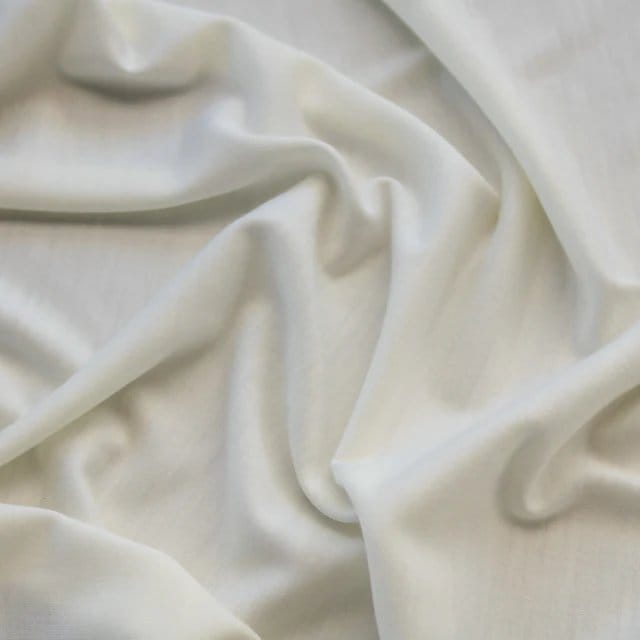
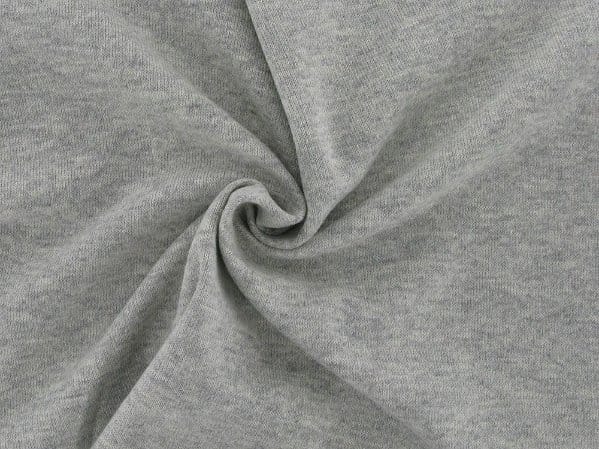
Close up view of wool jersey fabric texture and drape.
Wool jersey is a type of knit fabric made from wool fibers using a specific knitting technique called jersey knit (also known as single knit). Unlike woven fabrics that interlace threads in a crisscross pattern, wool jersey creates loops of yarn that interlock, giving the fabric its signature stretch and flexibility.
The Structure of Wool Jersey
The defining feature of wool jersey is its two distinct sides:
- Face side (right side): Smooth surface with fine vertical ribs that look like tiny “V” shapes running lengthwise
- Back side (wrong side): Textured surface with horizontal loops that give the fabric a slightly bumpy feel
This construction makes wool jersey fundamentally different from wool felt or wool flannel, which are woven fabrics with no natural stretch.
Single Jersey vs Double Jersey
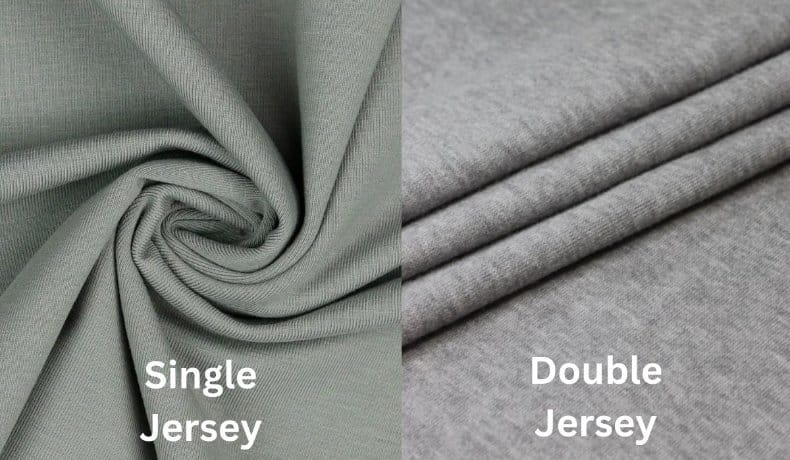
Comparison of single jersey and double jersey fabric construction.
Wool jersey comes in two main knit constructions:
| Feature | Single Jersey | Double Jersey (Interlock) |
|---|---|---|
| Weight | Lightweight to medium (150-220 GSM) | Medium to heavyweight (220-300+ GSM) |
| Stretch | More stretch (50% horizontal, 20% vertical) | Less stretch, more stable |
| Sides | Different textures on each side | Smooth on both sides |
| Edge behavior | Edges curl when cut | Edges lay flat |
| Best for | T-shirts, base layers, lightweight garments | Dresses, skirts, structured pieces |
How Wool Jersey is Made
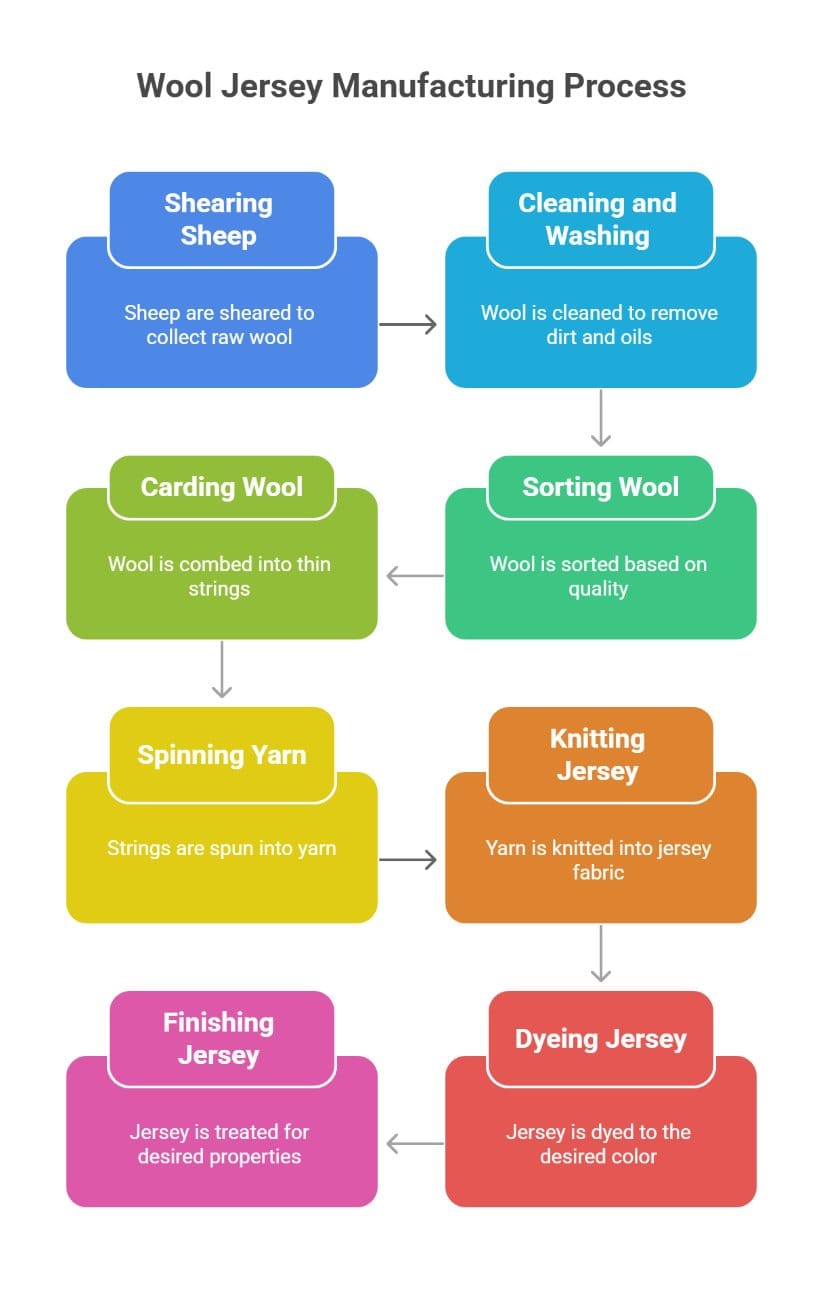
Step by step overview of how wool jersey fabric is produced.
The manufacturing process starts with shearing sheep (typically once or twice a year). The raw wool is then:
- Cleaned and washed at high temperatures to remove dirt and natural oils
- Sorted into grades based on fiber quality and micron count
- Carded (combed) into long, thin strings
- Spun into yarn
- Knitted using circular knitting machines that create the interlocking loop structure
- Dyed (either before or after knitting)
- Finished with treatments as needed
Want to learn more about different wool manufacturing methods? Check out our guide to boiled wool fabric, which goes through a special felting process that makes it quite different from wool jersey.
Is Wool Jersey the Same as Jersey Fabric?
No, they’re not the same, and understanding this distinction is important if you’re shopping for fabric or planning a sewing project.
The Key Difference
Jersey refers to the knit construction method (the way the fabric is made), not the fiber content.
Wool jersey is one specific type of jersey fabric that happens to be made from wool fibers.
Think of it this way: “jersey” is like saying “bread,” while “wool jersey” is like saying “sourdough bread.” Jersey is the general category, and wool jersey is a specific type within that category.
Types of Jersey Fabric by Fiber
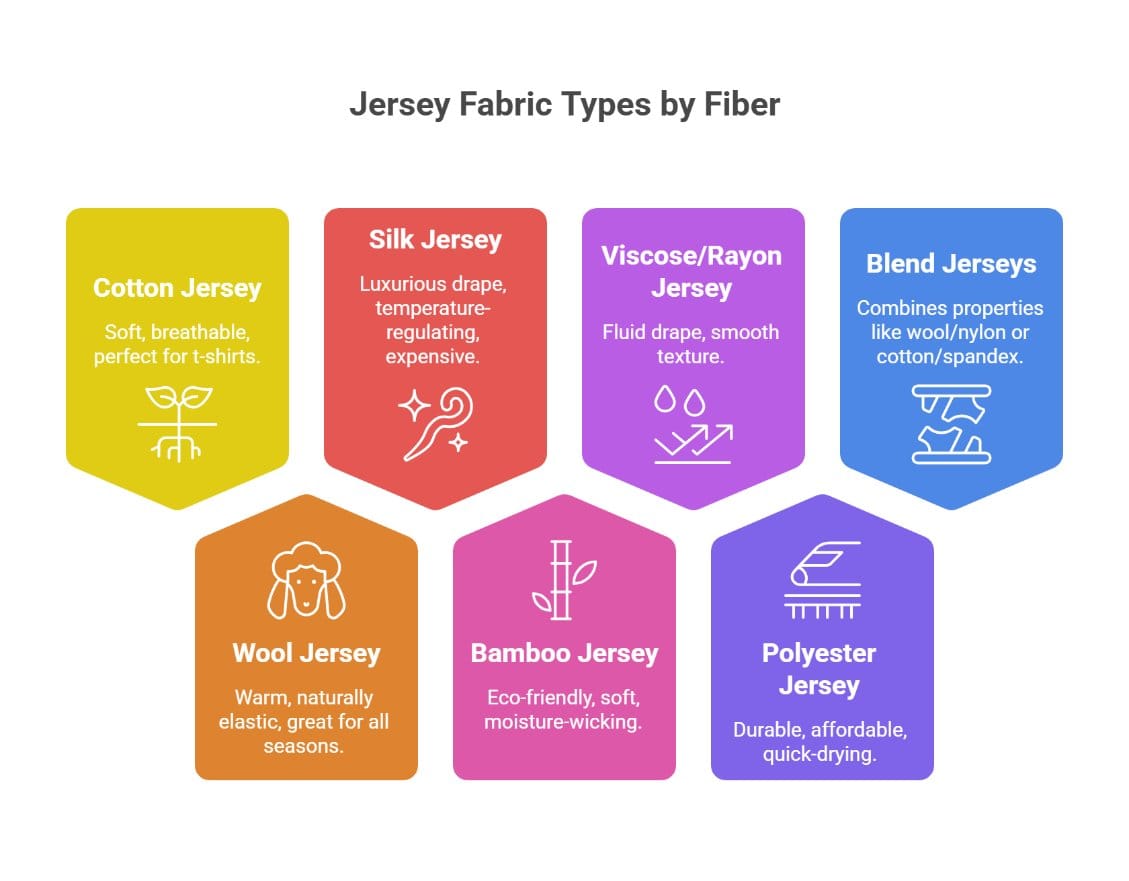
Common jersey fabric types categorized by fiber content.
Jersey can be made from many different materials:
- Cotton jersey: The most common type, soft and breathable, perfect for t-shirts
- Wool jersey: Warm, naturally elastic, great for all seasons
- Silk jersey: Luxurious drape, temperature-regulating, expensive
- Bamboo jersey: Eco-friendly, soft, moisture-wicking
- Viscose/rayon jersey: Fluid drape, smooth texture
- Polyester jersey: Durable, affordable, quick-drying
- Blend jerseys: Combines properties (like wool/nylon or cotton/spandex)
Historical Context
Interestingly, jersey fabric was originally made exclusively from wool on the Isle of Jersey. Fishermen’s sweaters and underwear were all wool jersey. When Coco Chanel popularized the fabric in 1916 for women’s fashion, and as manufacturing technology improved, jersey began being made from cotton, silk, and synthetic fibers. Today, cotton jersey is actually more common than wool jersey, but wool jersey remains popular for specific applications where its unique properties shine.
Types of Wool Jersey
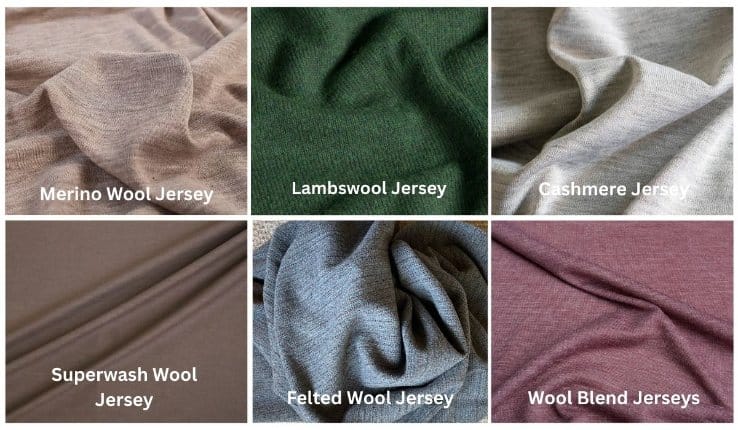
Various types of wool jersey fabrics with different textures and finishes.
Not all wool jersey is created equal. The type of wool used, how it’s processed, and what it’s blended with can dramatically change the fabric’s feel, performance, and price.
Merino Wool Jersey
This is the most popular type of wool jersey, and for good reason.
What Makes Merino Special?
Merino wool comes from Merino sheep, which have adapted to harsh climates by developing incredibly fine, soft fibers. The fineness is measured in microns (one millionth of a meter), and merino typically ranges from 15-24 microns. For comparison, human hair is about 30 microns thick.
Key characteristics:
- Super soft against skin (not itchy like traditional wool)
- Fine fiber diameter (15-24 microns)
- Excellent temperature regulation
- Natural moisture-wicking and odor resistance
- Lightweight yet warm
- Common weights: 150-200 GSM (grams per square meter)
- Price range: $25-60 per yard
Best for: Base layers, t-shirts, activewear, baby clothing, underwear, lightweight dresses
Lambswool Jersey
Lambswool comes from a sheep’s first shearing (usually around 7 months old). These young fibers have naturally tapered ends that make the wool exceptionally soft.
Key characteristics:
- Very soft and smooth
- Slightly thicker than merino (25-28 microns)
- Good elasticity and resilience
- Holds warmth well
- Common weights: 180-240 GSM
- Price range: $20-45 per yard
Best for: Sweaters, cardigans, children’s clothing, cozy base layers
Cashmere Jersey
The luxury option. Cashmere comes from the soft undercoat of cashmere goats and represents the softest, most expensive wool jersey you can buy.
Key characteristics:
- Incredibly soft (14-19 microns)
- Lightweight yet very warm
- Luxurious drape
- Less durable than other wools (pills more easily)
- Requires gentle care
- Price range: $80-200+ per yard
Best for: Special occasion sweaters, luxury base layers, high-end fashion pieces
Superwash Wool Jersey
This is wool that has been treated with a special chemical process to make it machine-washable without shrinking or felting.
How Superwash Treatment Works
Wool fibers naturally have microscopic scales on their surface. When exposed to heat, water, and agitation, these scales interlock and cause the fabric to shrink and felt. Superwash treatment either removes or coats these scales, preventing this interlocking effect.
Key characteristics:
- Machine washable (gentle cycle)
- Won’t felt or shrink significantly
- Slightly less breathable than untreated wool
- Can be tumble dried on low (though hanging is better)
- More convenient for everyday wear
- Price range: $30-55 per yard
Best for: Children’s clothing, everyday base layers, items that need frequent washing
Felted Wool Jersey
This is 100% wool jersey that has been intentionally shrunk through hot water washing and agitation. The result is a completely different fabric.
Key characteristics:
- Thick, compact texture
- Shrinks to about half its original size
- Does not fray when cut
- No longer stretchy
- More durable and structured
- Perfect for decorative edges and special techniques
Best for: Jackets, accessories, appliqué work, decorative projects
Important: Only 100% wool jersey (no blends) will felt properly. Always test a swatch first, as fabric stores can’t always guarantee fiber content accuracy.
Wool Blend Jerseys
Blending wool with other fibers can improve specific properties while reducing cost.
Wool/Nylon Blend (typically 75-80% wool, 20-25% nylon)
- More durable than pure wool
- Better shape retention
- Less pilling
- Slightly more elastic
- Common in activewear
Wool/Spandex or Wool/Lycra (typically 90-95% wool, 5-10% spandex)
- Significantly more stretch
- Better recovery (returns to original shape)
- Form-fitting without losing shape
- Great for leggings and fitted garments
Wool/Silk Blend
- Luxurious feel and drape
- Enhanced temperature regulation
- Beautiful sheen
- More expensive
- Excellent for special garments
Wool/Cotton Blend
- More affordable
- Softer texture
- Easier to care for
- Less likely to irritate sensitive skin
Properties and Benefits: Why Choose Wool Jersey?
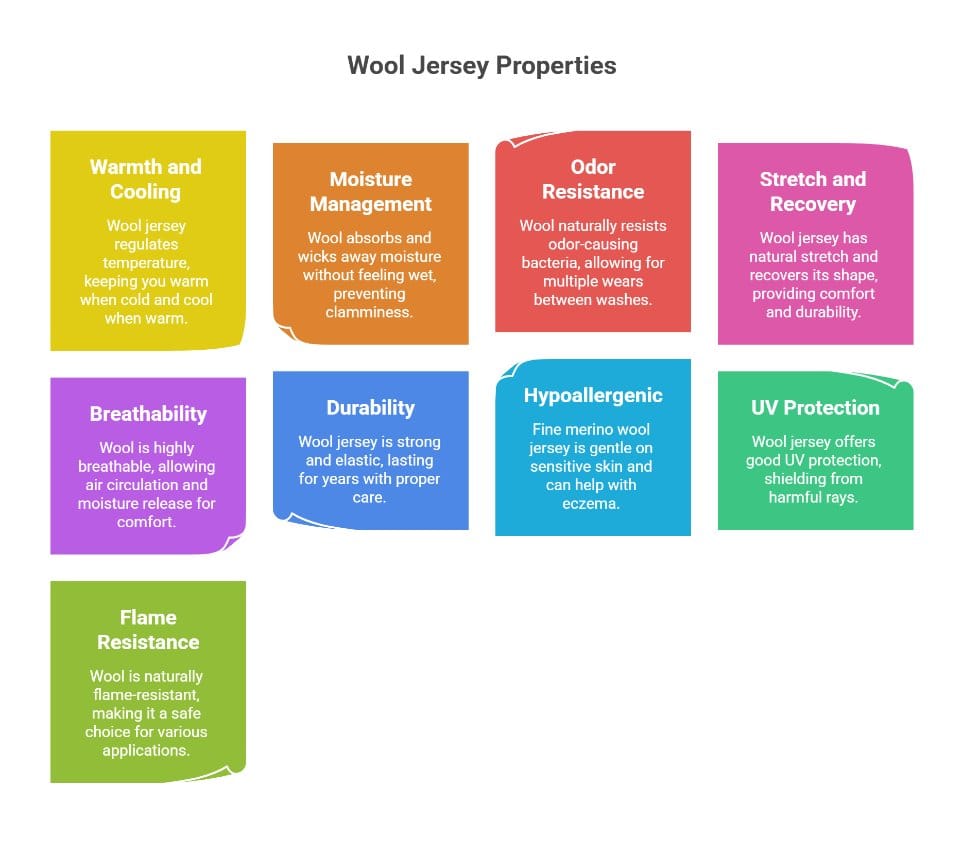
Key properties and performance benefits of wool jersey fabric.
Wool jersey offers a unique combination of properties that make it stand out from other fabrics. Let’s break down what makes this fabric special.
Is Wool Jersey Warm?
Yes, but not in the way you might think. Wool jersey is warm when you need it to be, but it’s also cooling when temperatures rise. This might sound impossible, but it’s one of wool’s most amazing natural properties.
The Science of Wool’s Temperature Regulation
Wool fibers have a natural crimp (waviness) that creates tiny air pockets within the fabric. These pockets trap body heat when it’s cold outside, providing insulation. But when it’s warm, wool’s breathability allows heat and moisture to escape, keeping you cool. This is why Bedouin tribes in the Sahara Desert wear wool, and why merino wool base layers work in both winter skiing and summer hiking.
The warmth level depends on the fabric weight:
| Weight Category | GSM Range | Best Season | Typical Uses |
|---|---|---|---|
| Lightweight | 150-180 GSM | Spring/Summer/Fall | Base layers, t-shirts, summer dresses |
| Midweight | 180-220 GSM | Year-round | Everyday wear, activewear, layering pieces |
| Heavyweight | 220-300+ GSM | Fall/Winter | Sweaters, outerwear, cold weather base layers |
Moisture Management Like No Other
Wool can absorb up to 30% of its weight in moisture without feeling wet. This is drastically different from cotton, which feels damp quickly, or synthetics, which repel moisture but trap sweat against your skin.
What happens to all that moisture? Wool naturally wicks it away from your skin and releases it into the air through evaporation. This process actually generates a tiny bit of heat, which is why wool base layers feel warm even when damp.
Real-world benefit: You can wear a wool jersey base layer during intense activity, get sweaty, then stop and rest without getting that clammy, cold feeling that happens with cotton.
Natural Odor Resistance
This might be wool jersey’s most surprising property. The fabric naturally resists odor-causing bacteria, which means you can wear wool jersey garments multiple times between washes without them smelling.
Why does this work? Wool fibers contain lanolin (natural sheep oil) and have a protein structure that bacteria find difficult to thrive in. The moisture-wicking properties also mean bacteria don’t have the damp environment they need to multiply.
Real-world benefit: Travelers love merino wool jersey t-shirts because they can wear them for several days without washing, making packing lighter easier.
Stretch and Recovery
The jersey knit construction gives wool jersey natural stretch (typically 20-50% depending on the fabric), but wool fibers themselves are also elastic. Merino wool can be stretched to 30% beyond its natural length and still return to its original shape. When wet, this increases to 50%.
This combination of knit stretch and fiber elasticity means:
- Garments move with your body without restriction
- Clothing returns to its original shape after wearing
- Less sagging and bagging over time compared to cotton jersey
- Comfortable fit without feeling tight
Breathability That Adapts
Wool is one of the most breathable natural fibers available. The fiber structure allows air to circulate while the fabric’s ability to absorb and release moisture keeps you comfortable. Scientific research from Woolmark’s technical studies shows that wool fabrics can move more than 25% of moisture (which contains heat) away from your skin, equivalent to an ambient temperature drop of up to four degrees.
Compare this to synthetic jerseys, which might be moisture-wicking but don’t breathe as well, or to woven wool fabrics like melton wool, which are much less breathable than wool jersey.
Durability and Longevity
High-quality wool jersey, when cared for properly, can last for years. Wool fibers are naturally strong (each fiber can bend 20,000 times before breaking, compared to cotton’s 3,000 times). The natural elasticity also means the fabric resists tearing.
However, pilling (those little fabric balls) can occur with wear, especially with softer, finer wools like cashmere. Higher-quality merino and wool blends with nylon tend to pill less.
Hypoallergenic and Skin-Friendly
Fine merino wool jersey (below 19 microns) is gentle enough for people with sensitive skin and has even been shown in medical studies to help with eczema symptoms. The soft fibers don’t irritate skin, and wool’s natural properties help regulate moisture and temperature at the skin surface.
That said, some people are sensitive to all wool. If you’re unsure, try a small swatch against your skin before committing to a project.
UV Protection
Wool naturally provides good UV protection, with many wool jerseys offering a UPF (Ultraviolet Protection Factor) rating of 30-50+. This is particularly beneficial for outdoor activities and children’s clothing.
Natural Flame Resistance
Unlike synthetic fabrics that can melt, wool is naturally flame-resistant. It has a high ignition temperature and is self-extinguishing when removed from flame. This makes wool jersey a safe choice for children’s sleepwear and home textiles.
Wool Jersey vs Other Fabrics
Understanding how wool jersey compares to other fabrics helps you make informed decisions for your projects.
Wool Jersey vs Cotton Jersey
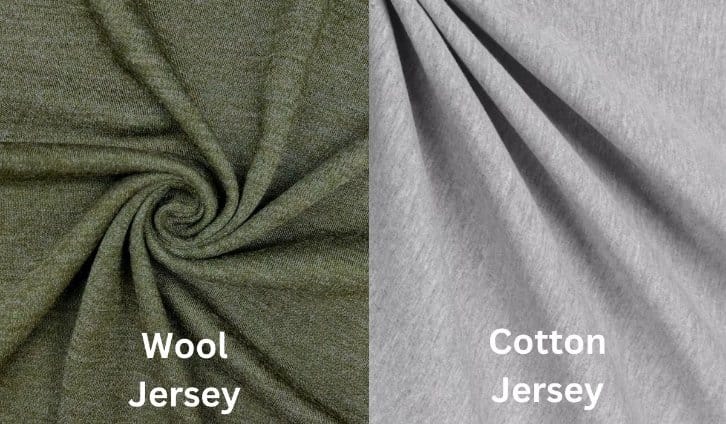
Visual comparison between wool jersey and cotton jersey fabrics.
| Feature | Wool Jersey | Cotton Jersey |
|---|---|---|
| Warmth | Warm in cold, cool in heat | Lightweight, not very warm |
| Moisture | Wicks and evaporates (30% absorption) | Absorbs but holds moisture (feels damp) |
| Odor resistance | Excellent (wear multiple times) | Poor (needs frequent washing) |
| Durability | Very durable, resists tearing | Moderate, can stretch out |
| Shrinkage | Can shrink significantly if not careful | 5-10% shrinkage typical |
| Care | Hand wash or gentle machine wash | Machine wash and dry easily |
| Price | $20-60+ per yard | $8-20 per yard |
| Best season | Year-round | Spring/Summer/Fall |
| Sustainability | Biodegradable, renewable | Biodegradable, but high water use |
Bottom line: Choose wool jersey for performance, year-round wear, and less frequent washing. Choose cotton jersey for affordability, easy care, and hot weather comfort.
Wool Jersey vs Synthetic Jersey (Polyester/Nylon)
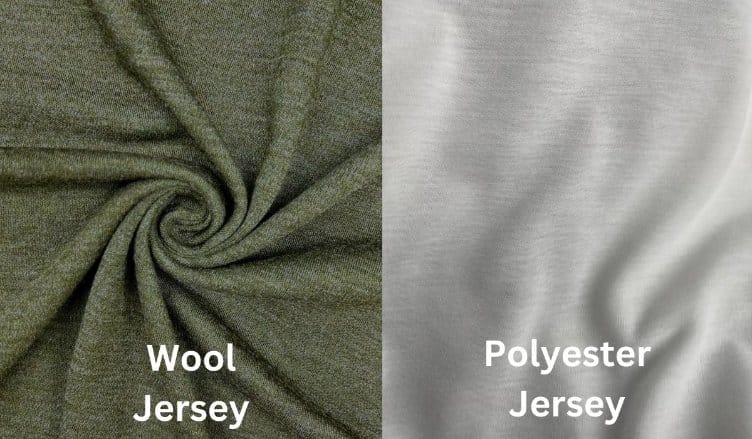
Wool jersey versus synthetic jersey fabric performance comparison.
| Feature | Wool Jersey | Synthetic Jersey |
|---|---|---|
| Breathability | Excellent natural airflow | Poor to moderate |
| Moisture handling | Absorbs and wicks | Wicks but doesn’t absorb |
| Odor control | Natural resistance | Traps odors (needs treatment) |
| Temperature regulation | Adapts to conditions | Can trap heat |
| Durability | Very durable | Extremely durable |
| Quick-drying | Moderate (holds moisture) | Very fast |
| Price | $20-60+ per yard | $5-15 per yard |
| Sustainability | Biodegradable, renewable | Petroleum-based, microplastic pollution |
Bottom line: Choose wool jersey for natural performance, better odor control, and environmental concerns. Choose synthetics for affordability, extreme durability, and activities where quick-drying is critical.
Wool Jersey vs Silk Jersey
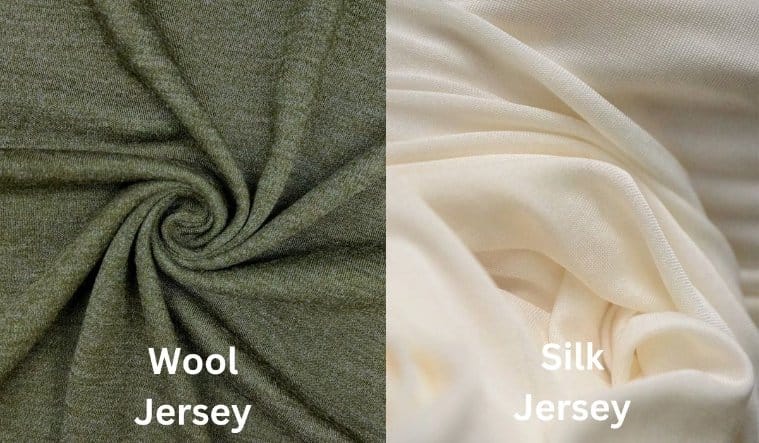
Wool jersey compared with silk jersey fabric surface and drape.
Both are luxury natural fibers with excellent drape, but they serve different purposes:
- Wool jersey: More durable, easier to care for, better for everyday wear, warmer, more affordable ($20-60/yard)
- Silk jersey: More delicate, luxurious sheen, incredible drape, requires dry cleaning, special occasions, expensive ($40-100+/yard)
Wool Jersey vs Other Wool Fabrics
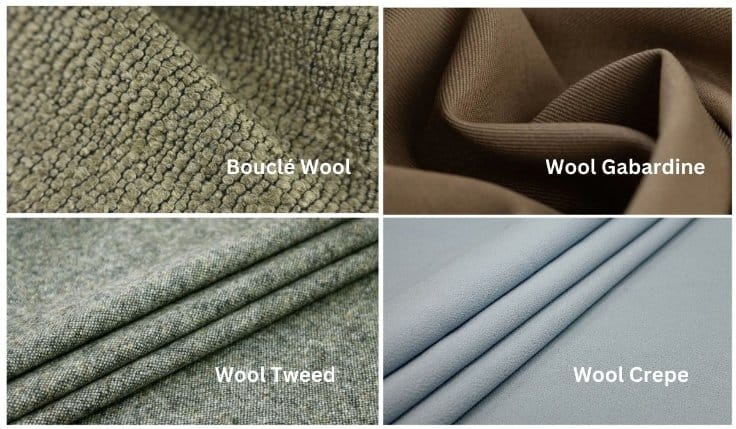
Wool jersey compared with other common wool fabric types.
Wool comes in many forms beyond jersey. Here’s how wool jersey compares to other wool fabric constructions:
vs Wool Crepe
Wool crepe: Woven fabric with pebbled texture, no stretch, more structure, dressier
Wool jersey: Knit fabric, stretchy, casual to semi-dressy, more comfortable for everyday wear
vs Wool Tweed
Wool tweed: Thick woven fabric, no stretch, very textured, heavy, best for jackets and coats
Wool jersey: Smooth knit, stretchy, lighter weight, better for base layers and flexible garments
vs Wool Gabardine
Wool gabardine: Tight twill weave, very smooth, holds a crease, perfect for tailored trousers
Wool jersey: Knit structure, relaxed fit, casual elegance, no crisp creases
vs Boucle Wool
Boucle wool: Looped texture, no stretch, very thick, statement piece fabric
Wool jersey: Smooth surface, stretchy, thinner, practical everyday wear
Sustainability and Ethics: The Environmental Impact of Wool Jersey
If you’re concerned about the environmental impact of your clothing choices, wool jersey has several advantages over synthetic fabrics.
Biodegradability
Wool is 100% biodegradable. When wool garments reach the end of their life, they decompose naturally in soil, releasing nutrients back into the earth. This process takes just a few years, compared to synthetic fabrics that can persist for hundreds of years.
In contrast, polyester and nylon jerseys shed microplastics with every wash, contributing to water pollution and entering the food chain.
Renewable Resource
Sheep produce a new fleece every year, making wool an infinitely renewable resource (as long as sheep populations are maintained). This is fundamentally different from petroleum-based synthetics, which rely on finite fossil fuels.
Carbon Footprint
The carbon footprint of wool production is complex. While sheep do produce methane (a greenhouse gas), wool’s long lifespan and biodegradability offset some of this impact. Wool has a lower overall carbon footprint than acrylic and polyester when you factor in the entire lifecycle.
Merino wool from regenerative farms can even be carbon-positive, as well-managed grasslands sequester more carbon than the sheep produce.
Durability Equals Sustainability
One of wool jersey’s strongest environmental benefits is its longevity. A well-made wool jersey garment can last 5-10 years or more with proper care, compared to fast fashion items that might last one season.
The environmental cost per wear drops dramatically when a garment lasts years instead of months.
Important Certifications to Look For
If sustainability and ethics matter to you, look for these certifications when buying wool jersey:
Responsible Wool Standard (RWS)
Ensures sheep welfare and responsible land management. Farms must meet strict animal welfare requirements and protect soil, water, and biodiversity. Learn more at Textile Exchange’s RWS page.
ZQ Merino
A New Zealand certification that guarantees high animal welfare standards, environmental stewardship, and fiber quality. ZQ-certified wool comes from farms that meet strict ethical standards.
Mulesing-Free
Mulesing is a controversial practice used primarily in Australia to prevent flystrike in sheep. Many consumers prefer mulesing-free wool for animal welfare reasons. Look for brands that explicitly state their wool is mulesing-free.
Organic Wool
Certified organic wool comes from sheep raised on organic pastures without synthetic pesticides or fertilizers. The sheep cannot be given growth hormones or routine antibiotics.
OEKO-TEX Standard 100
Certifies that the finished fabric contains no harmful chemicals. This is particularly important if you’re making baby clothes or have sensitive skin.
Ethical Considerations
The ethics of wool production vary greatly by region and farm:
- Animal welfare: Look for certifications that guarantee humane treatment
- Worker rights: Some wool comes from farms with poor labor practices
- Indigenous land rights: Some wool production, particularly of specialty fibers like alpaca, raises questions about land use and indigenous communities
Buying from brands that are transparent about their supply chains and hold certifications is the best way to ensure your wool jersey comes from ethical sources.
Making Sustainable Choices
To maximize the sustainability of wool jersey:
- Buy quality over quantity: One excellent wool jersey piece will outlast five cheap ones
- Care properly: Proper care extends garment life significantly
- Choose certified wool: Look for RWS, ZQ, or organic certifications
- Consider secondhand: Vintage wool jersey can be excellent quality
- Repair instead of replace: Learn basic mending skills
- Support ethical brands: Buy from companies committed to sustainability
Uses and Applications: What Can You Make with Wool Jersey?
Wool jersey’s unique combination of properties makes it suitable for a surprisingly wide range of projects.
Apparel Applications
Base Layers and Underwear
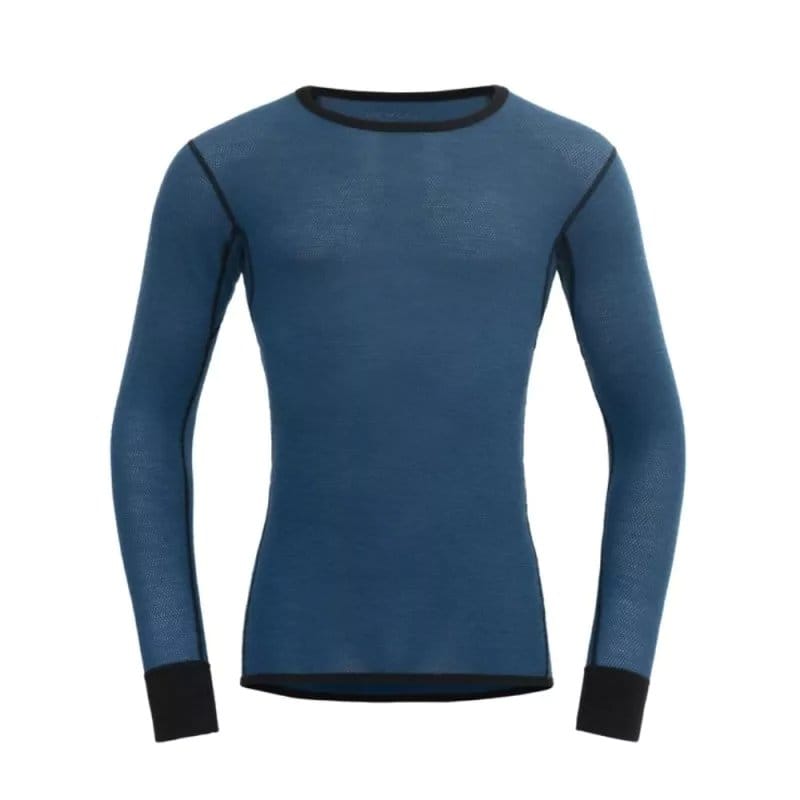
Wool jersey thermal underwear designed for warmth and moisture control.
This is where wool jersey truly excels. The fabric’s temperature regulation, moisture-wicking, and odor resistance make it perfect for garments worn next to skin.
Recommended weight: 150-180 GSM (lightweight)
Best wool type: Merino, superwash merino
- Long underwear tops and bottoms
- Thermal underwear for winter
- Performance underwear
- Camisoles and undershirts
- Bralettes
T-Shirts and Tops
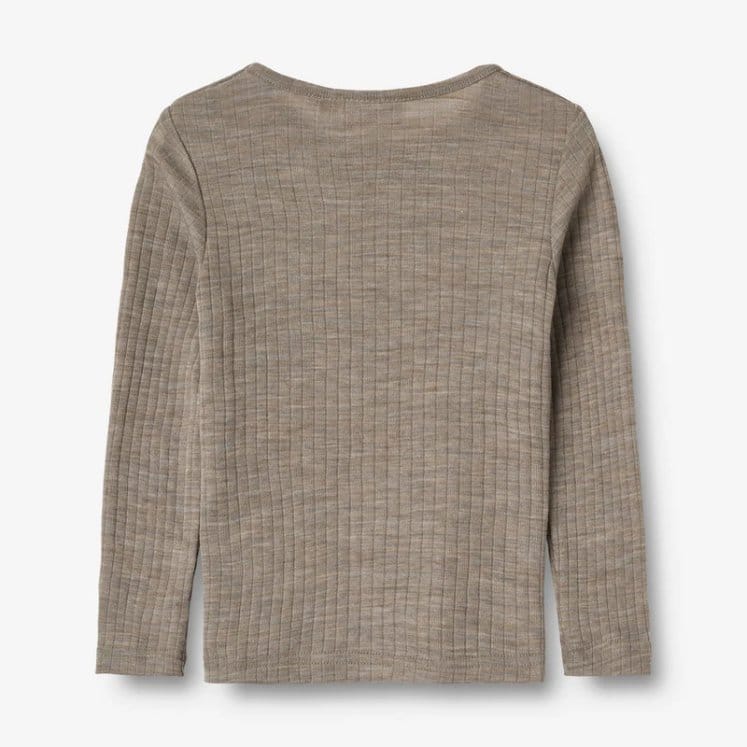
Wool jersey t shirt offering softness and everyday comfort.
Wool jersey t-shirts are becoming increasingly popular for their ability to be worn multiple times between washes and their year-round comfort.
Recommended weight: 160-200 GSM (lightweight to midweight)
Best wool type: Merino, merino/nylon blend
- Casual t-shirts
- Henley shirts
- Long-sleeve tees
- Tanks and camis
- Polo shirts
Activewear and Performance Clothing
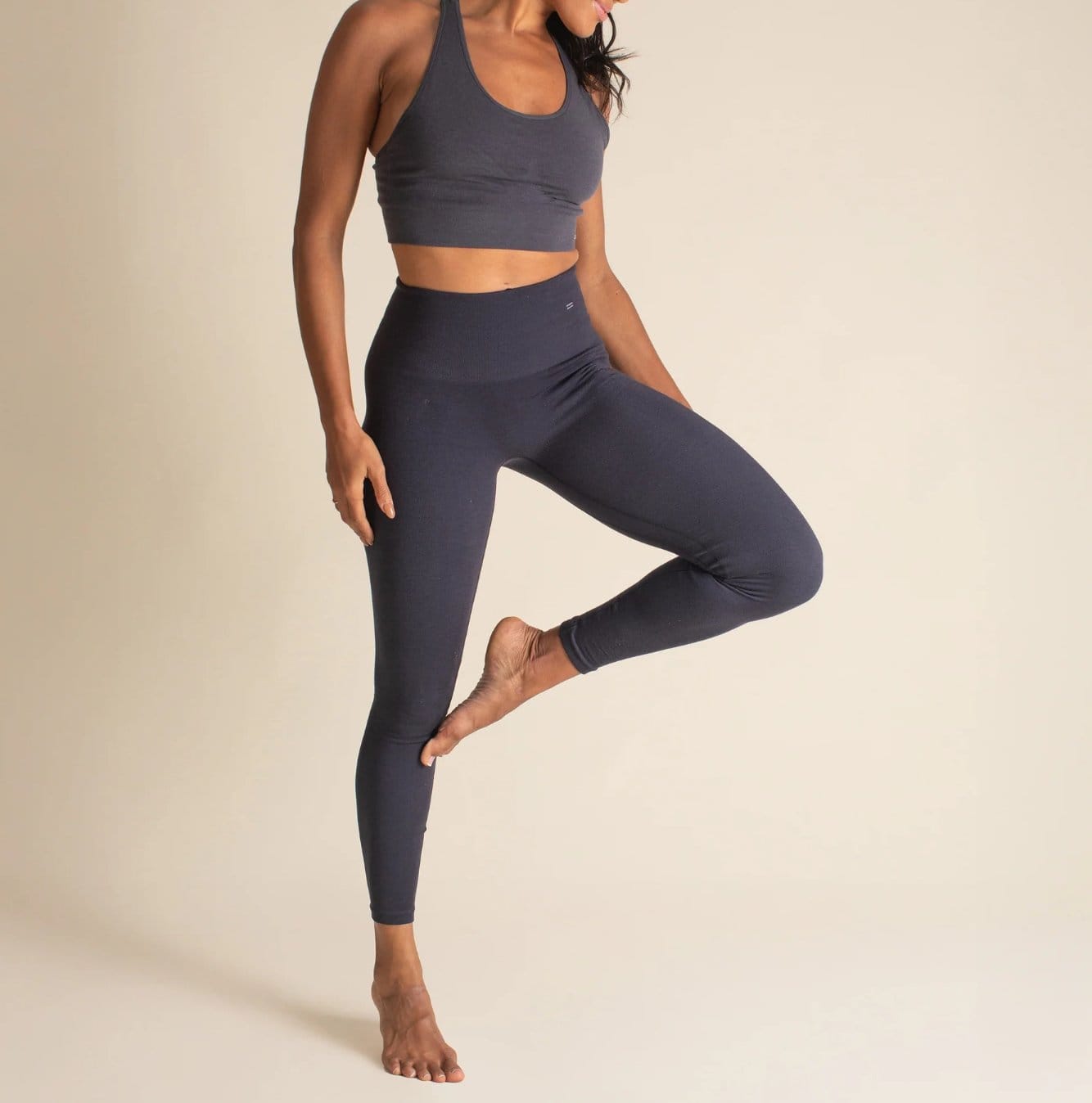
Wool jersey yoga wear designed for movement and comfort.
Athletes and outdoor enthusiasts love wool jersey for its performance properties.
Recommended weight: 150-220 GSM
Best wool type: Merino, merino/nylon blend, merino/spandex blend
- Running shirts
- Cycling jerseys (yes, athletic jerseys made from wool jersey!)
- Yoga tops and leggings
- Hiking base layers
- Ski and snowboard base layers
- Gym wear
Dresses and Skirts
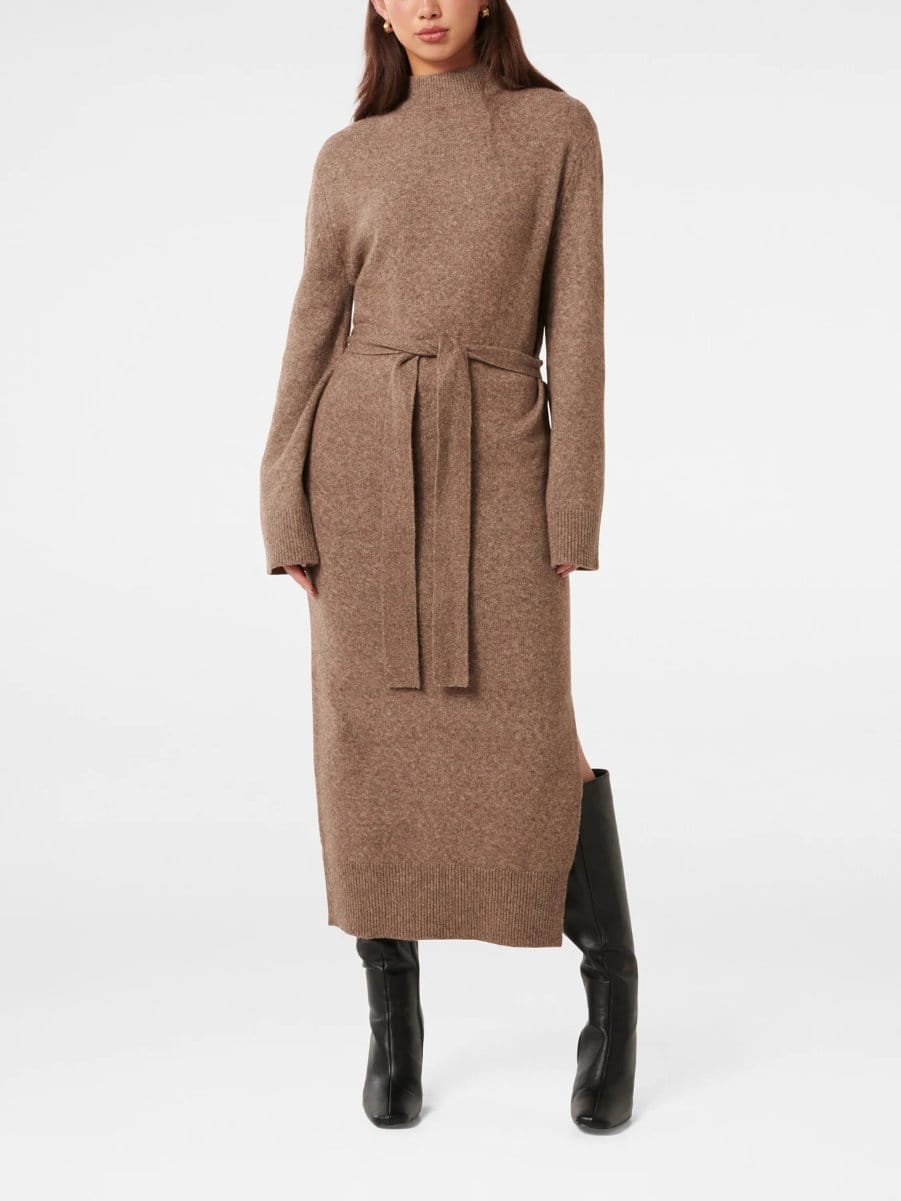
Wool jersey dress with elegant drape and natural stretch.
Wool jersey drapes beautifully and moves with the body, making it excellent for comfortable, flattering dresses.
Recommended weight: 180-240 GSM (midweight)
Best wool type: Merino, lambswool, merino/spandex for fitted styles
- Wrap dresses
- Shift dresses
- Bodycon dresses
- Maxi dresses
- A-line skirts
- Pencil skirts
Sweaters and Cardigans
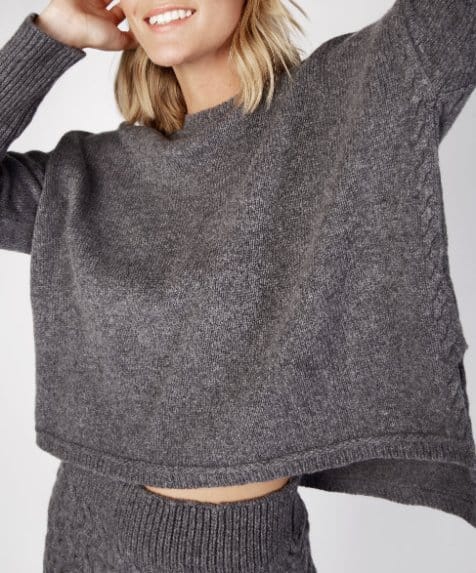
Wool jersey sweater designed for comfort and everyday wear.
Heavier wool jersey makes wonderful sweaters that are less structured than traditional knitted sweaters but warmer than woven fabrics.
Recommended weight: 220-300+ GSM (midweight to heavyweight)
Best wool type: Lambswool, merino, wool/cashmere blend
- Pullover sweaters
- Cardigans
- Turtlenecks
- Cowl neck tops
- Tunics
Outerwear
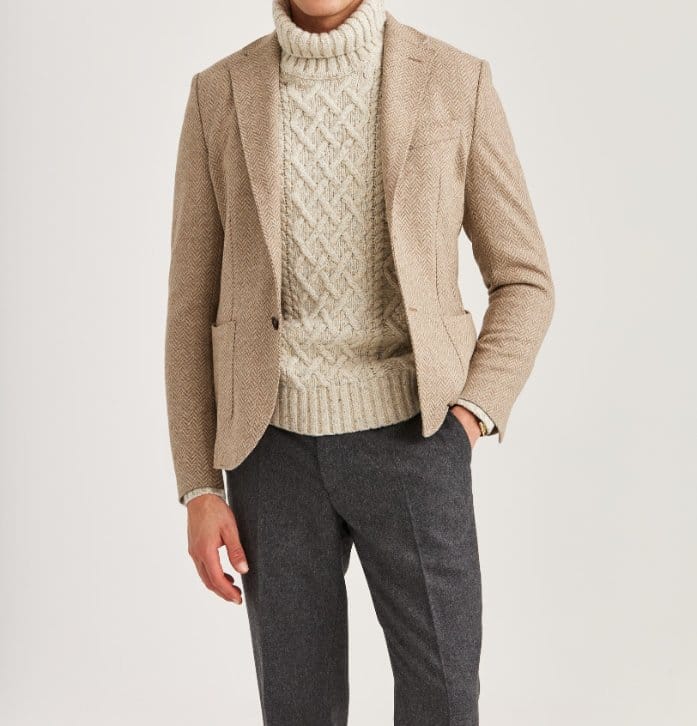
Casual jacket crafted from wool jersey fabric for everyday wear.
Heavyweight or felted wool jersey creates structured yet comfortable outerwear.
Recommended weight: 260-350+ GSM (heavyweight), felted wool
Best wool type: Felted 100% wool, lambswool, wool/nylon blend
- Casual jackets
- Vest layers
- Structured coats (felted wool)
- Shackets (shirt-jacket hybrids)
Baby and Children’s Clothing
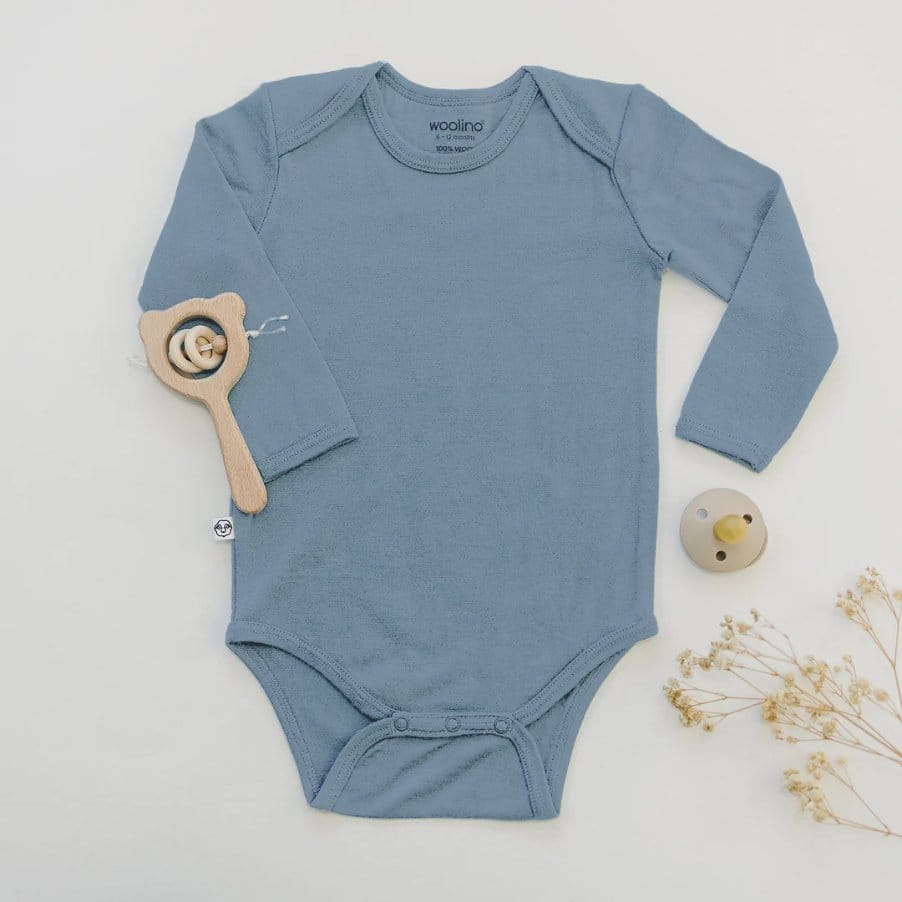
Wool jersey baby bodysuit designed for warmth and breathability.
Fine merino wool jersey is gentle enough for baby skin and provides excellent temperature regulation to prevent overheating.
Recommended weight: 150-180 GSM (lightweight)
Best wool type: Fine merino (18.5 micron or less), superwash merino
- Baby bodysuits
- Sleep sacks
- Rompers
- Toddler leggings
- Children’s base layers
- Kids’ pajamas
Home Textile Applications
Blankets and Throws
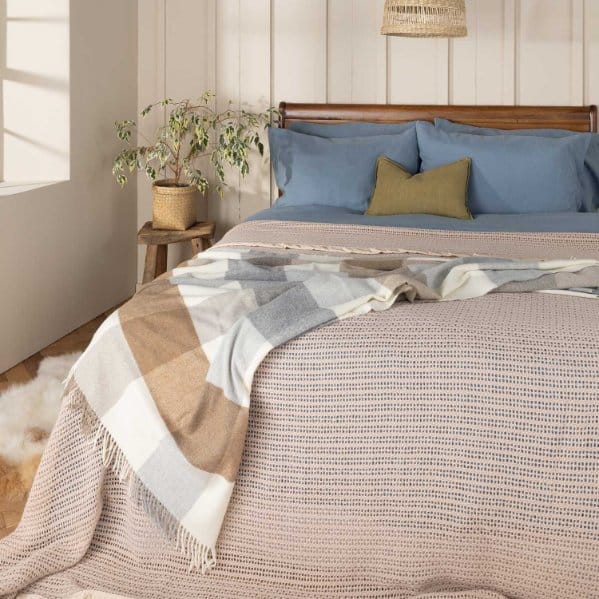
Wool jersey throw adding softness and comfort to bedroom decor.
Wool jersey’s natural temperature regulation makes it perfect for blankets that work year-round.
- Lightweight summer throws
- Baby blankets
- Travel blankets
- Couch throws
Bedding
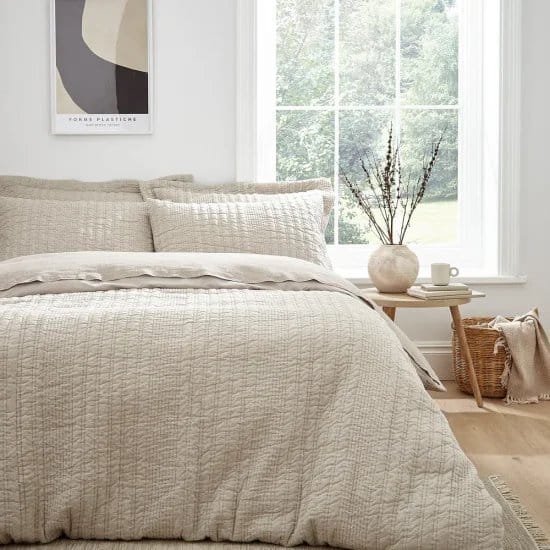
Wool jersey bedding offering comfort and natural temperature control.
Some people love wool jersey sheets for their temperature-regulating properties.
- Fitted sheets
- Flat sheets
- Pillowcases
Weight-to-Project Quick Reference
| GSM Range | Feel | Best Projects |
|---|---|---|
| 120-150 | Very lightweight, almost sheer | Summer base layers, baby clothing |
| 150-180 | Lightweight, perfect drape | T-shirts, underwear, base layers, summer dresses |
| 180-220 | Midweight, versatile | Everyday wear, dresses, activewear, light sweaters |
| 220-260 | Medium-heavy, substantial | Sweaters, warmer dresses, structured pieces |
| 260-300+ | Heavyweight, warm | Winter sweaters, coats, cold weather layers |
How to Sew with Wool Jersey: Tips and Techniques
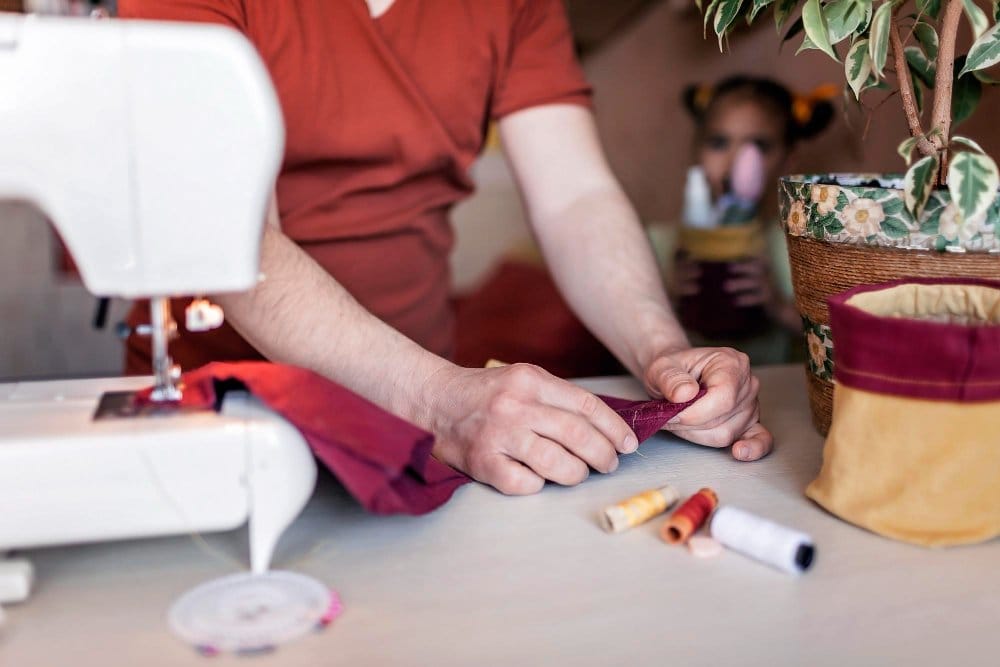
Sewing techniques used when working with wool jersey fabric.
Sewing with wool jersey is easier than you might think, especially if you’ve worked with other jersey fabrics. However, there are some wool-specific considerations to keep in mind.

5 Tricks That Make Sewing With Jersey Knits EASY
Pre-Washing: The Critical First Step
This is THE most important step when working with wool jersey. Skipping it can lead to disaster.
Why Pre-Washing Matters
Wool jersey can shrink 10-20% (or more) the first time it’s washed if not treated properly. Imagine making a perfect sweater, only to have it become unwearable after the first wash. Always pre-wash your fabric the way you plan to care for the finished garment.
Pre-washing steps:
- Check if it’s superwash: Superwash wool can go in the washing machine on gentle cycle with cold water
- For regular wool jersey:
- Hand wash in cool water (below 85°F/30°C)
- Use wool-safe detergent
- Gently squeeze, never wring or twist
- Roll in a towel to remove excess water
- Lay flat to dry on a clean towel
- Test a swatch first: Cut a 10×10 inch square, wash it, measure the shrinkage, and adjust your yardage accordingly
- Allow for drying time: Wool jersey can take 24-48 hours to dry completely when laid flat
Essential Tools and Supplies
Needles
The right needle prevents skipped stitches and fabric damage.
- Ballpoint needles: Best for natural fiber wool jerseys (merino, lambswool). The rounded tip slides between fibers instead of piercing them.
- Stretch needles: Better for synthetic-blend wool jerseys (wool/nylon, wool/spandex). They have a special eye and scarf to prevent skipped stitches.
- Size: 75/11 or 80/12 for lightweight wool jersey, 90/14 for heavier weights
Thread
- All-purpose polyester thread works well for most projects
- Cotton-wrapped polyester offers good strength with natural feel
- Match thread color to your fabric or go one shade darker
Additional Tools
- Ballpoint pins (prevent snagging)
- Walking foot or dual-feed foot (helps fabric feed evenly)
- Twin needle for professional hems
- Rotary cutter and cutting mat (easier than scissors)
- Weights instead of pins for pattern layout
Cutting Wool Jersey
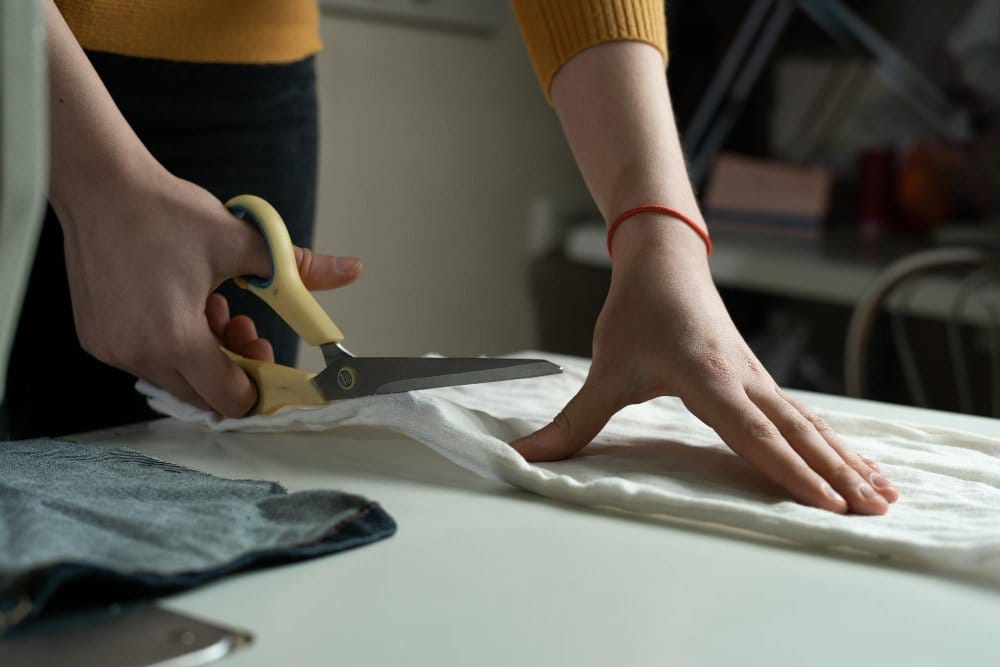
Cutting wool jersey fabric carefully to prevent stretching and distortion.
Wool jersey’s natural curl and stretch require special cutting techniques.
- Let fabric relax: After pre-washing and drying, let fabric relax for 24 hours before cutting
- Use a single layer: Wool jersey can shift when doubled, leading to uneven cuts
- Keep it flat: Don’t let fabric hang off the table edge (this causes stretching)
- Use weights instead of pins: Pins can distort stretchy fabric
- Cut with confidence: Use sharp scissors or a rotary cutter, making smooth, continuous cuts
- Pay attention to grain: The most stretch should go around the body, not up and down
Dealing with Curling Edges
Single jersey edges naturally curl. To minimize this:
- Spray with starch or sizing spray before cutting
- Press with a steam iron (use a pressing cloth to protect wool)
- Cut pieces and sew immediately
- Use a serger to finish edges right after cutting
Stitch Settings for Success
On a Regular Sewing Machine
Zigzag stitch: The most reliable for wool jersey
- Stitch length: 2.5-3.0mm
- Stitch width: 2.5-5.0mm (wider for more stretch)
- Practice on scraps to find the perfect setting
Stretch stitch: If your machine has one
- Built-in stitch that creates a zigzag-style seam with forward and backward motion
- Very strong and stretchy
- Check your machine manual for recommended settings
Never use straight stitch alone – it will break when the fabric stretches
On a Serger/Overlocker
If you have a serger, wool jersey is a dream to sew:
- 4-thread overlock for seams and finishing in one step
- 3-thread overlock for lighter finishing
- Differential feed: Set to 1.5-2.0 to prevent stretching
- Adjust tension for a balanced stitch
Sewing Techniques
Prevent Stretching While Sewing
- Don’t pull the fabric: Let the feed dogs do the work
- Use a walking foot: Helps top and bottom layers feed evenly
- Reduce presser foot pressure: If your machine allows it
- Sew slowly: Rushing causes wavy seams
- Start seams 1-2cm in: For lightweight wool, backstitch to the edge to prevent fabric from being pulled into the needle plate
Seam Finishing Options
1. Serged seams: Professional, quick, stretchy
2. Zigzag finish: Sew seam with narrow zigzag, trim close to stitching
3. Mock flat-fell seam: Sew seam, press to one side, topstitch with twin needle or cover stitch
4. Raw edges: Wool jersey doesn’t fray, so raw edges work for casual garments
Hemming Wool Jersey
Twin needle hem (most professional):
- Use a 2.5mm or 4.0mm twin needle
- Stitch length: 3.0mm
- Creates parallel rows of stitching on top, zigzag on bottom
- Stretches with fabric without breaking
Cover stitch (if you have a cover stitch machine):
- Creates a factory-style hem
- Very stretchy and professional
Zigzag hem:
- Fold hem to wrong side
- Topstitch with narrow zigzag from right side
- Simple and effective
Common Problems and Solutions
| Problem | Cause | Solution |
|---|---|---|
| Skipped stitches | Wrong needle type or dull needle | Switch to ballpoint or stretch needle, replace needle |
| Wavy seams | Stretching fabric while sewing | Don’t pull fabric, reduce presser foot pressure, use walking foot |
| Fabric pulled into needle plate | Lightweight fabric, wrong needle plate | Start sewing 1-2cm in, use straight stitch plate if available |
| Puckering | Thread tension too tight, presser foot pressure too high | Loosen tension, reduce pressure, use smaller stitch length |
| Stretched necklines | Overstretching during sewing | Stay-stitch neckline before attaching binding, use clear elastic |
| Curling edges | Nature of single jersey | Spray starch before cutting, sew immediately after cutting, finish edges |
Pressing and Steaming
- Use medium heat: Wool can scorch or become shiny with high heat
- Always use a pressing cloth: Protects wool from direct heat and shine
- Steam generously: Steam helps set seams and shape garments
- Press, don’t iron: Lift and lower the iron instead of sliding it
- Let cool before moving: Fabric can stretch when warm
Project Ideas by Skill Level
Ready to start sewing with wool jersey? Here are project ideas organized by skill level.
Beginner Projects
These projects use simple construction and minimal pattern pieces, perfect for getting comfortable with the fabric.
Infinity Scarf
Skill level: Beginner
Fabric needed: 3/4 yard of midweight wool jersey
Time: 1-2 hours
What you’ll learn: Basic seaming and finishing
Cut a rectangle (usually 60″ x 20″), sew the long sides together, then connect the short ends to create a loop. Perfect first project!
Simple Headband
Skill level: Beginner
Fabric needed: 1/4 yard or scraps
Time: 30 minutes – 1 hour
What you’ll learn: Sewing curves, turning tubes
Cut two strips, sew together, turn right side out, and connect ends. Great scrap-buster project.
Baby Leggings
Skill level: Beginner
Fabric needed: 1/2 yard of lightweight merino jersey
Time: 2-3 hours
What you’ll learn: Elastic waistband, crotch seam
Simple construction with straight seams. Wool jersey’s natural properties make these perfect for babies.
Intermediate Projects
These projects involve more pattern pieces, fitted construction, or special techniques.
Basic T-Shirt or Tank Top
Skill level: Intermediate
Fabric needed: 1-1.5 yards of lightweight to midweight wool jersey
Time: 3-5 hours
What you’ll learn: Neckline finishing, sleeve attachment (for tee), hemming
A wardrobe staple that you’ll wear constantly. Worth the effort to perfect the fit.
Leggings or Fitted Pants
Skill level: Intermediate
Fabric needed: 1.5-2 yards of wool/spandex blend jersey
Time: 4-6 hours
What you’ll learn: Fitted construction, elastic waistband, crotch curves
Use merino/spandex blend for best stretch and recovery. Great for yoga or everyday wear.
Wrap Dress
Skill level: Intermediate
Fabric needed: 2-3 yards of midweight wool jersey
Time: 6-8 hours
What you’ll learn: Drapey construction, tie details, fitted bodice
Wool jersey’s drape makes it perfect for wrap dresses. Flattering and comfortable.
Advanced Projects
These projects require precision, patience, and experience with knit fabrics.
Fitted Cardigan with Buttons
Skill level: Advanced
Fabric needed: 2-3 yards of heavyweight wool jersey
Time: 10-15 hours
What you’ll learn: Buttonholes in knits, fitted shaping, neat edges
Requires careful fitting and finishing. Consider using felted wool jersey for easier buttonholes.
Structured Coat (Felted Wool Jersey)
Skill level: Advanced
Fabric needed: 4-5 yards of 100% wool jersey (to be felted)
Time: 15-20+ hours
What you’ll learn: Felting process, lapped seams, edge treatments, coat construction
A showpiece project. The felting process transforms the fabric, allowing for special construction techniques.
Quick Reference: Yardage Requirements
| Project Type | Typical Yardage (45″ wide) | Typical Yardage (60″ wide) |
|---|---|---|
| Baby bodysuit | 1/2 – 3/4 yard | 1/2 yard |
| Child’s t-shirt | 3/4 – 1 yard | 1/2 – 3/4 yard |
| Adult t-shirt | 1.5 – 2 yards | 1 – 1.5 yards |
| Leggings | 1.5 – 2 yards | 1 – 1.5 yards |
| Simple dress | 2 – 3 yards | 1.5 – 2.5 yards |
| Cardigan/sweater | 2 – 3.5 yards | 1.5 – 3 yards |
Care Instructions: Making Your Wool Jersey Last
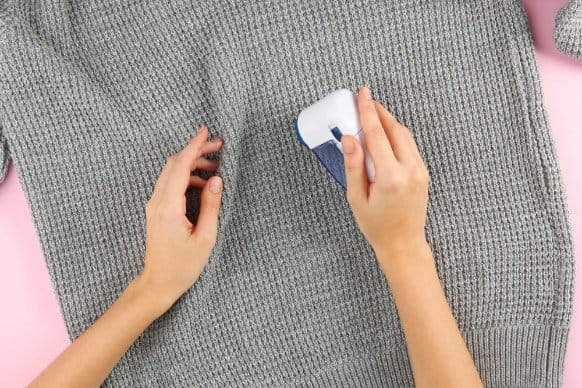
Proper care keeps wool jersey garments smooth and long lasting.
Proper care is what separates a wool jersey garment that lasts 10 years from one that’s ruined after the first wash. Let’s break down exactly how to care for this special fabric.
Washing Wool Jersey
Hand Washing (Safest Method)
This is the gentlest way to clean wool jersey and the best choice for precious garments.
- Fill a basin with cool water: Below 85°F (30°C) is ideal. Hot water causes shrinkage and felting.
- Add wool-safe detergent: Use detergent specifically made for wool or a gentle, pH-neutral soap. Avoid regular detergents, which can strip natural oils.
- Submerge garment: Gently press garment into water until fully saturated. Let soak for 10-15 minutes.
- Gently agitate: Swish gently, never twist, wring, or rub. Friction causes felting.
- Drain and rinse: Drain soapy water, press out gently (don’t wring). Rinse with cool water until soap is gone.
- Remove water: Press garment between hands to remove excess water. Roll in a clean, dry towel and press to absorb more water.
- Reshape and dry flat: Lay garment flat on a clean, dry towel on a flat surface. Reshape to original dimensions. Replace towel if it becomes saturated.
Machine Washing (For Superwash Wool Only)
If your wool jersey is labeled superwash, you can carefully machine wash it:
- Use delicate/wool cycle: Slowest spin speed, shortest cycle
- Cool water only: Cold or cool (below 85°F/30°C)
- Wool-safe detergent: Never use regular detergent
- Wash inside out: Protects surface from pilling
- Use a mesh bag: Extra protection during washing
- Remove promptly: Don’t let sit in washer
- Reshape and dry flat: Even superwash wool should be dried flat
Never Machine Wash Regular (Non-Superwash) Wool Jersey
Unless your fabric specifically says “superwash” or “machine washable,” always hand wash. Machine washing regular wool jersey will result in significant shrinkage and felting. One mistake can ruin a garment permanently.
Drying Wool Jersey
Always dry flat. Never tumble dry (unless superwash and labeled safe).
Flat drying steps:
- Lay a clean, dry towel on a flat surface (table, bed, floor)
- Smooth garment onto towel in its original shape
- Gently stretch to proper dimensions if slightly shrunken
- Replace towel if it becomes very wet
- Allow to dry completely (24-48 hours)
- Keep away from direct heat or sunlight (can cause yellowing)
- Ensure good air circulation
Can you hang dry? Generally no. Wet wool is heavy and will stretch out of shape if hung. For very lightweight wool jersey, you can hang after most moisture is removed, but laying flat is always safer.
How Often to Wash
One of wool jersey’s best features is that it doesn’t need frequent washing.
- Base layers worn next to skin: Every 2-3 wears (or when visibly dirty)
- T-shirts: Every 3-5 wears
- Sweaters/cardigans: Every 5-10 wears or seasonally
- Outerwear: Once or twice per season or as needed
Between washes, air out garments overnight. The natural antibacterial properties of wool mean odors don’t develop like they do with cotton or synthetics.
Detergent Recommendations
Never use:
- Regular laundry detergent (too alkaline, strips natural oils)
- Fabric softener (coats fibers, reduces breathability)
- Bleach (damages wool fibers)
- Enzyme-based detergents (break down protein fibers)
Safe options:
- Wool-specific detergents (Eucalan, Soak, Woolite)
- Baby shampoo (gentle, pH-balanced)
- Castile soap (natural, mild)
- Purpose-made wool wash
Stain Removal
Act quickly with stains on wool jersey:
General Stains
- Blot (don’t rub) with cool water immediately
- Apply wool-safe stain remover or diluted wool detergent
- Gently work into stain
- Rinse with cool water
- Wash normally
Oil-Based Stains
- Sprinkle with cornstarch or talcum powder
- Let sit for 30 minutes to absorb oil
- Brush off powder
- Wash with wool detergent
Protein Stains (Blood, Milk, etc.)
- Always use cold water (hot sets protein stains)
- Soak in cold water with wool detergent
- Gently work stain
- Rinse thoroughly
Storage
Proper storage prevents damage during off-season months.
Clean Before Storing
Always wash garments before storing. Moths and other pests are attracted to body oils, food particles, and dirt.
Fold, Don’t Hang
Hanging stretches wool jersey out of shape, especially heavier garments. Fold and store flat or on shelves.
Moth Prevention
- Cedar: Use cedar blocks, balls, or hang cedar in closet (replace yearly)
- Lavender: Sachets of dried lavender repel moths naturally
- Sealed containers: Store in airtight bins or garment bags
- Check regularly: Inspect stored items every few months
- Air out occasionally: Take items out for airing once or twice a year
Avoid These Storage Mistakes
- Plastic dry cleaning bags (trap moisture, cause mildew)
- Damp areas (basements, attics without climate control)
- Direct sunlight (causes fading and yellowing)
- Cardboard boxes (attract pests)
Pilling: Prevention and Removal
Pilling (those little fabric balls) is common with soft wools, especially merino and cashmere.
Prevention:
- Turn garments inside out when washing
- Reduce friction (be careful with bags, seatbelts)
- Wash less frequently
- Choose higher-quality wool or wool/nylon blends
Removal:
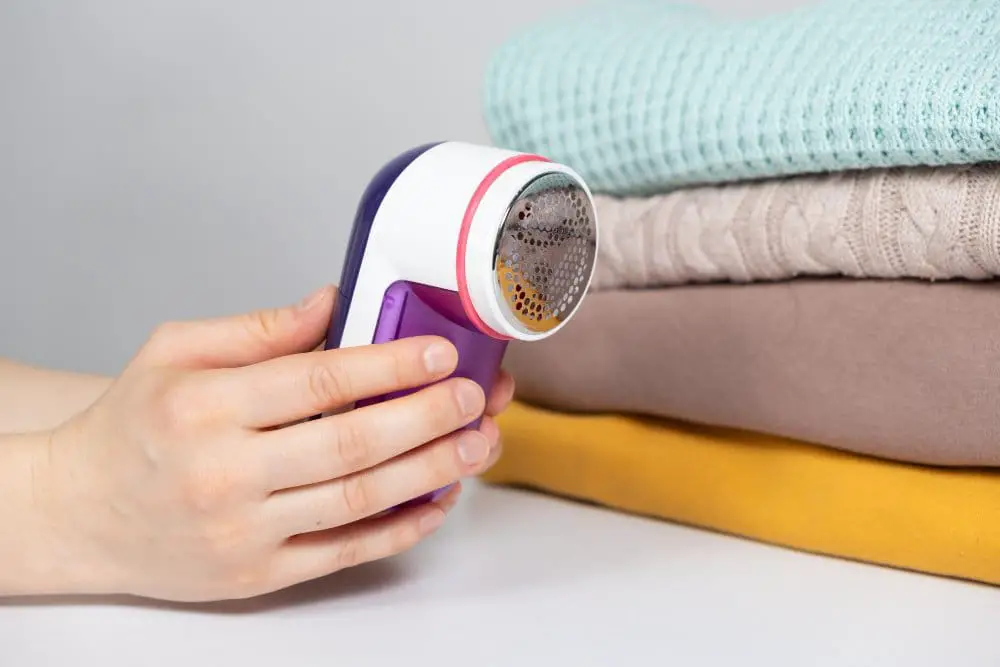
- Fabric shaver: Electric pill remover (most effective)
- Sweater comb: Gently comb away pills
- Sweater stone: Pumice-like stone that removes pills
- Scissors: Carefully snip off individual pills (tedious but works)
Pilling is Normal
Don’t panic if your wool jersey pills. It’s a natural process that happens when short fibers work their way to the surface. After removing the initial pills, most garments pill less over time as these short fibers are removed.
Shrinkage: What to Do If It Happens
If your wool jersey accidentally shrinks, you might be able to recover it:
- Fill basin with cool water and hair conditioner (1-2 tablespoons)
- Submerge shrunken garment and let soak for 30 minutes
- Gently stretch garment back to size while wet
- Roll in towel to remove excess water
- Lay flat on dry towel, continuing to gently stretch
- Pin edges to towel to hold shape while drying
This doesn’t always work, especially if felting has occurred, but it’s worth trying.
Buying Guide: How to Choose Quality Wool Jersey
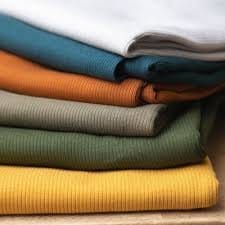
Choosing the right wool jersey fabric based on weight and intended use.
Not all wool jersey is created equal. Here’s how to evaluate quality and make smart purchasing decisions.
Understanding Fiber Quality
Micron Count Matters
Micron count measures the diameter of wool fibers. Lower numbers mean finer, softer wool. Want help evaluating quality? Try our Wool Quality Assessment Checklist before making a purchase.
| Micron Range | Feel | Quality Level | Common Uses |
|---|---|---|---|
| Below 17 | Ultra-fine, luxury soft | Premium | High-end base layers, baby clothing |
| 17-19 | Very soft, no itch | Excellent | Next-to-skin wear, performance clothing |
| 19-22 | Soft, comfortable | Good to very good | General apparel, everyday wear |
| 22-25 | Slightly coarser but still pleasant | Good | Sweaters, outerwear |
| Above 25 | Can be itchy for some people | Economy | Rugged outdoor wear, blankets |
Visual and Touch Quality Checks
What to Look For
Surface quality:
- Even, consistent texture
- No slubs or thick spots
- Smooth hand feel
- Minimal pilling on the bolt (some is normal)
Drape test:
- Hold fabric up and let it hang
- Should drape smoothly without stiffness
- Should recover when released (not stay stretched)
Stretch test:
- Gently stretch fabric horizontally (should stretch 20-50%)
- Release and watch it recover
- Should snap back to original size
- Stretched-out fabric that doesn’t recover indicates poor quality
Color consistency:
- Check for even dyeing
- Look for color variations or streaks
- Check both sides of fabric
Red Flags (Avoid These)
- Very cheap price (under $15/yard for merino usually indicates low quality)
- Harsh, scratchy feel
- Excessive pilling on the bolt
- Uneven dyeing or color streaking
- Stretches but doesn’t recover
- Stiff, cardboard-like feel (over-processed)
- Chemical smell (should smell like clean wool)
- Seller can’t confirm fiber content or origin
Understanding Labels and Specifications
Fiber Content
Look for clear labeling:
- “100% Merino Wool”
- “90% Wool, 10% Nylon”
- “Superwash Merino”
Be wary of vague descriptions like “wool blend” without percentages.
Weight (GSM)
Fabric weight should be clearly stated. If it’s not, ask or request a sample.
Width
Wool jersey typically comes in:
- 45″ wide (common for specialty wool)
- 58-60″ wide (more common, better value)
Origin
While not always indicated, knowing where wool comes from can indicate quality:
- New Zealand: Known for high-quality merino
- Australia: World’s largest wool producer, quality varies
- USA: Smaller scale but often ethically raised
- Italy: Premium wool processing and finishing
Where to Buy Wool Jersey
Online Fabric Retailers
Pros:
- Wider selection
- Competitive pricing
- Can shop specialty fabrics not available locally
- Often offer swatches
- Reviews from other sewers
Cons:
- Can’t feel fabric before buying
- Color may differ from screen
- Shipping costs
- Returns can be difficult
Tips for online shopping:
- Always order swatches when available
- Read reviews carefully
- Check return policy before ordering
- Ask questions about micron count, exact fiber content
- Look for detailed photos showing drape and texture
Local Fabric Stores
Pros:
- Can see, touch, and test fabric
- No shipping wait or costs
- Support local business
- Can ask staff questions
- Easy returns/exchanges
Cons:
- Limited selection (especially for wool jersey)
- Often more expensive
- May not have specialty wools
Specialty Wool Retailers
Some retailers specialize in wool fabrics and often have the best quality and selection. While typically more expensive, you’re paying for verified quality, ethical sourcing, and expert knowledge.
Price Guide: What to Expect
| Wool Type | Quality Level | Price per Yard | Notes |
|---|---|---|---|
| Budget wool jersey | Basic | $12-18 | Coarser wool, good for learning |
| Standard merino jersey | Good | $20-35 | Most common, good quality |
| Premium merino jersey | Excellent | $35-50 | Fine micron, excellent feel |
| Luxury merino/cashmere | Premium | $50-80 | Ultra-soft, special projects |
| 100% cashmere jersey | Luxury | $80-200+ | Special occasion fabric |
| Wool/nylon blend | Good to excellent | $22-40 | Durable, great for activewear |
| Superwash merino | Good to excellent | $28-45 | Convenience premium |
Budget vs Quality: Making Smart Choices
When to splurge:
- Garments worn next to skin (base layers, underwear)
- Baby clothing (worth the extra softness)
- Special occasion pieces you’ll treasure
- Items you’ll wear frequently
When budget options work fine:
- Learning projects (practice on cheaper fabric first)
- Garments worn as mid-layers (not against skin)
- Projects where durability matters more than softness
- Testing a pattern before using premium fabric
Calculating True Cost
Don’t just look at the per-yard price. Consider:
- Longevity: $40/yard fabric that lasts 10 years = $4/year
- Washing needs: Wool jersey’s natural odor resistance saves time and utility costs
- Versatility: One wool jersey piece can work across 3 seasons
- Cost per wear: Expensive fabric used frequently becomes economical
Quality Calculation Example
Premium merino jersey t-shirt:
$45 fabric + $10 supplies = $55 total
Wear 50 times per year × 5 years = 250 wears
Cost per wear: $0.22
Cheap cotton jersey t-shirt:
$15 fabric + $5 supplies = $20 total
Wear 20 times per year × 2 years (then worn out) = 40 wears
Cost per wear: $0.50
The premium wool jersey is actually cheaper in the long run!
Testing Fabric Before Committing
For expensive fabric, always:
- Order swatches first if buying online
- Test wash a swatch to check shrinkage
- Test sew a small piece to see how it behaves
- Check against your skin if you have sensitivities
- Verify the color in natural light
Spending $3-5 on swatches can save you from wasting $100+ on unsuitable fabric.
Frequently Asked Questions
It depends on the wool type and your sensitivity. Fine merino wool jersey (below 19 microns) is not itchy for most people and feels soft against bare skin. Coarser wools (above 25 microns) can be itchy for sensitive skin. The key is the micron count: finer fibers bend more easily and feel softer. If you’re sensitive to wool, look for superfine merino (17 microns or less) or merino/silk blends.
Yes! This surprises many people, but lightweight wool jersey (150-180 GSM) actually works great in warm weather. Wool’s natural breathability and moisture-wicking properties keep you cooler than synthetic fabrics. The fiber structure allows heat to escape while pulling moisture away from your skin. Many hikers and travelers prefer merino wool t-shirts for hot weather because they stay fresh longer and regulate temperature better than cotton.
Regular (non-superwash) wool jersey can shrink 10-20% or more if washed incorrectly, especially with hot water and agitation. This is why pre-washing is so important. Always wash wool jersey in cool water (below 85°F/30°C) and dry flat. Superwash-treated wool jersey resists shrinking but may still shrink 3-5%. To be safe, always test a swatch before washing your finished garment.
Standard wool jersey has moderate stretch (20-30% horizontal), which might not be enough for fitted leggings. For leggings, choose wool jersey with added spandex or lycra (usually 5-10%), which gives much more stretch (50%+) and better recovery. These blends are specifically designed for fitted, active garments and will hold their shape better over time.
Yes, absolutely. While a serger makes sewing wool jersey faster and easier, a regular sewing machine works perfectly fine. Use a ballpoint or stretch needle, sew with a zigzag or stretch stitch (never a straight stitch), and consider using a walking foot. Many home sewers create beautiful wool jersey garments on basic sewing machines.
Pilling depends on the wool quality and how the garment is worn. Softer wools (merino, cashmere) pill more initially than coarser wools. Areas with high friction (underarms, sides, where bags rub) pill more. Good news: after removing the initial pills with a fabric shaver, most wool jersey pills less over time. Wool/nylon blends pill less than 100% wool. Washing inside out and reducing friction helps prevent pilling.
Single jersey naturally curls due to its knit structure. To minimize curling: spray cut edges with starch or fabric stabilizer before sewing, sew pieces immediately after cutting (don’t let them sit), finish edges with a serger or zigzag right after cutting, or use double jersey (interlock) which doesn’t curl. During sewing, gently stretch the edge as you sew to counteract curling.
Yes, fine merino wool jersey (18.5 micron or less) is excellent for baby clothing. It’s gentle on sensitive skin, naturally regulates temperature (preventing overheating), wicks moisture, resists odor, and has natural antibacterial properties. Medical studies have even shown that fine merino wool can help with infant eczema. Always choose very soft, fine merino and pre-wash properly. Many parents prefer superwash merino for easier care with baby clothes.
Merino wool jersey is a specific type of wool jersey made from merino sheep wool. Regular “wool jersey” could be made from any type of sheep wool. Merino is prized for being much softer (finer fibers, 15-24 microns vs 25-40+ microns for regular wool), less itchy, and having better moisture-wicking properties. If a fabric is labeled just “wool jersey,” it’s likely coarser wool unless specified as merino, lambswool, or another specific type.
Yes, wool takes dye beautifully. Use acid dyes (despite the name, they’re safe for home use) specifically made for protein fibers. The dyeing process involves hot water, which can cause shrinkage, so factor this in. Pre-wash the fabric, then dye according to dye manufacturer instructions. The results are usually more vibrant and colorfast than cotton dyeing. Keep in mind that dyeing requires careful temperature control to prevent felting.
Several factors contribute to the higher cost: wool production is more labor-intensive than cotton growing, sheep require more care and land than crops, wool processing is more complex, fine merino wool is rarer and more sought-after, and quality wool jersey often comes from ethically-raised sheep with certifications. The higher price reflects the superior performance properties, longer lifespan, and often better environmental and ethical standards.
Check these indicators: micron count (lower is better, under 19 is excellent), even texture with no thick spots, good drape when held up, springs back when stretched, minimal pilling on the bolt, consistent color with no streaking, clear labeling of fiber content and weight (GSM), and certifications (RWS, ZQ, organic). If buying online, look for detailed specifications, customer reviews, and swatch availability. Avoid suspiciously cheap wool jersey (under $15/yard for merino usually indicates low quality).
Conclusion
After exploring everything from fiber science to sewing techniques, one thing becomes clear: wool jersey is a remarkable fabric that offers unique benefits you simply can’t find in other materials.
What Makes Wool Jersey Special
Unlike cotton jersey that leaves you clammy when sweaty, or synthetic jersey that traps odors, wool jersey manages moisture naturally while staying fresh wear after wear. Its year-round versatility means a single wool jersey garment can replace multiple seasonal pieces in your wardrobe. The natural stretch and recovery ensure clothes that move with you while maintaining their shape over years of wear.
Perhaps most importantly for our time, wool jersey aligns with sustainable fashion principles. It’s biodegradable, renewable, and when cared for properly, incredibly long-lasting. A quality wool jersey piece can serve you for a decade or more, making it a wise investment both financially and environmentally.
Key Takeaways
Remember These Important Points
For Sewers:
- Always pre-wash wool jersey before cutting (test a swatch first to measure shrinkage)
- Use ballpoint or stretch needles and zigzag/stretch stitches
- Let fabric relax for 24 hours after washing before cutting
- Consider starting with a simple project to learn how the fabric behaves
For Buyers:
- Fine merino (below 19 microns) is soft enough to wear next to skin
- Check for clear fiber content labeling and certifications (RWS, ZQ, organic)
- Budget $25-50/yard for quality merino jersey
- Order swatches when possible before committing to yardage
For Care:
- Hand wash in cool water or machine wash superwash varieties on gentle cycle
- Always dry flat, never tumble dry (unless labeled safe)
- Wash less frequently than other fabrics (odor resistance is real!)
- Use wool-specific detergent, never regular detergent or fabric softener
For Choosing:
- Lightweight (150-180 GSM) for base layers and summer wear
- Midweight (180-220 GSM) for everyday t-shirts and year-round pieces
- Heavyweight (220-300+ GSM) for sweaters and cold weather garments
- Add spandex for fitted garments like leggings
Your Next Steps
If you’re ready to try wool jersey:
- Start small: Order a yard or two of quality merino jersey for a simple first project like a t-shirt or scarf
- Test thoroughly: Pre-wash a swatch, test sew on it, check how it feels against your skin
- Invest in the right tools: A pack of ballpoint needles costs just a few dollars but makes all the difference
- Use our interactive tools: Check out our Fabric Weight Calculator to help choose the right GSM for your project, and try our Wool Type Selector Quiz to find your perfect wool match
- Learn proper care from the start: Good habits prevent expensive mistakes. Our Wool Care Calculator provides personalized washing instructions
Beyond the Basics
As you become comfortable with wool jersey, explore related wool fabrics to expand your skills. Wool fabric comes in dozens of forms, each with unique properties. You might discover that wool suiting is perfect for your next tailored project, or that wool challis creates flowing summer dresses.
For those interested in sustainable fashion, understanding how to care for wool properly extends to all wool types and helps you maintain a long-lasting, eco-friendly wardrobe.
A Final Word
Wool jersey represents hundreds of years of textile evolution, from humble fishermen’s underwear to high-performance athletic wear to everyday comfort. It’s a fabric that works harder for you than almost any other material, asking only for proper care in return.
Whether you’re sewing a base layer for mountain climbing, a t-shirt for travel, baby clothes that regulate temperature naturally, or just want clothing that performs better and lasts longer, wool jersey delivers. The initial investment in quality fabric pays dividends in comfort, performance, and longevity.
Start your wool jersey journey today. Your wardrobe (and the planet) will thank you.
Looking for even more quality wool options? Visit Wool and Cashmere fabrics for premium selections.