
Everything you need to know about construction, care, sustainability, and why designers love it
Table of Contents
- What is Double Cloth Wool Fabric?
- How Double Cloth is Made
- A Rich History: From Ancient Times to Modern Couture
- Double Cloth vs Other Wool Fabrics
- Why Double Cloth Wool is a Sustainable Choice
- What Makes High-Quality Double Cloth
- Practical Uses and Applications
- Complete Care Instructions
- Working with Double Cloth: Tips for Sewers
- How to Buy Double Cloth Wool
- Designer Spotlight: Ralph Rucci and Double Cloth Couture
- Frequently Asked Questions
- Conclusion
What is Double Cloth Wool Fabric?
Double cloth wool fabric is a unique textile construction where two separate layers of fabric are woven or connected together to create a single, thicker material. Think of it as two pieces of fabric joined at specific points, creating an air pocket between the layers that provides exceptional warmth without excessive weight.
Unlike regular wool fabric, which has just one layer, double cloth gives you two finished surfaces. This makes it perfect for creating reversible garments, self-lined coats, and structured outerwear that looks beautiful inside and out.
The magic of double cloth lies in its construction. When you hold it up and look at the edge, you can actually see where the two layers meet. Some double cloths are woven so that you can gently pull the layers apart, while others are more tightly bound together throughout.
This fabric has been around for centuries, but it’s experiencing a comeback in modern fashion. Why? Because people are looking for quality pieces that last, and double cloth delivers on that promise. It’s warmer than single-layer wool, more structured, and often more durable.
How Double Cloth is Made
The construction of double cloth wool is what makes it special. The weaving process uses multiple sets of threads:
- Two warp sets (the vertical threads on the loom)
- Two or three weft sets (the horizontal threads)
- Binding points where the layers connect
During weaving, the loom creates two separate fabrics simultaneously. At regular intervals, a binding thread weaves through both layers, connecting them. This creates small pockets of air between the layers, which trap warmth and give the fabric its insulating properties.
The spacing of these binding points matters. Too few, and the layers might separate too easily. Too many, and you lose the air pockets that make the fabric special. Skilled weavers know exactly how to balance this.
Double Cloth vs Double Face vs Pocket Weave: Clearing Up the Confusion
There’s a lot of confusion about these terms, so let’s break it down clearly:
| Type | Construction | Can Layers Separate? | Best For |
|---|---|---|---|
| Double Cloth (True Double Cloth) | Two separate fabrics woven together with binding threads | Yes, at the edges you can often pull them apart | Reversible coats, self-lined garments, structured outerwear |
| Double Face | Single fabric with two finished sides, often different colors or textures | No, it’s one piece of fabric | Scarves, wraps, lightweight coats |
| Pocket Weave | Specific type of double cloth where layers connect only at certain points, creating actual pockets | Yes, with distinct pocket spaces between layers | Extra warm outerwear, architectural garments |
The easiest way to tell them apart? Look at the edge of the fabric. If you can see two distinct layers and potentially separate them a bit, you’re looking at true double cloth. If it’s seamlessly one piece with no separation possible, it’s double face.
A Rich History: From Ancient Times to Modern Couture
Double cloth weaving isn’t new. In fact, it’s one of the oldest complex weaving techniques we know about.
700 AD
The earliest known examples of double weaving date back to around 700 AD. Ancient weavers discovered that connecting two layers created warmer, more substantial fabrics perfect for cold climates.
Late 1800s
William Morris, the famous craftsman and designer, became well-known for using double cloth in his work. He created beautiful fabrics using silk and wool together, with heavily patterned designs. These were woven by Alexander Morton & Co. in Scotland, a mill that helped perfect the technique.
Early 20th Century
Double cloth became a staple in high-quality tailoring, especially for winter coats. The fabric’s ability to provide structure without needing a separate lining made it popular with discerning customers.
2000s – Present
Designers like Ralph Rucci brought double cloth back into the spotlight. His use of double-faced cashmere to create reversible haute couture coats that looked as beautiful inside as outside showed the world what this fabric could do.
Today, double cloth wool represents a connection to that long history of craftsmanship. When you wear a double cloth coat, you’re wearing a piece of textile history that spans more than 1,300 years.
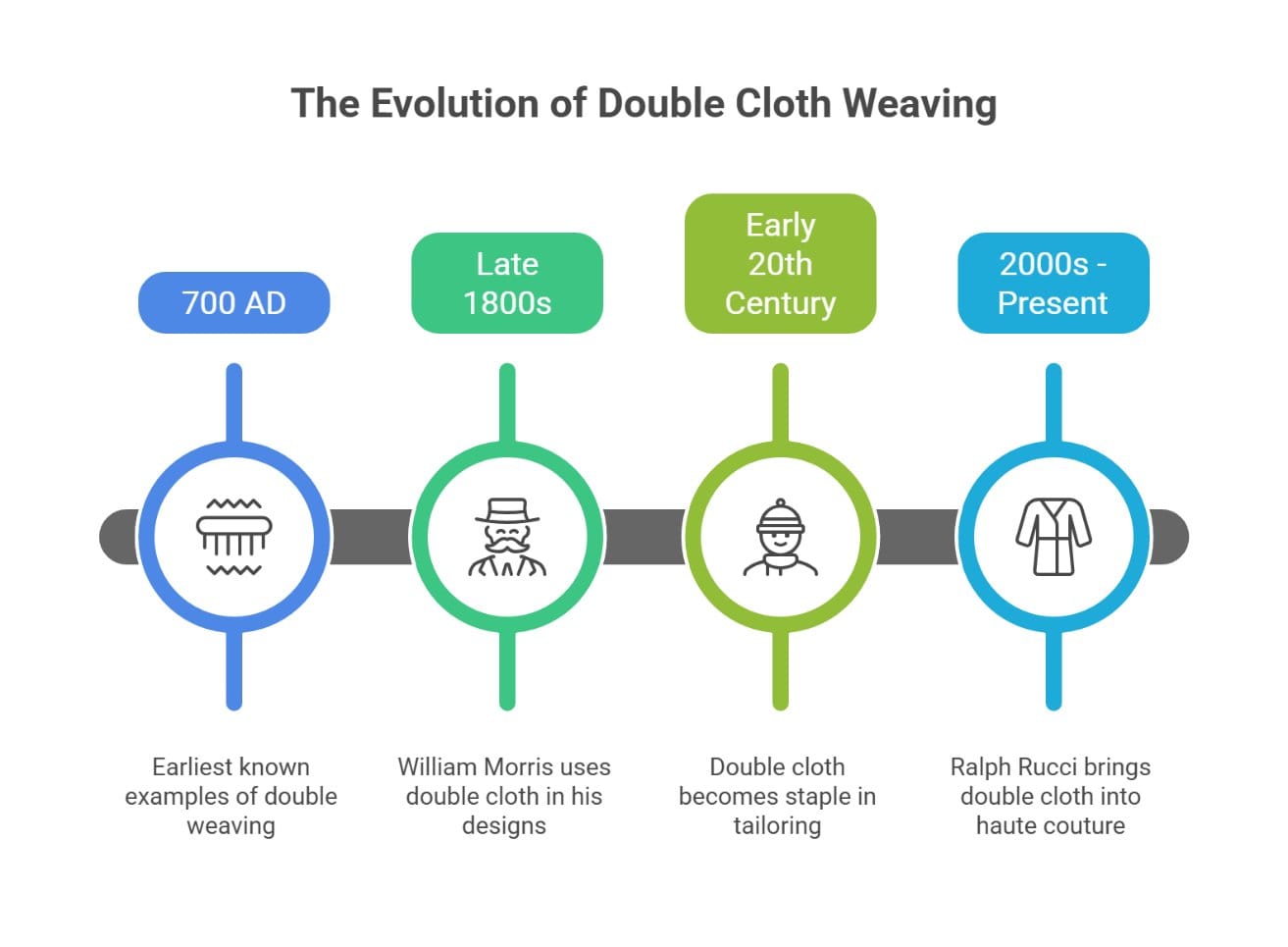
The evolution of double cloth weaving from ancient textiles to modern fashion
Double Cloth vs Other Wool Fabrics
Understanding how double cloth compares to other wool coating options helps you choose the right fabric for your project. Here’s how it stacks up:
| Fabric Type | Weight | Warmth | Drape | Best Uses | Price Range |
|---|---|---|---|---|---|
| Double Cloth Wool | Medium-Heavy | Very Warm | Structured, holds shape well | Reversible coats, tailored jackets, structured garments | $$$-$$$$ |
| Melton Wool | Heavy | Very Warm | Stiff, minimal drape | Peacoats, military coats, structured outerwear | $$-$$$ |
| Boiled Wool | Medium-Heavy | Warm | Some drape, felted texture | Casual jackets, accessories, slippers | $$ |
| Wool Crepe | Light-Medium | Moderate | Excellent drape, fluid | Dresses, blouses, flowing garments | $$-$$$ |
| Wool Tweed | Medium | Warm | Textured, some structure | Blazers, skirts, classic tailoring | $$-$$$ |
| Wool Flannel | Light-Medium | Warm | Soft, good drape | Suits, casual shirts, lightweight jackets | $$ |
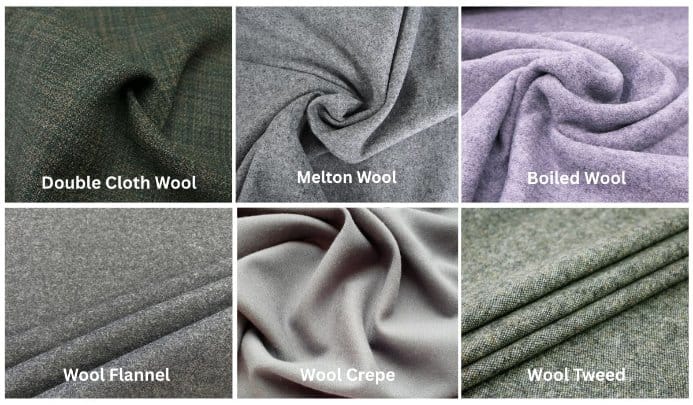
Double cloth wool compared with other common wool fabrics
When to Choose Double Cloth Over Other Options
Pick double cloth when you want:
- A reversible garment – The two finished sides make this possible
- Maximum warmth without bulk – The air pocket insulates better than a single-layer fabric of the same weight
- A self-lined look – No need for separate lining fabric
- Structure that holds its shape – Perfect for tailored coats that need to keep their silhouette
- A luxury investment piece – Double cloth coats can last 20+ years with proper care
Choose melton wool instead if you need something even heavier and don’t care about reversibility. Go with boiled wool if you want a more casual, felted texture. And pick wool crepe when you need drape over structure.
Why Double Cloth Wool is a Sustainable Choice
In a world focused on fast fashion, double cloth wool stands out as a genuinely sustainable option. Here’s why:
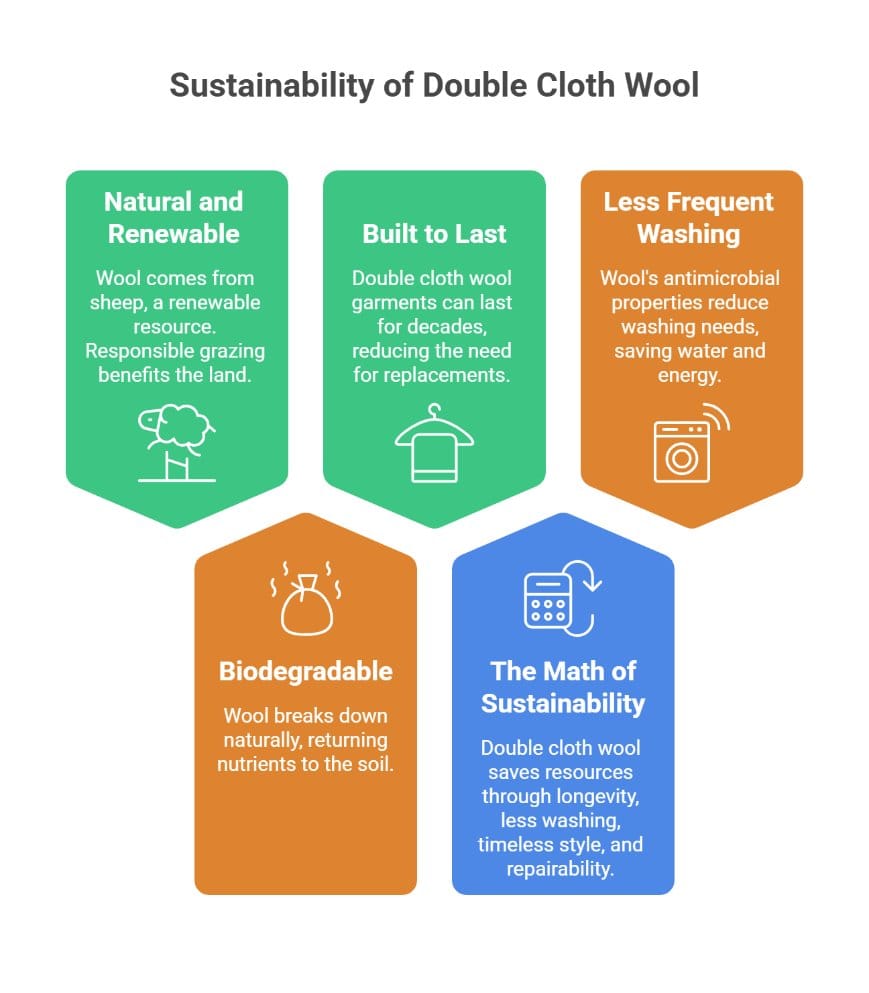
Why double cloth wool is a sustainable and eco-friendly fabric
Natural and Renewable
Wool comes from sheep, which regrow their fleece every year. Unlike synthetic fabrics made from petroleum, wool is a renewable resource. When sheep are raised responsibly, they’re part of a natural cycle that can actually benefit the land through managed grazing.
Biodegradable
When a double cloth wool garment finally reaches the end of its very long life, it will break down naturally. Wool is a protein fiber, similar to human hair. When it biodegrades, it returns nutrients to the soil instead of sitting in a landfill for centuries like polyester or nylon.
According to the International Wool Textile Organisation, wool biodegrades in both land and marine environments, meaning it doesn’t contribute to the growing microplastic pollution problem that synthetic fabrics cause.
Built to Last
Here’s where double cloth really shines for sustainability: it lasts. A well-made double cloth coat can easily serve you for 20 years or more. Compare that to a cheap polyester coat that might last two or three seasons at best.
The Math of Sustainability
- One double cloth coat lasting 20 years = buying 10+ fast fashion coats
- Less washing needed (wool resists odors naturally) = less water and energy used
- Timeless style = no need to replace when trends change
- Can be repaired and altered = extends life even further
Less Frequent Washing
Wool has natural antimicrobial properties. This means your double cloth coat won’t need washing nearly as often as synthetic fabrics. Most people spot-clean their wool coats and only do a full wash once or twice per season, if that. This saves water, energy, and detergent over the garment’s lifetime.
Look for Responsible Certifications
When buying double cloth wool, look for these sustainability markers:
- Responsible Wool Standard (RWS) – Ensures animal welfare and land management practices
- Organic Wool – No pesticides on pastureland, no chemical treatments on sheep
- Traceable Origins – Some mills can trace their wool back to specific farms
The Woolmark Company provides detailed information about wool’s environmental benefits, including its carbon cycle participation and recyclability.
The Carbon Story
Wool is made from atmospheric carbon. Sheep eat grass, which captures CO2 from the air through photosynthesis. This carbon becomes part of the wool fiber. When the wool eventually biodegrades, it releases those nutrients back into the soil, completing a natural cycle.
Synthetic fibers, on the other hand, are made from fossil fuels – carbon that’s been locked underground for millions of years. Making synthetic fabric releases that ancient carbon into the atmosphere.
What Makes High-Quality Double Cloth
Not all double cloth is created equal. Here’s what to look for when you’re shopping for quality:
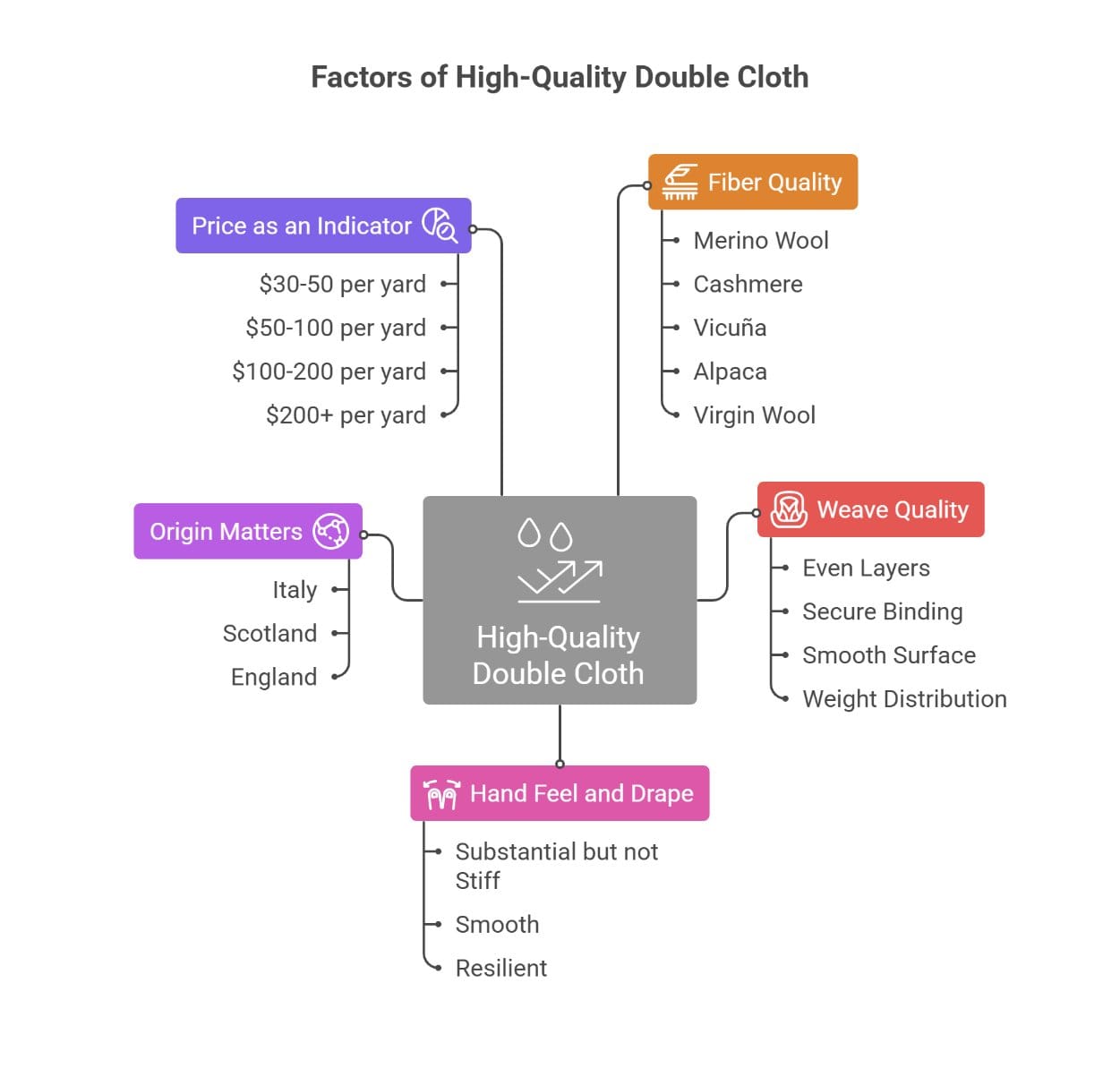
Key factors that define high quality double cloth wool
Fiber Quality
The type of wool used makes a huge difference:
- Merino wool – Soft, fine fibers, comfortable against skin
- Cashmere – Luxury fiber, extremely soft and warm
- Vicuña – Rarest and most expensive, incredibly soft
- Alpaca – Warmer than sheep’s wool, hypoallergenic
- Virgin wool – New wool, never processed before, higher quality than recycled
Higher-quality fibers create softer, more durable double cloth. They also tend to age better, developing a beautiful patina rather than looking worn out.
Weave Quality
Check these aspects:
- Even layers – Both sides should have consistent thickness
- Secure binding – The layers should stay connected, but not be stiff
- Smooth surface – Unless it’s intentionally textured, the fabric should be even
- Weight distribution – Should feel balanced, not heavier in some areas
Hand Feel and Drape
Quality double cloth should feel:
- Substantial but not stiff – It should have body without being boardlike
- Smooth – High-quality wool feels soft to touch
- Resilient – When you scrunch it, it should spring back
Origin Matters
Some regions are known for exceptional double cloth:
- Italy – Particularly mills like Loro Piana and Colombo for cashmere double cloth
- Scotland – Traditional expertise in wool weaving, including mills like Abraham Moon
- England – Historic wool production with attention to detail
If you’re looking for quality wool and cashmere options, reputable suppliers can help guide you toward the best choices for your needs.
Price as an Indicator
Let’s be honest: quality double cloth isn’t cheap. Here’s a rough guide:
- $30-50 per yard – Entry-level, likely wool blend
- $50-100 per yard – Good quality, 100% wool
- $100-200 per yard – High quality, fine wool like merino
- $200+ per yard – Luxury fibers like cashmere or vicuña
Remember, you typically need 2.5-4 yards for a coat, so factor that into your budget.
Practical Uses and Applications
Double cloth wool’s unique properties make it perfect for specific applications. Let’s look at where it really shines:
Outerwear
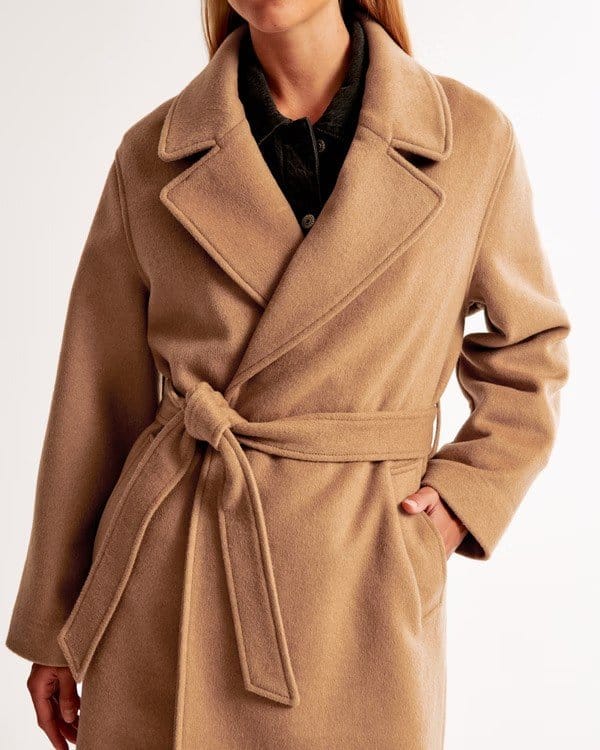
Double cloth wool winter coat with structured tailoring
This is where double cloth truly excels:
- Winter coats – The insulating air pocket keeps you warm without excessive bulk
- Reversible jackets – Two finished sides mean you get two looks in one garment
- Capes and ponchos – The structure helps these pieces hold their shape
- Tailored blazers – Creates crisp lines that stay put
The self-lining nature of double cloth means you can create an unlined coat that still looks finished and professional inside. This was a signature technique of designer Ralph Rucci, who we’ll talk more about later.
Accessories
Double cloth works beautifully for:
- Scarves – Two sides mean you can play with color and texture
- Wraps and shawls – The weight drapes nicely while providing warmth
- Bags – Structure without needing interfacing
- Hats – Warm and windproof
Home Décor
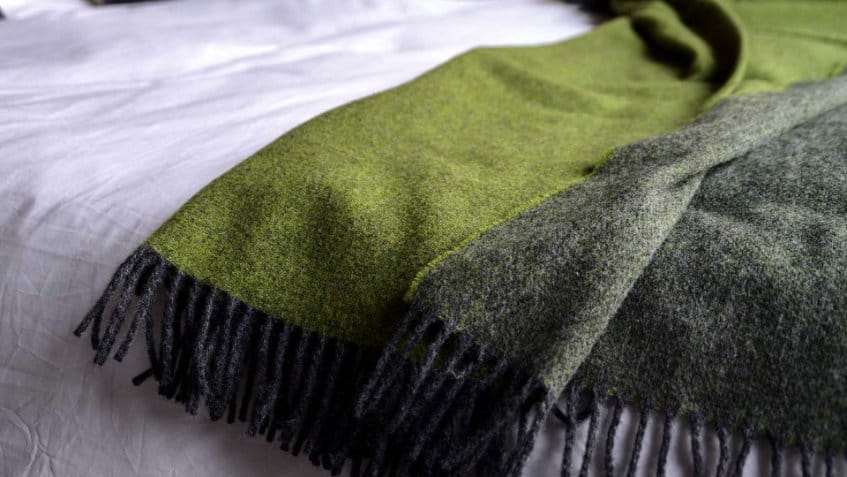
Double cloth wool used as a warm and luxurious throw
Don’t overlook double cloth for interior projects:
- Upholstery – Durable and substantial
- Throw blankets – Warm and reversible
- Pillows – Two-sided design possibilities
- Window treatments – Insulating properties help with temperature control
What Not to Make with Double Cloth
Double cloth isn’t ideal for everything:
- Flowing dresses – Too structured, doesn’t drape well enough
- Gathered skirts – The bulk makes gathering difficult
- Lightweight summer clothing – It’s warm, meant for cold weather
- Baby clothes – Too heavy and structured for little ones
For projects that need drape, consider wool crepe instead. For summer weight, look at wool voile.
Complete Care Instructions
Double cloth wool needs proper care to last for decades. Here’s everything you need to know:
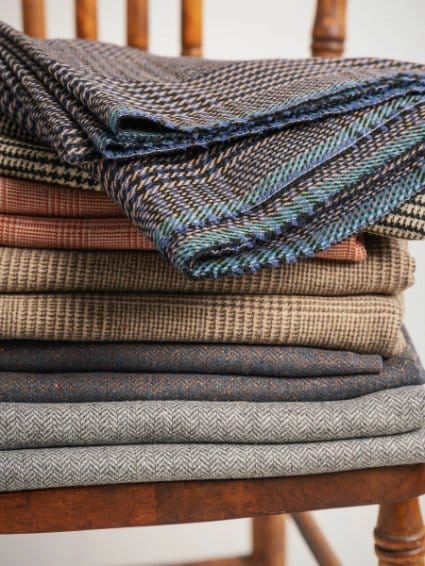
Care and maintenance of double cloth wool fabric
Daily Maintenance
The best care is preventive:
- Brush after each wear – Use a soft garment brush to remove surface dirt and lint
- Air out regularly – Hang in a well-ventilated area, away from direct heat
- Store properly – Use wide, padded hangers to prevent shoulder bumps
- Give it rest – Don’t wear the same coat every single day; rotation helps it last longer
Spot Cleaning
For small stains, spot cleaning is your friend:
- Act fast – The sooner you treat a stain, the better
- Blot, don’t rub – Rubbing pushes the stain deeper and can damage fibers
- Use cool water – Dampen a clean white cloth
- Add mild detergent – A tiny drop of wool-safe detergent or baby shampoo
- Dab gently – Work from the outside of the stain toward the center
- Rinse the cloth – Use a fresh damp cloth to remove detergent
- Press with a dry towel – Absorb excess moisture
- Air dry completely – Away from heat sources
Hand Washing
When your double cloth coat needs a full clean, hand washing is the safest method:
- Fill a clean tub or large sink – Use lukewarm water (never hot)
- Add wool-safe detergent – Use about ¼ cup for a coat-sized item
- Swirl to mix – Create suds before adding the garment
- Submerge the coat – Push it down gently until fully wet
- Let it soak – 15-30 minutes, no agitation needed
- Gently squeeze sections – Don’t wring or twist
- Drain and refill – Rinse with fresh cool water
- Repeat rinse – Until water runs clear, no soap left
- Press out water – Squeeze gently, starting at shoulders
- Roll in towels – Lay coat on clean towels, roll up to absorb water
- Reshape and lay flat – On a drying rack or clean surface
- Dry away from heat – Can take 24-48 hours to fully dry
Machine Washing (When Possible)
Some double cloth can be machine washed, but check the care label first. If it says “dry clean only,” don’t risk it.
If machine washing is approved:
- Turn the garment inside out
- Use a mesh laundry bag
- Select wool or delicate cycle
- Use cold water only
- Add wool-safe detergent
- Skip the spin cycle if possible (or use lowest speed)
- Remove promptly and dry flat
Dry Cleaning
Professional dry cleaning is often the safest option for valuable double cloth coats. Look for cleaners who specialize in wool and luxury fabrics.
How often? Most double cloth coats only need dry cleaning once or twice per season, unless they get heavily soiled. Over-cleaning can actually wear out the fabric faster.
Dealing with Pilling
Pills (those little balls of fiber) can happen with any wool. To remove them:
- Use a sweater stone or fabric comb
- Work gently in one direction
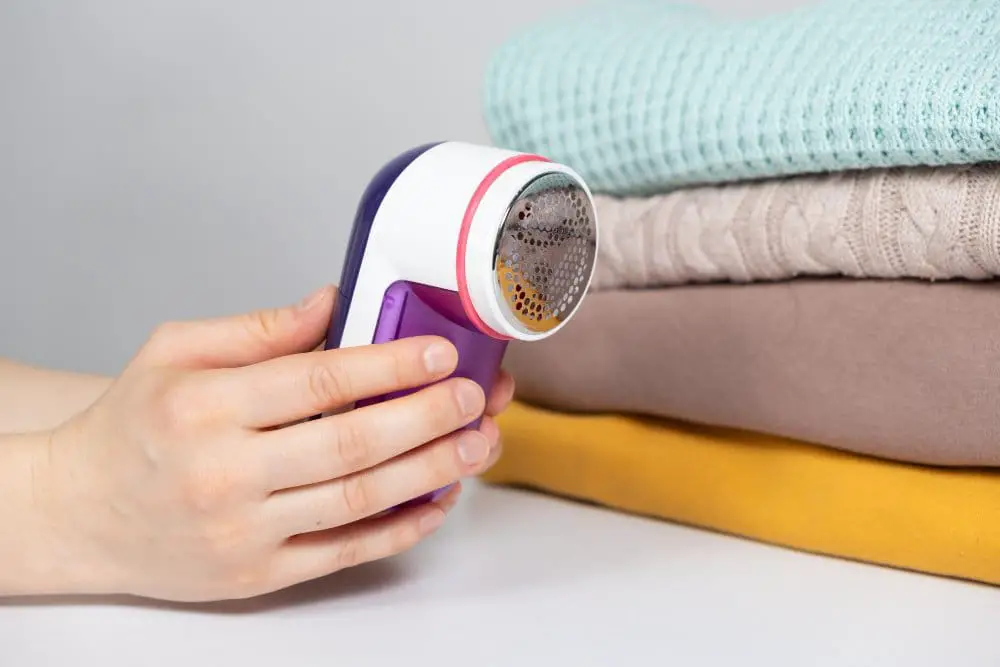
- For stubborn pills, carefully use a sweater shaver
- Never use scissors (too easy to cut the fabric)
Moth Prevention
Moths love wool. Protect your investment:
- Clean before storage – Moths are attracted to body oils and food stains
- Use cedar – Cedar blocks or hangers help repel moths
- Add lavender sachets – Natural moth deterrent
- Store in breathable bags – Never plastic, which can trap moisture
- Check regularly – Air out stored garments a few times per year
Steaming vs Ironing
Steaming is better for double cloth wool:
- Hang the garment
- Use a handheld steamer
- Work from top to bottom
- Don’t touch the steamer to the fabric
- Let the steam do the work
If you must iron:
- Use the wool setting (low heat)
- Always use a pressing cloth
- Never iron directly on the fabric
- Use a lifting motion, don’t slide the iron
- Work on the wrong side when possible
For more detailed wool care guidance, check out our complete wool care guide.
Working with Double Cloth: Tips for Sewers
Sewing with double cloth wool requires some special techniques. Here’s what you need to know:
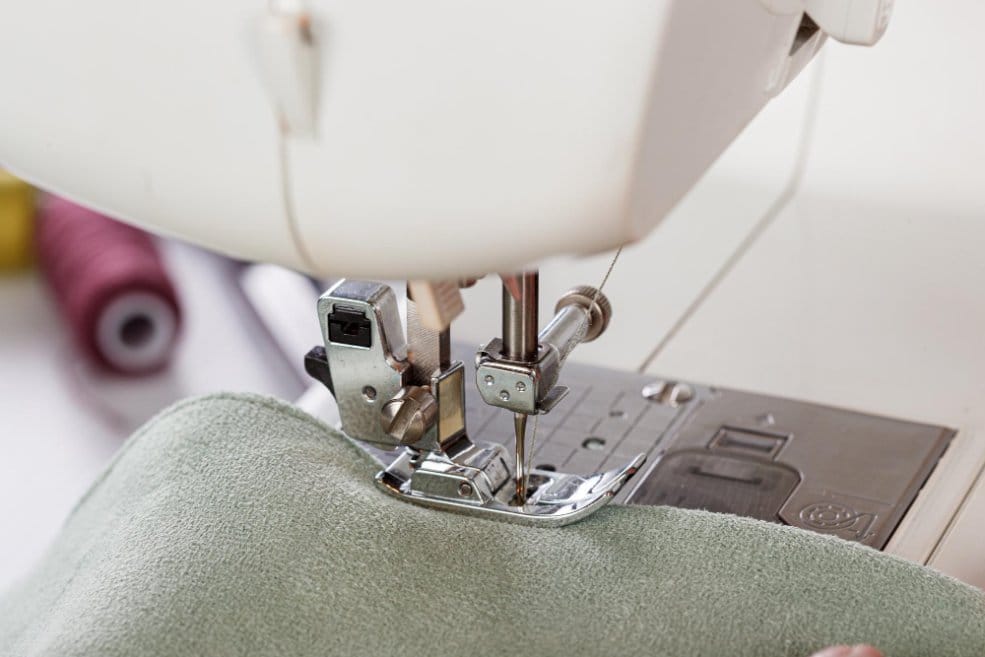
Sewing and working with double cloth wool fabric
Pattern Selection
Choose patterns wisely:
- Simple silhouettes work best – Too many details can look bulky
- Minimal seams – Less bulk to manage
- Straight or slightly flared – Avoid heavily gathered designs
- Consider reversibility – If using both sides, plan for visible seams
Cutting
Cutting double cloth needs care:
- Use sharp scissors – Dull blades will pull the layers apart
- Cut both layers together – Don’t separate them
- Use weights, not pins – Pins can leave permanent holes
- Cut in single layers – Don’t fold the fabric if possible
Seaming Techniques
Seams can get bulky with double cloth. Here are solutions:
- Grade your seams – Trim each layer to a different width to reduce bulk
- Press seams open – Rather than to one side
- Consider separating layers – For some construction methods, you can work with layers separately
- Use a walking foot – Helps feed the thick fabric evenly
Needles and Thread
- Needle size: 90/14 or 100/16 for coating weight
- Needle type: Universal or sharp
- Thread: All-purpose polyester or quality cotton
- Stitch length: Slightly longer than normal, around 3.0mm
Special Techniques for Reversible Garments
If you’re making a reversible coat:
- All seams must look good on both sides
- Use Hong Kong finish or binding for seam allowances
- Consider hand-sewn hems for invisible finish
- Buttonholes need special planning (or use toggles/frogs)
Pressing
Proper pressing is key:
- Use a press cloth always
- Steam generously
- Use a clapper to set the press
- Don’t slide the iron; lift and press
- Let fabric cool completely before moving
How to Buy Double Cloth Wool
Ready to purchase? Here’s how to find quality double cloth:
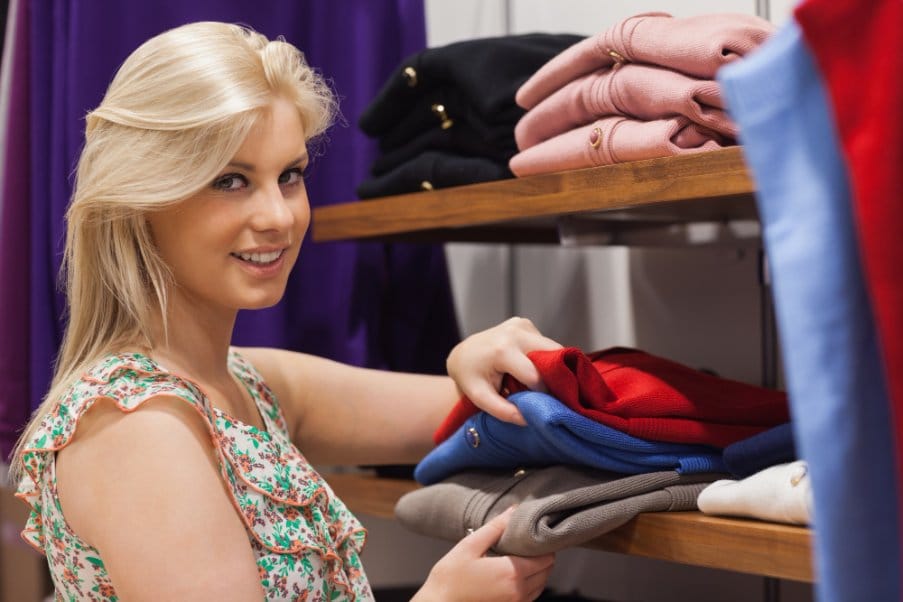
Tips for buying high quality double cloth wool
Where to Shop
- Specialty fabric stores – Better selection and knowledgeable staff
- Online fabric retailers – Mood Fabrics, B&J Fabrics, Fabric House
- Direct from mills – Some mills sell to consumers
- Fabric shows and markets – Good for seeing/touching in person
Questions to Ask
Before buying, ask:
- Is this true double cloth or double face?
- What fiber content? (100% wool, cashmere blend, etc.)
- What’s the weight? (Good for coats is usually 10-16 oz per yard)
- Has it been pre-shrunk?
- What are the care requirements?
- What’s the country of origin?
- Can I see/touch a sample?
Red Flags
Watch out for:
- Price seems too good – Quality double cloth isn’t cheap
- Seller can’t explain construction – They should know their products
- No fiber content listed – You need to know what you’re buying
- Can’t get a swatch – Reputable sellers provide samples
- Fabric feels stiff or rough – Quality wool should feel nice
How Much to Buy
Typical yardage for common projects:
- Knee-length coat: 2.5-3 yards
- Full-length coat: 3.5-4 yards
- Jacket: 2-2.5 yards
- Cape: 2-3 yards depending on fullness
- Scarf: 0.5-1 yard
Always buy a bit extra for pattern matching, mistakes, or future repairs.
Seasonal Availability
Double cloth wool is seasonal:
- Best selection: Late summer through fall (August-October)
- Sales: Late winter/early spring (February-March)
- Limited stock: Summer months
Plan your projects around fabric availability if possible.
Designer Spotlight: Ralph Rucci and Double Cloth Couture
When talking about double cloth in modern fashion, one name stands out: Ralph Rucci.
Who is Ralph Rucci?
Ralph Rucci is an American fashion designer who became the first American in over 60 years to be invited to show at Paris Haute Couture Week in 2002. This invitation, from the prestigious Chambre Syndicale de la Haute Couture, recognized him as one of only two Americans (the other being Mainbocher in the 1930s) to achieve this honor.
His Love for Double Cloth
Rucci became famous for his use of double-faced cashmere and wool. He created coats and jackets that were completely reversible, with every seam and detail as beautiful inside as outside.
His signature technique, which he called “suspensions,” involved cutting cashmere into individual pieces, hand-finishing the edges, and then connecting them with special hand-stitched links he called “worms” (modified French knots). This created see-through sections in otherwise solid double cloth garments.
“I’ve never compromised a collection in my life, not one.” – Ralph Rucci
Why His Work Matters
Rucci showed the fashion world what was possible with double cloth:
- Technical mastery – His garments demonstrated the highest level of craftsmanship
- Luxury without logos – The quality of the fabric and construction spoke for itself
- Timeless design – His pieces from the 1990s still look modern today
- Made in New York – He kept production local when others outsourced
Contemporary Designers Using Double Cloth
While Rucci brought double cloth to haute couture prominence, other designers have embraced it too:
- The Row (by Mary-Kate and Ashley Olsen) often features double cloth coats
- Max Mara is known for quality double cloth winter coats
- Jil Sander has used double cloth for minimalist, architectural pieces
What We Can Learn
Rucci’s work teaches us that:
- Quality materials deserve quality construction
- The inside of a garment matters as much as the outside
- True luxury is about craftsmanship, not branding
- Classic techniques remain relevant in modern fashion
Frequently Asked Questions
Conclusion
Double cloth wool represents something increasingly rare in modern fashion: genuine quality that lasts. This isn’t a fabric for chasing trends or building a disposable wardrobe. It’s for people who appreciate craftsmanship, who want pieces they’ll still be wearing (and loving) decades from now.
We’ve covered a lot of ground in this guide. You’ve learned that double cloth is actually two fabrics woven together, creating insulating air pockets that keep you warm without bulk. You understand the difference between true double cloth, double face, and pocket weave – distinctions that even some fabric sellers get wrong.
The history of double cloth spans more than 1,300 years, from ancient weavers who discovered this technique to William Morris’s decorative Victorian pieces, all the way to Ralph Rucci’s modern haute couture masterpieces. This deep history tells you something important: techniques that last this long do so for good reason.
From a sustainability standpoint, double cloth checks all the boxes. It’s made from renewable wool, biodegrades naturally at end of life, requires less frequent washing, and most importantly, lasts for decades when cared for properly. One quality double cloth coat replaces ten cheaper alternatives over its lifetime.
Key Takeaways
- Understand what you’re buying: Always check if you’re getting true double cloth or double face. Look at the fabric edge and ask questions.
- Quality varies widely: Price often reflects quality, but also check fiber content, weave quality, and origin. Italian and Scottish mills have strong reputations for good reason.
- Care extends life: Regular brushing, proper storage, minimal washing, and professional cleaning when needed will keep your double cloth looking new for years.
- Choose projects wisely: Double cloth excels in structured coats, jackets, and accessories. It’s not ideal for flowing dresses or gathered garments.
- Think long-term: The high upfront cost makes sense when you calculate cost-per-wear over 20+ years. This is an investment in quality, not an impulse purchase.
- Reversibility is a bonus: If you get true double cloth, consider making reversible pieces that give you two looks in one garment.
Final Recommendations
If you’re new to double cloth, start with a simple project. A scarf or wrap lets you experience the fabric without the commitment of a full coat. Once you understand how it behaves, move on to bigger projects.
When you’re ready to invest in a double cloth coat, take your time finding the right fabric. Visit stores in person if possible, order swatches, ask questions, and choose something you truly love. This isn’t a piece you’ll replace next season.
Consider the complete cost of ownership, not just the purchase price. A $400 double cloth coat worn for 20 years costs $20 per year. A $100 coat replaced every 2 years costs $50 per year. The expensive option is actually cheaper.
Look for certifications like Responsible Wool Standard if sustainability matters to you. Support mills and makers who prioritize animal welfare and environmental responsibility.
Finally, learn to care for your double cloth properly. The techniques in this guide – brushing, spot cleaning, proper storage, careful washing – are simple but make a huge difference in how long your garments last.
Double cloth wool fabric isn’t for everyone. It’s for people who value quality over quantity, who appreciate craftsmanship, and who want to build a wardrobe that lasts. If that sounds like you, double cloth might just become your favorite fabric to work with and wear.
The next time you slip on a beautifully made double cloth coat, you’ll feel the weight of its history, the warmth of its construction, and the satisfaction of owning something truly well-made. That’s a feeling worth investing in.