
Discover everything about this historic, weather-resistant fabric from medieval England to modern tailoring
Table of Contents
- What is Wool Broadcloth Fabric?
- The Rich History of Wool Broadcloth
- How Wool Broadcloth is Made
- Characteristics and Properties
- Types and Grades
- Wool Broadcloth vs Other Wool Fabrics
- Uses and Applications
- Sustainability and Environmental Impact
- Luxury and Quality Focus
- Care Instructions and Maintenance
- Buying Guide
- Working with Wool Broadcloth
- References and Further Reading
- Frequently Asked Questions
- Conclusion
If you’ve ever wondered what fabric kept medieval Europeans warm and dry, or what made those crisp military uniforms so durable, the answer is wool broadcloth. This historic fabric has been around since the 11th century, and it’s still used today for everything from tailored suits to historical reenactments.
While most articles focus on cotton broadcloth, this guide digs deep into the wool version. We’ll cover what makes it unique, how it’s made, and whether it’s the right choice for your next project. You already know about wool fabric in general, but wool broadcloth has some special tricks up its sleeve that set it apart from other wool suiting fabrics.
What is Wool Broadcloth Fabric?
Wool broadcloth is a dense, plain-weave fabric that’s been heavily fulled (also called milled) to create an exceptionally tight texture. Here’s what makes it different from other wool fabrics: it’s woven 50-75% wider than its final width, then shrunk down through a process involving hot soapy water and mechanical action.
This fulling process is what gives wool broadcloth its signature qualities. The individual wool fibers bind together during fulling, creating what textile experts call a “blind-face cloth.” This means you can’t see the individual yarns on the surface. The result? A smooth, dense fabric with a slightly stiff drape that’s incredibly weather-resistant and durable.
What is Broadcloth Fabric in the UK and US?
Here’s where it gets interesting. When someone in the UK says “broadcloth,” they’re usually talking about the traditional wool fabric we’re discussing here. But in the US since the 1920s, “broadcloth” often refers to a cotton or cotton-blend fabric with a subtle rib weave, commonly used for dress shirts.
This guide focuses on the original wool broadcloth. If you’re looking for information about the cotton version, check out our broadcloth cotton fabric guide instead.
Why is it Called Broadcloth?
The name “broadcloth” doesn’t come from its final width. Instead, it refers to the broad looms (wider than standard) used to weave it. Traditional broadcloth was woven about 1.75 yards wide, which was unusually wide for medieval looms. After fulling, it would shrink to a more manageable width while gaining that prized dense texture.
What is Another Name for Broadcloth Fabric?
Wool broadcloth has been called by several names throughout history. The French call it “drap,” while specific types have their own names. “Superfine broadcloth” refers to the highest quality made from merino wool. In historical contexts, you might also see “habit cloth” (used for women’s riding habits) or “lady’s cloth” (a lighter weight version).
The Rich History of Wool Broadcloth
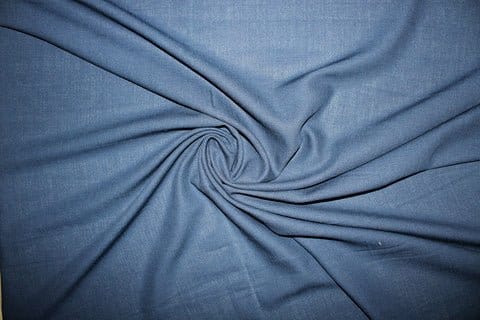
Wool broadcloth has a story that spans nearly a thousand years. It started in 11th-century Flanders (now Belgium), where weavers developed the fulling technique that made this fabric special.
From Flanders to England
By the 1400s, Leiden in Holland became Europe’s broadcloth capital. They were the first to industrialize the process, breaking production into specialized stages rather than making everything in one workshop. This quality control made Leiden broadcloth so respected that in 1417, the Hanseatic League (a powerful trade alliance) decided only approved Leiden broadcloth could be sold through their network.
England caught on quickly. English broadcloth became famous for its quality, especially wool from two regions. The Worcester area used wool from the Welsh border counties of Herefordshire and Shropshire, known as Lemster wool (from Leominster). The West Country used Cotswolds wool. Both produced excellent broadcloth because, surprisingly, the sheep grazed on relatively poor pasture, which led to wool with just the right qualities.
The Peak and Decline
English broadcloth exports hit their peak in the mid-1500s. At this point, it was one of England’s most important exports. But the 1600s brought problems. Currency issues in Eastern Europe and a failed government scheme called the Cockayne Project hurt the trade. Worcester remained a center for white broadcloth production, but overall, the industry declined.
Broadcloth in Different Grades
Not all broadcloth was created equal. Historical records show various types:
- Superfine broadcloth: The best quality, made from fine merino wool. This was the go-to fabric for gentlemen’s coats in the 18th and 19th centuries.
- Fine broadcloth: Good quality for formal wear.
- Coarse broadcloth: More economical but still durable. Used by working-class people.
- Habit cloth: British-made fine wool broadcloth for women’s riding habits.
- Poole cloth: Named after the famous Henry Poole & Co tailoring house (founded 1806), this had an extra-clear finish.
- Taunton: Originally from Taunton, available in medium or coarse grades at 11 ounces per yard (this weight was actually set by law).
Native American Trade Cloth
Wool broadcloth also played an important role in North American history. It became known as “trade cloth” and was highly valued by Native American communities. Companies like those that reproduced Stroud cloth (from Stroud, England, made in the 1700s-1800s) continue to supply authentic wool broadcloth for Native American regalia and mountain man reenactments today.
How Wool Broadcloth is Made
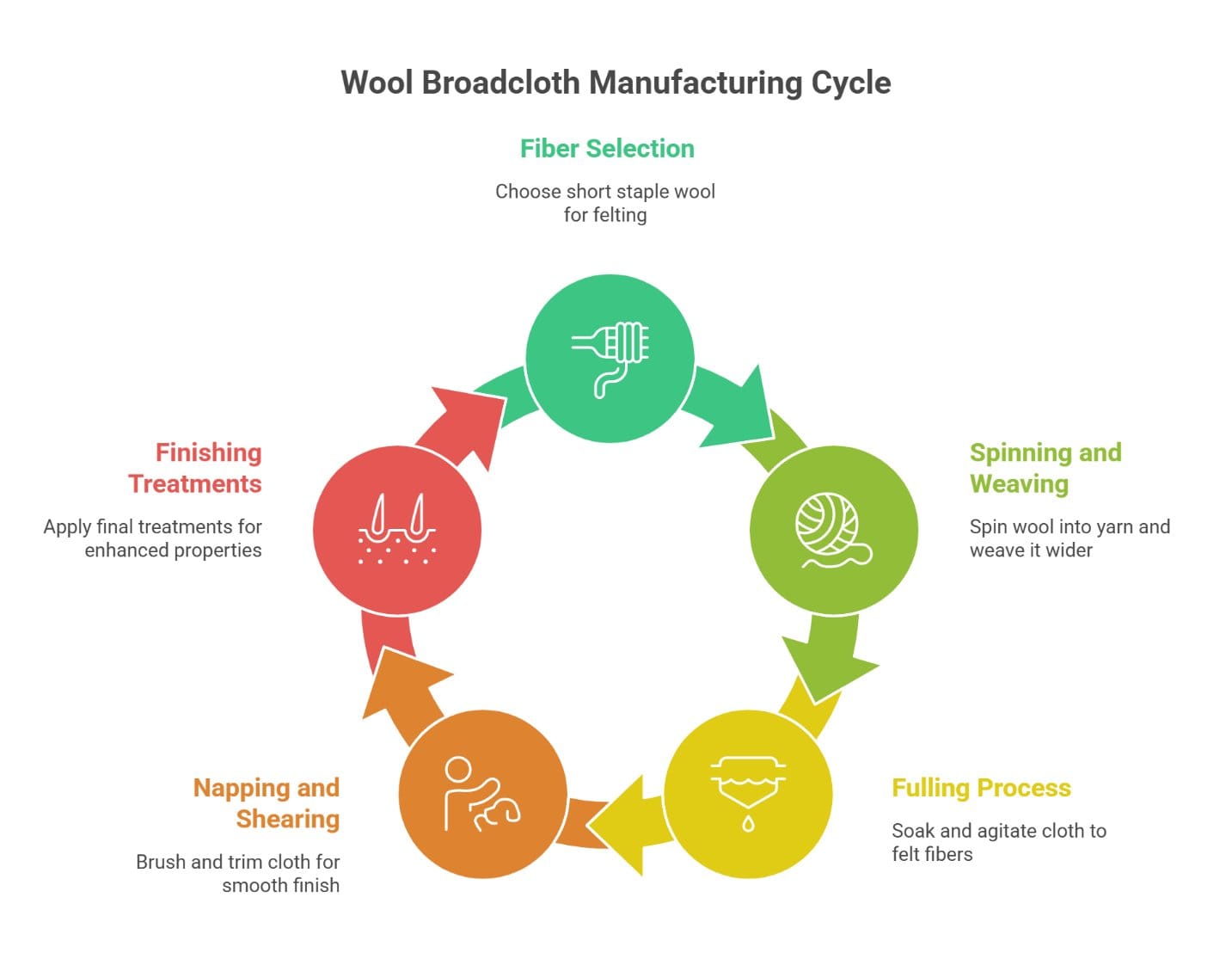
The manufacturing process is what makes wool broadcloth special. It’s not just about weaving. The fulling process after weaving is where the magic happens.
Step 1: Fiber Selection
Traditional wool broadcloth starts with short staple wool that’s been carded (brushed to align fibers). This is different from worsted wool, which uses longer, combed fibers. The carded short staple wool is what allows the fabric to felt properly during fulling.
Step 2: Spinning and Weaving
The carded wool is spun into yarn, then woven on a broad loom in a plain weave pattern (the simplest over-under weave). The key: it’s woven 50-75% wider than the desired final width. A piece meant to finish at 1 yard wide might be woven at 1.5 to 1.75 yards wide.
Step 3: The Fulling Process
This is what makes broadcloth different from other wool fabrics. Fulling involves soaking the woven cloth in hot soapy water while subjecting it to mechanical action.
Traditionally, this was done with heavy wooden trip hammers that pounded the cloth, or workers would actually walk on the fabric in water. Today, mechanized fulling mills do this work, but the principle is the same. The hot water and agitation cause the wool fibers to shrink and felt together.
What Fulling Does
The fulling process creates several key changes:
- Draws yarns much closer together than the loom could achieve
- Causes wool fibers to bind together through felting
- Creates a dense, “blind-face” surface where individual yarns aren’t visible
- Makes the fabric weather-resistant
- Allows cut edges without hemming (the dense structure prevents fraying)
Step 4: Napping and Shearing
After fulling, the cloth may be brushed to raise a slight nap (fuzzy surface), then sheared to trim excess fibers and create a smooth finish. This gives broadcloth its characteristic smooth, almost velvety feel.
Step 5: Finishing Treatments
Final treatments might include additional processes to set the fabric’s dimensions and enhance its properties. Some broadcloth receives extra pressing to create a lustrous surface.
Characteristics and Properties
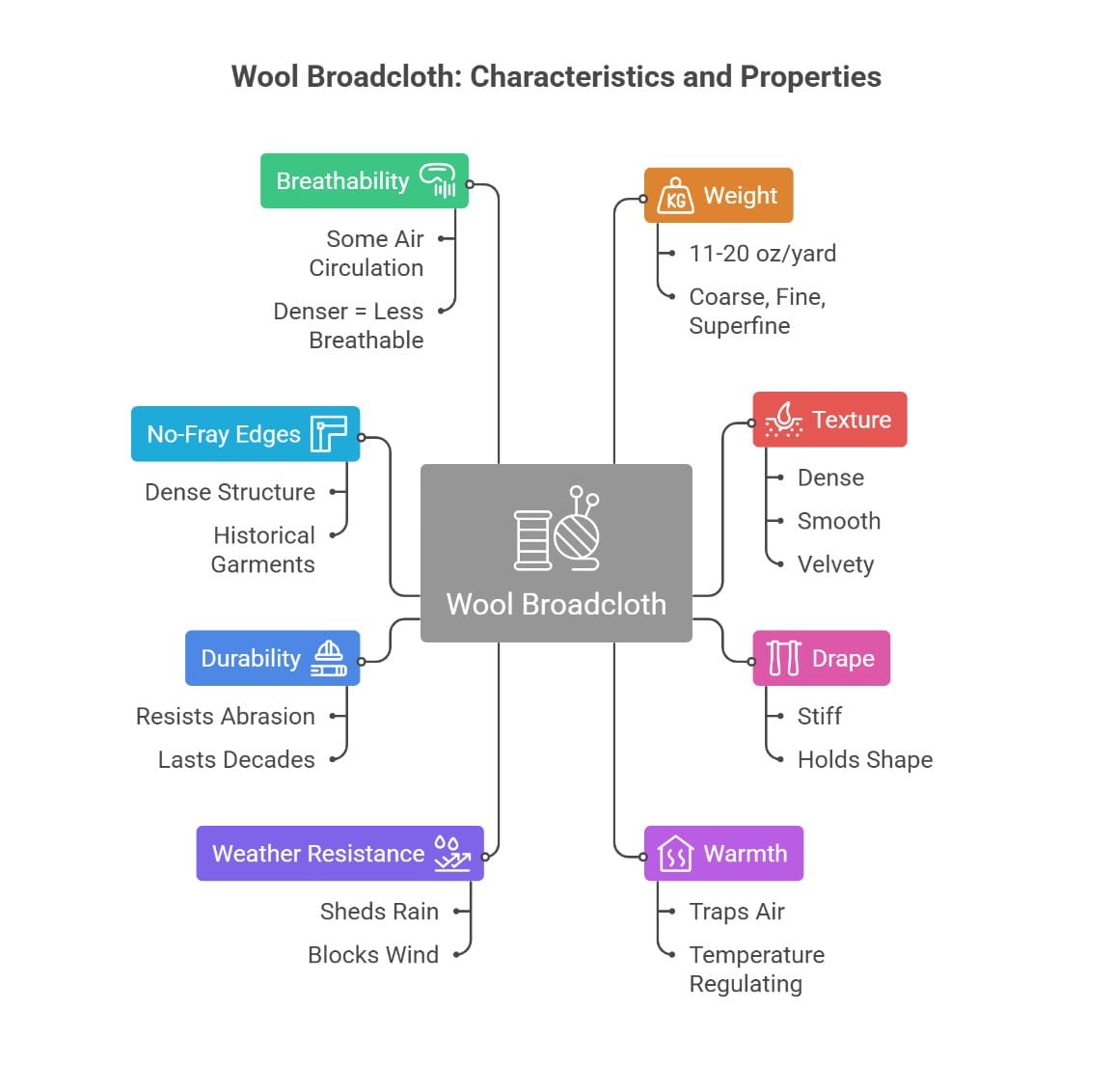
Now that you know how wool broadcloth is made, let’s talk about what makes it special to work with and wear.
Is Broadcloth Thick or Thin?
Wool broadcloth is typically medium to heavy weight. Most wool broadcloth falls in the 11-20 ounce per yard range. For context, lightweight wool might be 6-8 ounces, while heavy coating wool can be 20+ ounces. So broadcloth sits right in the middle to upper-middle range.
How Heavy is Broadcloth?
The weight depends on the grade. Coarse broadcloth might be 11 ounces per yard, fine broadcloth around 14-16 ounces, and superfine broadcloth can reach 18-20 ounces. Heavier doesn’t always mean better. The right weight depends on what you’re making.
Texture and Feel
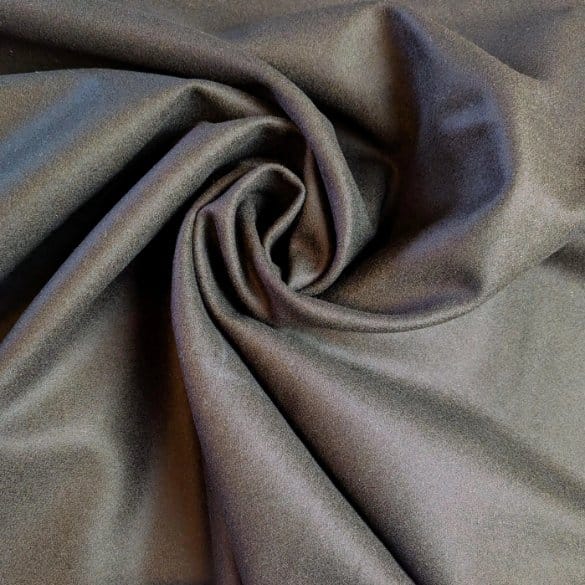
Wool broadcloth has a dense, smooth texture with what textile people call a “velvety” feel. Because of the fulling process, you can’t see individual yarns on the surface. It feels substantial in your hand, with a firm hand (that’s textile talk for how it feels when you squeeze it).
Drape and Structure
The drape is on the stiffer side. This isn’t a flowing, drapey fabric. Instead, it holds its shape well, which is why it’s perfect for tailored garments. That stiff drape means your coat or jacket will maintain clean lines and structure.
Is Wool Broadcloth Warm?
Yes, wool broadcloth is warm. The dense, fulled structure traps air between fibers, providing excellent insulation. Combined with wool’s natural temperature-regulating properties, broadcloth keeps you warm in winter without overheating. The weather-resistant finish also blocks wind, adding to its warmth.
Weather Resistance
This is one of broadcloth’s biggest selling points. The dense, felted structure makes it highly water-resistant. It won’t be completely waterproof like modern technical fabrics, but it sheds light rain and blocks wind exceptionally well. This is why it was so popular for outdoor coats and military uniforms.
Durability
Wool broadcloth is incredibly hard-wearing. The tight structure resists abrasion, and the felted fibers don’t pull apart easily. A well-made broadcloth coat can last decades with proper care.
No-Fray Edges
Here’s a unique feature: you can cut wool broadcloth and the edges won’t fray. The dense, felted structure holds together even at a raw edge. This made it perfect for historical garments where hemming every edge wasn’t practical.
Is Broadcloth a Breathable Fabric?
Wool broadcloth is moderately breathable. It’s not as breathable as lighter-weight wools or open-weave fabrics, but it still allows some air circulation thanks to wool’s natural structure. The denser the broadcloth, the less breathable it becomes.
Does Broadcloth Wrinkle Easily?
No, wool broadcloth resists wrinkling quite well. Wool’s natural elasticity helps it bounce back from creasing. The dense, fulled structure also makes it harder for wrinkles to form in the first place. Hang up your broadcloth garment after wearing, and minor wrinkles will often fall out on their own.
Pilling Resistance
The tight, felted structure means wool broadcloth pills less than looser wool weaves. While no wool is completely pill-proof, broadcloth is among the more resistant types.
| Property | Rating | Notes |
|---|---|---|
| Weight | Medium to Heavy | 11-20 oz per yard typical |
| Warmth | High | Excellent insulation |
| Weather Resistance | High | Water-resistant and windproof |
| Durability | Excellent | Can last decades |
| Breathability | Moderate | Less breathable than lighter wools |
| Wrinkle Resistance | Good | Resists creasing well |
| Drape | Stiff/Structured | Holds shape well |
Types and Grades of Wool Broadcloth
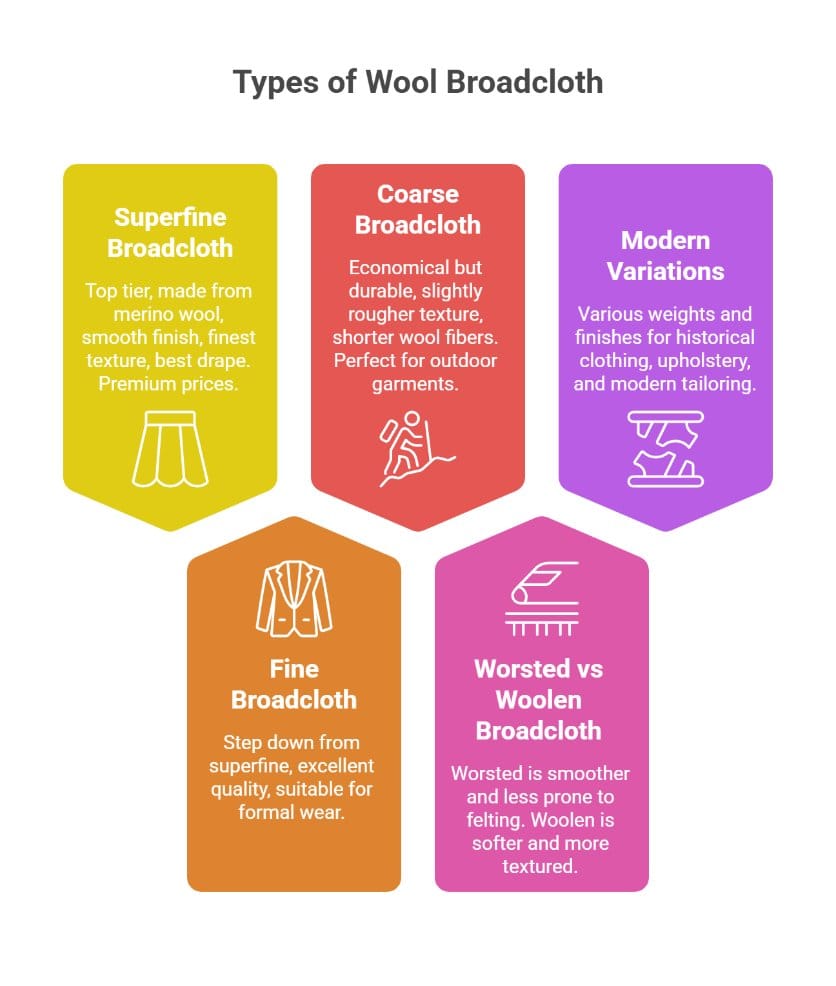
Not all wool broadcloth is the same. Different grades serve different purposes and come at different price points.
Superfine Broadcloth
This is the top tier. Made from merino wool, superfine broadcloth was the fabric of choice for gentlemen’s tailoring in the 18th and 19th centuries. It has the smoothest finish, finest texture, and best drape (within the broadcloth category). Expect to pay premium prices for authentic superfine broadcloth.
Fine Broadcloth
A step down from superfine, fine broadcloth still offers excellent quality. It’s suitable for formal wear and tailored garments where you want that broadcloth look and feel without the superfine price tag.
Coarse Broadcloth
More economical but still durable. Coarse broadcloth has a slightly rougher texture and may use shorter or less fine wool fibers. It’s perfect for practical outdoor garments, historical reenactment costumes, and projects where durability matters more than a luxurious feel.
Worsted vs Woolen Broadcloth
This gets technical, but it’s worth understanding. Traditional broadcloth is made from woolen-spun yarn (carded short fibers that are fuzzy and jumbled). But some modern broadcloth uses worsted yarn (combed long fibers that are smooth and parallel).
Worsted broadcloth will have a smoother, harder finish and be less prone to felting further. Woolen broadcloth has a softer, more textured feel and that classic blind-face finish. If authenticity matters for historical projects, look for woolen-spun broadcloth.
Modern Variations
Today, you’ll find wool broadcloth in various weights and finishes. Some are specifically marketed for historical clothing, others for upholstery, and some for modern tailoring. Always check the weight and intended use before buying.
Wool Broadcloth vs Other Wool Fabrics
If you’re trying to choose between different wool fabrics, here’s how broadcloth stacks up against other common options.
Wool Broadcloth vs Wool Flannel
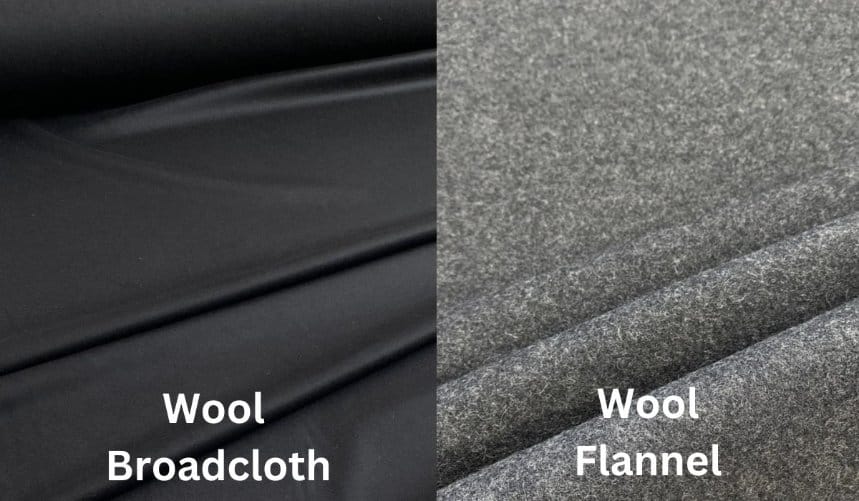
Wool flannel is softer and fuzzier than broadcloth. Flannel has a napped surface (brushed to raise fibers), while broadcloth has a smooth, dense surface. Flannel can be made with either woolen or worsted yarn and typically has a looser weave than broadcloth.
Flannel drapes more softly and feels cozier against the skin. Broadcloth is stiffer, more weather-resistant, and more structured. For suits and trousers, flannel is popular for its comfort, but it can develop a sheen (shine) with wear, especially around the seat. Broadcloth holds up better to repeated wear in high-friction areas.
Choose flannel for: Comfort, softer drape, casual tailored pieces
Choose broadcloth for: Structure, weather resistance, durability
Wool Broadcloth vs Wool Gabardine
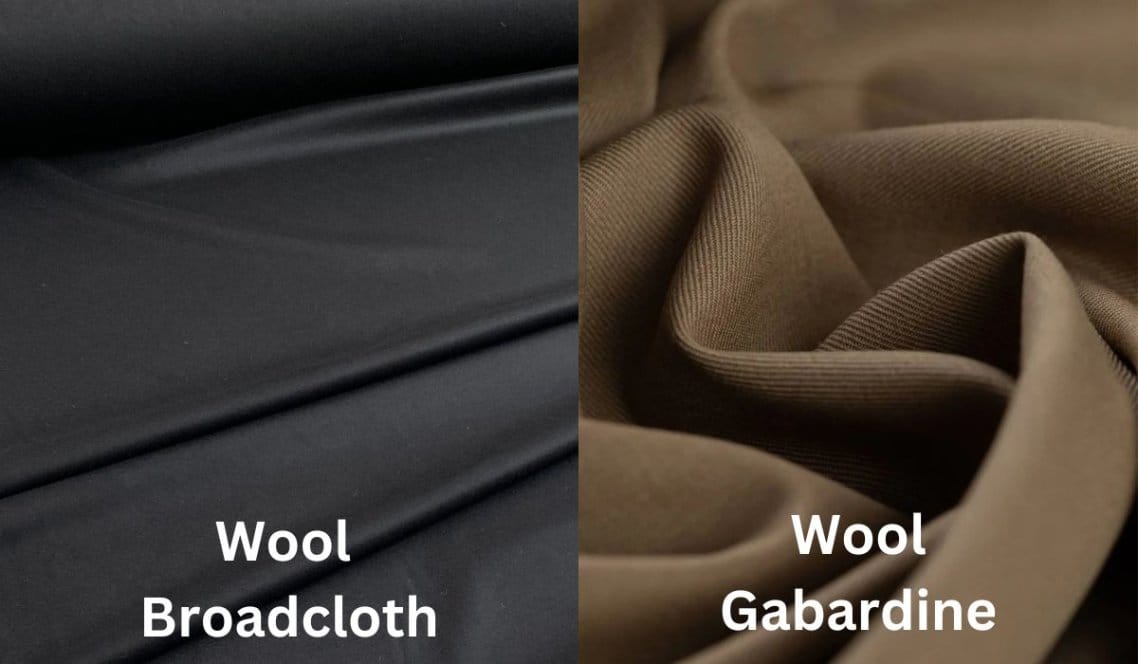
Wool gabardine has a twill weave (you can see diagonal lines) and is typically made from worsted wool. It’s tightly woven and can be very durable, but it has a different character than broadcloth.
Gabardine is smoother and has a subtle sheen. It’s excellent for tailoring and takes a sharp crease well. However, gabardine can develop shiny spots with wear, especially in lighter colors. Broadcloth’s plain weave and blind-face finish is less prone to this.
Both are good for tailored garments, but gabardine drapes slightly better while broadcloth is more weather-resistant. Gabardine is more commonly found in modern suiting, while broadcloth is more of a specialty fabric.
Choose gabardine for: Modern suiting, sharp creases, smooth appearance
Choose broadcloth for: Historical accuracy, weather protection, traditional tailoring
Wool Broadcloth vs Wool Serge
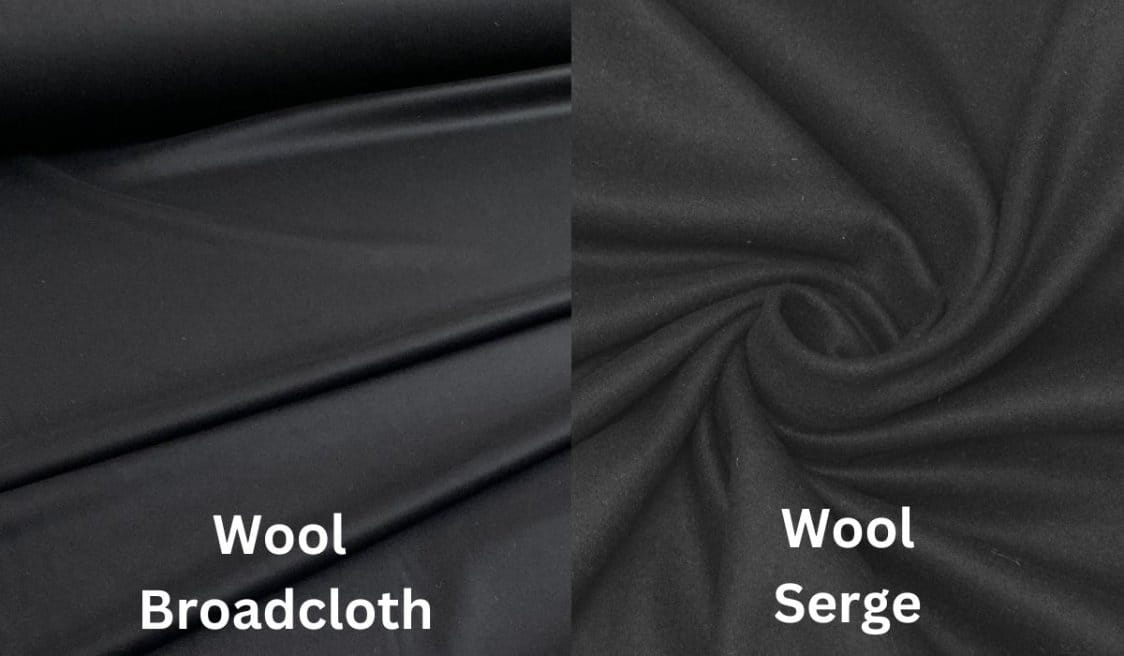
Wool serge is another twill weave fabric, but unlike gabardine, the diagonal lines are visible on both sides of the fabric. Serge is typically made from worsted wool and has a smooth, somewhat silky texture.
Serge is excellent for coats and suits and has been used extensively in military uniforms. It’s durable and wears well. Compared to broadcloth, serge has a softer drape and is less stiff. Broadcloth is denser and more weather-resistant.
Choose serge for: Classic military style, good drape, all-purpose suiting
Choose broadcloth for: Maximum weather protection, stiffer structure, historical projects
Wool Broadcloth vs Melton
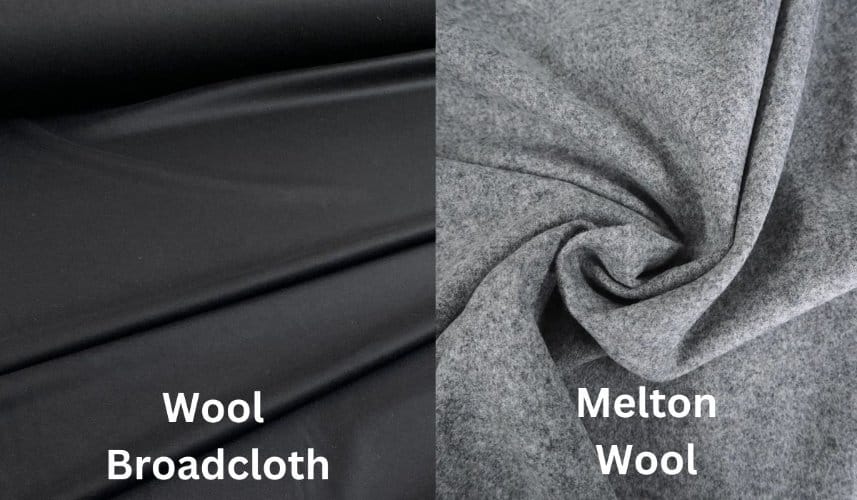
Melton wool is like broadcloth’s heavier cousin. It’s also heavily fulled, but melton is even denser and heavier. Traditional melton is so thick it’s almost felt-like.
Both fabrics can have cut edges without fraying. Both are weather-resistant. The difference is weight. Melton is typically used for heavy coats, while broadcloth can be used for everything from coats to suits to dresses depending on the weight.
Choose melton for: Heavy winter coats, maximum warmth
Choose broadcloth for: More versatility, lighter weight options
Wool Broadcloth vs Tweed
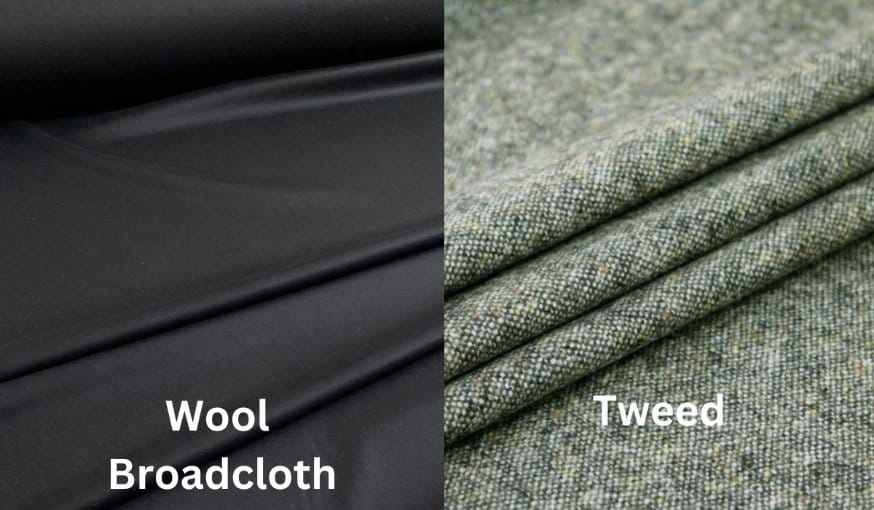
Tweed has a rough, textured surface with visible warp and weft yarns, often in multiple colors creating a mottled or heathered look. Tweed is typically woolen-spun and has been slightly felted, but nowhere near as much as broadcloth.
Tweed is stiffer and rougher than broadcloth. It’s very durable and weather-resistant, making it popular for outdoor sporting clothes. Broadcloth has a smoother, more refined finish. For formal wear, broadcloth wins. For country clothing and outdoor wear, tweed is traditional.
Choose tweed for: Outdoor wear, country style, texture and character
Choose broadcloth for: Formal wear, smooth finish, refined appearance
| Fabric | Weave | Surface | Drape | Best For |
|---|---|---|---|---|
| Wool Broadcloth | Plain | Smooth, blind-face | Stiff | Structured coats, historical clothing |
| Wool Flannel | Plain or twill | Napped, fuzzy | Soft | Comfortable suits, trousers |
| Wool Gabardine | Twill | Smooth, diagonal rib | Medium | Modern suiting, trousers |
| Wool Serge | Twill | Smooth, visible twill | Medium | Suits, military uniforms |
| Melton Wool | Plain | Dense, almost felt-like | Stiff | Heavy winter coats |
| Tweed | Various | Rough, textured | Stiff | Country wear, outdoor clothing |
What Fabric is Similar to Broadcloth?
The closest match to wool broadcloth is melton wool, which shares the heavily fulled construction. Boiled wool also goes through a similar felting process, though it’s typically knitted rather than woven. For similar smooth, dense qualities in a different fiber, look at wool coating fabrics.
Uses and Applications
What is Broadcloth Fabric Used For?
Wool broadcloth has been used for centuries in many different ways. Here’s where you’ll see it today.
Historical Uses
Men’s Formal Tailoring: Superfine broadcloth was the premier choice for gentlemen’s coats and formalwear from the 1700s through the 1800s. The smooth finish and ability to hold crisp lines made it perfect for the structured styles of the era.
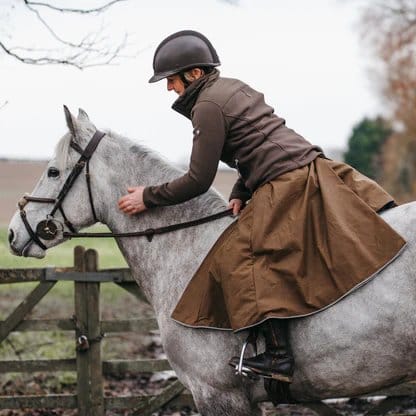
Women’s Riding Habits: Special fine broadcloth called “habit cloth” was made specifically for women’s riding clothes. It needed to be durable enough for outdoor activity but refined enough for proper fashion.
Military Uniforms: The weather resistance and durability made broadcloth perfect for military use. Many historical uniforms were made from broadcloth in various grades.
Native American Regalia: Trade cloth (wool broadcloth) became an important part of Native American traditional clothing and continues to be used for regalia today.
Modern Uses
Historical Reenactment: This is probably the biggest market for wool broadcloth today. Whether you’re recreating Tudor England, the American Revolution, or Civil War era, authentic broadcloth is often required for accuracy. It’s an important part of European folk costuming and historical clothing for film and theater as well.
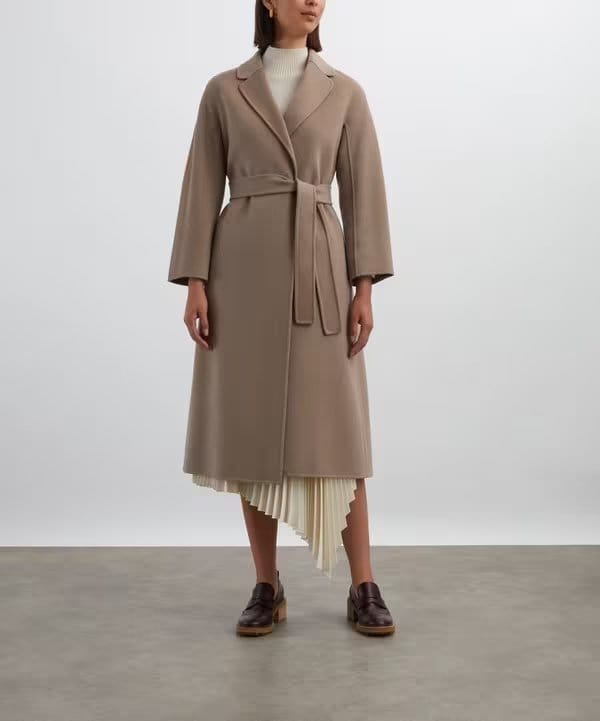
Tailored Coats and Suits: Some tailors still use wool broadcloth for structured coats. The stiff drape and weather resistance make it excellent for outerwear. It’s less common in modern suiting but still valued by those who appreciate traditional fabrics.
Blazers and Jackets: Medium-weight broadcloth works well for structured blazers that need to hold their shape.
Upholstery: The durability and felted surface make wool broadcloth suitable for furniture upholstery. It’s been used to upholster everything from antique chairs to classic car interiors. The velvet-like feel adds a luxurious touch.
Crafts and Costumes: Beyond historical reenactment, wool broadcloth is used for theatrical costumes, living history programs, and historical craft projects.
What is Broadcloth Best For?
Wool broadcloth excels in applications where you need structure, weather resistance, and durability. It’s the best choice for:
- Period-accurate historical clothing from the 11th-19th centuries
- Structured outerwear that needs to hold its shape
- Garments that will see outdoor wear in cool, damp weather
- Projects where you want a no-fray cut edge
- Long-lasting pieces that will be worn hard and need to last
Can Broadcloth Be Used for Curtains?
Yes, wool broadcloth can be used for curtains, though it’s not a common choice today. The dense weave blocks light well and provides good insulation. The weight means curtains will hang straight with a structured drape. The main drawback is cost; wool broadcloth is more expensive than typical curtain fabrics. But if you’re going for a historical look or want extremely high-quality, insulating curtains, it’s an option.
Benefits of Wearing Broadcloth
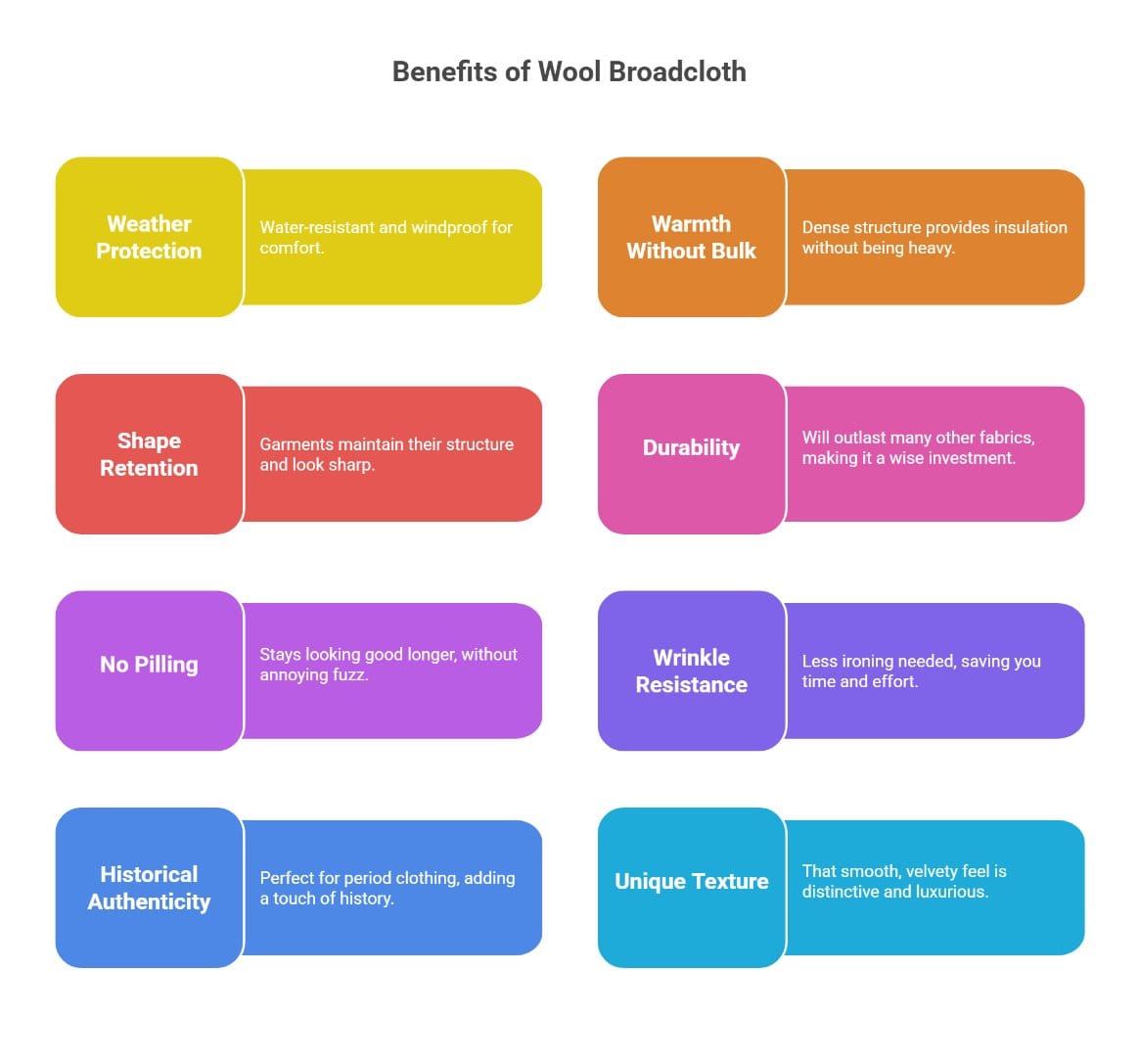
When you choose wool broadcloth for your garments, here’s what you get:
- Weather protection: Water-resistant and windproof
- Warmth without bulk: Dense structure provides insulation
- Shape retention: Garments maintain their structure
- Durability: Will outlast many other fabrics
- No pilling: Stays looking good longer
- Wrinkle resistance: Less ironing needed
- Historical authenticity: Perfect for period clothing
- Unique texture: That smooth, velvety feel is distinctive
Sustainability and Environmental Impact
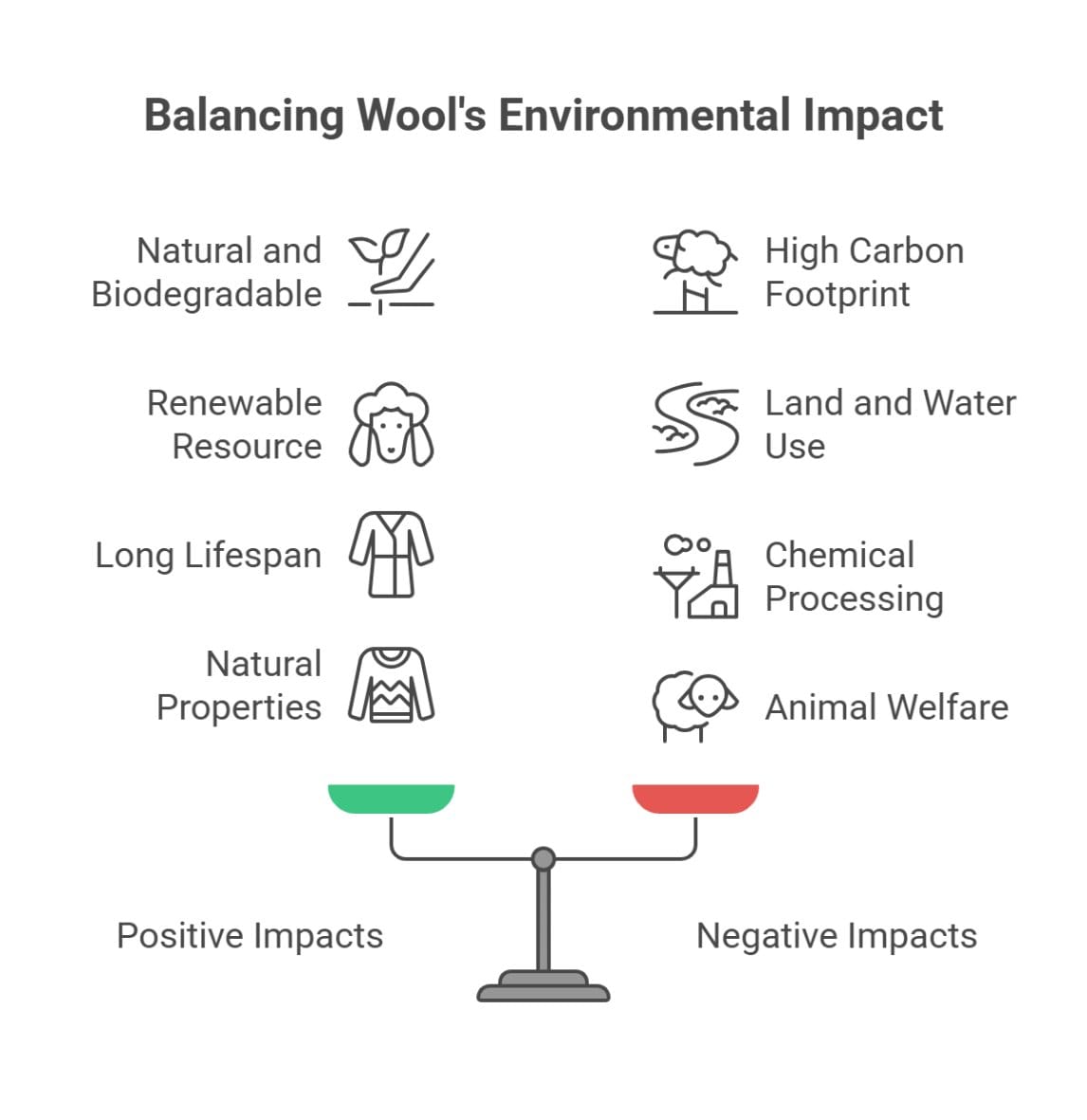
Let’s talk about the environmental side of wool broadcloth. Like all fabrics, it has both positive and negative impacts.
The Positive Side
Natural and Biodegradable: Wool is a natural protein fiber. When a wool broadcloth garment finally wears out, it will biodegrade in soil within years, not centuries like synthetic fabrics. It doesn’t contribute to microplastic pollution.
Renewable: Sheep grow new fleece every year. As long as sheep farming continues, wool production can continue.
Long Lifespan: A well-made broadcloth garment can last decades. This longevity means you’re buying fewer garments over time, reducing overall consumption.
Natural Properties Reduce Washing: Wool naturally resists odors and dirt. You can air out wool garments between wears rather than washing after every use. Less washing means less water and energy consumption over the garment’s life.
Temperature Regulation: Wool keeps you warm in winter and cool in summer. This natural climate control means less reliance on heating and air conditioning.
Recyclable: Wool can be mechanically recycled into new yarn. While recycled wool has shorter fibers and isn’t as strong, it’s still usable for many applications.
The Challenges
High Carbon Footprint: This is wool’s biggest environmental issue. Sheep produce methane during digestion, a greenhouse gas 28-34 times more potent than carbon dioxide. Studies show that producing a wool garment can generate 27 times more greenhouse gas emissions than a cotton one during the production phase.
Land Use: Sheep farming is land-intensive. In Australia (the world’s largest wool producer), sheep farming occupies about one-fifth of agricultural land. This can lead to habitat loss for native wildlife.
Water Consumption: Processing wool into fabric requires 200-300 kg of water per kg of fabric. That’s less than cotton but more than synthetic polyester.
Chemical Processing: The scouring (washing) process removes natural oils and dirt using surfactants. Dyeing and finishing add more chemicals. While hydrogen peroxide is a relatively eco-friendly bleaching agent, some processes use harsher chemicals that create polluting effluents.
Animal Welfare Concerns: Practices like mulesing (removing skin folds to prevent flystrike) are controversial. Tail docking and castration are often done without pain relief. These practices raise ethical questions about wool production.
Making Better Choices
If you want wool broadcloth but care about sustainability, here’s what to look for:
Sustainable Wool Options
- Responsible Wool Standard (RWS): Certifies farms that practice good land management and animal welfare
- Global Organic Textile Standard (GOTS): Ensures organic farming practices and environmental processing
- ZQ Merino: Focuses on animal welfare and environmental sustainability in merino production
- Recycled wool: Look for wool broadcloth made from recycled fibers
- European wool: Often has stricter animal welfare regulations than some other regions
- Small-scale producers: Heritage mills and small farms often have better practices
Also consider buying vintage or secondhand wool broadcloth garments. This gives existing items a longer life without creating demand for new production. You can find quality pieces from wool and cashmere retailers that carry both new and vintage options.
The Bottom Line on Sustainability
Wool broadcloth isn’t perfect environmentally. The high carbon footprint and land use are real concerns. But its durability, biodegradability, and potential for responsible production give it advantages over many alternatives. If you’re choosing between a synthetic fabric and certified sustainable wool broadcloth for a garment you’ll wear for decades, the wool might actually be the better environmental choice in the long run.
Luxury and Quality Focus
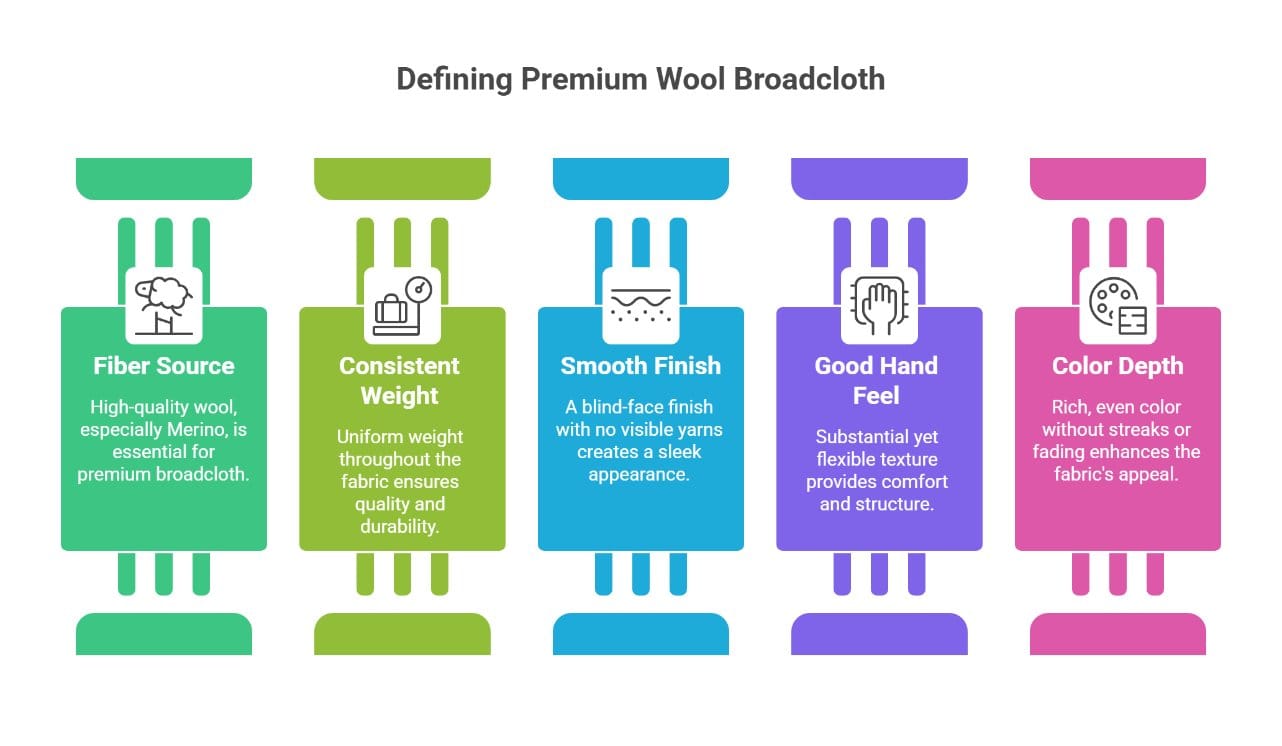
If you’re investing in wool broadcloth, you want to make sure you’re getting quality. Here’s how to tell good from great.
What Defines Premium Wool Broadcloth?
Fiber Source: The best broadcloth starts with high-quality wool. Merino is the gold standard, producing fine, soft fibers. Historical sources also prized specific regional wools like Cotswold or Lemster wool.
Consistent Weight: Quality broadcloth should have even weight throughout. Run your hand over it, and it should feel uniform without thick or thin spots.
Smooth, Even Finish: Look at the surface. Premium broadcloth should have that characteristic blind-face finish with no visible individual yarns. The surface should be smooth and even.
Good Hand Feel: This is subjective but important. Quality broadcloth should feel substantial but not stiff and board-like. It should have some flexibility while still holding its structure.
Color Depth: Well-dyed broadcloth will have rich, even color. Look for consistent color throughout without streaks or fading.
How to Identify Quality
Price as a Quality Indicator
Quality wool broadcloth isn’t cheap. Expect to pay significantly more than for standard wool suiting. Superfine broadcloth from heritage mills can cost upward of $40-60 per yard or more. Coarse broadcloth might start around $20-30 per yard.
Very low prices (under $15 per yard) might indicate a cotton blend marketed as broadcloth, or lower-quality wool that hasn’t been properly fulled. This doesn’t mean you can’t find deals, but be cautious of prices that seem too good to be true.
Heritage Producers
Some mills and companies have been producing quality wool broadcloth for generations. Names like Thomas Mason (British textiles), Hainsworth (Yorkshire mill), and specialized historical fabric suppliers like Burnley & Trowbridge are known for authentic, quality broadcloth.
For modern production, look for European mills. The UK and Italy still have mills producing quality wool fabrics with traditional techniques.
Care Instructions and Maintenance
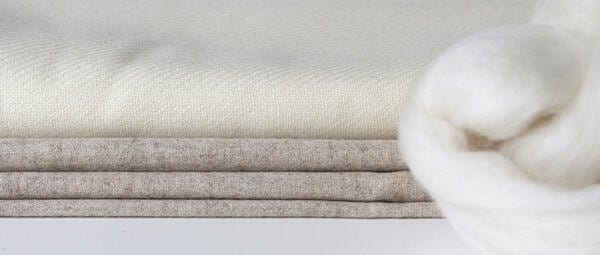
Wool broadcloth is an investment, so you want to take care of it properly. The good news is that its natural properties make it relatively low-maintenance.
Does Broadcloth Shrink When Washed?
Yes, wool broadcloth can shrink if washed improperly. Remember, it’s already been shrunk significantly during the fulling process. But additional exposure to hot water, agitation, and temperature changes can cause further felting and shrinking.
This is why dry cleaning is the recommended care method for wool broadcloth garments.
Does Broadcloth Fabric Shrink?
To be clear: the fabric was intentionally shrunk during manufacturing. It won’t shrink from normal wear or proper care. But washing it in hot water or machine washing will cause it to felt further and shrink more. This shrinkage is not reversible.
General Care Guidelines
Dry Cleaning (Recommended): Professional dry cleaning is the safest option for wool broadcloth garments. The dry cleaning process won’t cause shrinking or additional felting. For tailored pieces with structure and lining, dry cleaning is really the only option.
Frequency: You don’t need to clean wool broadcloth after every wear. Wool naturally resists odors and dirt. Air out your garment between wears. Clean only when actually soiled or at the end of the season before storage.
If You Must Hand Wash
For unlined, simple pieces, you might choose to hand wash. This is risky, but here’s how to minimize damage:
- Use cold water only: Never use warm or hot water
- Choose wool-specific detergent: Regular detergent can be too harsh. Use a pH-neutral wool wash
- Soak, don’t agitate: Fill a basin with cold water and detergent. Submerge the fabric and let it soak for 3-5 minutes. Gently squeeze (don’t wring) to work the detergent through
- Rinse thoroughly: Rinse in cold water until all detergent is removed. Any temperature change between wash and rinse water can cause felting
- Remove water gently: Never wring. Press water out gently, then roll in a towel to absorb more
- Dry flat: Lay flat to dry on a clean towel or mesh drying rack. Never hang wet wool broadcloth, as the weight can stretch it
Never Machine Wash
Even on a gentle cycle, machine washing wool broadcloth will cause shrinking, felting, and possible damage. The agitation is too much for this fabric. Skip the temptation to save time – you’ll ruin your garment.
Spot Cleaning
For small stains, spot cleaning is your best bet:
- Act quickly: Fresh stains are easier to remove
- Blot, don’t rub: Use a clean cloth to blot liquid stains
- Use cold water: Dampen a cloth with cold water and gently work on the stain
- Try wool detergent: For tougher stains, use a tiny amount of wool-safe detergent with cold water
- Rinse the area: Use a damp cloth with clean cold water to remove any soap residue
- Air dry: Let the spot air dry naturally
Ironing and Pressing
Wool broadcloth can be ironed, but use caution:
- Use low to medium heat: Check your iron’s wool setting
- Always use a press cloth: Place a clean cotton cloth between the iron and the broadcloth. Direct contact can create shine or scorch marks
- Use steam: Steam helps relax the fibers. Either use your iron’s steam function or use a spray bottle to lightly dampen the press cloth
- Press, don’t slide: Lift and press the iron rather than sliding it, which can stretch the fabric
Storage
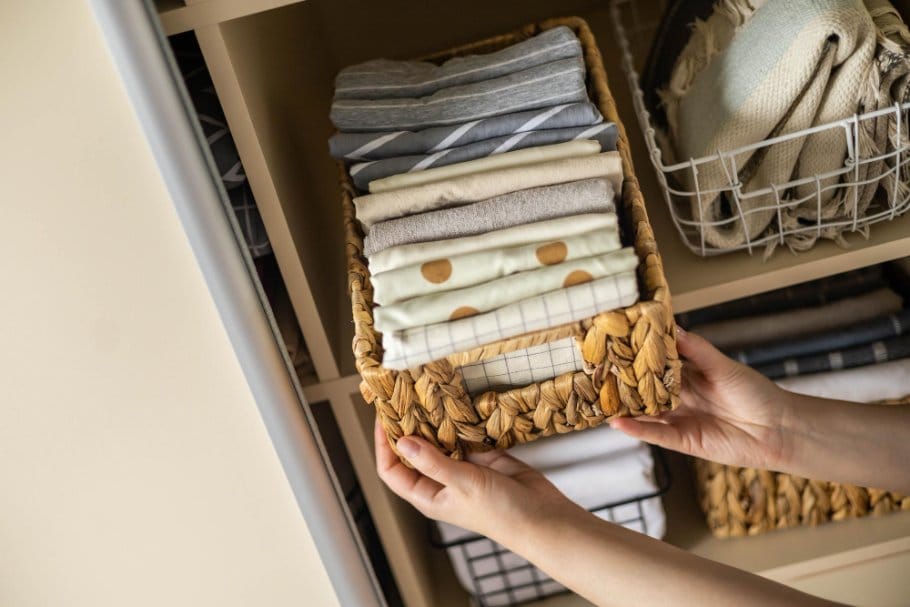
Clean before storing: Always clean garments before long-term storage. Moths and carpet beetles are attracted to body oils and food stains.
Fold, don’t hang: For long-term storage, fold wool broadcloth rather than hanging it. The weight can cause hanging garments to stretch over time.
Use cedar or lavender: Natural moth repellents like cedar blocks or lavender sachets are better than mothballs. Cedar has a fresh scent and is effective at deterring moths.
Store in a cool, dry place: Avoid damp basements or hot attics. A cool, dry closet is ideal.
Use breathable storage: Store in cotton garment bags or wrapped in cotton sheets. Avoid plastic bags, which can trap moisture and cause mildew.
Dealing with Shine
While wool broadcloth is less prone to developing shine than some wools, it can happen with repeated wear in high-friction areas. To minimize shine:
- Always use a press cloth when ironing
- Avoid over-pressing the same area
- Brush garments regularly with a soft clothes brush to lift the fibers
- If shine develops, try steaming the area and brushing gently while damp
What About Pills?
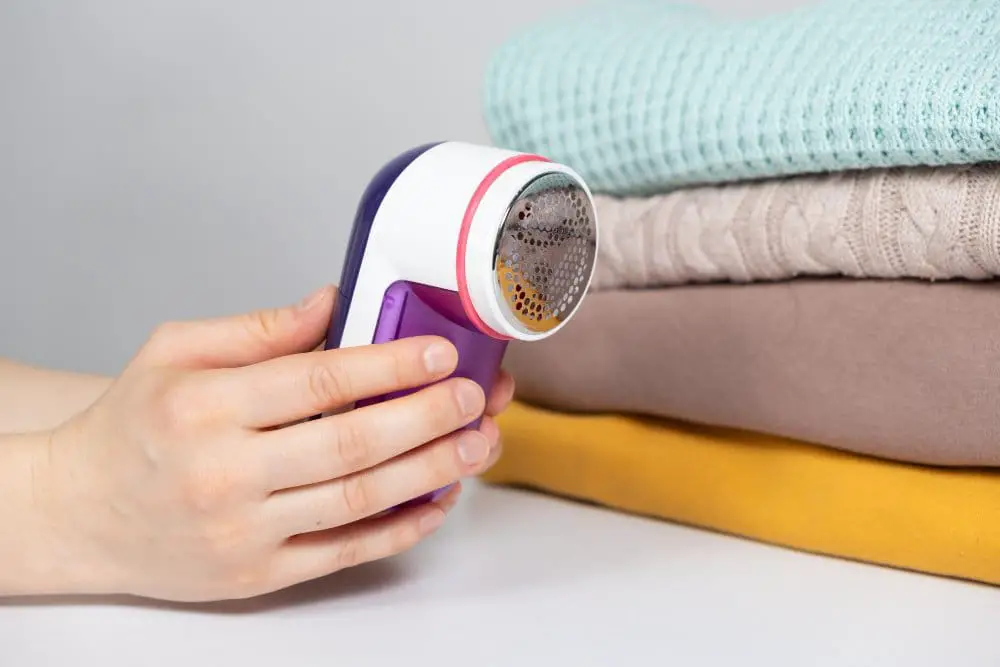
Wool broadcloth resists pilling better than many wool fabrics thanks to its dense structure. If you do get pills, remove them gently with a sweater comb or fabric shaver. Always comb in the direction of the fabric’s weave.
For more detailed wool care, check out our wool care guide.
Buying Guide
Ready to buy wool broadcloth? Here’s what you need to know.
Where to Buy Wool Broadcloth
Historical Reproduction Suppliers: These specialize in authentic period fabrics. Examples include Burnley & Trowbridge, Renaissance Fabrics, and The Tudor Tailor. They understand what historical reenactors need and often carry multiple weights and grades.
Specialty Fabric Stores: Some high-end fabric retailers carry wool broadcloth, though it’s not as common as it once was. Call ahead to check availability.
Online Fabric Retailers: Websites like Sartor Bohemia carry wool broadcloth, especially for sewing and costuming. Etsy also has suppliers selling wool broadcloth, both yardage and finished garments.
Direct from Mills: Some mills that produce wool broadcloth sell directly to customers. Yorkshire mills in the UK sometimes offer this option.
International Sources: European suppliers often have authentic wool broadcloth. Be aware of shipping costs and potential customs fees.
What to Look For When Buying
Weight: Check the ounces per yard or grams per square meter. Lighter (11-14 oz) works for dresses and lighter garments. Medium (14-18 oz) is good for suits and structured clothing. Heavy (18-20+ oz) is for coats and outerwear.
Fiber Content: Look for 100% wool for traditional broadcloth. Some suppliers offer blends with nylon for durability (common in upholstery-weight broadcloth). Blends work fine but aren’t historically accurate.
Width: Most wool broadcloth is 54-60 inches wide. Verify the width before calculating yardage needs.
Intended Use: Some broadcloth is specifically marketed for historical clothing, others for upholstery. Make sure you’re getting the right type for your project.
Color Options: Historical suppliers often carry period-appropriate colors. If you’re not bound by historical accuracy, you might find more colors from general fabric retailers.
Price Ranges to Expect
- Budget/Coarse broadcloth: $20-30 per yard
- Mid-range/Fine broadcloth: $30-45 per yard
- Premium/Superfine broadcloth: $45-70+ per yard
- Upholstery weight: Varies widely, $25-50 per yard typical
These are rough estimates. Prices vary based on supplier, current wool prices, and whether it’s domestic or imported.
Calculating Yardage
How much do you need? It depends on your project:
- Simple coat or jacket: 2-3 yards
- Structured coat with lining: 3-4 yards
- Long coat or cloak: 4-6 yards
- Vest or waistcoat: 1-1.5 yards
- Dress or skirt: 2-4 yards depending on style
Always buy a bit extra. If you’re making a historical garment from a pattern, the pattern will tell you how much you need. Add 1/2 yard extra for errors and testing.
Sample Swatches
Many suppliers offer sample swatches for a small fee. This is worth it for expensive fabric. You can see the actual color, feel the weight, and test how it behaves before committing to several yards.
Questions to Ask Suppliers
- What is the exact weight in ounces per yard?
- Is this 100% wool or a blend?
- What is the finished width after fulling?
- Is this woolen-spun or worsted?
- Is this suitable for garment making or is it upholstery weight?
- Do you offer samples?
- What are the care requirements?
Working with Wool Broadcloth
Is Broadcloth Easy to Sew With?
Wool broadcloth is generally easier to sew than many other fabrics. The dense, stable structure means it doesn’t shift or slide around while you’re working with it. The edges don’t fray, so you don’t have to rush to finish seams. And it holds a crisp edge when pressed, making construction easier.
That said, the weight and stiffness can make some tasks trickier. Turning tight corners or creating gathers is harder with a stiffer fabric. And you’ll need appropriate needles and techniques for the weight.
Preparing to Sew
Pre-washing? Generally, no. Wool broadcloth has already been shrunk during fulling. Washing before sewing could cause additional shrinkage and might not be even. If you’re concerned about shrinkage, test a small piece first.
Straightening the grain: If your broadcloth is off-grain, you can gently steam and reshape it. But the fulled nature means it won’t shift as much as looser weaves.
Cutting
Tools: Use sharp fabric scissors or a rotary cutter. Broadcloth is dense, so dull blades will make ragged cuts.
Technique: Cut through a single layer when possible for the most accurate cuts. Use weights rather than pins to hold your pattern in place (pins can leave marks).
No need to finish edges immediately: Since broadcloth doesn’t fray, you don’t have to finish seam allowances right away. This gives you flexibility during construction.
Machine Settings
Needle: Use a Universal or Sharp needle in size 80/12 or 90/14, depending on the broadcloth weight. Heavier broadcloth needs the larger needle.
Stitch length: Use a slightly longer stitch length (2.5-3mm) to avoid puckering in the dense fabric.
Thread: All-purpose polyester thread works fine. For a traditional approach, use cotton or wool thread.
Presser foot pressure: You might need to adjust your presser foot pressure for even feeding. Test on scraps first.
Pressing
Pressing is super important when sewing wool broadcloth. Good pressing makes the difference between a homemade-looking garment and a professional one.
- Press each seam as you go, before crossing it with another seam
- Use a press cloth always
- Use plenty of steam
- Press, lift, move rather than sliding the iron
- Let fabric cool and dry completely before moving to the next step
Seam Finishes
Since broadcloth doesn’t fray, you have options:
- Left raw: For historical garments, you can leave seam allowances raw. The fabric won’t unravel.
- Flat-felled seams: Great for sturdy construction. Learn more about flat-felled seams.
- French seams: Enclose raw edges for a neat interior. See our French seam tutorial.
- Serged: Overlock for a quick, neat finish if you have a serger.
- Hong Kong finish: Bound edges look professional in unlined garments.
Interfacing
Wool broadcloth is already quite stable, so you might not need interfacing. For collars, cuffs, and buttonholes, use a lightweight fusible or sew-in interfacing appropriate for medium-weight wool.
Test fusible interfacing on a scrap first. The heat and steam needed to fuse can affect wool broadcloth.
Pattern Selection
Wool broadcloth works best with structured designs:
- Tailored coats and jackets
- Military-style uniforms
- Fitted vests and waistcoats
- Structured dresses with defined shapes
- Historical patterns calling for broadcloth
Avoid patterns with lots of gathers, draping, or soft, flowing lines. Broadcloth’s stiff drape won’t work well for these styles.
If you’re new to sewing, check out our beginner’s guide to sewing first.
References and Further Reading
This article draws on authoritative sources about wool broadcloth and wool textiles:
- Broadcloth – Wikipedia: Comprehensive historical and technical information about broadcloth fabric.
- Wool as a Sustainable Fibre – The Woolmark Company: Official information on wool sustainability, environmental impact, and industry certifications.
- Wool Sustainability – International Wool Textile Organisation (IWTO): Global wool industry standards, research, and sustainability initiatives.
Frequently Asked Questions
Is wool broadcloth the same as cotton broadcloth?
No, they’re very different fabrics. Wool broadcloth is a dense, fulled wool fabric with a plain weave and blind-face finish. Cotton broadcloth (common in the US since the 1920s) is a lighter-weight cotton fabric with a subtle rib weave. They share the name but have different characteristics, uses, and care requirements.
Is broadcloth thicker than cotton?
Wool broadcloth is generally thicker and denser than typical cotton fabrics. While cotton broadcloth is a lightweight fabric (about 3-4 oz per yard), wool broadcloth ranges from 11-20 oz per yard. If you’re comparing to heavy cotton canvas, they might be similar in thickness, but wool broadcloth will still be denser due to the fulling process.
Is broadcloth woven or knit?
Broadcloth is woven, not knit. It uses a plain weave structure (the simplest over-under pattern) and then goes through fulling to create its dense, felted texture. The woven structure is what allows it to be fulled so effectively.
Are poplin and broadcloth the same thing?
This is confusing because it depends on context. In cotton fabrics, American poplin and cotton broadcloth are very similar – both have a rib weave, with broadcloth having a finer, tighter rib. But wool broadcloth and poplin are completely different. Wool broadcloth is a fulled, dense fabric, while poplin (when referring to wool) is a plain weave worsted fabric without the fulling process.
How do I know if my broadcloth is wool or cotton?
The easiest way is the burn test (do this carefully in a safe area). Wool smells like burning hair and leaves a crushable ash. Cotton smells like burning paper and leaves a soft ash. You can also check weight – wool broadcloth is much heavier (11+ oz/yard) than cotton broadcloth (3-4 oz/yard). Wool broadcloth also has a distinctive dense, slightly felted texture that cotton lacks.
Can I machine wash wool broadcloth?
No, machine washing wool broadcloth will cause it to shrink and felt further. The agitation and temperature changes of machine washing are too harsh for this fabric. Dry cleaning is the recommended care method. If you must wash at home, hand wash in cold water with minimal agitation.
Where can I find authentic wool broadcloth for historical reenactment?
Look for suppliers specializing in historical reproduction fabrics. Burnley & Trowbridge, Renaissance Fabrics, and The Tudor Tailor are well-known sources. European mills like Hainsworth in Yorkshire also produce authentic broadcloth. Make sure to specify the time period you’re recreating, as different grades and weights were used in different eras.
Is wool broadcloth good for upholstery?
Yes, wool broadcloth’s durability and dense structure make it suitable for upholstery. It’s been used to upholster furniture and car interiors, especially in vintage and classic vehicles. The felted surface resists wear, and the fabric holds up well to friction. Make sure you’re buying upholstery-weight broadcloth (typically heavier) rather than garment-weight if you’re doing furniture.
Why is wool broadcloth so expensive?
Several factors contribute to the cost. The fulling process requires extra steps beyond basic weaving. Quality wool fiber (especially merino) is expensive. The fabric is dense, meaning more fiber per yard than looser weaves. Production is relatively small-scale since it’s a specialty fabric. And if you’re buying authentic historical reproduction fabric, the supplier has done research to ensure accuracy. All of this adds up to higher prices than mass-produced fabrics.
Can I use wool broadcloth for a beginner sewing project?
Yes and no. The fabric itself is easier to handle than many others – it doesn’t shift, fray, or behave unpredictably. But the cost means mistakes are expensive. The weight and stiffness also require appropriate pattern selection. If you’re a beginner, practice with less expensive fabric first, or choose a simple pattern like a vest. Read our easy sewing projects for beginners guide for starter ideas.
Conclusion
Wool broadcloth has earned its place in textile history for good reasons. This dense, fulled fabric offers a combination of weather resistance, durability, and structure that few other fabrics can match. From its medieval origins in Flanders to modern historical reenactments and specialty tailoring, wool broadcloth continues to serve those who appreciate traditional craftsmanship and quality materials.
The manufacturing process – weaving wide then shrinking through fulling – creates that characteristic blind-face finish and no-fray edges that make broadcloth distinctive. While it’s not the most common fabric today, it remains the gold standard for period-accurate historical clothing and is valued by tailors who work with traditional techniques.
Key Takeaways
- Wool broadcloth is not cotton broadcloth – Despite sharing a name, these are completely different fabrics. Wool broadcloth is heavier, denser, and has been fulled to create its unique properties.
- The fulling process is what makes it special – This step of shrinking the woven fabric in hot soapy water creates the dense, weather-resistant, non-fraying fabric that defines broadcloth.
- It comes in different grades – From economical coarse broadcloth to premium superfine, choose the quality level that fits your project and budget.
- Dry cleaning is your friend – This isn’t a wash-at-home fabric for most applications. Professional dry cleaning protects your investment.
- Perfect for historical accuracy – If you’re recreating clothing from the 11th-19th centuries, authentic wool broadcloth is often necessary for period accuracy.
- Weather-resistant and durable – The dense structure blocks wind and sheds light rain while lasting for decades with proper care.
- Consider sustainability carefully – Look for certified wool from responsible producers to minimize environmental impact. The fabric’s longevity helps offset its production footprint.
- Not for every project – The stiff drape means broadcloth works best for structured, tailored garments rather than flowing, gathered, or draped styles.
Making Your Decision
Should you use wool broadcloth for your next project? Consider these questions:
- Do you need the structure and weather resistance broadcloth provides?
- Is historical accuracy important for your project?
- Are you comfortable with the care requirements (dry cleaning)?
- Does your budget allow for this investment?
- Is your pattern appropriate for a stiff, structured fabric?
If you answered yes to most of these, wool broadcloth might be perfect for you. It’s a fabric that rewards patience and care with garments that can last a lifetime.
For other wool options, explore our guides on wool flannel, wool gabardine, or melton wool. Each has its own strengths for different applications.
Ready to Start?
If you’re ready to work with wool broadcloth, start by ordering sample swatches from a few suppliers. Feel the different weights and qualities in your hands. This will help you understand exactly what you’re getting and choose the right broadcloth for your specific needs.
Remember that working with quality traditional fabrics like wool broadcloth connects you to centuries of textile history. There’s something special about using the same fabric techniques that kept medieval Europeans warm and clothed generations of tailored gentlemen. In a world of synthetic fast fashion, wool broadcloth stands as a reminder that some things are worth doing the traditional way.
Whether you’re making a reproduction 18th-century coat, tailoring a structured blazer, upholstering a vintage chair, or creating Native American regalia, wool broadcloth brings authenticity, quality, and durability to your project. Take the time to source the right fabric, learn proper techniques, and care for your finished piece, and you’ll have something that lasts for years to come.