

Everything You Need to Know About Choosing, Buying, and Caring for Wool Suiting Fabric
Table of Contents
- Introduction
- Why Wool is the Ultimate Suiting Fabric
- Understanding Wool Suiting Fabric
- Worsted vs Woolen: What’s the Difference?
- The Super Numbers System Explained
- Fabric Weaves and Textures
- The World’s Finest Wool Mills
- Wool Blends for Suiting
- Sustainability and Ethics
- The Complete Buying Guide
- The Ultimate Care and Maintenance Guide
- Wool vs Other Suiting Fabrics
- Essential Suit Knowledge
- Frequently Asked Questions
- Conclusion
Introduction
When you think of a well-made suit, chances are you’re picturing wool fabric. For centuries, wool has been the gold standard for suits, blazers, and trousers. But what makes wool suiting fabric so special? And with so many options available, how do you choose the right one?
This guide will walk you through everything you need to know about wool suiting fabric. Whether you’re a home sewer planning your first tailored jacket, a men’s style enthusiast building a wardrobe, or someone just curious about what makes a quality suit, you’ll find answers here.
We’ll break down the complex world of Super numbers, explain the difference between worsted and woolen, tour the legendary mills of Italy and England, and show you how to care for your wool garments so they last for decades. By the end, you’ll know exactly what to look for when buying wool suiting fabric and how to make it work for you.
Why Wool is the Ultimate Suiting Fabric

Key reasons wool is considered the best fabric for suiting.
Is Wool a Good Fabric for Suits?
Yes, and here’s why wool has dominated the suiting world for so long. Wool offers a unique combination of properties that synthetic fabrics simply can’t match.
Temperature Regulation: Wool keeps you cool in summer and warm in winter. This might sound impossible, but wool fibers trap air in their natural crimp. In cold weather, this trapped air insulates you. In warm weather, the same fibers allow moisture to evaporate, keeping you comfortable. Try doing that with polyester.
Natural Stretch and Recovery: Wool has something called “elastic recovery.” When you sit, bend, or move, wool stretches with you, then bounces back to its original shape. This is why a quality wool suit looks sharp even after a full day of wear. The fabric literally remembers its shape.
Wrinkle Resistance: Hang a wool suit overnight, and most wrinkles disappear. The natural elasticity of wool fibers means creases don’t set permanently like they do in cotton or linen.
Breathability: Unlike synthetic fabrics that trap sweat against your skin, wool wicks moisture away from your body. Wool can absorb up to 30% of its weight in moisture without feeling wet. For comparison, cotton maxes out around 8%.
Durability: A well-made wool suit can last 10, 20, even 30 years with proper care. The fibers are naturally strong and resilient. Many men inherit suits from their fathers and grandfathers.
Natural Water Resistance: Sheep produce lanolin, a natural wax that makes wool naturally water-repellent. While processing removes most lanolin, wool still resists light rain better than many other fabrics.
Odor Resistance: Wool naturally resists odors. The keratin protein in wool fibers actually breaks down odor molecules. This means you can wear a wool suit multiple times between cleanings without it smelling stale.
Quick Fact: Wool has been used in clothing for over 8,000 years. Ancient civilizations in Mesopotamia were raising sheep for wool before the invention of writing. If wool wasn’t incredibly practical, humans wouldn’t have stuck with it for millennia.
Understanding Wool Suiting Fabric
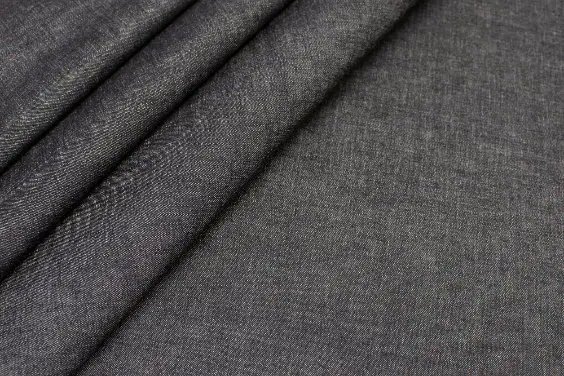
Detailed view of wool suiting fabric structure and finish.
The Science Behind Wool
To really understand wool suiting fabric, you need to know a bit about what makes wool unique at the fiber level.
Wool fibers come from sheep (and occasionally other animals like goats, alpacas, and camels). Unlike plant fibers like cotton or synthetic fibers like polyester, wool is a protein fiber. It’s made of keratin, the same protein in your hair and fingernails.
The Crimp Factor: If you look at a wool fiber under a microscope, you’ll see it’s not straight. Instead, it zigzags back and forth. This natural wave is called crimp, and it’s huge for suiting. Fine merino wool can have up to 40 crimps per centimeter. This crimp creates tiny air pockets that trap warmth while allowing breathability. It also gives wool its natural elasticity.
Scales and Smoothness: Wool fibers are covered in microscopic scales, kind of like roof shingles. In worsted wool (which we’ll discuss soon), these fibers are combed so all the scales point the same direction. This creates that smooth, lustrous surface you see on dress suits. In woolen fabrics, the scales point every which way, creating a fuzzier, more textured appearance.
Tensile Strength: Despite being soft, wool is surprisingly strong. A single wool fiber can be bent 20,000 times before breaking. Try that with cotton, which breaks after about 3,000 bends.
Types of Wool and Sheep Breeds
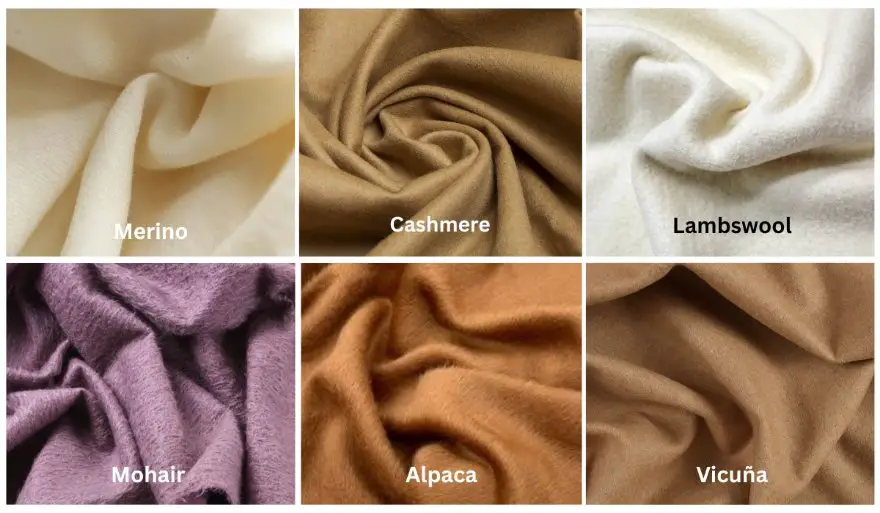
Different types of wool fibers from various sheep and animal breeds.
Not all wool is created equal. The type of sheep (and how it’s raised) makes a huge difference in the final fabric.
Merino Wool
Merino sheep, originally from Spain but now raised primarily in Australia and New Zealand, produce the finest wool fibers. Merino wool is exceptionally soft, fine, and perfect for suiting. When you see “Super 120s” or higher numbers on a suit, it’s almost always merino wool.
The best merino wool comes from sheep raised in Australia’s southern regions, where the climate extremes create particularly fine fibers. Some Italian mills even own their own sheep farms in Australia to control quality from the start.
Cashmere
Technically from goats, not sheep, cashmere is incredibly soft and luxurious. Pure cashmere suits exist but are rare and expensive. More commonly, you’ll find wool-cashmere blends (usually 90% wool, 10% cashmere) that add softness and warmth. These blends are perfect for winter suits.
Mohair
From Angora goats, mohair adds a subtle luster and incredible durability to suits. A wool-mohair blend (typically 95% wool, 5% mohair) creates a fabric that’s tough as nails while maintaining a beautiful sheen. It’s particularly popular for summer suits because mohair is naturally cooler than pure wool.
Alpaca
Alpaca wool is softer than sheep’s wool and hypoallergenic. Baby alpaca is incredibly fine and luxurious. Alpaca blends create warm, soft fabrics perfect for fall and winter suits.
Vicuña
The holy grail of animal fibers, vicuña comes from a South American relative of the alpaca. It’s incredibly rare (vicuñas can only be shorn every three years) and phenomenally expensive. A yard of vicuña fabric can cost thousands of dollars. Unless you’re royalty or a tech billionaire, you probably won’t encounter pure vicuña. Some luxury mills offer wool-vicuña blends for special occasion suits.
Lambswool
Lambswool comes from a lamb’s first shearing, usually around seven months old. It’s softer than regular wool because the fiber tips haven’t been cut before. Virgin wool (sometimes called new wool) has never been processed or recycled, making it stronger and more resilient than recycled wool.
Worsted vs Woolen: What’s the Difference?

Visual guide comparing worsted wool and woolen wool characteristics.
This is where things get interesting. When people talk about wool suiting, they’re almost always talking about worsted wool. But what does that actually mean?
Worsted Wool
Worsted wool is the smooth, refined fabric you think of when you picture a business suit. Here’s how it’s made:
- Fiber Selection: Only long wool fibers (called long-staple fibers) are used. Short fibers are removed.
- Combing: The fibers are combed with metal combs that align them all in the same direction, running parallel to each other. This is where the term “worsted” comes from – it originated in the English town of Worstead (now spelled Worsted) in Norfolk.
- Tight Spinning: The aligned fibers are spun into tight, smooth yarn.
- Weaving: The yarn is woven into fabric with a tight, even weave.
The result? A smooth, slightly shiny fabric with no fuzz. When you run your hand over worsted wool, it feels silky and cool. This is what you want for dress suits, business suits, and formal occasions.
Characteristics of Worsted Wool:
- Smooth surface
- Slight natural sheen
- Drapes beautifully
- Holds a sharp crease in trousers
- Perfect for tailored garments
- Available in lightweight and heavyweight versions
- Less insulating than woolen (because fibers are compact)
Woolen Wool
Woolen fabrics use a different process:
- Mixed Fiber Lengths: Short and long fibers are kept together.
- Carding Instead of Combing: Fibers are brushed (carded) but not aligned.
- Looser Spinning: The yarn is spun more loosely.
- Looser Weaving: The fabric is woven with more air space between threads.
The result is a fuzzier, more textured fabric. Think of a wool tweed jacket or a chunky sweater. The fibers point in all directions, creating air pockets that make woolen fabrics much warmer than worsted.
Characteristics of Woolen Wool:
- Textured, fuzzy surface
- Matte appearance (no sheen)
- Very warm and insulating
- More casual look
- Less structured drape
- Examples: flannel, tweed, melton
Which One for Suiting?
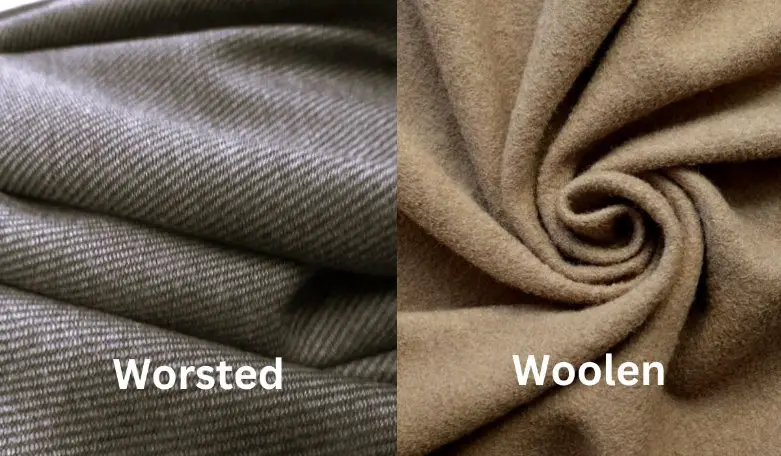
Worsted wool and woolen fabric differences explained visually.
For traditional business suits and formal wear, worsted wool wins every time. It’s smooth, it drapes well, and it looks professional. But woolens have their place too. A tweed sport coat or flannel trousers can be perfect for casual occasions or cold weather.
Here’s a simple way to remember: If you’re going to a job interview, wedding, or business meeting, choose worsted. If you’re going to the countryside, a casual dinner, or need extra warmth, woolen works great.
Can Merino Be Worsted? Yes! Merino refers to the type of sheep (and fiber quality), while worsted refers to how the wool is processed. Most high-quality worsted suiting uses merino wool. You can absolutely have merino worsted or merino woolen fabrics.
The Super Numbers System Explained
Walk into any men’s clothing store, and you’ll see tags bragging about “Super 120s” or “Super 150s” wool. But what do these numbers actually mean? And is a higher number always better?
The History of Super Numbers
Back in the 1800s, British wool merchants in Bradford, England, needed a way to classify wool quality. They developed the Bradford System (also called the English Worsted Yarn Count System). The system measured how many hanks (a hank is 560 yards of single-strand yarn) could be spun from one pound of combed wool.
In the 1960s, an Australian wool company developed a particularly fine merino wool and marketed it as “Super 100s.” The “Super” terminology was born. Today, the Super number indicates the diameter of individual wool fibers, measured in microns (one micron equals one-millionth of a meter).
What the Numbers Mean
Here’s the breakdown of common Super numbers and their corresponding micron counts:
| Super Number | Fiber Diameter (Microns) | Best For |
|---|---|---|
| Super 80s | 19.75 | Durable everyday suits, winter coats |
| Super 100s | 18.75 | Business suits, everyday wear |
| Super 110s | 18.25 | Quality business suits |
| Super 120s | 17.75 | Premium business suits, dressy occasions |
| Super 130s | 17.25 | Luxury suits, special occasions |
| Super 150s | 16.25 | Formal wear, wedding suits |
| Super 180s | 14.75 | Ultra-luxury, special occasions only |
| Super 200s+ | 14.00 and below | Extremely delicate, collector pieces |
Higher Isn’t Always Better
Here’s the truth that salespeople won’t tell you: a higher Super number doesn’t automatically mean a better suit. It just means finer fibers.
Finer fibers feel incredibly soft and have a luxurious hand (how the fabric feels when you touch it). They also drape beautifully. But they’re more delicate. A Super 180s suit might feel like butter, but it won’t stand up to daily wear like a Super 110s will.
The Sweet Spot: For most people, Super 100s to Super 130s is the ideal range. This gives you:
- Softness and comfort
- Good durability
- Excellent drape
- Reasonable price
- Resistance to snags and pulls
If you’re building a work wardrobe and plan to wear suits frequently, stick with Super 110s or 120s. Save the Super 150s for special occasions or if you rotate between many suits.
Beyond the Numbers: What Else Matters
The Super number only tells you about fiber fineness. It says nothing about:
- Fiber quality: Are the fibers strong and elastic?
- Spinning quality: How well was the yarn made?
- Weaving quality: How tightly and evenly is the fabric woven?
- Finishing: How was the fabric treated after weaving?
A Super 100s from a top mill like Vitale Barberis Canonico will outperform a Super 150s from a cheaper manufacturer. The mill’s reputation matters as much as the Super number.
Beware of Super Number Inflation: Not all manufacturers follow the same standards. One company’s Super 150s might actually be finer than another’s Super 180s. This is why it’s important to buy from reputable mills that follow the International Wool Textile Organization (IWTO) standards.
Fabric Weaves and Textures
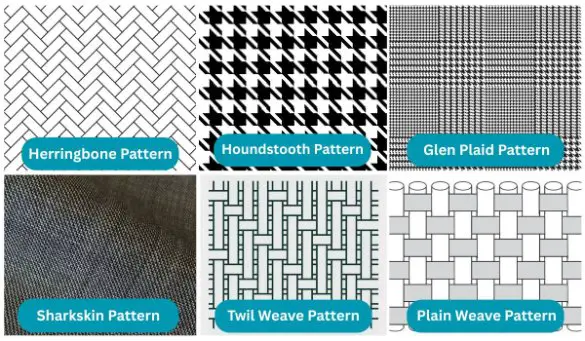
Overview of popular wool fabric weaves and surface textures.
The weave pattern dramatically changes how a wool fabric looks, feels, and performs. Here are the most common weaves you’ll encounter in suiting fabrics.
Plain Weave
The simplest and most common weave. Threads go over one, under one, creating a simple checkerboard pattern. Plain weave fabrics are durable, versatile, and work for most suits.
Best for: Year-round business suits, versatile blazers
Twill Weave
Threads pass over two or more threads before going under, creating a diagonal pattern. Twill weaves are soft, drape beautifully, and resist wrinkles better than plain weaves. Most dress suits use a twill weave.
Best for: Formal suits, dress trousers
Herringbone
A type of twill where the diagonal direction reverses every few rows, creating a V-shaped pattern that looks like fish bones. Herringbone adds subtle visual interest without being loud.
Best for: Business suits with personality, sport coats
Houndstooth
A distinctive pattern of broken checks that looks like jagged dog teeth. Usually created with two contrasting colors. Houndstooth is more casual and works best for sport coats and odd trousers.
Best for: Sport coats, autumn/winter jackets
Sharkskin
A tight twill weave that creates a subtle texture resembling shark skin. It has a slight sheen and is popular for business suits. Sharkskin patterns usually use two colors woven together to create depth.
Best for: Business suits, year-round wear
Seasonal Fabric Variations

Seasonal variations of wool suiting fabrics for different climates.
Tropical Wool
A plain weave made with fine, loosely twisted yarns. The looser weave allows maximum airflow, making tropical wool perfect for hot climates. These fabrics are typically in the 7-9 ounce range and don’t usually carry Super numbers because the open weave means the yarns are thicker.
Fresco Wool
Made with high-twist yarns woven in an open plain weave. Fresco has a slightly rough, textured surface and excellent breathability. It’s wrinkle-resistant and perfect for travel. Available in both lightweight (summer) and heavier weights (year-round).
Flannel
A woolen fabric (not worsted) with a soft, brushed surface. The fuzzy texture traps warmth, making flannel perfect for fall and winter. Flannel suits look more casual than smooth worsted suits.
Gabardine
A tightly woven twill with a pronounced diagonal rib. Gabardine is durable, has a slight sheen, and resists water and wind. It’s heavier than most suiting fabrics and works well for trousers and outerwear.
Fabric Weight Guide
Fabric weight is measured in ounces per yard (oz) or grams per square meter (gsm). Here’s what the numbers mean:
| Weight Range | Season | Best Use |
|---|---|---|
| 7-9 oz | Summer | Hot weather suits, tropical climates |
| 10-12 oz | Year-round | Business suits, most occasions |
| 13-16 oz | Fall/Winter | Cold weather suits, overcoats |
| 16+ oz | Winter | Heavy overcoats, extreme cold |
Most men’s suits fall in the 10-12 oz range. This weight works in most climates and most seasons (except extreme heat or cold).
The World’s Finest Wool Mills
Textile loom representing craftsmanship at leading wool mills.
When you buy wool suiting fabric, the mill matters as much as the Super number. These legendary manufacturers have spent decades (sometimes centuries) perfecting their craft.
Italian Mills: The Kings of Luxury
The Biella region in northern Italy has been the heart of fine wool manufacturing for hundreds of years. The area’s pure mountain water and centuries of expertise create some of the world’s best fabrics.
Vitale Barberis Canonico (VBC)
Founded in 1663, VBC is the oldest wool mill in the world still in operation. That’s over 360 years of making fabric. VBC is one of the few mills with complete vertical integration, meaning they control every step from owning sheep farms in Australia to the final fabric.
VBC fabrics offer an incredible balance of quality and value. Their Super 110s and 120s are workhorses that will last for years. Many tailors consider VBC the sweet spot: luxury quality without the extreme prices of Loro Piana or Zegna.
Signature fabrics: Four Seasons line (year-round wear), Revenge (ultra-fine 2-ply yarns), Greenhills (from their own Australian farm)
Loro Piana
The Loro Piana family started as wool merchants in the early 1800s, founding their company in 1924. Today, Loro Piana (now owned by LVMH) is synonymous with the absolute pinnacle of luxury fabrics.
Loro Piana is the world’s largest processor of cashmere and baby cashmere. They also work with vicuña and other ultra-rare fibers. When you see a Loro Piana label, you’re looking at some of the finest materials on Earth.
Signature fabrics: Tasmanian (ultra-fine Australian merino), Zealander (New Zealand wool), Four Seasons collections
Ermenegildo Zegna
Founded in 1910 in Trivero, Zegna started with a bold vision: to make the world’s finest fabrics. They succeeded. Like VBC and Loro Piana, Zegna controls the entire supply chain, including Australian sheep farms.
Zegna is unique because they’re both a fabric mill and a luxury fashion brand. The same fabrics they sell to tailors also go into Zegna-branded suits. They blend traditional craftsmanship with modern technology.
Signature fabrics: Trofeo (their signature wool line), Techmerino (performance fabrics), High Performance collections
Drago
Established in 1973 by Umberto and Laura Drago, this is one of the younger Italian mills, but it’s quickly earned respect for quality and innovation. Drago fabrics are known for their softness and beautiful colors.
Signature fabrics: Blue Feel (lightweight open weave), Rugby (flannel), Four Seasons collections
Reda
Founded in 1865, Reda combines tradition with sustainability. They were early adopters of eco-friendly practices and now lead the industry in environmental responsibility. Reda fabrics work particularly well in warm climates.
Signature fabrics: Rewoolution (merino performance fabrics), Cashmerello (cashmere blends)
Carlo Barbera
A smaller, more exclusive mill, Carlo Barbera is the choice for discerning bespoke tailors. They’re famous for their meticulous processing, including resting wool in caves for a year before spinning. This allows the fibers to relax and stabilize.
Carlo Barbera fabrics are expensive, but they represent the absolute pinnacle of quality.
English Mills: Tradition and Structure
British mills take a different approach than Italian ones. Where Italian fabrics prioritize softness and drape, English fabrics emphasize structure, durability, and weather resistance.
Scabal
Founded in Brussels but with strong English ties, Scabal has supplied fabrics to royalty, heads of state, and Hollywood stars since 1938. They’re known for bold patterns and colors alongside classic worsted wools.
Dormeuil
A French-English house founded in 1842, Dormeuil combines French elegance with English structure. They’re famous for innovative fabrics, including patterns and textures you won’t find elsewhere.
Fox Brothers
Established in 1772 in Somerset, England, Fox Brothers specializes in heavier woolens, tweeds, and flannels. If you want a proper British country suit or sport coat, Fox Brothers is the gold standard.
Choosing a Mill
For your first quality suit, VBC offers the best combination of quality and value. As you expand your wardrobe, explore Loro Piana or Zegna for special occasion suits. If you love traditional British style, look at Scabal or Dormeuil.
Remember: the mill name matters more than the Super number. A VBC Super 110s will outperform a no-name Super 150s every single time.
Wool Blends for Suiting
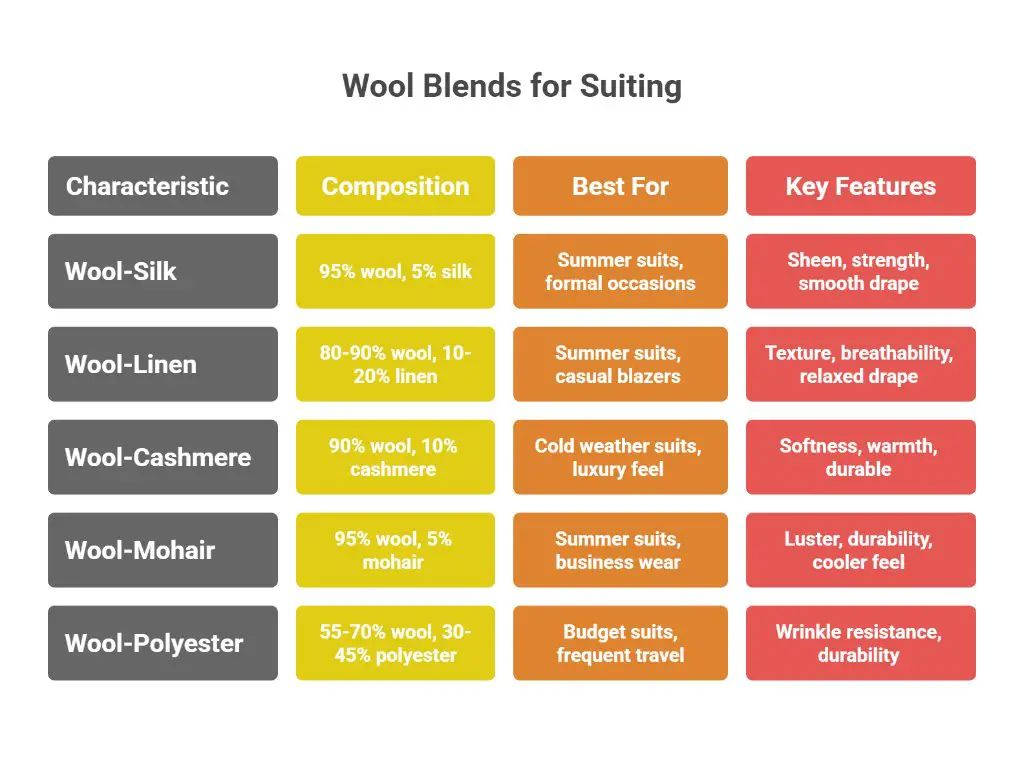
Overview of popular wool blends used in suiting fabrics.
What is the Best Wool Blend for Suits?
While 100% wool suits are the traditional choice (and we’ll discuss whether they’re worth it next), wool blends serve specific purposes. The “best” blend depends on your needs.
Wool-Silk Blends
Typically 95% wool, 5% silk. Silk adds a beautiful sheen and extra strength to the fabric. The slight luster makes these blends perfect for evening wear and formal occasions. Silk also helps the fabric drape smoothly.
Best for: Summer suits, formal occasions, adding subtle elegance
Wool-Linen Blends
Usually 80-90% wool, 10-20% linen. Linen adds texture, breathability, and a relaxed drape. These blends are cooler than pure wool and perfect for summer. The linen gives the fabric a slightly slubbed texture.
Best for: Summer suits, casual blazers, warm climates
Wool-Cashmere Blends
Typically 90% wool, 10% cashmere. Cashmere adds incredible softness and warmth. These blends feel luxurious but are more durable and affordable than pure cashmere. Perfect for fall and winter suits.
Best for: Cold weather suits, luxury feel on a budget
Wool-Mohair Blends
Usually 95% wool, 5% mohair. Mohair adds luster, durability, and a cooler feel. The slight sheen looks elegant without being showy. These blends resist wrinkles exceptionally well and wear like iron.
Best for: Summer suits, business wear, durability
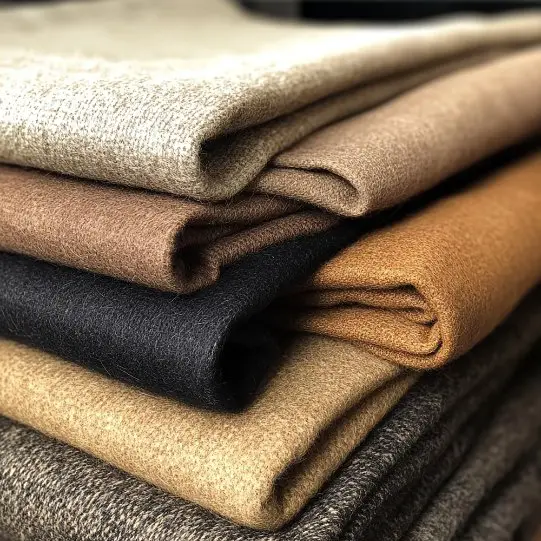
Examples of wool blend fabrics used in suits.
Wool-Polyester Blends
Typically 55-70% wool, 30-45% polyester. These are controversial. Polyester adds wrinkle resistance and durability while lowering cost. But it also reduces breathability and can make the fabric feel less natural.
High-quality wool-polyester blends (with more wool than poly) can work for everyday business wear. Avoid cheap blends with more polyester than wool.
Best for: Budget suits, frequent travel, extreme durability needs
Is a 100% Wool Suit Worth It?
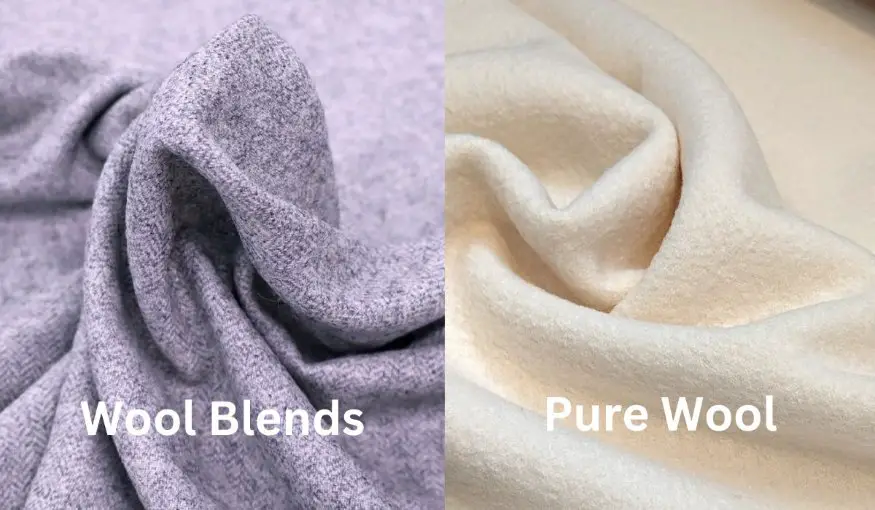
Comparison of wool blends and pure wool fabrics for suiting.
Yes, especially for your first quality suit. Here’s why:
Breathability: Pure wool breathes better than any blend. You’ll stay cooler in summer and won’t feel clammy when you sweat.
Temperature Regulation: Wool’s natural properties work best without synthetic interference. Blending with polyester reduces wool’s ability to regulate temperature.
Longevity: A 100% wool suit from a good mill will last longer than blended alternatives. Wool’s natural elasticity means the fabric recovers from wear better than blends.
Drape: Pure wool drapes more naturally than blends. The fabric moves with your body instead of looking stiff or artificial.
Aging: Wool ages beautifully. A well-cared-for wool suit looks distinguished after years of wear. Polyester blends often develop a tired, pilled appearance.
Resale Value: If you ever want to sell or consign your suit, 100% wool from a good mill holds value. Blends don’t.
That said, natural fiber blends (wool-silk, wool-linen, wool-cashmere) can be fantastic. These add specific benefits while maintaining wool’s core properties. Just avoid high-polyester blends unless budget is your primary concern.
The Bottom Line on Blends
For your core wardrobe, stick with 100% wool or natural fiber blends. Save polyester blends for travel suits or situations where you need extreme wrinkle resistance. Your comfort (and your dry cleaner) will thank you.
Sustainability and Ethics
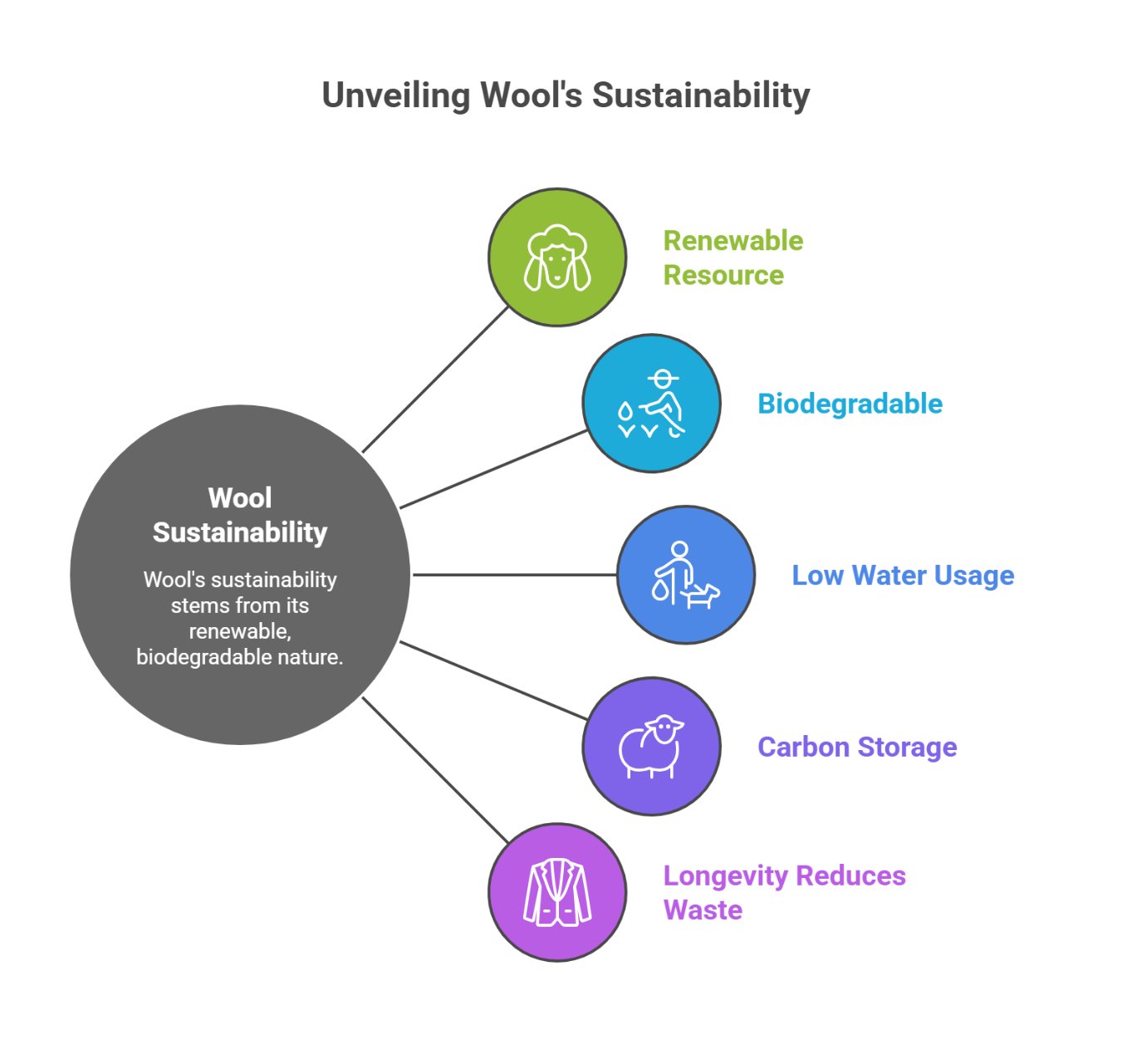
Visual overview of wool sustainability and ethical benefits.
If you care about environmental impact, wool is one of the best fabric choices you can make. Let’s look at why wool is genuinely sustainable, and what to watch for.
Why Wool is Sustainable
Renewable Resource
Sheep grow a new fleece every year. Unlike cotton (which requires replanting) or synthetics (which use petroleum), wool is infinitely renewable as long as we care for sheep properly.
Biodegradable
Put a wool garment in a landfill, and it will decompose naturally within a few years. Compare that to polyester, which can take 200+ years to break down and releases microplastics in the process.
Natural wool releases nutrients back into the soil as it decomposes. It’s literally food for the earth.
Low Water Usage
Producing wool requires significantly less water than cotton. Cotton is incredibly water-intensive, especially in the growing phase. Sheep drink water, but they’re not irrigated like cotton fields.
According to industry studies, producing one kilogram of wool yarn uses about 4% of the water needed for cotton yarn.
Carbon Storage
Sheep grazing on grasslands actually help sequester carbon in the soil. Well-managed grazing lands can store carbon, offsetting some of the methane sheep produce.
Longevity Reduces Waste
A quality wool suit lasts 20-30 years. Fast fashion polyester suits might last 2-3 years before looking shabby. Which is more sustainable: buying one wool suit or ten polyester ones over the same period?
What to Look For: Certifications and Standards
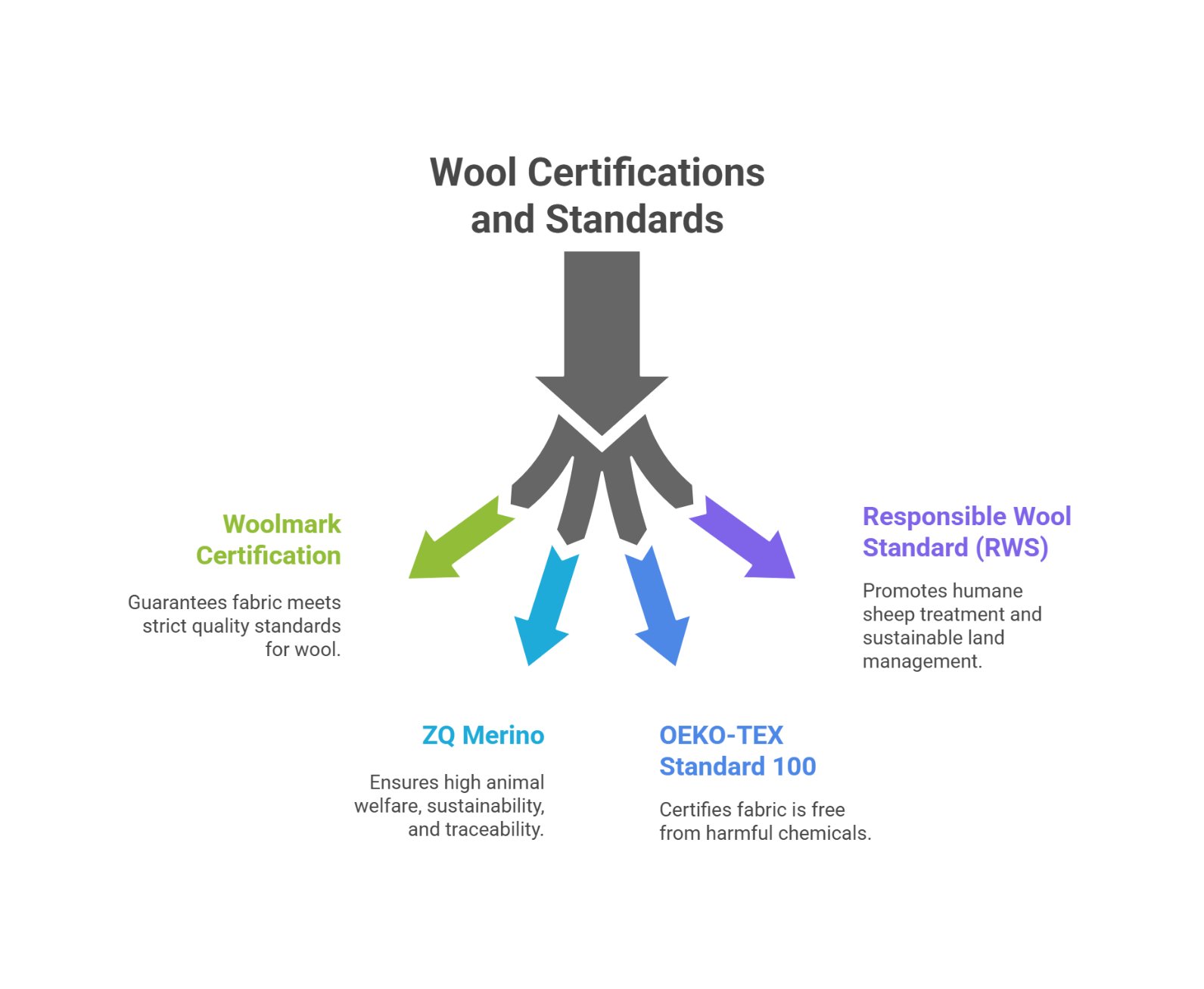
Key certifications and standards to check before buying wool fabric.
Woolmark Certification
The Woolmark logo means the fabric meets strict quality standards for pure new wool. It’s a mark of quality and authenticity.
ZQ Merino
ZQ-certified wool comes from farms that meet high standards for animal welfare, environmental sustainability, and worker conditions. The wool is traceable back to the specific farm where it was grown.
OEKO-TEX Standard 100
This certification means the fabric has been tested for harmful chemicals and is safe for human skin. Many top mills use OEKO-TEX certified dyes.
Responsible Wool Standard (RWS)
RWS certification ensures sheep are treated humanely and land is managed sustainably. It’s becoming increasingly common among ethical mills.
Animal Welfare Concerns
Not all wool is produced ethically. Here are issues to be aware of:
Mulesing
This controversial practice involves removing strips of skin from sheep to prevent flystrike (a parasitic infection). It’s common in Australia but increasingly criticized as cruel. Look for non-mulesed or mulesing-free wool.
Farm Conditions
Sheep should have freedom to move, access to food and water, protection from extreme weather, and veterinary care when needed. Certifications like ZQ and RWS help ensure these standards.
Sustainable Mills
Some mills go above and beyond in sustainability:
Reda: Leaders in sustainable practices, using renewable energy and recycling water in their processes.
Loro Piana: Works directly with communities in Peru to ensure sustainable, ethical vicuña harvesting.
Vitale Barberis Canonico: Owns and manages sheep farms with high animal welfare standards.
Wool vs Synthetics: The Real Comparison
Polyester suits are marketed as practical and affordable. But consider:
- Polyester is made from petroleum (a non-renewable resource)
- Manufacturing polyester releases significantly more greenhouse gases than wool processing
- Polyester sheds microplastics when washed, polluting waterways
- Polyester doesn’t biodegrade
- Cheap polyester suits wear out quickly, creating more waste
If you care about sustainability, wool and cashmere are smart choices for your wardrobe.
The Complete Buying Guide

Hands on evaluation of wool suiting fabric during the buying process.
Now that you understand wool, let’s talk about actually buying it. Different audiences have different needs.
For Home Sewers and DIY Tailors
Where to Buy Fabric by the Yard
Quality wool suiting fabric is available online and at specialty fabric stores. Look for:
- Online retailers: Mood Fabrics, B&J Fabrics, Gorgeous Fabrics
- Direct from mills: Some mills sell remnants or sample lengths
- Local fabric stores: Build relationships for better prices and advice
How Much Fabric Do You Need?
For a men’s suit jacket (sizes 38-44):
- 2.5-3 yards for a single-breasted jacket
- 3-3.5 yards for a double-breasted jacket
For trousers:
- 1.5-2 yards depending on size and style
For a complete two-piece suit:
- 4-5 yards total (more for larger sizes or patterned fabrics that need matching)
Always buy an extra half yard for insurance. Dye lots can vary, so you can’t always match fabric later.
Should You Pre-Wash Wool Suiting?
No, don’t wash it. But you should pre-shrink it. Here’s how:
- Lay the fabric flat on a clean surface
- Use a steam iron or garment steamer, hovering just above the fabric
- Steam thoroughly on both sides
- Let it cool and dry completely (24 hours)
- Press with a dry iron if needed
This removes any residual shrinkage without risking damage from water immersion.
For Bespoke and Made-to-Measure Customers
What to Ask Your Tailor
When commissioning a custom suit, ask:
- Which mills do you work with?
- Can I see the full fabric book?
- What Super number do you recommend for my needs?
- Is this 100% wool or a blend?
- What’s the fabric weight?
- How will this fabric age and wear?
A good tailor will guide you based on how you’ll use the suit, not just push the most expensive option.
How to Evaluate Fabric Quality
When looking at fabric swatches:
- Touch it: Does it feel soft but resilient? Or does it feel limp?
- Crumple it: Squeeze the fabric, then release. It should bounce back quickly.
- Hold it to light: Look at the weave. It should be tight and even.
- Check the hand: Drape the fabric over your hand. It should flow smoothly.
- Look at the finish: The surface should be consistent with no slubs or thick areas (unless it’s supposed to have texture).
For Off-the-Rack Buyers
How to Read Suit Labels
When shopping for ready-to-wear suits, the label tells you a lot:
- 100% Wool: Good. This is what you want.
- Super 110s, 120s, etc.: Higher numbers are softer but not necessarily better.
- Worsted Wool: The smooth finish you want for business suits.
- Italian Wool: Often indicates quality, but verify the actual mill.
- 55% Wool, 45% Polyester: Budget option. Will wear okay but won’t breathe as well.
What labels DON’T tell you:
- Which mill made the fabric
- Fabric weight
- Weave type (usually)
- Construction quality (half-canvas, full-canvas, fused)
How to Spot Quality
Look for:
- Mill name: If the label says VBC, Loro Piana, Zegna, etc., you’re getting quality fabric.
- Consistent weave: Hold the suit to light and look at the weave pattern. It should be even.
- Good drape: The fabric should flow smoothly, not look stiff.
- Clean finish: Seams should be straight, buttons should be sewn securely.
- Lining quality: Cheap suits have cheap linings (thin, crinkly material). Good suits use Bemberg or silk lining.
By Season and Climate
Hot Weather (Summer, Tropical Climates)
Choose:
- Tropical wool (7-9 oz)
- Fresco weaves
- Open weave fabrics
- Lighter colors (reflect heat)
- Wool-linen blends
- Wool-mohair blends
Year-Round Wear
Choose:
- 10-12 oz worsted wool
- Super 110s-130s
- Plain or twill weave
- Medium colors (navy, charcoal, mid-gray)
- 100% wool or wool-silk blends
Cold Weather (Fall/Winter)
Choose:
- 13-16 oz fabric
- Flannel weaves
- Wool-cashmere blends
- Darker colors
- Textured fabrics (holds warmth better)
By Occasion
Business/Office Wear
Go with:
- Worsted wool
- Super 110s-130s
- Classic colors: navy, charcoal, medium gray
- Subtle patterns if any (thin pinstripes, small checks)
- 10-12 oz weight
Formal Events (Weddings, Galas)
Choose:
- Fine worsted wool
- Super 130s-150s
- Solid colors or very subtle patterns
- Wool-silk blends for sheen
- Lighter weights for warm weather events
Casual/Smart Casual
Consider:
- Textured fabrics (flannel, fresco, hopsack)
- Wool-linen blends
- Bolder patterns (larger checks, herringbone)
- Earth tones, browns, olives
- Sport coats rather than matched suits
Budget Considerations
Entry Level ($300-600 for a suit)
Look for:
- 100% wool from good brands (not necessarily mill-specific)
- Super 100s-110s (durable and affordable)
- Fused construction (common at this price)
- Standard colors and patterns
Mid-Range ($600-1500)
You should get:
- 100% wool from named mills (VBC, Reda, etc.)
- Super 110s-130s
- Half-canvas construction
- Better fit and finishing
Premium ($1500-3000)
Expect:
- Top mill fabrics (Loro Piana, Zegna, VBC)
- Super 120s-150s
- Full-canvas construction
- Excellent fit and finishing
- Made-to-measure options
Luxury ($3000+)
You’re getting:
- Bespoke tailoring
- Exclusive fabrics
- Super 150s and above
- Rare blends (vicuña, ultra-fine cashmere)
- Hand finishing throughout
Try our fabric cost comparison calculator to help you budget for your next suit project.
The Ultimate Care and Maintenance Guide
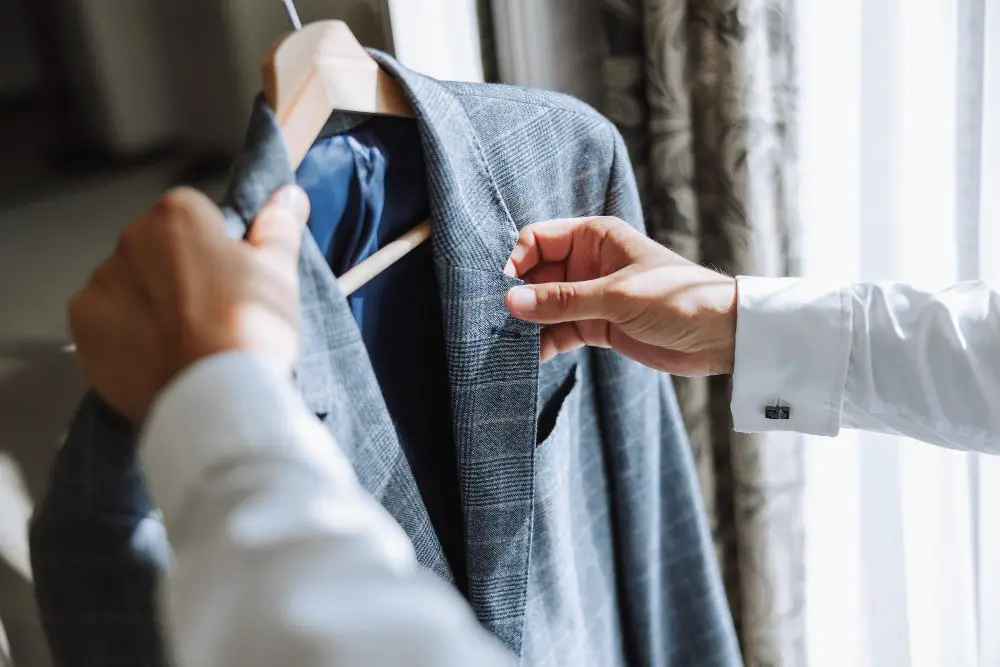
Correct care and storage practices for wool suiting garments.
Proper care can make a wool suit last decades. Here’s everything you need to know.
Daily Maintenance
Brushing
After each wear, brush your suit with a soft clothes brush. Use long, smooth strokes following the direction of the fabric. This removes dust, lint, and surface dirt before they become embedded.
Pay special attention to:
- Under the collar
- Shoulders
- Sleeves (especially cuffs)
- Trouser legs
A good brushing takes 2-3 minutes and can extend the time between dry cleanings by months.
Airing Out
Never put a suit away immediately after wearing. Instead:
- Hang it on a proper hanger (more on this below)
- Leave it in a well-ventilated space for 24 hours
- This allows moisture from your body to evaporate
- The wool fibers can recover their natural shape
If you sweat heavily, hang the suit in a bathroom while you shower (not during, just the residual humidity). The light steam helps refresh the fabric.
The 24-Hour Rule
Always rest a wool suit for at least 24 hours between wears. Wool needs this time to recover its shape and release moisture. This is why serious suit wearers own multiple suits – rotation is key.
Spot Cleaning
Deal with spills and stains immediately. The longer they sit, the harder they are to remove.
For Water-Based Stains (coffee, tea, juice)
- Blot (don’t rub) with a clean, dry cloth
- If the stain persists, use a barely damp cloth with cold water
- Blot gently from the outside of the stain toward the center
- Let air dry completely
For Oil-Based Stains (food, grease)
- Blot excess with a paper towel
- Sprinkle cornstarch or talcum powder on the stain
- Let it sit for several hours to absorb the oil
- Brush off gently
- If the stain remains, take it to a dry cleaner
For Mystery Stains
When in doubt, don’t try home remedies. Take it to a professional dry cleaner and point out the stain. Tell them what caused it if you know.
Steaming vs Pressing
For removing wrinkles, steaming beats pressing every time.
How to Steam a Suit
- Hang the suit on a hanger
- Use a handheld garment steamer or the steam function on your iron (held a few inches away)
- Move the steamer in long, smooth strokes
- Never let the steamer touch the fabric directly
- Steam from the inside first, then outside
- Let the suit dry completely before wearing (30 minutes minimum)
Why steaming is better: Pressing with an iron can flatten the fabric’s natural texture and create shiny spots (especially on worsted wool). Steaming relaxes fibers without crushing them.
If You Must Press
Sometimes pressing is necessary for sharp creases in trousers:
- Use a press cloth (a thin cotton cloth between the iron and suit)
- Set iron to the wool setting (never higher)
- Use steam
- Press, don’t iron (set the iron down, lift it up, move to next spot)
- Never drag the iron across the fabric
- Always press on the inside when possible
Storage
Daily Storage
Hangers matter: Use wide, shaped wooden hangers with broad shoulders. Thin wire hangers will distort the shoulders and create creases. The hanger should support the entire shoulder line of the jacket.
Spacing: Don’t pack suits tightly in a closet. They need air circulation. Leave at least 2-3 inches between garments.
Garment Bags: For suits you wear regularly, skip the garment bag. They need to breathe. Use garment bags only for long-term storage or to protect against dust in very dusty environments.
Long-Term Storage (Seasonal Suits)
When storing suits for months:
- Clean first: Always dry clean before long-term storage. Food stains and body oils attract moths.
- Use breathable bags: Cotton garment bags, not plastic. Plastic traps moisture.
- Moth protection: Use cedar blocks, lavender sachets, or moth repellent strips. Place them near (not touching) the suits.
- Climate control: Store in a cool, dry place. Avoid basements (too humid) and attics (too hot).
- Check periodically: Every few months, take suits out, air them, and check for moths or moisture.
Trouser Storage
For trousers:
- Hang by the cuffs: Use a clamp-style trouser hanger. Hanging upside down helps gravity pull out wrinkles.
- Or fold carefully: If you must fold, fold along the crease and lay flat with minimal weight on top.
Dry Cleaning: When and How Often
Here’s the truth about dry cleaning: it’s harsh on fabric. The chemicals used in dry cleaning gradually break down wool fibers. Each cleaning shortens your suit’s life a tiny bit.
How Often Should You Dry Clean?
For a suit you wear regularly:
- Maximum twice a year if you maintain it properly
- Only when truly necessary: visible stains, odors that won’t air out, or before long-term storage
If you follow the daily care routine (brushing, airing, spot cleaning), you can go 6-12 months between cleanings easily.
Choosing a Dry Cleaner
Not all dry cleaners are created equal:
- Ask if they use genuine dry cleaning solvents (not water-based cleaning)
- Look for cleaners that specialize in fine garments
- Point out any stains and explain what caused them
- Remove everything from pockets (cleaners often don’t check)
- Ask them not to over-press; specify “light press” or “hang to dry”
Warning Signs of Bad Dry Cleaning
- Shiny patches on the fabric (over-pressing)
- Chemical smell that doesn’t dissipate
- Color fading or bleeding
- Shrinkage
- Stains that weren’t removed
If you see these, find a new cleaner.
Travel Care
Packing a Suit
- Turn the jacket inside out
- Fold one shoulder into the other (the lining protects the outside)
- Fold in half lengthwise
- Lay flat in your suitcase or garment bag
- For trousers, fold along the crease and lay on top of the jacket
Hotel Room Steam Trick
When you arrive:
- Hang your suit in the bathroom (not in the shower)
- Run a hot shower for 10-15 minutes
- The steam fills the room and relaxes wrinkles
- Leave the suit hanging for a few hours afterward
- It’ll look freshly pressed
Special Care for High Super Numbers
If you own a Super 150s or higher suit, baby it:
- Brush more gently (finer fibers snag easier)
- Avoid sitting on rough surfaces
- Be extra careful with spot cleaning
- Consider professional cleaning more often (the fabric is more delicate)
- Rotate frequently to minimize wear on any one suit
Dealing with Moths
Moths are wool’s worst enemy. They eat holes right through your suit.
Prevention
- Clean suits before storage (moths are attracted to food stains and body oils)
- Use cedar blocks, cedar hangers, or lavender sachets
- Keep your closet clean and well-ventilated
- Inspect suits regularly for small holes or moth larvae
If You Find Moths
- Remove all suits from the closet
- Vacuum the closet thoroughly
- Freeze affected suits in sealed plastic bags for 72 hours (this kills larvae and eggs)
- Clean or discard damaged items
- Use moth traps to catch adults
- Implement stronger prevention measures
For more detailed fabric care instructions, check out our comprehensive wool care guide or visit The Woolmark Company’s official care guidelines.
Wool vs Other Suiting Fabrics
How does wool stack up against other suiting options? Let’s compare.
Wool vs Cotton
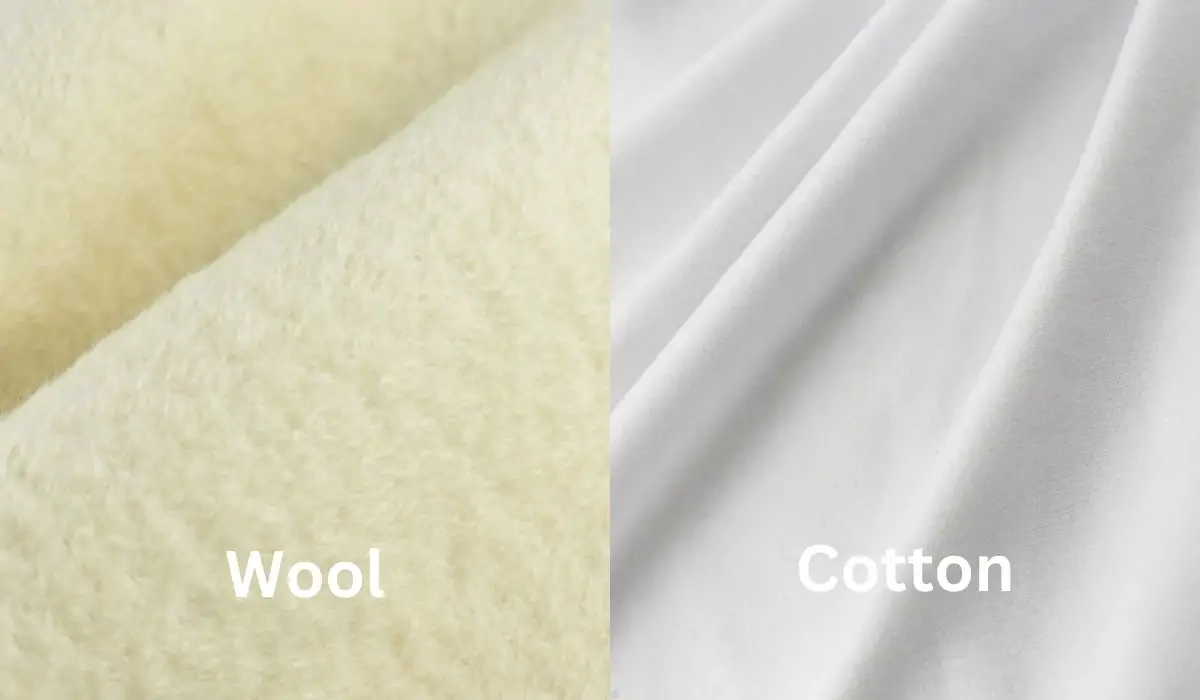
Wool versus cotton fabric comparison for clothing and suits.
| Feature | Wool | Cotton |
|---|---|---|
| Wrinkle Resistance | Excellent | Poor (wrinkles easily) |
| Breathability | Excellent | Very Good |
| Moisture Wicking | Excellent (30% capacity) | Good (8% capacity) |
| Temperature Regulation | Excellent | Good (cooling only) |
| Durability | Excellent | Good |
| Drape | Excellent | Fair to Good |
| Formality | Business to Formal | Casual to Business Casual |
| Price | Higher | Lower |
| Best For | Year-round professional wear | Summer, casual occasions |
Verdict: For business suits, wool wins. Cotton works great for summer casual suits and blazers, but it doesn’t have wool’s versatility or professional appearance.
Wool vs Linen
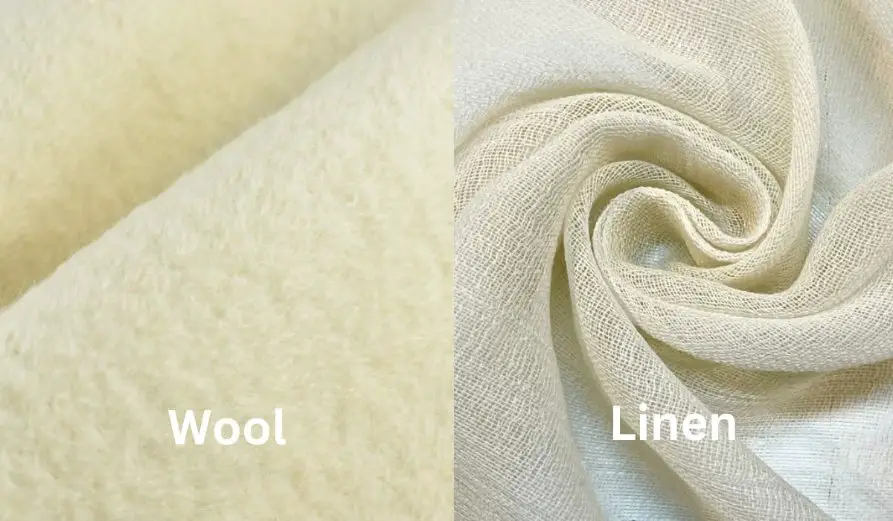
Wool and linen fabric comparison highlighting weave and drape.
| Feature | Wool | Linen |
|---|---|---|
| Wrinkle Resistance | Excellent | Very Poor |
| Breathability | Excellent | Outstanding |
| Cooling Effect | Good | Excellent |
| Durability | Excellent | Very Good |
| Drape | Excellent | Good (more relaxed) |
| Formality | Business to Formal | Casual to Business Casual |
| Care | Easy | Moderate (wrinkles) |
| Best For | Professional, year-round | Summer, casual, warm climates |
Verdict: Linen is cooler than wool, but the constant wrinkles make it impractical for business settings. Linen suits work beautifully for summer weddings, beach events, and casual occasions. For the office, choose tropical weight wool instead.
Wool vs Polyester
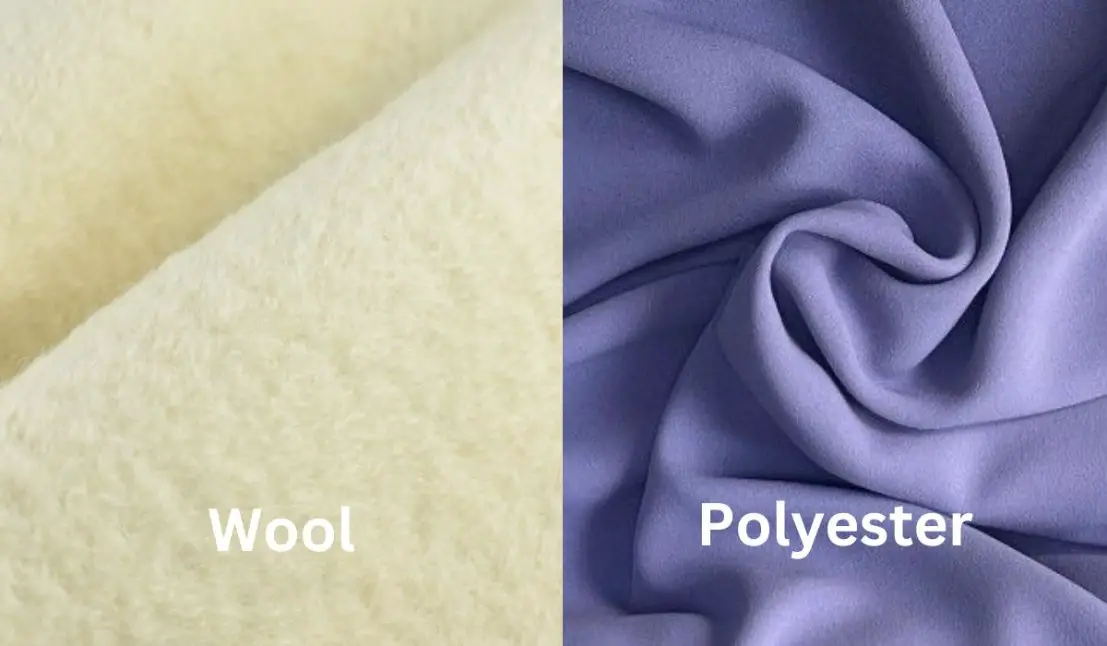
Wool versus polyester fabric comparison for suiting materials.
| Feature | Wool | Polyester |
|---|---|---|
| Breathability | Excellent | Poor |
| Moisture Wicking | Excellent | Poor (traps sweat) |
| Temperature Regulation | Excellent | Poor |
| Wrinkle Resistance | Excellent | Excellent |
| Durability | Excellent | Good to Excellent |
| Longevity | Decades | Years |
| Odor Resistance | Excellent | Poor (holds odors) |
| Environmental Impact | Low (biodegradable) | High (petroleum-based) |
| Price | Higher | Lower |
| Best For | Quality, comfort, longevity | Budget, travel |
Verdict: Polyester is cheap and wrinkle-resistant, but it’s uncomfortable in warm weather and doesn’t breathe. You’ll sweat more and feel clammy. Polyester suits also develop a tired, shiny appearance after a few years. If you can afford wool, choose wool.
Wool Blends vs Pure Wool
We covered this earlier, but here’s a quick reference:
- Wool-Silk (95/5): Adds sheen and strength. Great for formal occasions.
- Wool-Linen (80/20): Cooler and more casual. Perfect for summer.
- Wool-Cashmere (90/10): Softer and warmer. Ideal for winter.
- Wool-Mohair (95/5): More durable with subtle luster. Excellent for year-round.
- Wool-Polyester (60/40): Budget option. Less breathable but more affordable.
Compare different fabric options with our interactive fabric comparison tool.
Essential Suit Knowledge
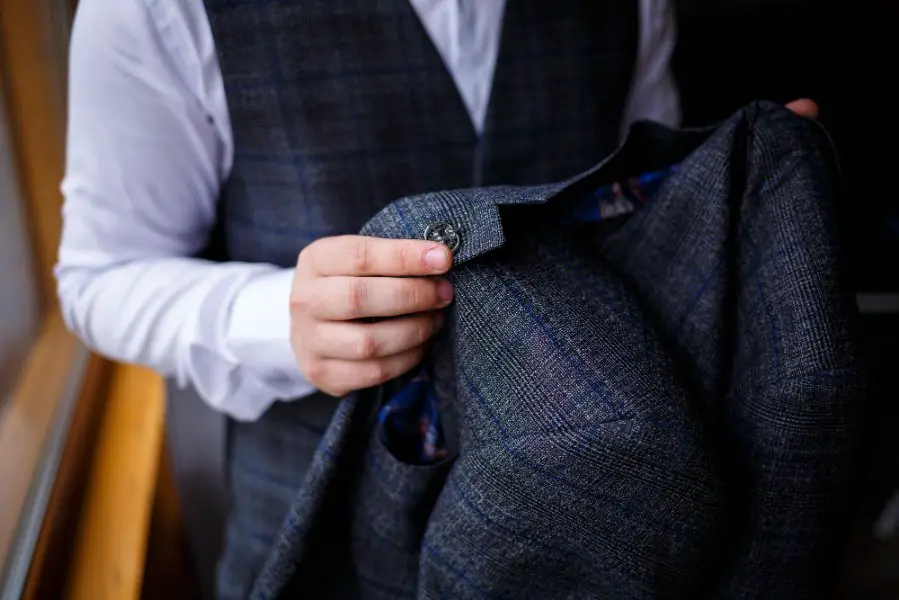
Close inspection of a wool suit highlighting craftsmanship and fabric quality.
What is the 5 Suit Rule?
The “5 suit rule” is a guideline for building a versatile suit wardrobe. The idea is that five suits in strategic colors and styles will cover almost any situation you might encounter.
The Five Essential Suits:
- Navy Blue Suit: Your most versatile suit. Works for business, interviews, weddings, funerals, and everything in between. Should be solid navy worsted wool, Super 110s-120s, year-round weight. This is your foundation.
- Charcoal Gray Suit: Your second most versatile suit. Nearly as adaptable as navy but gives you variety. Also solid worsted wool, similar quality to your navy suit.
- Medium Gray Suit: Lighter than charcoal, this works for spring/summer business wear and less formal occasions. Can have subtle patterns (pinstripes, windowpane) if you kept the first two solid.
- Dark Brown or Tan Suit: Your casual/creative option. Earthy tones work for business casual, creative industries, and smart casual events. Can be textured (flannel, hopsack) or patterned.
- Patterned or Seasonal Suit: This is your flex spot. Could be a summer-weight suit for hot weather, a winter flannel, a pinstripe, or a check pattern. Fill the gap in your wardrobe based on your lifestyle and climate.
With these five suits and some basic dress shirts and ties, you’re covered for professional life. You can wear a different suit every day of the work week without repeating.
If You’re Starting from Zero: Get the navy suit first. It’s the most versatile single suit you can own. Add charcoal gray second, then build from there as your budget allows.
What is the Most Attractive Suit Color for Men?
Studies consistently show that navy blue and charcoal gray are perceived as the most professional and attractive suit colors for men. Here’s why:
Navy Blue:
- Conveys confidence, authority, and trustworthiness
- Works with all skin tones
- Pairs easily with shirts and ties
- Appropriate for virtually any occasion
- Research shows people perceive navy-suited men as more competent and reliable
Charcoal Gray:
- Sophisticated and modern
- Slightly more formal than navy
- Works in all professional settings
- Conveys seriousness and professionalism
- Perfect for important meetings and presentations
For attractiveness specifically: Darker colors (navy, charcoal) are generally more flattering because they:
- Create a slimming silhouette
- Provide strong contrast with most shirt colors
- Look sharp and put-together
- Hide minor imperfections or wear better than light colors
Other attractive options:
- Medium Gray: Modern and versatile, though less formal than charcoal
- Dark Brown: Warm and approachable, works well in creative fields
- Black: Formal and elegant, but can be severe for everyday business wear
The “most attractive” color also depends on context. For a job interview or important business meeting, navy or charcoal wins. For a wedding or social event, you have more flexibility with colors and patterns.
What Does 44S Mean in Suits?
Suit sizing uses a combination of numbers and letters. Understanding this helps you find suits that actually fit.
The Number (44): This is your chest measurement in inches. A size 44 suit is designed to fit a chest that measures approximately 44 inches around. The actual jacket will be cut slightly larger than this (usually 4-6 inches of ease) to allow for comfort and layering.
The Letter (S): This indicates the jacket length and is based on your height:
- S (Short): For men approximately 5’4″ to 5’7″
- R (Regular): For men approximately 5’8″ to 6’0″
- L (Long): For men approximately 6’1″ to 6’3″
- XL (Extra Long): For men approximately 6’4″ and taller
So 44S means: A suit jacket designed for a man with a 44-inch chest who is on the shorter side (roughly 5’4″ to 5’7″). The jacket will have shorter sleeves and a shorter overall body length than a 44R or 44L.
Important Notes:
- These are starting points, not guarantees. Different brands fit differently.
- Your true chest size might not match your suit size (a 42″ chest might wear a 40 suit or a 44 suit depending on how much room you like)
- Always try suits on. Even if you’re normally a 44R, you might need a different size in certain brands or cuts
- Body proportions vary. You might be 5’10” but have longer arms, requiring a Long instead of Regular
Other Sizing Variations:
- Portly/Executive cuts: Some brands offer these for men with fuller builds (larger waist relative to chest)
- Athletic cuts: For men with broader shoulders and chests relative to their waist
- Slim/Modern fits: Cut closer to the body with less room in the chest and waist
The best approach? Know your approximate size, but always try before you buy (or order with a good return policy for online purchases). And if you’re investing in a quality suit, budget for alterations. Even the perfect size off the rack usually needs minor adjustments for an ideal fit.
Frequently Asked Questions
A: Generally, no. Wool suiting fabrics are designed for dry cleaning. The structure, interfacings, and construction of a finished suit won’t survive washing. However, you can spot clean minor stains and use steam to refresh the fabric between cleanings. If you’re working with fabric before construction, you can pre-treat it with steam, but avoid submerging in water.
A: With proper care, a quality wool suit can easily last 10-20 years, and some last 30+ years. The key factors are: quality of the original fabric and construction, frequency of wear (rotate between multiple suits), proper care (brushing, airing, minimal dry cleaning), and appropriate storage. Suits from top mills with good construction can literally last a lifetime.
A: Not necessarily “better” – just different. Super 150s is finer and softer, with a more luxurious hand feel and drape. But Super 120s is more durable and resistant to snags and wear. For frequent business wear, Super 120s is often the smarter choice. Save Super 150s for special occasions or if you rotate between many suits. Think of it like this: Super 150s is a sports car (exciting but delicate), Super 120s is a luxury sedan (comfortable and reliable).
A: Several reasons: centuries of expertise and refined techniques, vertical integration (many mills control the entire process from sheep to fabric), incredibly fine Australian merino wool as raw material, meticulous quality control at every step, smaller production runs than mass-market mills, and brand reputation. You’re paying for genuine quality, not just marketing. That said, mills like VBC offer excellent quality at more reasonable prices than ultra-luxury brands.
A: Absolutely! Tropical weight wool (7-9 oz), fresco weaves, and open weave fabrics are specifically designed for hot weather. Wool’s moisture-wicking properties actually make it more comfortable than many synthetics in heat. Wool absorbs sweat and allows it to evaporate, while polyester traps moisture against your skin. Choose lighter weights, looser weaves, and lighter colors for summer. Many men in hot climates like Texas, Florida, or Southeast Asia wear wool suits year-round with the right fabric choices.
A: Virgin wool (also called new wool) has never been processed, used, or recycled before. It comes directly from the sheep’s first shearing or from wool that’s being used for the first time. Recycled wool has been used in a previous garment, broken down, and re-spun into new yarn. Virgin wool is stronger, softer, and more durable because the fibers haven’t been damaged by previous processing. Look for “virgin wool” or “new wool” labels for the best quality.
A: Check for: a reputable mill name (VBC, Loro Piana, Zegna, etc.), consistent, even weave with no irregularities, good hand feel (should be soft but resilient, not limp), strong recovery (crumple it, should bounce back quickly), appropriate weight for its intended use, clear labeling with fiber content and Super number if applicable. When in doubt, trust established mills over unknown manufacturers.
A: Yes, unfortunately. Moths are attracted to wool, especially if it has food stains or body oils. They lay eggs in the fabric, and the larvae eat holes as they grow. Prevention is key: clean suits before long-term storage, use cedar or lavender in your closet, inspect suits regularly, keep your closet clean and well-ventilated, and avoid overcrowding (moths like dark, cramped spaces).
A: No, good quality worsted wool should not be itchy. The itch you might associate with wool usually comes from coarser fibers or shorter, broken fibers poking out of the yarn. Worsted wool uses long, smooth fibers that lie parallel to each other, creating a soft, comfortable fabric. Fine merino worsted wool feels soft as silk. If a wool suit feels itchy, it’s either poor quality wool or you might be sensitive to wool (which is rare). The lining should also prevent the wool from touching your skin directly.
A: For your core wardrobe, stick with 100% wool or natural fiber blends (wool-silk, wool-linen, wool-cashmere). These maintain wool’s best properties while adding specific benefits. Avoid high-percentage synthetic blends (like 50/50 wool-polyester) unless budget is your primary concern. The exception: small amounts of synthetic (95% wool, 5% stretch fiber) can add comfort and recovery without sacrificing breathability.
A: Get a navy or charcoal worsted wool suit in Super 110s or 120s, year-round weight (10-12 oz), from a reputable mill if possible (VBC is great quality for the price). This combination gives you versatility, durability, comfort, and professional appearance. It’ll work for job interviews, business wear, weddings, and most formal occasions.
Conclusion
We’ve covered a lot of ground in this guide, from the microscopic structure of wool fibers to the legendary mills of Italy, from Super numbers to suit care. Let’s bring it all together with some key takeaways to guide your decisions.
The Essential Takeaways
1. Wool truly is the king of suiting fabrics. Its natural properties – breathability, temperature regulation, wrinkle resistance, durability, and natural elegance – simply can’t be matched by synthetics. After centuries of use, wool remains the gold standard for good reason.
2. Higher Super numbers aren’t always better. A Super 110s or 120s from a quality mill will serve most people better than a Super 180s. The sweet spot for business wear is Super 110s to 130s. You get softness, drape, and durability without excessive fragility.
3. The mill matters as much as the Super number. A Vitale Barberis Canonico Super 110s will outperform a no-name Super 150s. Trust established mills with centuries of expertise: VBC, Loro Piana, Zegna, Drago, Reda, and others mentioned in this guide.
4. Worsted wool is your friend for business suits. That smooth, lustrous finish is what you want for professional wear. Save woolen fabrics (tweeds, flannels) for casual sport coats and cold weather.
5. Proper care extends a suit’s life by years, even decades. Brush after each wear, let it air for 24 hours between wears, spot clean immediately, steam instead of press, and dry clean only when truly necessary (maximum twice yearly for regular-wear suits). These simple habits make the difference between a suit that lasts 5 years and one that lasts 25.
6. Wool can absolutely be worn year-round. Choose tropical weights and open weaves for summer, medium weights for year-round, and heavier fabrics or flannel for winter. The right wool suit works in any climate.
7. Sustainability matters, and wool wins. Wool is renewable, biodegradable, requires less water than cotton, and lasts for decades. One quality wool suit beats ten polyester suits in both environmental impact and long-term value. Look for certifications like ZQ Merino and Responsible Wool Standard.
8. For your first quality suit: navy or charcoal, worsted wool, Super 110s-120s, year-round weight. This combination covers 90% of situations and will serve you for years.
9. Natural fiber blends can be excellent. Wool-silk adds sheen, wool-linen adds breathability, wool-cashmere adds warmth, and wool-mohair adds durability. But stick with 100% wool or natural blends for your core wardrobe. Avoid high-polyester blends unless budget is your only consideration.
10. Fit matters more than fabric. A well-fitted Super 110s suit looks better than a poorly fitted Super 180s. Budget for alterations, even with off-the-rack suits. The most expensive fabric won’t save a bad fit.
Your Next Steps
Where you go from here depends on your situation:
If you’re buying your first quality suit: Start with navy or charcoal worsted wool, Super 110s-120s, from a reputable brand. Look for 100% wool labeled with a known mill name. Get it properly fitted (allow budget for alterations). Learn the basic care routine and stick to it.
If you’re a home sewer: Start with a medium-weight worsted wool from a fabric retailer that lists the mill name. Practice on less expensive fabric before cutting into luxury cloth. Pre-treat with steam, not water. Consider starting with trousers or a vest before attempting a full jacket.
If you’re building a wardrobe: Follow the 5-suit rule as a framework, but adapt it to your lifestyle and climate. Rotate suits regularly (never wear the same suit two days in a row). Invest in proper hangers, a good clothes brush, and a garment steamer. Consider made-to-measure once you understand what you like in fit and fabric.
If you’re upgrading from synthetics: You’ll immediately notice the difference in comfort and breathability. Expect to sweat less and feel more comfortable all day. The first time you see wrinkles disappear overnight just from hanging your suit, you’ll understand why people stick with wool.
The Investment Perspective
Quality wool suiting is an investment, not an expense. When you break down the cost per wear, a $1,500 suit that lasts 15 years and gets worn 150 times costs $10 per wear. A $300 polyester suit that lasts 3 years and gets worn 60 times costs $5 per wear – but that’s before you factor in discomfort, dry cleaning, and replacement.
More importantly, how you look and feel affects confidence, which affects performance in work and life. A suit that fits well, looks sharp, and keeps you comfortable through a long day is worth far more than its price tag.
Final Thoughts
The world of wool suiting fabric is rich with history, science, and craftsmanship. From the sheep farms of Australia to the ancient mills of Biella, countless skilled people work to create these remarkable fabrics.
When you wear a quality wool suit, you’re wearing centuries of expertise. You’re wearing a fabric that has clothed everyone from ancient Romans to modern world leaders. You’re wearing something that will serve you well for decades if you treat it right.
Whether you’re sewing your first jacket, buying your first business suit, or building a wardrobe of bespoke pieces, understanding wool makes you a smarter consumer. You know what to look for, what questions to ask, and how to care for what you buy.
Now you’re equipped to make informed decisions. You understand Super numbers, you know the difference between worsted and woolen, you can evaluate mills, and you have a care routine that will keep your suits looking great for years.
Go forth and suit up. Your wool suiting fabric knowledge is now solid.